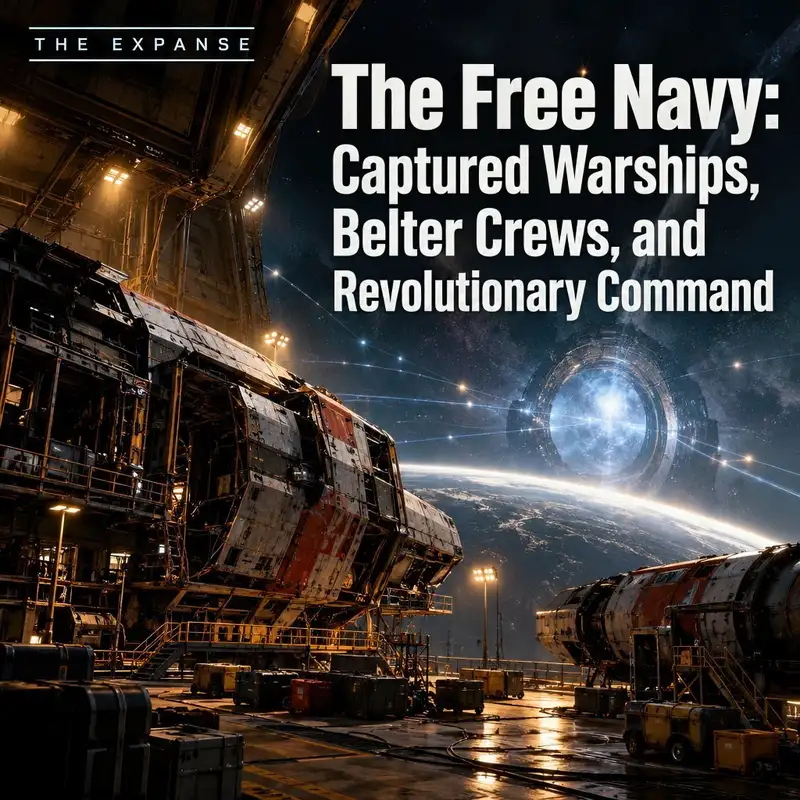
The Free Navy: Captured Warships, Belter Crews, and Revolutionary Command
Marco Inaros came back toward Medina Station with a fleet that was still dangerous enough to force a decision, but no longer strong enough to pretend it controlled the Solar System. His flagship, the Pella, led the surviving core of his force toward the Slow Zone. Around it came other warships, many of them descended from Martian military power that had changed flags, crews, and political purpose without changing their fundamental need for fuel, ammunition, repairs, and trained people to operate them. The immediate objective was not to retake Earth, reoccupy Ceres, or restore Free Navy authority across the Belt. It was Medina. Whoever held Medina held humanity’s principal junction to the Ring Network, the transit space through which ships reached more than a thousand new systems. Marco’s final approach was therefore both an offensive and an admission of failure. His movement had begun by claiming that the Belt would no longer live at the mercy of Earth and Mars. Now its survival depended on recovering one station in an alien transit hub. The Free Navy had struck Earth with unprecedented force, seized installations, broken old alliances, and made the established powers look slow and vulnerable. Yet by the time Marco turned toward Medina, the revolution had narrowed to a desperate attempt to preserve strategic relevance. That contradiction explains the Free Navy better than its flags or speeches do. It was a movement that obtained the instruments of great-power war before it had built the institutions capable of sustaining them.
The Ring Network created the crisis that Marco exploited, though he did not create the conditions himself. Before the gates opened, the Belt occupied an essential place in the Solar System’s political economy. Belter labor extracted resources, operated stations, moved cargo, repaired ships, processed ice, and kept much of the system’s transport infrastructure functioning. That dependence did not mean equality. Earth and Mars possessed larger governments, larger populations, stronger industrial bases, and most of the recognized legal authority. Belters often carried the physical risks of vacuum work, low gravity, poor medical access, dangerous contracts, and distant rule while others took the larger share of political and economic reward. The gates threatened to make even that unequal role less secure. New systems offered land, resources, and the promise of political escape. People who had once seen Mars as the great long-term human project could look through a gate and see worlds that did not require centuries of terraforming before they could become homes. Capital, skilled workers, and ambitious families began to turn outward. For Mars, this weakened the social faith that had supported the terraforming project and its disciplined national culture. For the Belt, it raised a more immediate fear. If Earth, Mars, and the corporations that linked them could find new sources of food, minerals, and settlement, what happened to the people whose leverage came from being indispensable in the old system? That fear was grounded in real structural vulnerability.
It did not make the Belt a unified political body. Stations had their own interests. Crews had their own contracts. OPA factions disagreed over negotiation, separatism, armed resistance, commerce, and survival. Many Belters wanted reform, autonomy, and respect without wanting to destroy Earth. Marco’s achievement was to turn a broad anxiety about abandonment into a military program. His crime was to make domination and mass death the program’s tools.
The Free Navy was more than the Outer Planets Alliance under another name. The OPA was an umbrella of factions, crews, stations, organizers, criminals, unionists, radicals, pragmatists, and local leaders with overlapping but incompatible goals. Marco’s organization drew from that world, but it was built around a narrower coalition. It combined believers in Belter liberation, commanders seeking power, crews seeking protection, people who had lost faith in negotiation, and others who found that refusing Marco was more dangerous than joining him. His public language promised a new balance of power. His military organization promised that Belters would no longer survive by asking the Inners for permission. But the Free Navy’s actual structure was never the stable architecture of a conventional state navy. Marco stood at the center as political leader, military commander, propagandist, and final source of personal authority. Around him were people responsible for money, production, ship acquisition, and administration. Rosenfeld Guoliang became associated with the difficult business of adapting and supporting the movement’s military assets. Nico Sanjrani handled financial and administrative functions that a revolution requires but rarely celebrates. Individual commanders controlled ships, crews, local supply networks, and loyalties that did not always belong to Marco. This mattered because the Free Navy was strongest when moving quickly, threatening decisively, and presenting itself as inevitable. It was weaker when it had to reconcile competing needs. A commander could support attacking Earth while disagreeing about feeding Ceres. A station authority could welcome liberation from Inner control while rejecting conscription or confiscation.
A crew might be loyal to its captain, its family, or its home port rather than to Marco’s grand strategy. Revolutionary rhetoric could bring these interests together temporarily. It could not automatically turn them into a durable chain of command. And rhetoric, however powerful, did not provide the modern warships that made Marco’s campaign possible.
The decisive transfer of military power came from Mars. A rogue faction within the Martian Congressional Republic Navy, associated with Admiral Winston Duarte, provided Marco’s movement with advanced ships and military technology while pursuing a separate project of its own. Duarte did not openly command the Free Navy, and Marco was more than a subordinate executing Laconian orders. Their relationship was closer to a covert alignment of interests. Duarte’s faction needed the old order weakened. Earth and Mars had to be distracted, divided, and exhausted while Martian defectors, personnel, technology, and resources disappeared toward Laconia. Marco needed ships capable of fighting the established navies on something closer to equal terms. Each side could use the other. The result was a form of proxy warfare conducted inside a collapsing state. The Free Navy’s most formidable combat power did not emerge from the gradual conversion of rock hoppers and cargo ships into an improvised Belter armada. It came from access to military hulls designed, built, and equipped by one of the Solar System’s major naval powers. Those ships carried the advantages of dedicated sensors, weapons, armor, redundancy, maneuvering systems, and combat engineering. They also carried an aura of state power. A Belter force in scavenged civilian vessels could threaten commerce, raid isolated targets, and exploit local knowledge. A Belter force operating transferred Martian warships could challenge governments. The Pella embodied that transformation. It was a Martian combatant remade through capture or transfer, political allegiance, and Belter command.
Its hull did not become less Martian because its crew answered to Marco. Its existence instead revealed a deeper failure inside Mars itself. The Martian state had spent generations building a technically sophisticated military to defend its national project. A faction within that military diverted part of the result into a war that damaged Mars, destabilized the entire system, and concealed the defection of those preparing to build something else beyond the gates. Ships can change hands quickly. Naval competence cannot. A hull comes with machinery, but not with a reliable political system, a secure supply chain, or a shared professional ethic.
The Free Navy’s preparation also included the theft of capabilities that reduced warning time. Filip Inaros took part in a raid on the Callisto shipyards aimed in part at obtaining Martian high-density resonance coating. The operation mattered because it showed that Marco’s movement was not relying on anger alone. It involved intelligence gathering, infiltration, specialized objectives, access to hostile infrastructure, and an understanding of what technical advantage could accomplish at the strategic level. The coating did not make ships or asteroids permanently invisible. It did not repeal the realities of heat, movement, active emissions, or the need to maneuver. A vessel that burns hard, communicates carelessly, activates sensors, or launches weapons still creates opportunities for detection. But stealth need not be perfect to be decisive. It only needs to deny the defender enough warning that ordinary procedures fail. A hidden object approaching Earth does not need to remain unseen forever. It needs to remain uncertain until governments cannot identify the threat, evacuate vulnerable populations, position defenses, or decide how to respond. That is what stealth changed for Marco. It attacked the defender’s decision cycle. It created ambiguity first, then panic, then irreversible consequences. The Callisto raid also demonstrated one of the Free Navy’s recurring strengths. Its people understood that power in space often lies in apparently mundane things: coatings, maintenance access, encrypted traffic, shipyard knowledge, cargo routing, forged authority, and the ability to obtain a part before anyone realizes it is missing.
The dramatic attack comes last. The preparation begins months earlier in warehouses, docking bays, black-market transactions, compromised institutions, and the spaces between official jurisdictions. The raid was not an isolated theft. It was part of the groundwork for a synchronized campaign meant to make Earth, Mars, the anti-Marco OPA, and the emerging gate order fail at the same time.
The opening offensive succeeded because it combined political violence with operational coordination. The asteroid bombardment of Earth was not a conventional military strike against a fleet base or command installation. It was a deliberate mass-casualty attack on a civilian world. Its effects extended beyond the immediate destruction. Earth’s ecosystems, food production, transportation networks, public institutions, and already strained systems of distribution all suffered. The damage would shape policy long after the impacts themselves. Marco understood that Earth’s population and infrastructure made it powerful, but also made it vulnerable to catastrophe on a scale no station could absorb. The attack was designed to break confidence as much as to destroy physical targets. At the same time, Free Navy operations struck at Tycho Station, threatened Martian political leadership, moved against rivals within the OPA, and seized Medina Station. The campaign did not ask one enemy to surrender after another. It created simultaneous emergencies so that every opponent faced incomplete information, divided attention, delayed orders, and uncertainty about which threat mattered most. Tactically, the Free Navy achieved remarkable results. It hit targets that had not been adequately prepared for attack and used surprise to make smaller forces appear larger and more coherent than they were. Operationally, it seized the initiative. Earth and Mars could no longer act according to their own schedules. Their leaders had to deal with disaster, internal fear, disrupted communications, damaged infrastructure, and the possibility that more attacks were coming.
Strategically, Marco forced the old powers to reconsider the basic assumption that the Belt could be contained through superior industry and naval prestige. Politically, however, the same violence that made him seem powerful narrowed the coalition capable of sustaining his victory. Belters who hated Inner domination did not necessarily accept the starvation of Earth’s civilians as liberation. Station populations could celebrate a weakening of Earth while fearing what Marco’s command would demand from them next. The attack on Earth also ensured that any future settlement would be shaped by grief, rage, and the demand for security. Marco gained stature through shock. He also made it harder for his movement to become a legitimate government. Surprise wins time. It does not produce food, spare parts, medical care, or consent.
Belter crews gave the Free Navy real strengths, but not a uniform professional navy. Many Belters possessed practical knowledge that Inner military institutions could not just teach in a classroom. They understood vacuum work, failing seals, station machinery, hazardous transfers, salvage, improvised repairs, cargo handling, and the daily discipline of living where air and water are visible parts of the budget. They knew how ships behave when maintenance has been deferred, how crews react when a recycler starts making the wrong sound, and how quickly a minor equipment problem can become a life-support emergency. In low gravity and on the float, many had physical experience that Inner-born personnel did not share. These were serious advantages in space. But the Free Navy’s personnel were not one body with one background or one level of training. It included committed revolutionaries, former OPA fighters, transport crews, station personnel, opportunists, people recruited through ideology, people compelled by circumstance, and people who followed a local commander rather than Marco himself. Operating a sophisticated Martian warship requires more than courage and mechanical instinct. It requires standardized maintenance, weapons integration, fire-control discipline, damage-control drills, spare parts, reliable procedures, and officers who can make difficult decisions without collapsing their own chain of command. A captured hull can carry advanced sensors, but someone must know how to calibrate and interpret them. A magazine can hold torpedoes, but someone must maintain them, account for them, and decide when they can be spent.
A crew can survive a battle, but only if it has trained to isolate damaged compartments, treat injuries, preserve power, and keep the ship functioning under pressure. The Free Navy had capable people. It also had uneven readiness and divided loyalties. Its best ships represented transferred Martian industrial and institutional power. Its crews represented the Belt’s adaptability, anger, and technical skill. The combination was formidable in a short campaign. Over time, the difference between owning a navy and sustaining naval readiness became harder to hide.
That problem was most visible wherever the Free Navy tried to govern. Ceres was more than a symbol of Belter power. It was a political center, a port, a source of labor, a place where ships could find docks, supplies, information, and people who understood the realities of Belt life. It was also a station whose civilians depended on systems that could not be replaced by slogans. A fleet dispersed across the Solar System requires reaction mass, ammunition, food, water, medicine, repair parts, trained technicians, communications links, safe docking facilities, and access to civilian transport. Warships do not manufacture these things while maneuvering. They depend on economies behind them. The Free Navy could seize supplies, commandeer shipping, compel work, raid depots, and redirect cargo. In the short term, those methods could keep ships moving. In the longer term, they damaged the networks that made survival possible. A merchant who fears confiscation hides cargo. A technician threatened by political violence may flee, sabotage equipment, or do the minimum required to survive. A station that receives no reliable food shipments cannot be governed by speeches about liberation. The Free Navy’s logistical weakness was therefore also a political weakness. Its leaders needed civilian cooperation but often treated civilians as inventory. They needed ports but made port authorities fear them. They needed Belter labor but spent Belters as though their lives were just another consumable in the war against Earth. Propaganda could describe this as sacrifice for a future Belt.
Families facing shortages, intimidation, and arbitrary power experienced it differently. The movement’s revolutionary claim rested on the argument that the old order had treated Belters as expendable. Its conduct on Ceres and elsewhere too often reproduced the same logic under a new flag. That did not erase the reality of prior exploitation. It demonstrated how easily a movement organized around grievance can become dependent on coercion when it lacks a viable economic program.
Michio Pa’s defection exposed the Free Navy’s coalition problem with unusual clarity. Pa was more than a subordinate who changed her mind. She commanded ships, crews, local relationships, and a body of political legitimacy that Marco could not replace through intimidation alone. Her break came from recognizing that Marco’s promises to support the Belt and improve Belter conditions were not being fulfilled. His war consumed resources while the communities in whose name it was fought faced scarcity and abandonment. Pa’s forces did not match the most capable Martian-derived core of Marco’s fleet. That was precisely why the defection mattered. The Free Navy had always depended on more than its best warships. It needed auxiliary vessels, local intelligence, docking access, supply contacts, crew recruitment, and the appearance that Marco spoke for a united Belt. When Pa left, she took away part of that connective tissue. Her departure showed other commanders that disagreement did not have to end in submission. It also gave Marco’s enemies Belter partners who could not be dismissed as Inner occupiers. In coalition war, legitimacy is a material asset. It affects who shares intelligence, who opens a port, who accepts orders, who sends supplies, and who believes that a victory will improve rather than worsen life afterward. Marco’s command style was well suited to the opening phase of the war. He could set a dramatic objective, exploit fear, punish hesitation, and direct attention toward an external enemy. It was poorly suited to negotiation among allies with independent interests.
Dissent was treated as betrayal rather than information. Subordinates were expected to obey rather than explain what their crews and stations could no longer endure. That makes a command structure appear strong until the moment it fractures. A professional organization can survive disagreement when it has procedures, institutions, and trusted channels for correction. Marco’s organization relied too heavily on his personal authority. Once commanders concluded that his ambitions endangered the Belt itself, his charisma became less a source of cohesion than a reason to leave.
Marco’s greatest strategic accomplishment was forcing enemies with long histories of distrust to cooperate against him. After Fred Johnson’s death, the United Nations, the Martian Congressional Republic, and anti-Marco OPA forces had compelling reasons to work together, even though none of them had forgotten their past conflicts. The Consolidated Fleet did not emerge because those factions suddenly trusted one another. It emerged because the Free Navy had made isolation more dangerous than cooperation. Earth had suffered a catastrophe that made defense and recovery inseparable. Mars had been compromised by defections from its own military and faced the collapse of confidence in its national project. Anti-Marco Belters knew that a Free Navy victory would not guarantee autonomy. It might instead produce a more centralized and violent form of Belt rule. The coalition’s campaign did not depend on one clean battle in which every Free Navy ship was destroyed. Warfare across the Solar System rarely offers such clarity. Operations around Pallas, Callisto, and Titan helped fix Free Navy forces in place, draw attention, divide available assets, and prevent Marco from concentrating his remaining strength wherever he chose. Some actions were meant to destroy ships. Others were meant to create pressure, deny resupply, gather information, protect routes, or force commanders to reveal their intentions. The coalition’s advantage was more than a matter of aggregate numbers. It combined surviving industrial capacity, established repair infrastructure, professional naval experience, access to trained personnel, intelligence sharing, and the political value of anti-Marco Belter participation.
A fleet that can repair its vessels, rotate exhausted crews, move ammunition, and coordinate among several governments possesses an endurance that a captured force may struggle to match. Yet the Consolidated Fleet remained fragile. Earth, Mars, and the Belt had reasons to suspect one another, and every negotiation carried memories of exploitation, war, and betrayal. Its success depended on recognizing a limited but important truth: Marco could be defeated only by a coalition that offered more than the restoration of the old order.
The campaign narrowed toward Medina because the station mattered more than any single outpost in the old Solar System. Medina sat in the central transit space of the Ring Network. It was not magical in the sense of granting instant authority over every colony, but it was a chokepoint. Ships traveling between systems passed through the Slow Zone and the gates around it. Control of Medina meant influence over traffic, commerce, migration, security, and access to the expanding human frontier. The first battle for Medina removed Free Navy control and disabled the immediate threat posed by the Ring Station’s railguns. That was a major coalition success, but it also created an uncomfortable operational reality. The alien defenses could not just become a reliable human weapon. The coalition had prevented them from threatening its own ships, but it had not gained a button that could safely erase any future attacker. Holding Medina meant defending it by ordinary human means: ships, crews, sensors, firing plans, supplies, station security, and command decisions made under uncertainty. Seizing a chokepoint is not the same thing as securing it. Marco understood this. His return toward Medina was not a nostalgic attempt to recover a lost headquarters. It was an effort to regain access to the strategic geography that could keep his movement alive. If he controlled the Slow Zone, he could threaten the network’s traffic, preserve a route toward the Laconian project that had helped empower him, and reassert himself as the figure through whom the new human frontier had to negotiate.
The move also showed how far his position had deteriorated. He was effectively abandoning wider territorial claims in the Solar System to concentrate on one decisive objective. The Free Navy had once tried to reorder the system through dispersed pressure and coordinated terror. By the end, it needed Medina because it no longer possessed the political or logistical strength to govern everywhere else.
The final defeat of Marco’s command fleet came from pattern recognition, not from a conventional superweapon. Naomi Nagata had studied earlier disappearances associated with Ring transit. The exact mechanism remained beyond human understanding. People could observe effects, compare events, and notice that the network appeared to react under certain conditions. They could not claim mastery over the alien systems that had created the gates or over the unknown forces associated with those disappearances. Naomi’s insight was to treat the pattern as an operational fact. If traffic through the network could be timed in a way that provoked the transit anomaly, then that danger might be turned against Marco’s approaching ships. The coalition did not need a complete scientific theory to act. Militaries and governments often make decisions under partial knowledge. The question is whether the observed pattern is reliable enough to justify the risk. In this case, it was. As the Pella and its accompanying force approached Medina, the Consolidated Fleet exploited the network’s behavior. Marco’s ships vanished in transit. The result was not a missile strike. It was not a railgun engagement. It was not evidence that humanity had gained dependable command over Ring-builder physics. It was the use of a dangerous, only partly understood condition of the transit system against an enemy who had failed to recognize the same vulnerability. Tactically, Marco’s command force was eliminated. Operationally, the immediate threat to Medina ended. Strategically, the Free Navy lost the ships, leadership, and cohesion that allowed it to function as a system-wide military power.
The intelligence lesson was equally important. The Free Navy had built its success on reducing warning time, exploiting secrecy, and making its opponents confront threats they had not anticipated. In the end, it was defeated by an opponent who had learned to see a pattern Marco had missed. His final offensive was meant to restore initiative. Instead, it demonstrated that even a brilliant campaign can become captive to the assumptions that made its earlier victories possible.
Marco’s disappearance did not instantly end every armed holdout or erase the anger that had brought people into the Free Navy. Ships remained. Crews remained. Stations still faced shortages, distrust, and the political aftermath of war. But the organization no longer possessed the command center, strategic direction, and high-end military core needed to act as a system-wide navy. Its surviving elements could resist, bargain, flee, or become local problems. They could not restore Marco’s project. The postwar settlement therefore faced a problem larger than punishment. Earth and Mars could not just declare victory, reimpose the old arrangement, and expect the Belt to accept it. The war had revealed that the prewar order was not stable. The Ring Network had changed the map of human civilization, but it had also exposed how much power depended on controlling transit, labor, and access. The creation of the Transport Union placed Belt leadership at the center of gate governance. This was not a reward for Marco’s atrocities, and it was not proof that his violence had been necessary. It was an institutional response to the conditions his movement had exploited. If Belters were expected to carry the risks of transport, station maintenance, and frontier connection, then they required meaningful authority over the system that made those activities possible. The Transport Union did not end inequality. It did not heal every station, guarantee prosperity, or erase Earth’s catastrophe. It did not turn all Belter factions into allies.
What it did was acknowledge that durable order required more than Inner fleets policing the routes on which everyone else depended. The Free Navy proved that the old Solar System could be shaken by a movement that combined real colonial grievance with transferred state power, stealth, and political audacity. It failed because its warships were inherited, its industry was insecure, its coalition was conditional, and its command culture treated dissenters and civilians as expendable. Marco could seize the instruments of power. He could not build the institutions that make power endure.