Acceleration, Gravity, and the Human Limits of Space Warfare
Solomon Epstein’s first great success was also a death sentence. In the short history that bears his name, an engineer takes a modified fusion drive out for a test and discovers that it produces far more sustained thrust than he expected. The ship keeps accelerating. That is the achievement. It is also the trap. He has not prepared a recovery plan equal to the performance of his invention, and there is no convenient brake waiting in empty space. He has made a machine that can carry a human being across interplanetary distances with unprecedented efficiency, then discovered that the human being inside it is still made of blood, bone, and organs.
That contradiction sits near the center of warfare in The Expanse. The Epstein drive makes fast, regular movement across the Solar System practical enough to support states, corporations, mining networks, military fleets, and communities spread far from Earth. But more thrust is never simply more freedom. A ship can only use acceleration that its structure, machinery, supplies, and crew can survive. It must still reserve enough capacity to slow down. It must still manage heat, repair damage, carry reaction mass, and keep people alive long enough to make decisions. The engine expands human reach. The body defines the cost of using it.
Epstein’s test flight should not be mistaken for a complete naval doctrine in miniature. He was an inventor, not a fleet commander, and the first uncontrolled flight was not a standardized military maneuver. Still, it reveals the problem later navies live with. Propulsion is not merely a question of getting somewhere. It determines the conditions under which every person aboard works, rests, eats, sleeps, fights, receives medical care, and survives. A ship with a powerful drive is also a machine capable of pressing its crew into their couches until the force becomes intolerable. In that sense, the drive does not merely move the ship. It governs the human environment inside it.
Before the Epstein drive, the Solar System was still connected by trade, exploration, and settlement, but distance imposed a punishing schedule. Travel between worlds required patience, planning, and a willingness to accept that people, cargo, and political authority moved slowly. Sustained fusion acceleration changes that equation. It does not make the Solar System small, and it certainly does not make it instant. But it makes routine movement between planets, moons, stations, and mining operations practical on a scale that can support a complex interplanetary civilization.
That new mobility has military consequences almost immediately. A government can move ships farther from home. A corporation can protect or threaten distant extraction sites. A station can receive supplies, workers, equipment, and armed security without waiting for a rare alignment or a long, fragile transit. Mars can become more than an isolated colony with an ambitious atmosphere project. The Belt can become a dense network of work sites, transport routes, ports, and settlements. Earth can project influence through commerce, law, credit, and naval force across a system whose industrial life increasingly depends on material gathered far from its surface.
Yet the drive does not erase strategic geography. Ships still travel through physical space. Planets, moons, asteroids, stations, and traffic routes remain separated by immense distances. A vessel does not point at a destination, activate its engine, and arrive without consequence. It accelerates, coasts when necessary, turns, and eventually must slow down. The more quickly it builds velocity, the more urgently it must plan for the moment when it needs to lose that velocity again. The old problem of distance becomes more manageable, but it is not abolished. It is converted into a more demanding problem of timing, momentum, fuel, and endurance.
The same transformation tightens political dependence. Earth, Mars, and the Belt become more connected because ships can move essential goods and people through the system. But connection is not equality. Control over transport means influence over food, medical supplies, industrial equipment, replacement parts, and access to markets. A powerful drive is valuable, but so are the ports that service it, the shipyards that repair it, the workers who maintain it, and the institutions that decide whose cargo receives priority. Mobility becomes a form of power because immobility can become a sentence.
A ship under thrust also creates its own local version of gravity. When a vessel accelerates, everyone inside is pressed toward the deck opposite the drive. The force feels like weight. A cup stays on a table. A person can stand, walk, sleep in a bed, and work at a console without drifting away from it. This is often called thrust gravity, and for the crew it is operationally real. Their muscles, circulation, balance, and movement all respond to the acceleration as though the ship has acquired a temporary down.
But it is not the same as being on a planet. The ship has not generated a gravitational field like Earth’s or Mars’s. It is accelerating, and the crew is being carried along with it. When the drive stops, the apparent gravity stops as well, unless the ship is inside a significant natural gravity well or is using rotation to create a different form of artificial weight. In open space, with no thrust and no rotation, the crew is on the float. Objects do not settle. Injuries become harder to treat. Work becomes a matter of handholds, straps, magnetic surfaces, and practiced motion.
This distinction matters because people often speak of one gee as though it were a speed or a universal comfort setting. It is neither. One gee is an acceleration comparable to the gravity people experience at Earth’s surface. It says nothing by itself about how fast a ship is traveling. A vessel can be moving at extraordinary speed while its crew feels no thrust at all, provided it is coasting. It can also be moving relatively slowly while subjecting its occupants to a severe acceleration. What matters is the force, its direction through the body, how long it lasts, the crew’s posture, their health, their training, and the support available if something goes wrong.
For a ship moving between distant points, the usual logic is straightforward even if the execution is not. The vessel spends part of the journey accelerating toward its destination. At some point, it rotates, or flips, and begins thrusting in the opposite direction. That second burn reduces the velocity it built during the first. It is not a magical stop. The ship keeps moving throughout. It is simply changing its motion so that it can arrive without racing past the destination at a speed useful only to a missile.
That requirement gives braking the same strategic importance as acceleration. A commander cannot commit all available performance to a dash toward an objective without considering how the ship will depart, evade, dock, rendezvous, or stop near a station. A courier may accept a punishing ride to deliver a message. A warship may need to preserve margin for a fight after arrival. A transport full of civilians may have less tolerance for aggressive maneuvers than an armed patrol with prepared crew and medical support. The fastest route on paper may be the least useful route in practice if it leaves everyone aboard exhausted, injured, or unable to respond to a threat.
The human body experiences thrust directly. Under sustained acceleration, blood shifts, breathing becomes more difficult, muscles work harder, and simple movement can become labor. A person trying to reach a control panel under heavy thrust is not merely walking uphill. Their limbs, chest, and head all carry more apparent weight. The force can become painful, disorienting, and dangerous. At the extreme, it can produce loss of consciousness, stroke, organ damage, or death. The novels do not offer a neat universal threshold because there is no one threshold. Human tolerance varies. So do ships, missions, medical preparations, and the risks commanders are willing to take.
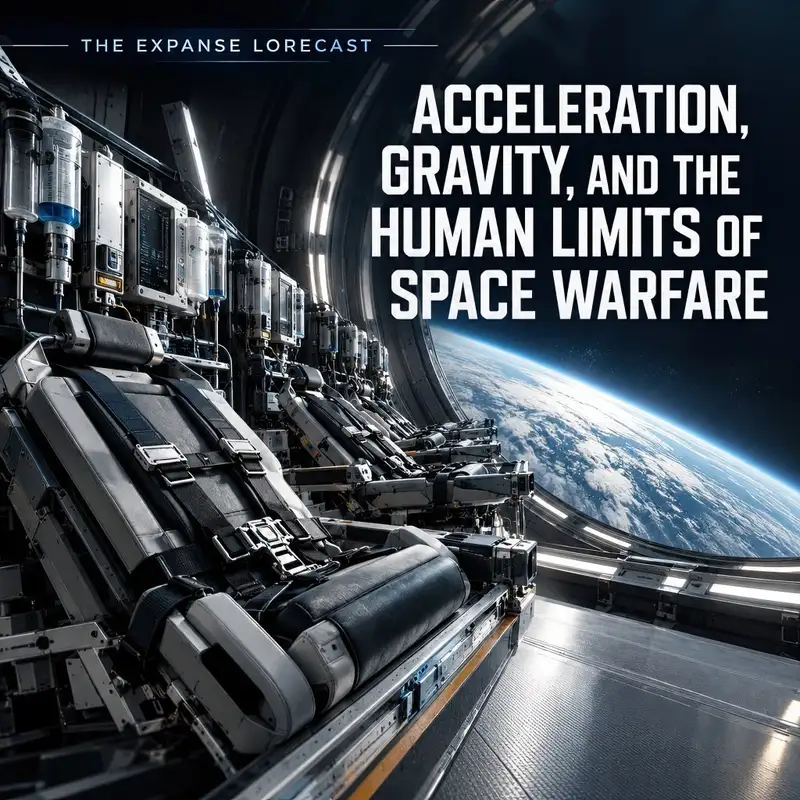
Crash couches are one answer to that problem. They support the body during high-acceleration maneuvers, distribute force as safely as possible, and keep crew members restrained when the ship changes its vector. A couch is not comfortable furniture. It is survival equipment. It allows a pilot, gunner, engineer, or passenger to remain in place when the ship’s movement would otherwise make ordinary motion impossible. The design reflects a basic truth of space warfare: when the ship maneuvers hard, the crew cannot simply brace themselves and carry on.
The juice is another answer, though an incomplete one. The setting establishes that crews use acceleration drugs to reduce some of the worst effects of high-gee burns. These drugs help people endure maneuvers that would otherwise incapacitate or kill them. They do not make the body invulnerable, and the novels do not provide a fully documented formula or a fixed catalogue of safe limits. The important point is not chemical detail. The important point is that naval capability depends partly on medicine. A ship’s usable performance is tied to what its crew can endure with couches, restraints, conditioning, monitoring, and pharmaceutical support.
That creates different categories of acceleration. A routine burn is one a crew can sustain while carrying out ordinary work. An emergency burn is more punishing and may be accepted because the alternative is worse. A desperate maneuver is something else again. It may save the ship from an incoming threat, but it can leave the people aboard injured, unconscious, impaired, or medically compromised. A captain who orders such a burn is not simply selecting a speed setting. The captain is spending physical readiness that may be impossible to restore during the next critical hours.
The distinction is especially important in combat. A ship might have engines capable of delivering more thrust than its crew can use repeatedly. Its theoretical acceleration is not its practical combat acceleration. A vessel that can briefly make a violent maneuver may not be able to continue fighting afterward. Its crew may need treatment. Its technicians may be unable to reach damaged systems. Its officers may be trying to assess an engagement while struggling to remain conscious. The engine may be functioning perfectly. The ship may still be approaching combat ineffectiveness.
That is why space combat in The Expanse is not an aerial dogfight transferred into a black background. Ships do not stop when their engines stop. They carry momentum. They can rotate to point sensors, weapons, or communications equipment in a direction different from their travel. They can fire while moving sideways relative to an opponent. A vessel may flip to decelerate, then alter its attitude again to bring a weapon to bear. The geometry is three-dimensional, and the decisive question is often not who turns more tightly, but who can change the relationship of speed, position, and timing before the other side can respond.
Missiles and torpedoes make that geometry more demanding. A guided weapon can force a target to maneuver, and maneuver is expensive. It requires reaction mass, creates stress on machinery, and imposes acceleration on the crew. Point-defense cannons can destroy incoming threats, but they are not shields. They have firing arcs, ammunition limits, targeting problems, and finite time to act. A ship can survive one attack only to find that the next maneuver has worsened its position, consumed its defensive resources, or pushed the crew toward the edge of what they can tolerate.
Railguns create a different kind of danger. A railgun round moves along a line. It does not chase a target in the way a guided missile can. But when range, relative motion, and firing geometry favor the shooter, that line can be deadly. Avoiding it may require changing the ship’s vector, and changing vector means thrust. Again, the machine and the body are joined. A tactical maneuver that moves a hull away from a firing solution also subjects everyone inside the hull to the cost of that movement.
A battle therefore becomes a contest in which each side is trying to impose difficult choices on the other. Missiles may be used not only to destroy a ship, but to force it to burn hard, expose its drive plume, consume point-defense ammunition, break formation, or miss a rendezvous. A ship might evade successfully and still lose the broader mission because it can no longer reach a station in time, protect a convoy, maintain sensor coverage, or support a boarding operation. Tactical survival is not the same as operational success.
The same principle applies to damage. A warship is not just armor around guns and engines. It is a pressure vessel, power plant, computer network, life-support system, medical facility, and workplace. A hull can remain largely intact while the ship loses its ability to fight. Decompression can injure or kill crew. A damaged sensor suite can blind the captain. A maneuvering failure can turn a controlled burn into a liability. A fire, severed cable, jammed mechanism, or crippled life-support loop can matter as much as visible structural damage.
Combat crews prepare for this by compartmentalizing systems, wearing suits when necessary, rehearsing damage control, and maintaining redundancy where they can. But redundancy has limits. It adds mass, complexity, maintenance burden, and cost. Every backup system must be inspected, powered, supplied, and understood by someone who may be exhausted or injured when it is needed. A vessel with excellent weapons but poor damage control is not an excellent warship for long. Procurement documents tend to celebrate propulsion and armament. The filters, couch restraints, medical kits, coolant lines, and technicians are less glamorous, which is one reason they are so often discovered to be important during a crisis.
High acceleration also complicates command. A captain rarely knows every relevant fact about an opponent. A drive plume can reveal that a ship is accelerating. Active sensors, transponders, traffic data, intercepted communications, and visual observation can reveal pieces of a larger picture. But detecting motion is not the same as understanding intent. An enemy contact may be fleeing, setting up an ambush, protecting another vessel, conserving fuel, hiding damage, or trying to force pursuit into an unfavorable geometry.
A commander usually cannot know an opponent’s remaining reaction mass, the health of its crew, the condition of its crash couches, the effectiveness of its medical preparation, or the highest acceleration its people can sustain without breaking. Even a ship’s apparent performance can deceive. A vessel may burn hard because it is strong and well prepared. It may burn hard because it is desperate and has no reserve left. The same sensor reading can support several interpretations, and the wrong interpretation can commit a force to a fight it cannot finish.
Cold coasting introduces further uncertainty. A ship that limits emissions may be more difficult to detect than one driving hard across the system. But concealment is not invisibility. Heat must eventually go somewhere. Engines, sensors, communications, and weapons all create signatures or risks. A vessel trying to remain hidden may sacrifice information, speed, or the ability to communicate freely. This is not a setting in which stealth solves the problem of war. It merely changes the balance between detection and uncertainty.
Light-speed communication adds another constraint. Political leaders and admirals may issue orders across the Solar System, but the messages do not arrive instantly. A tactical opportunity can vanish before a distant command authority even learns it existed. A captain may have to decide whether to pursue, retreat, fire, dock, or burn hard without current guidance from any government. That does not make the captain independent of politics. It makes the captain responsible for carrying politics into a situation where instructions may arrive too late to be useful.
The audience often sees more than the people making those decisions. Readers may know that a contact is hostile, that an ally is approaching, or that a supposed retreat masks a larger plan. A commander inside the story may know none of that. Military judgment has to be assessed against the information available at the time, not against the complete picture revealed afterward. The central difficulty is not merely courage. It is acting under uncertainty while the physical consequences of action arrive immediately.
A warship is therefore part medical ward, part factory. It needs people who can monitor crew condition, treat injuries, maintain life support, repair systems, manage power, control heat, and keep the drive operating safely. A vessel on a prolonged mission may be carrying weapons, but it is also carrying a small industrial ecosystem. Its engineers are responsible for machinery that must work under vibration, stress, battle damage, and the relentless wear of operations. Its medical personnel must make decisions when the ship’s movement itself can worsen a patient’s condition.
Heat is a useful reminder that no part of the system is free. Engines, electronics, weapons, and bodies generate waste heat. In space, getting rid of that heat is not as simple as opening a window. Thermal management takes equipment, planning, and time. A ship trying to hide may limit radiators or emissions, but that creates other problems. A ship burning hard may gain tactical mobility while increasing strain on systems that need inspection and maintenance. Every apparent advantage creates a bill. The question is who pays it, when, and whether they can still pay after the first exchange of fire.
Crew fatigue matters for the same reason. A hard maneuver does not end when the engines throttle down. People may remain shaken, injured, medicated, or unable to sleep. They may need to repair systems in free fall after operating under heavy thrust. They may need to make decisions while their bodies are still recovering from the force that saved the ship. A commander planning a sequence of aggressive maneuvers must consider not only whether the drive can execute them, but whether the same crew can remain competent through all of them.
The burn begins long before a ship launches. It begins in shipyards, training facilities, pharmaceutical supply chains, maintenance depots, and ports. It begins with the workers who fabricate hull sections, test reactors, manufacture electronics, load ammunition, inspect seals, maintain recyclers, and prepare medical stores. It begins with the people who calculate trajectories and the people who clean filters. Military mobility is built on systems that rarely appear in heroic accounts of battle because they are already doing their job when the firing starts.
Reaction mass is one of those systems. The Epstein drive is extraordinarily efficient by the standards of the setting, but it does not eliminate the need to push mass out the back of a ship to produce thrust. A vessel that spends too much of that resource early may reduce its later options. It may reach an objective quickly but lack margin for evasive maneuvers, braking, rescue work, or a return journey. The same is true of reactor fuel, though its role is different, and of food, water, air, medicine, spare parts, and ammunition. Every mission is a calculation of what can be carried, consumed, replaced, or left behind.
This is where tactical mobility separates from sustained operational capability. A ship can make one extraordinary burn. A navy must make many journeys, maintain many crews, repair many hulls, and preserve enough readiness to respond after the first emergency. That requires safe ports, resupply routes, trained replacements, reliable industry, and political control over the infrastructure that supports them. A force with powerful engines but weak sustainment can achieve a dramatic appearance of reach. It cannot necessarily hold that reach.
Replacement personnel are often more difficult to recreate than hardware. Hull material can be fabricated if a yard survives and resources are available. Experienced engineers, medics, pilots, damage-control specialists, and commanders represent years of training and accumulated judgment. Losing them weakens a force in ways that do not appear on a ship registry. The destruction of a vessel is obvious. The loss of the people who know how to keep the next vessel alive may be strategically worse.
Those burdens are not distributed equally. People raised in different gravity environments do not enter the same workplace, medical system, or military service with identical physical assumptions. A burn that an Earther can tolerate may impose a different cost on a Belter, while a crew accustomed to low gravity may face limits when operating on a planetary surface. Training and medicine can change the margin, but they do not make every body interchangeable.
That physical difference becomes political when access to work, travel, and military service depends on what a body can endure. For Belters especially, gravity is not an abstract feature of the setting. It can determine which jobs are available, which destinations are realistic, and how much medical risk accompanies a journey into an Inner-planet environment. Life support deepens the same dependency because every ship and station requires continuous maintenance of air, pressure, water, and power.
Mars responds to these limits by building doctrine around preparation, redundancy, and trained crews. Earth brings greater demographic and industrial depth but carries the burden of a much larger civilian society. The Belt relies on practical expertise developed in environments where failure can become fatal quickly. None of these populations is physically uniform, yet each is shaped by the conditions in which its institutions learned to survive.
The early conflicts of the novels demonstrate why speed does not equal control. Interception, pursuit, escape, and response all depend on detection, available thrust, crew endurance, and the support waiting at the other end of a journey. A ship may race to investigate a crisis and arrive too late. It may evade an enemy only to lose contact with the evidence it was trying to preserve. It may reach a station first but lack the fuel, personnel, or political authority to control what happens there. Movement creates options. It does not guarantee that those options are good.
A damaged or exhausted crew can become the decisive limitation even when the ship itself remains afloat. If sensors are degraded, medical supplies are strained, engineers are injured, or the crew has spent too long under punishing acceleration, the vessel may no longer be able to carry out its mission. It can still occupy space. It may still have weapons. But combat effectiveness is more than being present and armed. It is the ability to detect, decide, maneuver, communicate, repair, and sustain action under pressure.
This is also why commanders cannot measure victory solely by destruction. Destroying an enemy ship may protect a route, but it may also consume ammunition, reveal a force’s location, and leave survivors in need of rescue. Escaping an engagement may preserve a valuable hull, but it may abandon civilians, intelligence, or political credibility. A hard burn that wins a tactical exchange may leave a crew unable to respond to the next threat. The most important result of an action may be the margin it leaves for everything that follows.
The realism of The Expanse rests partly on this refusal to let technology erase consequences. The Epstein drive is astonishing, but it does not make people immune to inertia, injury, fatigue, fear, or dependence on support systems. It makes the Solar System governable and contestable at a scale that would otherwise be impossible. It gives governments and corporations the means to extend power. It gives isolated communities a chance to connect. It also makes every one of those institutions more dependent on the workers, crews, and medical systems that keep motion from becoming death.
Solomon Epstein’s first flight captures the whole pattern. He discovers a way to compress distance, but the immediate experience of that discovery is confinement. His ship can go farther than he imagined. He cannot simply step outside the problem. Later crews inherit a safer, more mature version of the technology, along with couches, drugs, procedures, shipyards, training, and doctrine. Yet they never escape the fundamental bargain. To move quickly is to accept force. To accept force is to place the human body inside the calculation.
Acceleration shapes warfare in The Expanse because it determines more than where a ship can go. It determines whether the crew can remain conscious, competent, supplied, medically stable, and politically useful when the ship arrives. A navy may possess powerful drives, but its true mobility depends on maintenance workers, medical personnel, reaction mass, spare parts, trained crews, and commanders who understand that every hard maneuver spends a finite reserve of human endurance.
The decisive limit on military movement is not the emptiness of space. It is the fragile human institution carried inside the accelerating ship.