Tycho Station, Fred Johnson, and the War Inside the OPA
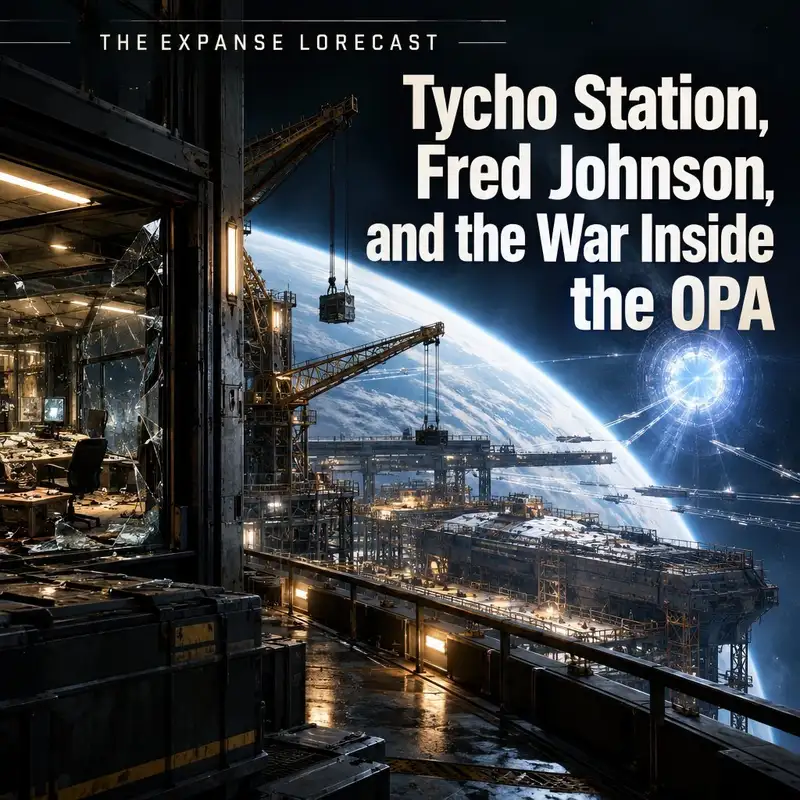
Tycho Station mattered because it could do the unglamorous work that turns political aspiration into power. It had docks, fabrication bays, repair crews, storage, communications, contracts, and workers who knew how to keep pressure vessels alive in vacuum. During the Free Navy crisis, Fred Johnson needed every part of that machinery. He was trying to gather OPA factions that distrusted one another, coordinate forces that had never served under one command, and preserve a political future for the Belt while Marco Inaros tried to define that future through terror.
That was the operational irony at the heart of Fred Johnson’s career. The man trying to establish a credible Belter center of power worked from a construction station, not a palace or a fortified capital. Tycho’s value came from supply routes and trained labor, from spare parts and secure berths, from people who could weld a hull, diagnose a recycler, reload a ship, or keep a damaged vessel from becoming a coffin. Those things were less dramatic than a railgun duel. They were also what made sustained political independence possible.
The Outer Planets Alliance was still an umbrella rather than a single government, spanning station communities, crews, labor organizers, local authorities, armed cells, smugglers, political movements, and mutual-aid networks. Those groups shared grievances more readily than commands or end states. Fred Johnson therefore had to build coalitions across the Belt rather than pretend he could simply issue orders to it.
Fred understood that no leader could simply issue orders to the Belt and expect obedience. Belter politics was too dispersed, too local, and too shaped by hard experience. A station’s priorities could differ from those of a mining ship. A transport crew might distrust a radical organizer. An armed faction might accept OPA language while answering only to its own commander and its own supply network. Tycho gave Fred influence, but it did not give him sovereignty. It gave him leverage in a movement where leverage was often more useful, and more dangerous, than formal authority.
His authority also carried an inescapable stain. Before he became one of the OPA’s most capable political figures, Fred Johnson had been a respected officer in the United Nations military. The Belt knew him by another name. To many Belters, he was the Butcher of Anderson Station.
Anderson Station was more than an ugly episode in Fred’s past. It was the event that made his later career possible and suspect at the same time. It taught him what organized force could do when a powerful government decided that a remote population had become an inconvenience. It also gave the people he later claimed to serve every reason to wonder whether he had truly changed, or had simply found a different side from which to exercise power.
As a United Nations Marine officer, Fred had been trained to think in terms of missions, chains of command, rules of engagement, and the preservation of order. Those habits were not inherently monstrous. In a complex system of stations, ships, and contested jurisdictions, disciplined organization could prevent panic and save lives. But military professionalism becomes morally dangerous when it teaches officers to treat political consequences as someone else’s responsibility. Anderson Station exposed that danger with brutal clarity.
The operation was conducted against a Belter station caught in rebellion and repression. From the perspective of the United Nations military structure, the situation was a security problem. There was armed resistance. There were demands. There was a need to establish control and prevent the crisis from spreading. From the perspective of the people on the station, it was another instance of Inner authority deciding that Belter lives could be placed at risk in the name of restoring order.
Fred followed a mission that his superiors could defend in institutional language. The operation produced a result that could be described as decisive. It also left him confronting the human meaning of that decision. The United Nations military could frame the action in terms of containment, discipline, and necessity. Belters remembered people who had been trapped, abandoned, or killed by a system that expected them to accept danger as the normal price of living beyond Earth and Mars.
That difference in memory mattered. Fred did not become a Belter because he suddenly discovered that the Belt was morally pure, or because a single atrocity erased the rest of his identity. He had been formed by the Inner military world. He retained its confidence, its strategic habits, and its comfort with compartmentalizing information. What changed was that he came to understand how often the Belt had been treated as an expendable frontier. The people who extracted resources, moved cargo, maintained stations, and accepted physical risks that most Inner citizens never faced had almost no reliable political protection.
Fred’s later politics were shaped by guilt, but guilt alone does not build an organization. He also had ambition, competence, and a belief that the Belt needed institutions capable of surviving contact with Earth and Mars. He did not abandon the lessons of military command. He redirected them. The question was whether those lessons could be used to build Belter self-government rather than enforce Belter subordination.
Tycho Station was the answer he attempted to construct. It was more than an OPA headquarters. Calling it that makes it sound like a building full of offices and political banners. Tycho was an industrial organism. It built large vessels. It repaired damaged ships. It housed technical labor. It stored materials and equipment. It had access to communications networks, cargo traffic, and skilled specialists whose work could not be replaced by rhetoric.
In the Belt, industrial capacity was political capacity. A faction with a few armed ships could threaten a convoy, seize a cargo, or make a statement. A faction with repair facilities, fabrication capacity, secure berths, personnel, and dependable supply relationships could keep ships operating over time. It could recover from damage. It could maintain loyalty by providing work. It could move material without pleading for every favor from an Inner corporation or a rival station authority.
Tycho did not free the Belt from every dependency. It did not create food, water, medicine, reaction mass, or political legitimacy out of vacuum. It remained embedded in a system of contracts, trade, labor, and access controlled in part by larger powers. But it gave Fred something that many OPA leaders lacked: a durable base from which to bargain. He could offer protection, repair, employment, information, and a place for allies to dock. In Belt politics, those were not secondary assets. They were the foundations of influence.
The station also made Fred’s authority deliberately difficult to classify. He was an industrial executive, a political broker, an intelligence handler, and, when circumstances demanded it, a military organizer. Tycho resources could appear to be corporate property in one negotiation, OPA assets in another, and emergency infrastructure when the system faced catastrophe. That ambiguity gave Fred room to maneuver. It also made rivals uneasy. A movement demanding accountability from Earth and Mars could not ignore the fact that one of its strongest leaders controlled a powerful industrial platform through relationships that were personal as much as constitutional.
The Canterbury crisis gave Fred an opportunity to use Tycho’s power on a wider stage. When the ice hauler was destroyed and the surviving crew became entangled in accusations that could have pushed Earth and Mars toward open war, Fred recognized that the Belt could become the convenient target. In a system already accustomed to blaming Belter violence for instability, a crisis of uncertain origin could invite collective punishment long before anyone understood what had actually happened.
The destruction of the Martian battleship Donnager made the danger even greater. It showed that a force existed outside the normal balance between Earth and Mars, and it left every government and faction asking who had the ships, weapons, money, and intent to challenge a major navy. The surviving Canterbury crew, especially James Holden, possessed testimony that mattered because they had seen events no government could easily dismiss. Their survival made them witnesses. Their witnesses made them political assets.
Fred offered protection, but protection was never the whole of his strategy. He wanted the crew alive because their account could complicate the simple story that Earth, Mars, and some Belter factions were ready to tell. He needed evidence that the Belt had not simply launched another reckless attack. He needed proof that the crisis involved actors with resources beyond the ordinary reach of an OPA cell. And he needed enough control over the flow of information to prevent every frightened government from acting on its worst assumptions.
That put him in tension with Holden. Holden’s instinct was to disclose. In a crisis built on secrecy and manipulation, that instinct had moral force. Public information could prevent governments from quietly burying evidence or manufacturing a pretext for war. But Fred understood the other side of the problem. Information released without context could become propaganda. Evidence in the hands of a frightened government could be weaponized. Intelligence was more than truth waiting to be shared. It was leverage, and whoever controlled it could shape the choices available to everyone else.
This was one of Fred’s enduring contradictions. He wanted the Belt to be treated as a legitimate political actor, but he often acted through secrecy, selective disclosure, and personal networks. Sometimes that caution protected lives. Sometimes it deepened the distrust of people who believed that the OPA’s future should not depend on one former United Nations officer deciding what others were permitted to know. Fred could explain why information needed to be compartmentalized. He could not make that arrangement feel democratic.
The crisis led to Thoth Station and to the discovery that the threat facing the system was more than a matter of national rivalry or Belter insurgency. Protogen’s work with the protomolecule had produced horrors that neither Earth, Mars, nor the OPA had prepared to confront. Thoth Station was a research installation, but it was also evidence of a political economy in which corporate wealth, private security, scientific ambition, and state interests could combine behind layers of secrecy.
The assault on Thoth demonstrated what the OPA could do before it possessed anything resembling a unified state. Fred’s people worked with the Rocinante and with allies whose interests only partially overlapped. The objective was not a clean conventional victory. It involved stopping a dangerous program, recovering what information could be recovered, and preventing a hostile organization from retaining uncontested control of knowledge that could alter the balance of power throughout the Solar System.
Coalition warfare of that kind is difficult even for established governments with shared doctrine and standardized communications. The OPA had none of those advantages. Its fighters and crews came from different backgrounds. Its command relationships were improvised. Its participants did not necessarily trust one another with intelligence, prisoners, captured research, or future political credit. Yet the operation succeeded in showing that Belter power could operate alongside more conventional military actors when the stakes required it.
It also showed the limits of that power. No faction could fully understand the protomolecule simply because it had captured a laboratory or seized files from a research project. Possession was not mastery. Fred could control access to information, decide who received reports, and use the existence of the research as political leverage. He could not turn alien technology into a reliable OPA weapon or guarantee that every discovery would remain in friendly hands.
The Eros crisis pushed those limits even further. Preventing catastrophe required cooperation across political boundaries that had seemed nearly impossible only months earlier. It required ships, intelligence, engineering, and a willingness to act before every participant had a full explanation of what they were confronting. Fred’s method was pragmatic. He worked with people he distrusted because the alternative was worse. He used assets built for one purpose to confront a danger no one had anticipated.
The largest of those assets was the Nauvoo. Tycho had built it as a generation ship for a Mormon migration project. Its original purpose was religious settlement on a scale that required extraordinary planning. It was meant to carry a community across vast distances, preserving life, identity, and social order during a journey that would outlast the lives of many of the people who began it. The Nauvoo was an engineering achievement, but it was also the embodiment of somebody else’s hope.
When Eros had to be stopped, the Nauvoo became a strategic instrument. Its mass, propulsion, and structural strength made it useful in a way no ordinary warship could match. The attempt to use it against Eros was not a conventional naval engagement. It was an emergency engineering solution applied to an alien threat. But the decision carried a political cost. Fred and the OPA were taking a civilian religious project and placing it inside a crisis that demanded sacrifice on a massive scale.
That choice was defensible as an act of necessity. It was also an assertion of power. The OPA had demonstrated that it could claim access to the system’s greatest industrial projects when survival required it. For people who had spent generations watching Inner governments and corporations make decisions over Belter lives, that mattered. But it also raised a difficult question. If the Belt demanded that its own rights be respected, how would it handle the rights of others when it held the stronger hand?
The Nauvoo did not cease to be the same hull when it later became the Behemoth. But it became a radically different institution. As the Behemoth, it was an OPA warship, political symbol, command platform, and declaration that Belter power could no longer be dismissed as scattered crews with improvised weapons. The conversion gave the OPA a vessel with unusual scale and strategic importance. It did not give the OPA a mature navy.
That distinction was essential. A purpose-built warship is designed around combat systems, command arrangements, crew routines, maintenance schedules, and a doctrine that has been tested through training and experience. The Behemoth was a converted generation ship. It had great utility, mass, capacity, and symbolic value. It also carried the compromises of its origin. Changing the mission of a hull does not instantly create the institutions required to use it well.
The Behemoth’s transformation was therefore both an achievement and a warning. Tycho could build and refit. Fred could assemble assets that forced Earth and Mars to take the Belt seriously. But political authority did not emerge automatically from industrial capacity. Every conversion required decisions about command, ownership, staffing, discipline, and purpose. A ship could be renamed more easily than a movement could be unified.
The Ring operation exposed that truth under the harshest possible conditions. The Behemoth entered a situation unlike any prior military deployment. The Ring was not a battlefield in the familiar sense, yet it became a contested strategic space almost immediately. Earth, Mars, OPA forces, scientists, opportunists, and civilians all arrived with different objectives and incompatible assumptions about who had the right to act.
Fred placed Carlos “Bull” de Baca in a senior role aboard the Behemoth because the ship needed someone who understood organization and command. Bull was more than there to operate machinery. He represented an effort to impose professional discipline on a vessel whose political identity mattered as much as its tactical role. The Behemoth had to show that the OPA could function as a responsible participant in a crisis involving every major power in the system.
But responsibility meant different things to different people aboard the ship. Some saw the Behemoth as the beginning of a true Belter navy. Some saw it as a means to secure recognition. Some feared that any compromise with Earth and Mars would repeat the old hierarchy under new language. Others distrusted Fred’s influence, Bull’s authority, or the idea that one vessel could speak for a movement as varied as the Belt.
The result was more than personality conflict. It was an institutional problem. The OPA had accumulated symbols of state power before it had built the habits of state power. It had a major vessel, a visible political role, and a claim to represent people who had long been excluded from system-wide decisions. It did not yet have a settled chain of command accepted by all of its own factions. It lacked the shared doctrine, legal authority, and professional trust that allow a military organization to function when fear, injury, and uncertainty begin to overwhelm normal discipline.
The Ring crisis made those weaknesses dangerous. The Behemoth’s people had to operate under extreme physical conditions, with damaged systems, divided loyalties, and limited understanding of the forces affecting them. Under that pressure, command became personal. Personal command can be necessary in an emergency. It is also fragile. When authority depends on individual credibility rather than agreed institutions, every dispute becomes a test of loyalty.
Fred’s broader strategy survived the Ring crisis, but it did not emerge unchanged. The gates opened access to more than a thousand systems. For much of humanity, that was a moment of expansion and possibility. For the old political order, it was a structural shock. The Solar System had been organized around scarcity, distance, and the strategic importance of a limited number of worlds, stations, and transport routes. The Ring Network changed the map without changing human needs.
The Ring Network changed the environment in which Fred's politics had to operate. New systems offered land, resources, and the possibility of starting again, though colonists still needed ships, equipment, medicine, technical skill, secure routes, and functioning institutions. The promise was powerful precisely because it offered an exit from old compromises before anyone had solved the injustices that made those compromises necessary.
Mars felt the change most sharply, but the Belt also faced a strategic loss. Its labor and transport networks had been indispensable inside one Solar System; a thousand new destinations made that centrality less certain. Fred's model of Belter power depended on turning infrastructure, negotiation, and recognized authority into institutions that Earth and Mars could not ignore.
Marco Inaros offered a simpler answer. He drew on real exploitation, contempt, political exclusion, and the exhaustion of communities repeatedly told to wait for justice. Yet the Free Navy was not the Belt itself. Belters supported Marco, feared him, opposed him, profited from him, and suffered under him in different combinations.
The difference between Fred and Marco was therefore not whether the Belt had legitimate grievances. Fred tried to convert those grievances into durable capacity: yards, ships, political recognition, bargaining power, and institutions. Marco converted them into spectacle, coercion, personal authority, and violence large enough to force everyone else onto his timetable.
Fear can produce rapid results. It can paralyze governments, divide alliances, and make every uncertain contact seem threatening. The Free Navy benefited from black-market Martian military ships and from the destabilization already spreading through Mars. It could strike with capabilities that many opponents did not expect Belter forces to possess. It could exploit confusion over loyalties, transponders, supply chains, and command relationships. In a fragmented political environment, uncertainty itself became a weapon.
The Free Navy also used propaganda effectively because it offered emotional clarity. It identified enemies. It promised dignity through dominance. It translated complicated systems of exploitation into a story with one leader, one cause, and one supposedly decisive answer. Fred’s approach was less satisfying to hear. It required negotiations with former oppressors, rules that constrained allies, and the acceptance that any durable Belter future would depend on administering infrastructure for civilians, including civilians who did not agree with one another.
Explaining Marco’s appeal does not excuse his conduct. Attacks on civilians, mass violence, and coercive political control were strategic choices. They were not unavoidable expressions of Belter suffering. The Free Navy claimed to seek liberation, but its methods threatened the same life-support networks, trade routes, and political trust on which Belters depended. It turned the Belt’s real grievances into fuel for a project centered on Marco’s own authority.
Fred understood that the Free Navy presented a threat beyond ships and missiles. It threatened to redefine the OPA itself. If Marco could persuade Earth and Mars that all Belters were enemies, then every station could become vulnerable to retaliation. If he could persuade Belters that compromise was treason, then leaders who had spent years building political relationships would be isolated or killed. If he could seize enough infrastructure, he could turn fear into a substitute for legitimacy.
That made Tycho important again. In the war against the Free Navy, its greatest value was more than as a place from which to launch armed ships. It was a repair center, a supply node, a communications hub, a secure meeting place, and a symbol that anti-Marco Belters still possessed organized capacity. Coalition warfare required more than a shared enemy. Ships needed ammunition, replacement parts, medical support, fuel, crews, docking access, intelligence, and somewhere to conduct the slow work of planning.
Tycho could help provide those things. It could also help create political space. Fred tried to bring major non-Free-Navy OPA factions into a common front, not because he believed that old disputes had vanished, but because Marco’s campaign made continued fragmentation strategically disastrous. The coalition needed Belter participation if it was to defeat the Free Navy without turning the war into a renewed campaign of Inner domination over the Belt.
That was a narrow path. Earth and Mars had their own military priorities, fears, and demands. Belter factions wanted assurance that cooperation would not become surrender. Commanders required reliable information, but intelligence sharing meant revealing vulnerabilities to partners who might become rivals after the war. Every agreement had to answer practical questions. Who protected the docks? Who supplied the ships? Who controlled captured material? Who spoke for a station when its population was divided?
Tycho’s openness was both its strength and its weakness. A political center has to receive people, messages, cargo, and requests for help. A logistics hub cannot survive by sealing itself completely from the networks around it. Yet every new connection created opportunities for infiltration, sabotage, divided loyalty, and coercion. The more important Tycho became, the more valuable it became to enemies who understood that destroying a coalition’s infrastructure could be as damaging as defeating a fleet.
The war inside the OPA eventually reached Tycho itself. Fred Johnson’s death came amid that environment of betrayal, sabotage, and contested authority. It was not a clean battlefield death against an obvious external enemy. That was fitting in the bleakest sense. Fred had spent years trying to prevent Belter politics from becoming a struggle in which every faction treated every other faction as a target. He was killed when the movement’s unresolved divisions became a direct operational vulnerability.
His death was a tactical loss, but its larger consequence was institutional. Tycho remained valuable. Its docks, machinery, workers, and location did not disappear with one man. The anti-Free-Navy coalition could continue, and it had to. But Fred had performed a role that no formal constitution had yet fully replaced. He could speak to Belter factions, Inner governments, military professionals, corporate interests, and independent crews in languages each of them understood. He could make bargains because he knew what each side feared losing.
That ability had always been imperfect. It depended too heavily on personal relationships and on Fred’s own credibility. To some Belters, he remained the Butcher of Anderson Station no matter what he built afterward. To some Inner officials, he remained an OPA radical using corporate power as cover. To more militant Belters, he was too willing to negotiate with systems that had never treated the Belt fairly. These criticisms did not cancel one another out. Together, they described the burden of trying to mediate a conflict that no one person could resolve.
Fred’s achievements were real. He helped turn Tycho Station into proof that Belter power could rest on more than anger and improvisation. Tycho could construct and repair. It could support military action without becoming merely a military base. It could gather intelligence, shelter allies, employ skilled workers, and give the OPA an industrial presence that Earth and Mars had to take seriously. The Nauvoo and Behemoth showed that Belter institutions could operate at a scale once reserved for the Inner planets.
He also helped establish that the OPA could be a participant in system-wide diplomacy rather than simply an object of security policy. During crises involving the Canterbury, Eros, the Ring, and the Free Navy, Fred insisted, through action as much as argument, that the Belt had interests that could not be ignored. His strategy won gains because it forced other powers to deal with Belters as necessary partners. It was not naïve. It prevented worse outcomes more than once.
But Tycho could not solve the deeper problem of political consent. It could build ships, but it could not make every station accept the same leadership. It could provide repair capacity, but it could not erase the anger created by generations of unequal survival. It could host negotiations, but it could not make compromise feel like justice to people who had spent their lives watching compromise benefit someone else. It could not stop ambitious leaders from using grievance as a weapon against the institutions meant to address that grievance.
The Ring Network made that challenge even harder. It expanded the horizon of human possibility while destabilizing the old structures that had given Fred’s coalition its purpose and leverage. The Belt needed representation in a changing civilization, but no single station, ship, or leader could permanently settle what representation meant. A future built on migration, new colonies, and contested gate traffic would require rules that could outlast individual mediators.
Fred Johnson’s greatest achievement was making Tycho Station a demonstration of what Belter governance might become: practical, industrial, connected, and capable of protecting more than its own faction. His failure was not that he misunderstood the Belt’s anger. He understood it too well to dismiss it. His failure was that no one leader could reconcile a movement shaped by unequal survival, local autonomy, historical trauma, and competing visions of freedom. Tycho could hold a coalition together for a time. It could not, by itself, build the consent required to govern the people who depended on it.