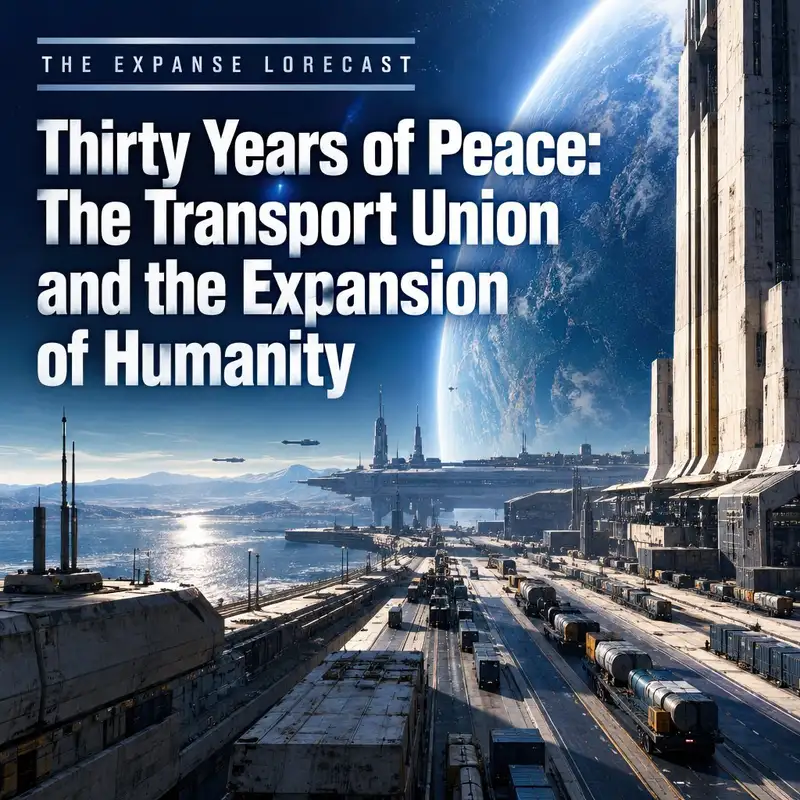
Thirty Years of Peace: The Transport Union and the Expansion of Humanity
Freehold did not fire on anyone. It did something more ordinary, and in a mature interstellar system, more revealing: it sent a ship through a Ring gate without authorization. That single transit challenged the schedules and safety rules that kept traffic moving through humanity’s shared crossroads. Camina Drummer, president of the Transport Union, answered with a three-year trade prohibition and sent James Holden and the Rocinante to deliver the ruling. No invasion followed. No colony was occupied. The punishment worked through access, because access had become one of the foundations of survival.
That response revealed what power had become. Freehold was far beyond the old centers of Earth, Mars, and the Belt. The Union had no need to invade it, occupy it, or claim authority over every aspect of its local life. It could impose consequences because the colony required commerce, replacement parts, trained personnel, medical supplies, markets, and access to the larger human network. A trade ban could reach farther than a gunboat. It was also more troubling than a gunboat in its own way. It showed that control over circulation could become control over survival.
By the opening of Persepolis Rising, this was ordinary government work. It was burdensome, contested, and bureaucratic. That was the point. Humanity had lived through a generation in which a conflict between Earth, Mars, the Belt, and the Free Navy had threatened the basic systems that kept millions alive. Now its most important interstellar institution was spending time on permits, schedules, commercial penalties, transfer stations, and arguments over who had the right to move where. Civilization often looks less dramatic once it begins functioning. It also becomes easier to mistake its institutions for permanent features of the landscape.
The Transport Union did not emerge because humanity had suddenly learned to trust itself. It emerged because the old order had failed too catastrophically to restore. The end of the Free Navy War left Earth devastated, Mars politically shaken, the Belt divided, and the Ring Network open. More than a thousand systems had become reachable through the gates. That opportunity could have created a new era of expansion under Inner control. Earth and Mars still possessed wealth, old institutions, technical capacity, and armed forces. They could have treated the gates as another frontier to be managed from the center.
For Belters, that prospect carried a familiar threat. The Belt had long supplied labor, water, minerals, shipping, and technical expertise to societies that often treated Belter lives as expendable. The opening of new worlds did not automatically erase that history. It could have repeated it on a larger scale. The Inners might claim the most valuable routes, dictate terms of trade, and leave the people who actually operated stations and ships with the same old risks and little of the authority. The gates promised abundance, but abundance without political change would only have given exploitation more places to happen.
The Transport Union was the answer to that immediate political problem. It was a settlement intended to make the Belt central to the new human geography rather than subordinate within it. Belter leadership gained authority over traffic through the Ring Network, with Medina Station as the key operational center. The arrangement was not simply a commercial contract. It was a constitutional bargain among former rivals who needed each other and did not trust each other enough to create a single unified state.
Earth needed recovery. Mars needed time to understand what the new frontier meant for its national project. Belter communities needed a role in the future that was not confined to extracting wealth for others. The colonies needed access to the systems that could supply them. The Transport Union gave each of these interests a reason to accept limits. Earth and Mars could not simply dominate the gates. The Belt could not use the network as a weapon of unrestricted revenge. Colonies could seek their own futures, but not without recognizing that every route depended on a shared transit system.
This was peace, but not reconciliation. The dead did not return because a new institution had been formed. Earth’s damaged cities, poisoned ecosystems, broken supply chains, and displaced populations did not become whole through legal language. Belters did not forget generations of exploitation because Inner governments acknowledged new rules. Mars did not stop being Mars because settlement worlds had suddenly made terraforming seem less inevitable. The settlement did something narrower and more durable. It gave old enemies a practical interest in not destroying the infrastructure that all of them required.
Medina Station, the operational center of that system, was not merely a symbol. It was infrastructure. Ships entered the Slow Zone through the Sol gate and departed through gates leading to distant systems. That movement had to be organized. Traffic needed rules. Ships needed docking space, cargo handling, repair facilities, records, communications, pilots, technicians, customs officials, security personnel, and enough confidence in the system to commit expensive cargoes and vulnerable crews to it. A station at the crossroads could not make every decision for every colony. It could, however, determine whether the routes connecting those colonies remained usable.
The Ring gates changed strategic geography without abolishing it. They made it possible to reach systems that would otherwise have remained beyond any practical human journey. But a gate only brought a ship into a system. It did not deliver that ship to a colony, a mine, an orbital platform, or a habitable world. The distance from a gate to a destination still had to be crossed under conventional propulsion. Cargo still needed to be loaded, repaired, guarded, insured, and delivered. A colony on a distant planet could possess fertile land and still wait months for a critical shipment.
That created a new form of chokepoint power. Before the gates, the Solar System’s strategic map centered on planets, stations, asteroid routes, and the long movement of goods between them. After the gates, Medina and the transit rules around it became the narrow throat through which interstellar civilization passed. Control over that throat was not the same as ownership of everything beyond it. But it was enough to shape every distant economy. A colony could declare itself independent. It could not manufacture a replacement reactor, train a surgeon, replace a failed agricultural system, or establish a reliable export trade simply by making a declaration.
The Transport Union’s authority was therefore built on competence as much as law. Someone had to keep ships moving. Someone had to understand docking, repair, cargo transfer, life-support emergencies, transit scheduling, and the ordinary hazards of working in places where a bad seal, a missed maintenance cycle, or an inattentive pilot could become a mass-casualty event. The people best prepared for that work were often the people who had been doing versions of it for generations.
Belters had lived in the physical reality of space long before the Ring Network turned it into the center of human expansion. They worked in low gravity and vacuum. They operated stations, repaired machinery, handled cargo, navigated between worlds, managed life-support systems, and survived in environments where air and water were not background conditions but visible parts of daily life. This did not make every Belter a Union official, a political organizer, or a skilled spacer. The Belt was never that uniform. But it meant that Belter communities possessed a depth of practical knowledge that the new transit order could not function without.
That expertise changed the political meaning of the Belt. For much of human expansion, Belters had been treated as a labor force at the edge of Inner power. Their work made Earth and Mars richer and more capable, while their own communities faced dependence on contracts, imported necessities, and distant authorities. The Transport Union reversed part of that relationship. The people who knew how to make stations and ships function became the managers of the routes that everyone else now needed.
It was a major redistribution of power, but not an egalitarian revolution completed in a single generation. Belter workers still labored under unequal conditions. Crews still faced risk. Stations still depended on maintenance and resupply. Some people gained office, wealth, influence, and access to institutions. Others remained on the margins, vulnerable to the decisions made by governments, corporations, ship owners, and Union administrators. The Outer Planets Alliance, the Transport Union, station governments, independent ship crews, former Free Navy supporters, labor networks, and criminal organizations were not interchangeable categories. A Belter-led institution did not automatically speak for every Belter life.
The Union’s authority rested less on ideology than on the movement of necessities. Peace had to be material before it could be political. Food had to reach hungry people. Water systems needed filters and replacement parts. Ships required fuel, reaction mass, ammunition where security demanded it, and components that could not always be fabricated locally. Medical supplies had to arrive before an outbreak or industrial accident became a catastrophe. New colonies required agricultural equipment, machinery, construction materials, technicians, teachers, engineers, and the thousand small pieces of expertise that make settlement something more than a camp with a flag.
The Ring Network multiplied destinations, but it also multiplied dependencies. Every new colony extended the supply chain. A world could be rich in minerals and poor in medicine. It could have soil and no stable agriculture. It could have abundant water and no industrial base able to produce precision electronics. It might have settlers willing to endure hardship, but no local capacity to replace the people who died, the machines that failed, or the crops that did not grow. Expansion turned the human species outward. It did not make human beings less dependent on one another.
The work of keeping those dependencies alive was not glamorous. It involved schedules, staging areas, safe ports, repair yards, cargo manifests, inspection rules, insurance, contracts, maintenance crews, and people willing to work long shifts in hazardous environments. It involved deciding which cargo got priority when capacity was limited. It involved resolving disputes between a colony that wanted immediate access and a network that could not survive if every ship ignored common rules. It involved the old truth of logistics: a system is only as stable as its ability to move the unremarkable things that people notice only after they stop arriving.
For civilians, the Transport Union was not primarily an abstract political settlement. It was the ship that arrived when a station needed replacement pumps. It was the price of medicine. It was the delay before a damaged agricultural facility received parts. It was the availability of work, the reliability of a food shipment, and the knowledge that a child who needed specialist care might have a route to somewhere that could provide it. In a network spread across many systems, transport policy was social policy. A missed convoy could become a local emergency. A trade ban could become a judgment on an entire community.
Earth’s reconstruction made the system indispensable. The planet had survived the Free Navy’s bombardment, but survival was not recovery. Its immense population, damaged infrastructure, and ecological strain required resources, industrial support, and the restoration of reliable exchange with the rest of humanity. Earth remained powerful. It still possessed institutions, technical knowledge, economic depth, and the political weight of billions of people. But it no longer occupied the unquestioned center of the human future.
The opening of the gates made Earth one great society among many possible societies. That was psychologically as important as it was economically significant. For generations, Earth had been the origin point of human civilization and the center against which other places measured themselves. Mars defined much of its identity through independence from Earth. The Belt developed in the shadow of Earth and Mars alike. The colony worlds changed that arrangement. They offered people a future that did not begin with Earth’s gravity, Earth’s government, or Earth’s damaged environment.
Mars faced the sharper crisis. The Martian Congressional Republic had built its national project around sacrifice for a long future. Terraforming was not simply an engineering effort. It was a promise that disciplined work across generations would turn a hostile planet into a true home. Martian institutions, culture, military service, industry, and political imagination were tied to that promise. Then the Ring Network opened access to worlds where some settlers could find air, water, soil, and open land without waiting centuries for Mars to become what it hoped to be.
The Transport Union helped stabilize the new order while making that crisis impossible to ignore. Its transit system gave Martians access to colony worlds, trade, and opportunity. It also made exit easier. The same infrastructure that integrated humanity weakened the social cohesion of a state built around one planet’s long-term transformation. Mars did not collapse because it lacked ships or soldiers. It began to lose its future because the future it had taught its citizens to serve no longer seemed unique.
That wider Martian decline formed part of the environment in which Winston Duarte and his followers departed through the Laconia gate with military assets and protomolecule-related resources. Their departure was not simply the private escape of one ambitious officer. It emerged from fractures in Martian institutions, military networks, and political confidence. Yet it would be too simple to treat the entire republic as a conspiratorial machine or every Martian as an accomplice. Most Martians did not choose the future Duarte intended to build. Many were left to face the consequences of a national project being hollowed out by forces they could not fully control.
The colonies offered new beginnings, but they also inherited old political problems in compressed form. More than a thousand systems became accessible through the Ring Network. None of that meant more than a thousand successful, self-sufficient, prosperous societies. Some worlds were more inviting than others. Some had usable land, water, or resources. Some were harsh, remote, biologically dangerous, or difficult to reach even after passing through a gate. Some settlements developed institutions and trade relationships. Others remained fragile outposts dependent on the next ship arriving on time.
Colonization was not the same as stability. A group of settlers could establish a claim, raise shelters, build a landing field, and announce a new community. None of that guaranteed medical care, durable agriculture, local industry, political legitimacy, or defense. A world could contain valuable resources while lacking the skilled labor and machinery to exploit them. It could have a local government but no ability to enforce decisions beyond a small settlement. It could have enough food in a good year and no margin for a failed crop, an accident, a delayed shipment, or a dispute with the people controlling its access to trade.
The Union had to govern around these conditions without pretending it could govern every world directly. It could regulate transit. It could enforce contracts. It could control access to stations and trade routes. It could establish common standards that reduced the chance of chaos at the gates. But it could not know every local condition, settle every colonial dispute, or provide a garrison for every vulnerable settlement. Distance remained politically meaningful. Even when a gate made another system reachable, communication delays, local geography, economic weakness, and the simple limits of administrative attention kept that system partly beyond the center’s grasp.
The novella Strange Dogs offers a narrow but revealing view of this era. It does not provide a census of the colony worlds or a general account of Union administration. It follows one family on Laconia, a place shaped by alien ruins, unfamiliar ecology, and the unsettling presence of technologies humans did not understand. Its value is precisely in its limits. It shows that settlement could bring ordinary human hopes into contact with environments that were neither empty nor fully legible. Colonists were not simply founding towns on blank maps. They were entering worlds with histories and dangers beyond their knowledge.
That was the irony of expansion. Humanity had escaped the old confinement of the Solar System, but it had not escaped uncertainty. Every new world offered possibility and risk. Every new route created trade and exposure. The Transport Union could make movement more orderly, but it could not make colonization safe by administrative decree. Its success depended on recognizing that the network was not a collection of prizes to be claimed. It was a system whose failures could travel along the same routes as its prosperity.
The Union’s strongest achievement was therefore also its central contradiction. It had been created to prevent Inner powers from monopolizing the human future. Yet it necessarily developed a monopoly of its own over transit. Common rules were essential. If every colony, corporation, government, or independent captain treated gate access as a private right, Medina would become unmanageable. Unscheduled ships, conflicting traffic, unregulated cargo, and disputes over access could endanger everyone. A network connecting more than a thousand systems could not operate as a collection of improvised personal arrangements.
But rules that are necessary at the center may feel coercive at the edge. A distant colony sees its own crisis before it sees the network’s wider needs. It knows what a delayed shipment means to its people. It knows what an inspection costs, what a tariff changes, and what a trade prohibition can do to a local economy. The Union might see a safety violation. The colony might see distant officials using their control over survival to punish political independence. Both perspectives could contain truth.
Freehold made the problem visible. Its unauthorized transit was dangerous because the network depended on predictability. Drummer’s trade ban was not arbitrary in the sense of being without rule or purpose. It was a proportionate form of enforcement compared with military occupation. It signaled that gate traffic could not be governed by whoever was willing to take the risk. Yet the very fact that the penalty could be imposed showed how much power the Union had accumulated. It could make access to the larger human economy conditional on obedience.
Transportation authority was not sovereignty, but it could exert pressure that sovereign-minded communities found difficult to resist. The Union did not routinely appoint local governments, own every planetary resource, or station troops across the colonies. It did not need to. A system that controls the routes through which goods, people, expertise, and opportunity move can shape politics without owning territory. That made the Union a stabilizing institution, but it also ensured that resentment would remain part of its operating environment.
Its leaders had to practice restraint. A union that treated every challenge as rebellion and every regulation as an excuse for domination would become another version of the order it had replaced. A union that refused to enforce its rules would lose the confidence of the people whose lives depended on safe transit. The difficulty was not finding the moral purity of one side or the other. It was accepting that governing a network of unequal, distant, and interdependent communities required power, while recognizing that every use of power created a debt of legitimacy.
Camina Drummer stood at the center of that problem in the novel continuity. By the beginning of Persepolis Rising, she was president of the Transport Union, responsible for an institution much larger than the wartime networks from which it had emerged. Her task was not to command a conventional empire. It was to preserve the credibility of a system built on rules, access, and mutual need. She had to make enforcement real enough that colonies and governments respected Union authority, but limited enough that the Union did not become an occupying force in everything but name.
James Holden and the Rocinante illustrated the ambiguity of that arrangement. The Rocinante was not a standard Union warship. Its crew were long-serving contractors with an unusual history, unusual capabilities, and unusually strong habits of independent judgment. Drummer could send them to carry out a Union mission because their reputation and skill made them useful. She could not turn them into a simple instrument of bureaucratic command. That tension was not a flaw unique to Holden. It reflected the wider structure of the Union, which relied on capable actors who retained loyalties and moral judgments outside any one chain of command.
The opening of a major transfer station near Lagrange Five showed the other face of this order. It was infrastructure made visible. Earth’s recovery, interplanetary commerce, and the maturity of the Union’s system could be represented in a facility built to move people and goods more efficiently. Such projects rarely inspire the same attention as warships. They should. A transfer station is a promise that traffic will continue, that schedules can be trusted, that repairs and labor will be available, and that the future will arrive through something sturdier than emergency improvisation.
The peace of the Transport Union was real because it converted former enemies into participants in a shared system. But it was never complete peace in the sense of universal safety or the disappearance of violence. There were still crimes, local disputes, labor conflicts, political grievances, private armed forces, resentful colonies, and institutions competing for advantage. The old powers still possessed military capability. The Union could impose penalties and organize security, but it was not a unified interstellar navy with a single doctrine, a single command structure, and a single political master.
The Union’s authority was broad, but its security structure was not an integrated interstellar defense system. Policing a transit network is not the same as defending a civilization against a concentrated military threat. The Union’s normal problems were problems of enforcement, safety, traffic, contract compliance, and limited coercion. Its institutions were designed to stop a ship from taking an unauthorized route, to manage an emergency at a station, or to make economic penalties credible. They were not designed to assemble all human military power instantly against an enemy that had spent decades preparing for war.
The network itself made defense difficult. Human settlement was now dispersed across more than a thousand systems. No central authority could keep strong forces everywhere. Reinforcements still required ships, crews, fuel, planning, and transit. A gate connected systems, but it did not eliminate the travel required after arrival. Political leaders could not receive complete information at once. Commanders could not assume that a message sent from Medina would resolve a crisis on a remote colony before circumstances changed. The new geography had made humanity broader, richer in possibility, and harder to defend as a single whole.
The greatest weakness was not simply a shortage of firepower. It was an information problem. Laconia had become a remote system beyond the effective observation of the old Solar System. The full intelligence picture during the three decades is not completely documented. It would be inaccurate to say that everyone simply forgot Laconia, or that some single agency incompetently ignored an obvious threat. The more serious problem was structural. A gate led to a system where a breakaway group could build institutions, pursue research, train personnel, and develop industry outside the normal political and commercial circuits of the Transport Union.
Duarte’s followers possessed advantages that no ordinary colony enjoyed. They had Martian military experience, stolen or diverted assets, a disciplined command structure, and access to protomolecule-related resources. They found alien infrastructure whose capabilities they could use in part without fully understanding. That combination created a project that was both human and alien-derived. Its strength did not come from a magical weapon alone. It came from secrecy, patience, specialized industry, centralized authority, and a willingness to organize an entire society around military preparation.
The Transport Union’s success made Laconia harder to see in another sense as well. The Union was busy making ordinary life possible across an expanding civilization. It had to manage trade, disputes, colonial access, reconstruction, and the daily frictions of a system that had finally become too large for any one planet to dominate. Its achievements were visible in ships moving safely, transfer stations opening, and settlements remaining connected. Laconia’s preparation was hidden precisely because it was not participating in that order. It was building for the moment when participation would no longer be necessary.
When Laconia returned, it did not merely challenge the Union’s authority. It tested the assumption beneath thirty years of relative peace: that commercial interdependence could restrain the major powers strongly enough to preserve the system. The answer was painful. Interdependence had made war costly. It had not made war impossible. The Union had built a civilization of routes, contracts, and shared dependencies. Laconia had built a concentrated military instrument capable of exploiting the gap between economic integration and strategic unity.
The immediate military imbalance mattered. Laconian forces possessed advanced capabilities and the advantage of preparation. But the operational failure of their opponents was broader than any one battle. Earth, Mars, the Union, and the colonies could not rapidly convert their dispersed resources into a coherent defense. Their ships, commanders, intelligence systems, and political authorities were not arranged for a sudden war against a unified rival emerging from the network’s edge. The very distribution that made human expansion possible complicated collective response.
The political consequences were equally important. The Transport Union had legitimacy. It had earned that legitimacy by making the gates work and by giving Belters a central role in the future of humanity. But legitimacy does not instantly produce military unity. A transportation authority can coordinate commerce across vast distances while still lacking the legal mandate, centralized command, and permanent armed structure required to resist an empire. Drummer’s Union could tell Freehold that it would lose trade access. It could not guarantee that every human government would fight, supply, and sacrifice under one command when a new conqueror arrived.
For civilians, the return of Laconia meant that the systems of regulated interdependence they had learned to rely on became vulnerable to conquest. The danger was not confined to fleets and officials. Occupation, disrupted trade, altered law, political repression, and uncertainty over access to food, medicine, transport, and work all followed from the collapse of the old balance. The Union had taught humanity that distant worlds could depend on one another without being ruled from Earth. Laconia intended to teach them that dependence could also be organized from the barrel of a gun.
The Transport Union’s achievement was to make interstellar civilization ordinary enough that traffic rules, repair schedules, contracts, and access disputes mattered more often than fleet battles. That achievement also defined its limit. It could bind distant societies through circulation and mutual dependence, but it had never turned them into a single strategic community. When Laconia returned, humanity discovered that a system built to keep people connected was not automatically a system built to make them fight as one.