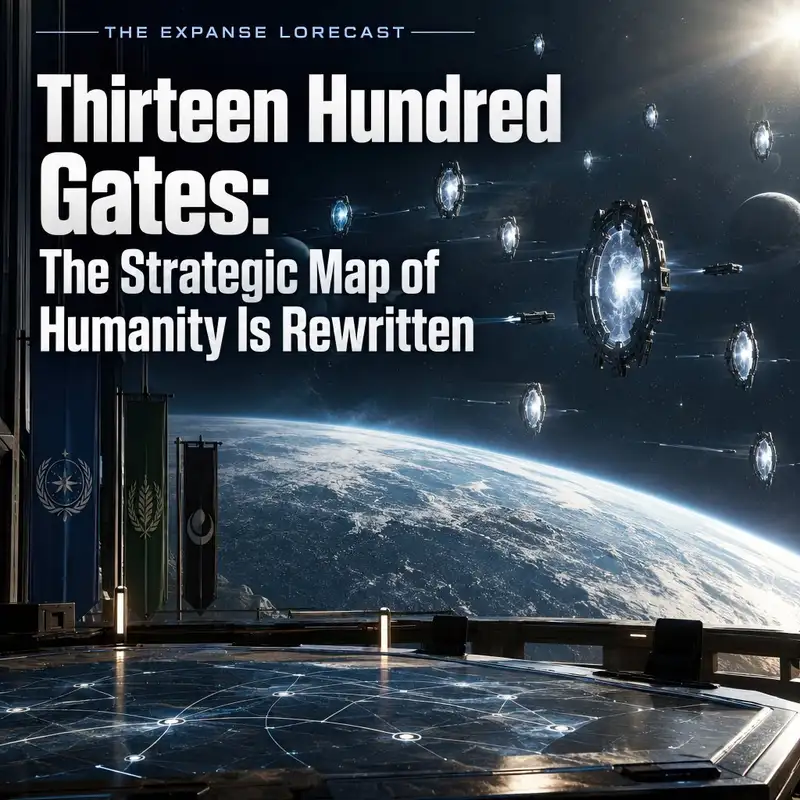
Thirteen Hundred Gates: The Strategic Map of Humanity Is Rewritten
The first fleet to enter the new interstellar age did not find freedom. It found a speed limit. Ships from Earth, Mars, and the Belt crossed the Ring near Uranus expecting mystery, danger, and perhaps opportunity. Instead, inside the artificial space beyond it, their velocity was forced down by a rule none of them understood. The change came too quickly for bodies built around ordinary human engineering. Crews were injured. Some died. Warships that had entered under national flags and civilian vessels that had entered under commercial ones were suddenly equal before an infrastructure older than humanity. They were trapped in a place no government owned, near a station no government could command.
That was the first strategic lesson of the Ring network. The gates did not simply open thirteen hundred new worlds. They placed humanity inside a transportation system whose rules, chokepoints, and failure modes had been designed by someone else. The old map of the Solar System had been hard, unequal, and familiar. The new one was larger beyond comprehension, but it was also organized around a single interchange. Prosperity, migration, military movement, and eventually political survival would depend on controlling passage through that interchange without ever fully controlling the system that made passage possible.
Before the Ring, humanity’s strategic geography was confined to one star system. That did not make it simple. Earth possessed population, old institutions, agricultural capacity, and the administrative depth of the United Nations government. Mars had built a disciplined state around an immense shared project, the slow transformation of a hostile planet into a home. It also possessed advanced industry and a formidable military establishment. The Belt, spread across stations, moons, asteroids, ships, and extraction sites, provided labor, transport, volatiles, minerals, and much of the difficult work that kept the Inner planets supplied.
But interdependence did not mean equality. Belter workers often lived where air, water, radiation shielding, medical care, and replacement parts were matters of contract terms and shipping schedules. Earth and Mars relied on Belt labor while retaining much of the political power to regulate it. Mars depended on an economic system strong enough to sustain terraforming over generations. Earth had greater aggregate wealth than either, but also profound internal inequality and a vast population living under systems that could provide survival without necessarily providing meaningful power.
Distance enforced those arrangements. The Epstein drive made travel across the Solar System practical on a scale earlier human history could not imagine, but it did not make travel instantaneous. Ships still needed reaction mass, maintenance, trained crews, food, medicine, spare parts, and safe places to dock. Messages moved at light speed. Governments could issue orders, but commanders might receive them after the decision had already been made. A food crisis at Ganymede, a labor dispute at Ceres, or a military incident near Jupiter could become politically decisive long before Earth had a complete picture.
Then the Ring appeared, and for a brief moment it seemed as though geography itself had surrendered. It had not. Geography had changed its form.
The Ring near Uranus led not directly to another star, but into an artificial central space later known as the Slow Zone. Around that space stood other gates, each leading outward toward another system. The arrangement was not a frontier where ships could wander from neighboring star to neighboring star. It was a hub-and-spoke network. Every route passed through the same central junction. To travel from Sol to a colony system, a ship first had to reach the Sol Ring, transit into the hub, cross that strange enclosed space, and then pass through the appropriate outbound gate. Once there, the ship still faced ordinary travel within its destination system. A planet might be days, weeks, or longer away from its gate, depending on its orbit, its infrastructure, and the ship’s capabilities.
The first expedition did not know any of that in useful detail. It knew only that the gate had swallowed vessels and delivered them to a place bounded by impossible structures. It knew that an alien station sat at the center. And then it learned that the station could impose physical constraints on every human ship present.
The sudden velocity reduction was not a battle in the ordinary military sense. No side had fired a weapon. No admiral had issued the decisive order. Yet it was a strategic shock more severe than many conventional engagements. It demonstrated that Earth’s naval strength, Mars’s technological confidence, and the Outer Planets Alliance’s political demands all existed inside an environment whose operating rules could be altered without warning.
The fleets entered carrying their own rivalries. Earth feared Martian advantage. Mars feared Earth’s numerical and industrial weight. Belter representatives feared that the Inner planets would divide the discovery between themselves and leave the people who had made interplanetary transport possible outside the room again. Those concerns did not disappear because the participants were trapped together. If anything, fear made them sharper. Every ship had to calculate air, injuries, power, medical capacity, and the risk that another faction might exploit the crisis.
What no human command possessed was mastery. They could observe effects. They could make theories. They could attempt cautious tests. They could not order the station to explain itself. The Ring network had arrived as infrastructure, but not as public infrastructure. It had no user manual, no maintenance authority, no treaty language, and no human institution capable of guaranteeing that it would remain open.
The immediate crisis ended only because the station’s active control was interrupted through events centered on James Holden and the protomolecule-created interface known as the Investigator. That process mattered enormously, but not because it represented a human victory over alien technology. Humanity did not conquer the station. It did not reverse engineer the Ring builders’ systems or establish reliable command over them. It found a way, under extraordinary circumstances, to stop one dangerous response.
The distinction would matter for the next several decades. The gates became usable. They did not become understood.
Once passage through the network was possible, humanity confronted a scale that no pre-Ring political order had been built to manage. Roughly thirteen hundred gates opened onto roughly thirteen hundred systems. Some led toward worlds that could support settlement. Some led to systems with alien ruins, unusual environments, or resources worth investigating. Others held little immediate promise. Human beings did not receive a complete strategic survey the moment the gates opened. There was no authoritative chart identifying every habitable planet, every mineral reserve, every biological threat, or every artifact capable of killing a settlement by accident.
There was instead a rush outward, driven by hope, desperation, ambition, faith, profit, and the very human desire to leave a place where somebody else had already decided your prospects.
The gates transformed the idea of territory. Before them, Earth, Mars, and the Belt competed within a single system whose major routes and resources were at least broadly known. After them, the potential map became too large for any one government to explore, settle, defend, or regulate. A state could claim an interest in a new world, but getting people there was only the first task. Somebody had to build landing facilities, shelters, farms, water systems, clinics, communications relays, workshops, roads, power generation, and local government. Somebody had to keep those systems running after the first enthusiastic settlers had stopped posing for recruitment posters and started discovering what the local soil, weather, gravity, pathogens, and alien machinery would actually permit.
The Ring created access before it created order. That sequence shaped nearly every conflict that followed.
Ilus, also called New Terra, became an early and revealing example. On paper, the corporation possessed documents. On the ground, the settlers possessed homes, work sites, families, and the immediate knowledge that removal could mean death. Both sides could identify a form of legitimacy. Neither form was enough to create peace.
The conflict on Ilus was not simply a dispute over who owned valuable land. It exposed the difference between legal title, physical occupation, and sustainable settlement. A settlement’s courage and labor did not automatically erase every competing claim. Security personnel could enforce corporate power for a time, but they still required supplies, communications, political cover, and some answer to the problem of governing people who had crossed interstellar space precisely to escape decisions made elsewhere.
The alien structures beneath Ilus added another layer of danger. The planet was not empty in the sense human law preferred. The lesson was repeated across the Ring worlds in different forms. A colony was not merely a dot on a map. It was a living system assembled from cargo manifests, exhausted labor, uncertain ecology, and fragile technical competence.
For many colonists, that risk was acceptable because remaining in the old order carried risks of its own. A Belter family might seek a world where their children could grow up under a sky rather than beneath station bulkheads. The frontier was dangerous, but it was also an indictment of the places people had left.
That migration began to alter the old balance of power almost immediately. The Ring gates introduced hundreds of competing futures. Why spend generations turning one cold planet into a home when other worlds already offered air, water, soil, and open land, however imperfectly? The answer was not the same for every Martian. Many remained committed to Mars, its institutions, and its collective project. But the political and economic foundation beneath that project had changed.
Investment could leave. Skilled workers could leave. Young people could leave. Officers and engineers could begin to question whether the military system they had served was protecting a future that no longer existed in the same form. The gates did not cause every later Martian defection, conspiracy, or act of disillusionment. They did, however, remove the assumption that Mars was humanity’s only plausible second home. That was a strategic change with consequences far beyond colonization policy.
The Belt faced a different version of the same problem. For generations, Belter labor had connected the Solar System. Belters flew ships, worked docks, mined rock, moved ice, maintained stations, and handled the difficult commerce that Earth and Mars could not conduct without. The opening of the gates gave those workers new importance. Every new route required pilots, mechanics, dockworkers, freight handlers, and people comfortable living where a failed pump or damaged seal could become a fatal emergency.
But the Ring also threatened to bypass the old Belt economy. If settlers, investors, and industry could move outward to new worlds, the stations and extraction routes of the Solar System might lose leverage. The Belt could become the bridge to humanity’s future, or it could become an aging industrial corridor that others crossed without sharing power.
The Outer Planets Alliance was never one answer to that problem. It was an umbrella of factions, communities, organizers, armed groups, station leaders, criminal networks, and political movements. Some sought recognition, representation, and fair access to the wealth that Belter labor created. Some focused on local survival. Some profited from instability. Some embraced revolutionary violence. The gates intensified all of these currents because they made the question of who controlled movement more important than ever.
Territory now appeared abundant. Transport was not. Habitable infrastructure was not. Skilled labor was not. Hulls, medical supplies, agricultural systems, trained administrators, and trustworthy institutions were not.
That mismatch created opportunity for people who understood that a transport network could be turned into a weapon.
The Free Navy emerged from genuine grievances rooted in Belter exploitation, exclusion, and anger. It also emerged from Marco Inaros’s personal ambition, from political coercion, from stolen Martian military capacity, and from a willingness to murder on a scale no claim of liberation could justify. The Free Navy was not the Belt. It was not the Outer Planets Alliance as a whole.
Its campaign demonstrated how the new map could be exploited without conventional conquest. Mars retained major military resources even as its political system weakened. The Free Navy could not occupy either Inner planet in the ordinary sense. It did not need to. By attacking Earth with redirected asteroids, disrupting trade, threatening shipping, and using the gates to disperse forces and create uncertainty, it inflicted strategic paralysis.
The rock strikes on Earth were acts of mass civilian killing. Their military effects were real, but that did not make them legitimate warfare or a necessary price of political reform. They shattered infrastructure, overwhelmed governance, and created a humanitarian catastrophe whose consequences extended far beyond the moment of impact.
The Ring network gave the Free Navy room to maneuver. Ships could vanish into new systems, find refuge beyond the immediate reach of Earth and Mars, or exploit the difficulty of tracking traffic across a vastly expanded map. But the same network also concentrated traffic at predictable points. Colony vessels, freighters, military escorts, refugees, and couriers all had to move through gates.
The war therefore became a struggle over transit as much as over firepower. Destroying an enemy ship mattered. Holding the infrastructure through which ships, food, personnel, ammunition, and information moved mattered more.
At the center of that infrastructure stood Medina Station.
Medina had begun as the Behemoth, itself a radically repurposed generation ship hull. By the time it became the permanent station at the heart of Ring Space, its meaning had changed again. It was no longer a vessel designed to carry a population on a one-way voyage.
Its location gave it extraordinary strategic importance. Medina could support traffic control, docking, repair, communications relays, inspection, customs functions, and defense. It could become a place where governments exchanged messages, merchants arranged freight, crews took on supplies, and military forces assessed who was moving where. In a network spread across thirteen hundred systems, the hub was not merely a station. It was the point where the network became visible to itself.
This made Medina a chokepoint, but not an all-powerful throne. Controlling it did not provide direct authority over every colony. A governor on a distant planet still had local conditions, local militias, local food stocks, local grievances, and the inconvenient fact that people rarely become obedient merely because someone else controls the nearest gate. Medina could influence movement.
Still, influence over movement was immense. A delayed cargo ship could mean a shortage of medicine. An inspection regime could become a political instrument. Control of docking and relays could determine which forces received warning, which merchants paid fees, and which communities found themselves isolated in a crisis. Refugees could be admitted, redirected, or trapped.
Humanity had built an interstellar age around a traffic interchange, then discovered that traffic authorities are political actors. The administrative vocabulary may sound less dramatic than naval combat, but a denied transit clearance can have effects that no railgun round can achieve.
The Free Navy conflict showed that neither Earth nor Mars could simply claim Medina and expect the rest of humanity to accept permanent Inner control. The postwar settlement therefore had to address more than the defeat of Marco Inaros. It had to establish a system for regulating passage before the struggle for passage produced another war.
The Transport Union was the answer, imperfect but consequential. It gave Belters a formal role in managing commerce and transit through the Ring network. Its authority rested on Medina’s infrastructure, on the need for reliable traffic regulation, and on the willingness of Earth, Mars, the Belt, and the colonies to recognize that no single old-system power could sustainably monopolize the hub.
This was not Belter sovereignty over every colony. The Transport Union could not manufacture political trust on a distant world, compel a settlement to prosper, or resolve every dispute between corporations, colonists, governments, and local communities. Its power was narrower and, in some ways, more modern. It regulated access. It managed movement. It made commerce and migration more predictable.
That mattered because predictable passage is not merely a concern for shipping companies. It determines whether a clinic receives medicine before its reserves run out. Fees, inspections, schedules, and priority rules are often treated as bureaucratic detail until the people waiting for a cargo vessel discover that bureaucracy is the form survival takes in a dispersed civilization.
The arrangement reduced some immediate conflict. It also preserved tensions that could not be solved by administrative design alone. Colonies wanted autonomy. Earth and Mars retained interests and suspicions. Belters did not all agree on what their new institutional power should serve.
For roughly thirty years, that balance held well enough to allow a much larger civilization to emerge. Not a unified civilization. Not an equal one. But a connected one.
Three decades after the Free Navy war, the Ring network had changed humanity’s scale. The old Solar System remained important, but it was no longer the whole story. Human settlements existed across many systems, each with its own stage of development, resources, vulnerabilities, and relationship to the transit network. Some were prosperous. Some remained dependent on imported machinery, specialists, and supplies. Some had developed local identities that no authority in Sol or Medina could fully understand.
This dispersed order created strategic depth. It also created strategic fragmentation. A crisis in one system could be distant not only in physical space, but in political attention. Reinforcement required passage through the hub, then conventional travel within the destination system. No central government could see everything. No fleet could be everywhere.
Laconia exploited that reality. The Laconian project emerged from Martian defectors who had carried military skill, political purpose, and stolen resources into one of the colony systems. There, in secrecy, they developed specialized industry and made use of alien-derived capabilities they only partly understood.
Its success did not rest on technology alone. Laconia had preparation. It had secrecy. It had command unity. It had an ideology that treated division as weakness and imposed order as a moral necessity. It also faced opponents whose forces and political authority were scattered across a network designed for commerce and migration, not for rapid unified defense against a prepared imperial challenger.
The same map that had liberated colonies from Solar System confinement made them difficult to defend collectively. Systems had uneven military capacity. Earth, Mars, the Transport Union, and independent colonies had interests that overlapped without becoming identical. Laconia could use surprise to turn those differences into paralysis.
Control of Medina and the hub gave the empire operational leverage. It could regulate movement, move military forces through the central space, impose inspection regimes, and make resistance more difficult by controlling the primary interchange. But the limits of that control became clear as occupation deepened.
An empire can seize a transit system. It cannot automatically govern the lives at the far ends of thirteen hundred routes.
Laconian rule rested on coercive order, military intimidation, surveillance, political restructuring, and the claim that humanity’s dispersed conflicts required central discipline. Predictable shipping, reduced piracy, and clear authority are not trivial goods. But compliance is not consent, and silence is not necessarily loyalty. A colony may accept imperial directives because its people need food shipments, because its leaders fear punishment, because it lacks weapons, or because it has learned that open resistance is suicidal. None of those conditions establishes legitimacy.
The empire faced a problem common to every centralized power, magnified by interstellar scale. Local grievances became reports, reports became summaries, and summaries became policy. Distance gave colonies room to conceal, adapt, collaborate selectively, or resist. The network that allowed Laconia to project power also created innumerable points where power depended on technicians, pilots, dockworkers, local administrators, and ordinary people deciding how much cooperation was safe.
Its alien-derived military superiority introduced another vulnerability. Possession was not comprehension. Activation was not mastery. A state that believes it has learned to command an ancient machine may discover, at the worst possible moment, that it has merely learned which button produces a useful result under familiar conditions.
The wider network carried warnings of that danger. Some systems contained dead worlds, ruins, or evidence that the builders of the gates had faced a catastrophe on a scale beyond human experience. The ancient creators had built an interstellar civilization. They had established a network whose range dwarfed anything humanity had imagined. And yet that civilization had fallen.
Human observers gave the builders and their enemies informal names, but those labels should not be mistaken for understanding. The entities associated with their defeat remain even more difficult to describe. Humanity could observe that something terrible had happened. It could infer that the network itself was implicated.
This changed the strategic meaning of the gates once again. They were not only a migration route, a trade system, a military chokepoint, or an imperial instrument. Every human society connected by the gates depended on mechanisms that had already outlived their creators and whose limits had never been fully tested by human hands.
Laconian ambition made that danger worse because authoritarian systems often confuse command over people with command over reality. A ruler can compel laboratories to produce results, officers to report confidence, and subjects to obey transit rules. He cannot compel an alien system to become comprehensible. He cannot order unknown entities to respect imperial borders.
By the time the final crisis came, the question was no longer who would govern the gates. It was whether continued dependence on the gates was survivable at all.
The closure of the Ring network in the final conflict ended the interstellar order built around Medina. The gates did not become a prize for another victorious fleet. They ceased to provide passage. Sol was cut off from the colony systems. Colony systems were cut off from one another.
The tactical result was stark. No fleet maneuver could reopen the routes. No force could outflank the problem, seize a better orbital position, or overwhelm it with greater firepower. The network had been the condition that made interstellar movement possible.
The operational consequences were equally severe. Reinforcement ended. Interstellar supply chains ended. Every colony had to rely on what it already possessed, what it could improvise, and what knowledge had survived locally. Some systems may have had the resources and institutions to endure. Others may have faced desperate shortages. The record does not provide a neat universal outcome, and it would be dishonest to invent one.
Strategically, the closure ended the empire and the network-wide order that had made empire possible. Humanity did not vanish. It became plural in a new and harder sense, divided not by ideology alone, but by the physical impossibility of contact. Every isolated system would have to decide what parts of old civilization it could preserve, what new institutions it required, and how it would live with the knowledge that the wider human world still existed somewhere beyond an unreachable boundary.
The Ring network had rewritten the map by turning one Solar System into a civilization of controlled passage. It expanded territory, opportunity, and military reach, but it concentrated dependence in Medina, transport labor, fragile political institutions, and alien infrastructure no one could repair. Humanity did not escape the old problems of distance, inequality, legitimacy, and coercion. It carried them through thirteen hundred gates, enlarged them, and learned too late that no civilization can safely build its future on a system it does not understand and cannot maintain.