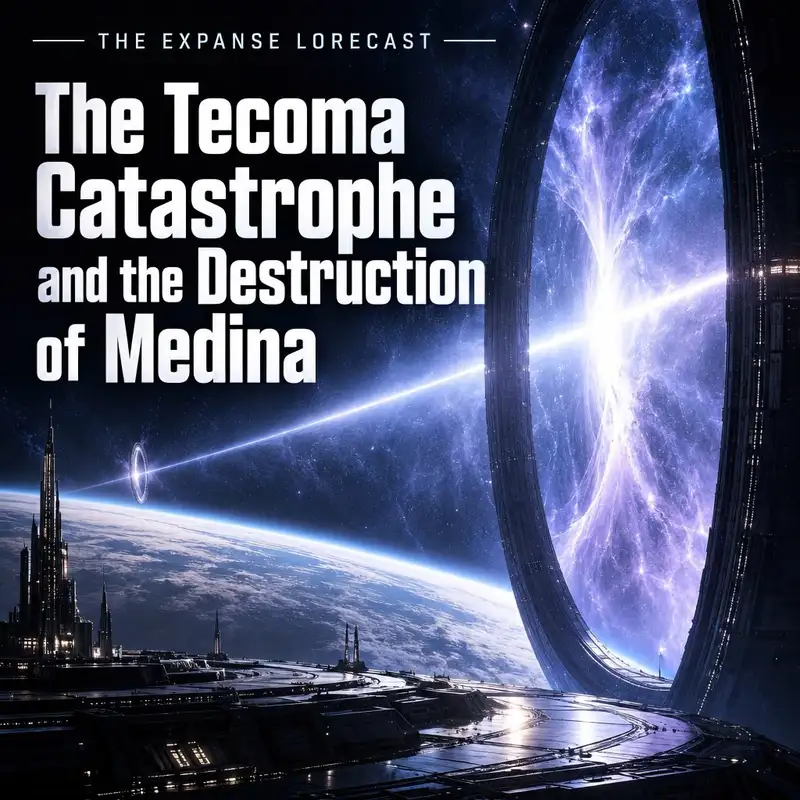
The Tecoma Catastrophe and the Destruction of Medina
The Falcon entered Tecoma expecting a system with little obvious human value and found a machine-like arrangement on a scale that immediately changed the mission. The neutron star, the gate, and the surrounding conditions did not look like an accidental curiosity. They looked engineered. For Elvi Okoye, that made Tecoma both an archaeological discovery and a warning: someone had built this environment for a purpose, and Laconia was preparing to disturb it before anyone understood what that purpose was.
By this point in the novel continuity, humanity had spread through roughly thirteen hundred Ring-connected systems. The gates had changed human geography more profoundly than the Epstein drive had changed transportation. Worlds that would once have been separated by generations of travel could now be reached through the Slow Zone, the strange central space linking every gate in the network. But access was not the same as order. Ships still needed crews, repairs, docking space, traffic management, security, law, and someone to decide who had the authority to impose rules.
That authority belonged, at least on paper, to the Laconian Empire. Its physical center inside the network was Medina Station. Medina controlled the transit hub, processed traffic, supported military deployments, regulated commerce, and stood as a visible reminder that Laconia could reach almost any human settlement. Tecoma, by contrast, had no apparent place in the empire’s political economy. It had no population to govern and no wealth to extract. Its value lay in the fact that it was wrong.
Elvi Okoye understood enough of the Ring Builders’ surviving infrastructure to recognize that wrongness mattered. The dead systems had already taught her that alien ruins were not merely archaeological sites. They were pieces of an enormous machine built by a civilization that had vanished under circumstances humanity could only partly reconstruct. Tecoma’s emptiness, its unstable neutron star, and the gate’s precise position suggested design. Not necessarily a design humans could explain. Not necessarily a weapon. But a system arranged to do something.
That distinction was the beginning of the catastrophe. Tecoma was not a harmless mystery because no one lived there. It was dangerous precisely because it appeared to have been built around an extreme physical condition. A neutron star near collapse was not scenery. It was stored potential on a scale beyond human industry. The gate’s position made the configuration more troubling still. If the system had a purpose, that purpose might involve the network itself.
The Falcon’s expedition had arrived under the banner of science. Elvi led the research side of the mission, supported by specialists including her husband, Fayez. The ship was investigating dead systems, searching for traces of the civilization that had built the gates and for clues to the force that had destroyed it. Those were legitimate goals. Laconia had inherited technologies it could activate but did not fully understand. It had built an empire around that partial inheritance. Learning more was not optional.
Yet the Falcon also carried Admiral Mehmet Sagale and a classified purpose that the scientific team had not been allowed to assess in advance. The expedition was not simply collecting evidence. It was moving through selected systems on a timetable shaped by Duarte’s strategic priorities. The scientists did not fully learn that until Tecoma, when it was too late to argue over whether the mission should have gone there at all.
The pattern had been visible earlier. In the Adro system, the Falcon encountered a vast green, diamond-like structure that Elvi interpreted as a possible archive or information repository. It might have been one of the most important alien discoveries since the Ring network opened. But the expedition could not remain and investigate it properly. Orders drove the ship onward. The military schedule had precedence over the scientific opportunity.
That decision was more than bureaucratic impatience. It revealed the command culture of the Laconian Empire. Duarte’s government valued expertise, but only within boundaries set by imperial necessity. Scientists could identify risks. They could interpret evidence. They could build instruments and offer warnings. They did not decide the strategic purpose of a mission once the High Consul had chosen it. The empire had centralized authority because centralized authority had helped it conquer human space. The same system now made it difficult for informed dissent to reach the point where it could change a decision.
The hidden purpose at Tecoma grew out of a problem Laconia could not bomb, occupy, or negotiate with. Ships had vanished during Ring transit in events humans called Dutchman events. Crews and passengers had experienced episodes of lost consciousness and altered perception connected to the network’s deeper instability. The evidence pointed toward the unknown entities associated with the destruction of the Ring Builders. But that was not the same as understanding those entities.
Humanity had names for them, theories about them, and an accumulating record of horrifying effects. It did not know where they were. It did not know whether they were biological, computational, physical, or something that made those categories inadequate. It did not know whether a Dutchman event was an attack, a reaction, an automated defense, or a consequence of operating the gates under conditions their builders had once controlled. It did not know what the entities wanted, if wanting was even the right word.
Duarte’s answer was deterrence. The logic would have been familiar to any twentieth- or twenty-first-century strategic command. If an enemy harms you, demonstrate that harm can be answered. If the enemy believes it can act without cost, impose a cost. If its attacks are beyond your present ability to stop, create uncertainty in its calculations. Force it to recognize that humanity is not defenseless.
The problem was that deterrence depends on assumptions. It assumes an adversary can receive a signal. It assumes the adversary can connect action to consequence. It assumes that something the adversary values can be threatened. It assumes that retaliation reaches the right target rather than producing an effect somewhere else. And it assumes, at the most basic level, that the adversary shares enough of your reality for coercion to mean anything.
Duarte had evidence of danger, but not evidence for those assumptions. Still, his government possessed antimatter, advanced ships, alien-derived industrial capacity, and the confidence of a regime that had defeated every human rival it had faced. Laconia had learned that concentrated force, preparation, secrecy, and superior technology could overturn the political order of the thirteen hundred systems. It was understandable that its rulers would seek a military answer. It was not sound strategy to mistake the need for an answer with possession of one.
Sagale’s classified mission was to use a bomb ship during a Dutchman event. The concept was simple only when described at a distance. A vessel carrying antimatter would be sent into the conditions associated with transit disappearance. If the event involved a reachable enemy, perhaps the bomb could injure it. If a response followed, perhaps Laconia could measure that response. The empire would move from helpless observation toward active retaliation.
This was not a conventional strike plan. There was no confirmed target, no mapped enemy installation, no known command center, and no established battle space. The bomb ship was an experiment conducted at strategic scale. Its purpose was not to seize terrain or destroy a fleet. It was to discover whether the unknown could be made vulnerable.
Elvi objected because Tecoma did not look like a safe laboratory. The neutron star’s condition mattered. Fayez’s analysis reinforced the danger. The system had almost no loose matter, as though it had been carefully cleared, while the star sat near a catastrophic threshold. In an ordinary setting, an empty system might simply be a poor candidate for settlement. In Tecoma, emptiness looked like preparation.
Elvi’s interpretation was that Tecoma may have been an old Ring Builder weapon, trap, or defensive mechanism. That was an inference, not established history. No surviving alien record explained the system’s intended purpose. No label on the gate announced what would happen if the star crossed its threshold. But the arrangement suggested that someone had placed a vast source of destructive energy in a configuration linked directly to the network.
Her objection was not that science should never take risks. Elvi had spent much of her life confronting alien systems whose dangers were inseparable from their value. Her concern was narrower and more urgent. The Laconian operation was about to introduce an unknown disturbance into a structure whose failure mode could be unimaginably large. Tecoma was not merely a place where something strange might happen. It appeared built so that something immense could happen.
Sagale did not dismiss the risk because he was foolish or because he lacked discipline. He was a senior officer executing a classified imperial order. In a less centralized state, Elvi’s warning might have triggered a political review, a scientific board, an interagency dispute, or at least a delay. Under Duarte, the purpose had already been set at the top. The expedition existed to carry it out.
That is one of the quieter failures in the Tecoma catastrophe. Secrecy protected the operation from interference, public scrutiny, and rival political interests. It also ensured that the people most capable of recognizing the danger had been excluded from the decision until the moment when their objections could no longer alter the mission. Compartmentalization can protect a secret. It cannot make a bad premise sound.
The bomb ship went into the event and disappeared. At first, that might have looked like the expected result. A vessel had been committed to a phenomenon already known for making ships vanish. But the disappearance was not the end of the experiment. It was the beginning of Tecoma’s response.
Abnormal particle activity increased. Matter began appearing in the system that had been almost entirely empty. The exact mechanism remains uncertain. The sequence is clear enough. The Laconian test came first. The system changed. Material appeared where it should not have been. The neutron star, already near collapse, crossed a threshold.
A neutron star is not simply a small star. It is matter compressed to a density that makes ordinary engineering language feel absurdly inadequate. Its stability depends on balances that operate under immense gravity. Tecoma had apparently been arranged close to a point where even a relatively small change, by the standards of stellar mass, could matter catastrophically. The new matter was enough.
The neutron star collapsed into a black hole. The collapse released a gamma-ray burst of lethal energy. This was not an ordinary explosion expanding through space with a fireball and a blast wave. In vacuum, destruction follows radiation, heat, high-energy particles, and the geometry of what is exposed. Tecoma’s deadly energy had a path shaped by the alignment of star and gate.
Whether that outcome was an intentional counterattack by the unknown entities, an automated response embedded in ancient infrastructure, or a system behavior that does not fit either description remains unresolved. The novel establishes the observed chain of cause and effect. It does not provide a complete account of agency. What humanity knew was worse in one respect than a clear enemy plan. The people involved could see what had happened without knowing what, exactly, had made it happen.
Tactically, the Laconian operation achieved nothing it had set out to achieve. No enemy target was identified. No enemy capability was confirmed destroyed. No vulnerability was established. There was no evidence that the antimatter bomb had reached anything recognizable as an opponent. The experiment did not create deterrence. It created an event whose consequences Laconia could not contain.
Strategically, the empire had activated an alien configuration without understanding its purpose. This was not merely a weapon malfunction. A weapon is supposed to remain within a human chain of command. Tecoma was never under Laconian control. The empire had only found a switch and assumed it knew what the machine did.
The gamma-ray burst traveled through the Tecoma gate into the Slow Zone. The Ring network had made human expansion possible by joining distant systems through a common transit space. That same connection now carried disaster away from its point of origin. The Tecoma gate was destroyed. So was the gate opposite it in the Slow Zone, the gate to Thanjavur.
For Thanjavur, the result was immediate isolation. The system had lost both of its connections to the network. It could no longer receive ordinary traffic through its gate. It could no longer send ships, people, cargo, messages, or requests for help through the routes on which its relationship with the wider human civilization depended. The exact population of Thanjavur is not the point. Any colony built on regular access to the network was suddenly cut off from its suppliers, markets, institutions, and allies.
Isolation did not necessarily mean instant death. Colonies varied in their self-sufficiency, local resources, food production, industry, and political resilience. But Thanjavur’s future was no longer something its inhabitants could negotiate with distant authorities. The gate system had made their world part of a larger civilization. The destruction of those gates removed that connection in an instant.
This first disaster did not destroy Medina Station. That distinction matters. Medina survived the gamma-ray burst’s initial effects, though the Ring station was struck and became intensely luminous. The station at the center of the Slow Zone remained in existence. Its personnel could assess damage, issue orders, coordinate traffic, and attempt to determine what had just happened. For a brief interval, the administrative heart of the network was wounded but still present.
The Falcon escaped into the Slow Zone after Tecoma’s collapse. Its crew entered an environment transformed by radiation, damage, fear, and uncertainty. They had survived a stellar catastrophe only to arrive at the one place where every consequence of that catastrophe became politically concentrated. Medina was where Laconia’s imperial system met the physical reality of the gates.
Medina’s importance was not simply its size or its location. It had begun life as the generation ship Nauvoo, later became the improvised Behemoth, and eventually served as the central station of the Ring network. By the Laconian era, its history had been absorbed into a new function. It was customs office, traffic authority, military base, supply point, communications center, jurisdictional symbol, and administrative capital for movement between worlds.
A gate network without a transit hub is still a network, but it is not an easy one to govern. Ships have to enter and leave safely. Traffic has to be scheduled. Disputes require arbitration. Inspection, enforcement, repair, rescue, and military response all require people and infrastructure. A distant colony might reject Laconian authority in theory. Medina made that authority tangible at the one place nearly every interstellar route had to pass.
The station also concentrated Laconia’s vulnerabilities. Centralization creates efficiency. It reduces duplication, shortens chains of command, and allows a state to monitor the movement of people and material. It also turns a single location into a point of failure. If Medina was the center of empire, then any force capable of destroying Medina could damage Laconia far beyond the station’s own hull.
The Magnetar-class battleship Eye of the Typhoon was present in the Slow Zone as part of Medina’s defense. It represented a category of military power that the older governments of Earth, Mars, and the Belt could not casually match. Laconia’s Magnetar-class ships were rare products of advanced industry and alien-derived capability. Their presence was meant to make the meaning of imperial control obvious.
Against human opponents, that force mattered enormously. A Magnetar-class ship could intimidate fleets, compel local governments, and embody the brutal advantage Laconia had accumulated during its long preparation beyond the gates. But military capability is always conditional. A railgun is useful when there is a target along a firing line. Missiles matter when they can acquire and pursue an enemy. Armor matters when it can absorb or deflect a form of attack.
None of those assumptions held in the second catastrophe.
After the first shock came another network-wide episode of lost consciousness. Across the Ring network, people experienced a disruption that made ordinary command and control unreliable at exactly the moment it was most needed. Duarte himself was badly affected. His protomolecule modifications appeared to make him especially vulnerable to the consciousness-disrupting effects associated with the unknown entities, though the precise medical or physical mechanism was not fully established.
Then the attack reached the Slow Zone directly. Observers encountered dark, tendril-like phenomena that did not behave like ships, missiles, radiation, boarding parties, or any weapon human doctrine recognized. Portions of vessels, structures, and people were removed from existence. Not burned away. Not shattered by impact. Not disabled in a pattern that damage-control crews could isolate behind bulkheads. Human objects simply ceased to remain whole.
The language of battle becomes inadequate here because no conventional engagement developed. There was no useful range to close, no enemy signature to track, no firing solution to calculate, and no target against which the Eye of the Typhoon could apply its extraordinary weapons. Point-defense cannon could not shoot an absence. Armor could not resist an effect that ignored the assumptions on which armor was designed. Maneuver could not evade an attack whose geometry was unknown.
This was the final collapse of Duarte’s deterrence theory. Laconia had built its power on the ability to identify an adversary, concentrate force, seize initiative, and impose costs. Even when its methods were brutal, they were methods directed at opponents who occupied territory, commanded ships, relied on infrastructure, and could be threatened. The unknown entities did not present themselves in any of those ways.
The Eye of the Typhoon was not useless because it was badly designed. It was useless because superiority over one category of threat does not transfer automatically to another. A state can possess the finest warship in human history and still find itself defenseless when the attack is not a weapon in any form it can recognize.
The Falcon was caught in the destruction along with Medina and the other ships in the Slow Zone. It suffered catastrophic damage. Much of its crew died. Elvi and Fayez were gravely injured. Survival became a matter of fragments: damaged systems, injured people, incomplete information, and a narrowing window in which some action might still work.
Elvi’s contribution at that moment was not a brilliant command decision in the ordinary military sense. It was recognition. Her previous encounters with alien systems had taught her that the impossible was not always random. The Ring Builders’ artifacts had patterns, even when the humans using them understood only a tiny part of the logic. Elvi recognized enough of that pattern to activate the Falcon’s emergency escape procedure.
The Falcon got out. That survival should not be mistaken for victory. It did not defeat the entities. It did not protect Medina. It did not preserve the expedition or recover the knowledge Laconia had sought. It was a narrow escape enabled by scientific observation and prior experience, not by the antimatter experiment or by the empire’s conventional military preparation.
That contrast is central to the event. The Laconian operation began with a strategic model imposed from above. Its one meaningful survival response emerged from someone whose warning had been overridden. Elvi had not been able to stop the experiment. But her understanding of alien behavior gave the Falcon a chance when superior weapons and centralized command had nothing useful to offer.
While the Falcon escaped, Medina did not. The later direct attack destroyed the station, the Eye of the Typhoon, Admiral Sagale, and the other vessels in the Slow Zone. The gamma-ray burst had damaged the transit center and destroyed two gates. The subsequent assault was what annihilated Medina itself.
Tactically, the result was stark. Ships and station infrastructure were gone. Personnel aboard Medina, including workers, travelers, merchants, military crews, representatives, and all the other people required to make a transit hub function, became casualties of an event whose exact human toll is not established. The absence of a precise count does not reduce the scale of the loss. A station is not an empty piece of infrastructure. It is a community built around labor, movement, and dependence.
The Eye of the Typhoon’s destruction had a separate military significance. Magnetar-class ships were not interchangeable patrol craft that could be replaced by routine procurement. They represented rare industrial capacity, specialized knowledge, long preparation, and technologies that Laconia itself did not completely master. Losing one reduced more than the empire’s available firepower. It reduced the credibility of a system that claimed technological superiority as the foundation of its political order.
Operationally, the destruction of Medina removed the principal node through which Laconia managed movement in the Ring network. The gates remained, apart from Tecoma and Thanjavur, but the administrative machinery at their center had been shattered. Traffic enforcement, military staging, customs regulation, emergency coordination, and the daily practical exercise of imperial jurisdiction all became more difficult at once.
The empire did not vanish when Medina died. Laconia still held ships, systems, personnel, weapons, and institutions. It remained dangerous. Its fleets did not suddenly lose their crews or forget their training. But its power had become more brittle. A regime that relies on central coordination can survive a local defeat. It struggles when the center itself is removed.
The destruction also struck at the political story Laconia told about itself. Duarte’s empire justified its domination in part through order. The old system of competing governments, divided factions, and uncontrolled expansion had been presented as chaotic and weak. Laconia would impose stability through discipline, superior knowledge, and a command structure capable of seeing farther than local politicians or independent colonies.
Tecoma exposed the limit of that claim. Laconia could control human traffic through Medina. It could not control the network’s underlying physics. It could deploy alien-derived warships. It could not guarantee that alien technology would remain legible. It could suppress dissent. It could not make uncertainty disappear by classifying it.
Duarte’s incapacitation made the institutional problem worse. His empire was highly centralized not only administratively but personally. The High Consul was strategist, founder, ideological center, and final authority. When the consciousness attack removed him from effective command, the regime lost the person around whom its senior officers and political structures had been organized.
The exact nature of Duarte’s condition was not fully understood by those around him. What mattered politically was that the empire had no easy way to replace him. A system that concentrates judgment in one extraordinary figure gains speed when that figure is capable. It also creates a crisis when he is absent, incapacitated, or wrong. Medina’s destruction removed the empire’s transit hub. Duarte’s condition removed the center of decision-making that might have organized a rapid response.
For the Underground, this created an opening. Not an instant liberation of the thirteen hundred systems. Not a sudden reversal of every Laconian advantage. The empire still possessed formidable forces, and fear did not evaporate because one station had been destroyed. But the appearance of inevitability had been punctured. Laconian control now had visible limits. Its command system could be disrupted. Its most advanced assets could be lost. Its ruler could be rendered helpless.
That mattered because empires do not govern through weapons alone. They govern through expectations. A provincial official complies because resistance appears futile. A merchant follows the regulations because the enforcement system seems permanent. A colony accepts an imposed governor because the center appears able to send ships, impose penalties, and reward loyalty. Once that confidence is broken, coercion becomes more expensive and administration becomes less reliable.
The destruction of Medina therefore had consequences beyond the physical loss of a station. It loosened the relationship between the gates and Laconian authority. The empire still claimed the network, but it no longer possessed the same practical means to manage the network at its center. Distance returned as a political problem. Local actors had more room to maneuver. Communications, logistics, and enforcement no longer converged on a single fortified hub.
Thanjavur’s isolation made the human cost of that failure even clearer. Medina’s destruction weakened an empire. The loss of both Thanjavur gates stranded a population that had not chosen to become part of Duarte’s experiment. The system’s people were separated from family, trade, medical support, supplies, political representation, and any expectation that help could arrive by the routes that had defined their lives.
The catastrophe began as a Laconian effort to demonstrate that humanity could strike back. It ended by proving that interdependence could be broken in ways no government had planned for. The Ring network had made human civilization wider, richer, and more connected. It had also made each world dependent on infrastructure built around assumptions of continuity. Tecoma showed how quickly those assumptions could fail.
The central error was not simply that the antimatter weapon produced unintended consequences. Military history contains many cases of states using imperfect intelligence, testing new systems, and suffering from miscalculation. Tecoma was more fundamental. Duarte tried to apply a familiar logic of retaliation to an adversary whose location, motives, vulnerability, and relationship to physical reality were all unknown.
He assumed that harm could be answered with harm, and that the answer would be understood. He assumed that an enemy responsible for Dutchman events could be reached through the event itself. He assumed that demonstrating capacity for punishment would alter the enemy’s behavior. None of those assumptions had been established. The experiment was framed as a way to acquire knowledge, but it was built on a conclusion already chosen.
Elvi’s warning identified the deeper danger. The system was not empty. It was full of intention, even if that intention belonged to an extinct civilization and could only be inferred from structure. Tecoma had been engineered around forces so immense that human weapons were almost irrelevant. Laconia did not build that machinery. It did not understand it. It merely touched it.
The resulting chain reaction had distinct levels of failure. Tactically, Laconia did not strike or damage a known enemy. Operationally, it lost the Tecoma and Thanjavur gates, the Slow Zone’s military presence, Medina Station, and the Eye of the Typhoon. Strategically, it weakened direct control over interstellar transit and gave its human opponents greater freedom to act.
Politically and institutionally, the catastrophe exposed the fragility of a regime built around centralized command and the authority of one High Consul. Civilians paid in ways that could not be reduced to military accounting. Medina’s population died with the station. Thanjavur was isolated from the civilization that had made its settlement possible. Across the network, people learned that the empire claiming to guarantee order could not explain the danger it had provoked.
The Tecoma catastrophe did not prove that humanity should stop studying the alien network. The gates had already made ignorance impossible to treat as safety. It proved something narrower and more important: access to extraordinary technology is not the same as understanding the system that produced it. Laconia could dominate human opponents with tools it only partly understood. Tecoma showed the limit of that advantage when the thing being challenged was no longer human.