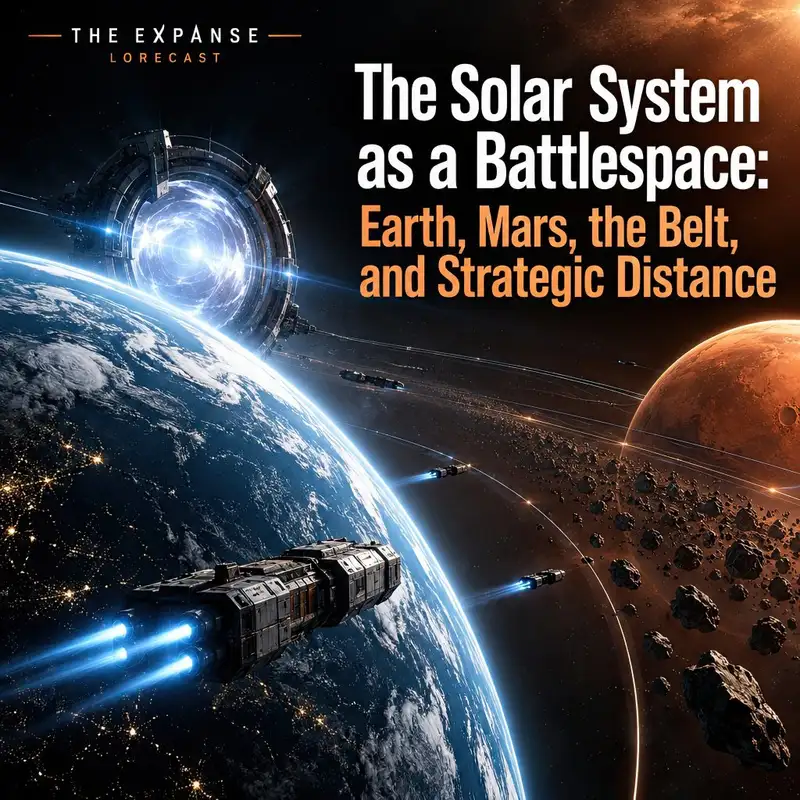
The Solar System as a Battlespace: Earth, Mars, the Belt, and Strategic Distance
The Canterbury dies far from any capital, but its death does not stay local. An ice hauler disappears in the outer system, then its distress call begins moving outward at the speed of light. The ship is gone before most people hear the message. Earth receives an accusation. Mars receives an implication. Belter stations receive one more piece of evidence, or what seems like evidence, that the people who profit from the Belt can destroy Belters without consequence. Naval commands receive an intelligence problem. News networks receive a crisis. The survivors receive a warship.
The pre-Ring Solar System was built around a contradiction. A ship, a cargo route, or a station may be physically distant from the centers of power, yet politically central within minutes or hours. Information travels farther than a ship can. Fear often travels faster than verification. But neither messages nor fleets travel instantly, and that delay gives distance its military importance. By the time a government understands a crisis, local commanders, station authorities, corporate managers, and frightened crews may already have acted.
The destruction of the Canterbury was not dangerous only because people died. It was dangerous because nobody who mattered had the same picture of what had happened. The governments of Earth and Mars were already armed, suspicious, and accustomed to reading events through the logic of deterrence. Belter communities had long experience with neglect, extraction, and official explanations that did not improve their air supply or repair a failing recycler. A conspiracy could use that political landscape as effectively as it used weapons.
The Solar System had become connected enough for a single attack to threaten the balance among Earth, Mars, and the Belt. It had not become connected enough for any authority to control the story, the response, or the consequences. That condition was the product of the Epstein drive. The drive made the system smaller in practical terms. It did not make it equal, orderly, or easy to govern.
Before that transformation, human expansion beyond Earth was constrained by a simple and stubborn fact. Space is large. Not poetically large. Operationally large. Every journey required energy, reaction mass, equipment that could survive a hostile environment, and people who could remain alive until arrival. A destination might be visible through a telescope and still be effectively beyond the reach of routine settlement, trade, or military patrol.
The asteroid Belt and the outer planets were not unreachable before efficient fusion propulsion. They were simply difficult to use at scale. A prospecting mission could go outward. A scientific expedition could carry supplies and accept long transit times. But a civilization requires more than expeditions. It requires regular transport, spare parts, medical care, food, contracts, repair facilities, trained labor, and some confidence that a ship sent for help will arrive before the emergency becomes a memorial service.
Military power faced the same problem. A government can claim a distant region on a map without possessing the ability to reinforce it, inspect it, protect commerce there, or punish those who challenge its authority. A warship that takes too long to arrive is not useless, but it is no longer a reliable instrument of day-to-day control. Distance turns formal sovereignty into an argument that must be repeatedly supported by logistics.
The old frontier was therefore scattered. Earth remained the great center of population and political authority. Mars was a difficult neighboring world, promising but hostile. The Belt was a region of potential wealth whose resources were expensive to reach and even more expensive to exploit. The outer system was farther still, a place for specialized activity rather than dense human life. The practical map of civilization was narrow because the cost of moving people and material was high.
Solomon Epstein’s modified fusion drive changed that practical map. The story of its first test is not a tale of a scientist calmly unveiling a finished technology. It is a story of discovery through risk, followed by catastrophe. Epstein’s breakthrough demonstrated a form of propulsion efficient enough to sustain acceleration over periods that made interplanetary travel more practical. He did not solve every problem of spaceflight. He changed the scale on which those problems could be managed.
The strategic effect was compression. Journeys that had once made regular commerce, settlement, and patrol prohibitively difficult became part of a working system. Ships could accelerate for extended periods, then turn and decelerate toward their destination. This was not faster-than-light travel. A ship still crossed real distances. It still had to navigate moving planets and moons. It still needed to arrive with enough control, fuel, reaction mass, functioning machinery, and living crew to do something useful once it got there.
The familiar maneuver called flip-and-burn captures the logic. A vessel accelerates to build velocity, then rotates and uses thrust in the opposite direction to slow down. The details depend on the route, the destination, the condition of the ship, and the mission. It is not a universal halfway turn in a neat diagram. It is a practical answer to the fact that a ship does not stop merely because its engines go quiet. In space, momentum is patient.
The drive also did not give crews unlimited endurance. Sustained thrust creates apparent gravity, but high acceleration can injure or kill the people inside the ship. The body remains a constraint. The juice, acceleration couches, training, and medical support can expand tolerance. They cannot make human organs indifferent to force. A ship’s engineering limits, its crew’s condition, and its cargo all influence how hard and how long it can burn.
Nor did efficient propulsion remove the need for maintenance. Fusion drives require expertise. Ships need radiators, power systems, navigation, filters, seals, communications equipment, and replacement parts. A vessel far from a repair yard may be able to fight, flee, haul cargo, or conduct rescue operations, but it cannot escape the arithmetic of wear. The Epstein drive made the Solar System active. It did not make it frictionless.
Propulsion transformed society before it transformed politics, and that gap shaped the order that followed. Regular movement created routes. Routes created markets. Markets created stations, contracts, shipyards, storage depots, transport crews, and financial claims. The Belt became a place where people could live and work in numbers large enough to matter, though never in conditions that made life easy. The outer system became tied to the Inner planets through extraction, shipping, research, and agriculture.
Human civilization became one economy before it became one political community. Earth, Mars, and the Belt were bound together by material needs, not shared authority. Earth needed resources and transport networks beyond its gravity well. Mars needed trade, technology, routes, and security while sustaining its long project of transforming an inhospitable planet into a home. Belt communities needed customers, equipment, food, legal recognition, investment, and access to systems that had often been designed elsewhere and owned by someone else.
Dependence did not create equality. It often created leverage for whoever controlled the bottleneck. A government that controlled inspection rights, military patrols, customs rules, or supply contracts could influence life far from its own territory. A corporation that controlled a dock, a shipment, a refinery, or a food agreement might determine whether a station’s workers had employment and whether its families had reliable provisions. A ship captain might possess more immediate authority over a crew’s survival than any legislature on Earth or Mars.
The political map created by that mobility was unequal from the beginning. Earth remained the demographic and institutional center. Mars used separation, technical development, and military preparedness to become a sovereign rival rather than a remote dependency. Between and beyond them, Belter communities supplied labor, transport, extraction, maintenance, and local expertise across a network of stations whose survival depended on regular access to food, water, air systems, medicine, and parts.
Those three populations were connected by necessity, not by a common government. Earth and Mars could project power through fleets, contracts, and regulation, but neither could administer every distant habitat as though it were a neighborhood of a planetary capital. Belters could disrupt traffic, withhold labor, hide ships, or organize locally, yet the Belt had no single chain of command. The Outer Planets Alliance grew from that political space as an umbrella for many movements rather than as a ready-made nation.
The result was a system in which mobility increased both control and resistance. Governments could reach farther than before, but so could smugglers, organizers, corporations, independent crews, and clandestine armed groups. Every new route widened the strategic theater while making it harder for any one authority to claim complete control of it.
The Solar System was therefore a battlespace long before fleets exchanged fire. It was a battlespace of routes, contracts, life-support systems, labor relations, and information. A naval presence mattered, but so did who controlled a shipyard, who could issue docking clearance, who held a food contract, and who knew which captain would accept a risky cargo. Military force operated within that web. It could shape the web, damage it, or exploit it. It could not replace it.
Space itself imposed a distinct operational logic. The planets and moons are moving. Asteroids are moving. Stations and ships are moving. A route is not a straight line drawn across a political map. It is a changing calculation involving position, velocity, acceleration, fuel, braking, and time. A commander who understands where an enemy is now but not where that enemy will be when weapons arrive does not yet possess a firing solution.
A ship’s direction of travel is also not the same as its orientation. Vessels can rotate to point sensors, weapons, communications equipment, or thrust in a useful direction while continuing along a trajectory established long before. This is one reason space combat does not resemble aircraft fighting in an atmosphere. There is no universal up or down, no convenient horizon, and no expectation that a ship can simply turn sharply and begin moving in a new direction without cost.
Acceleration is a tactical resource. A ship that burns harder can alter the geometry of an engagement, but it may exhaust its crew, strain its systems, or commit itself to a course that will later require equally demanding braking. A civilian freighter, a patrol vessel, and a military warship do not share identical performance or identical tolerance for risk. Even a powerful ship may be constrained by the people inside it, the condition of its engines, the ammunition in its magazines, and the mission it has been assigned.
Communications create another layer of distance. A tightbeam message may reduce the chance of interception, but it must still cross space at light speed. Orders from Earth cannot reliably direct every moment of an encounter near Jupiter. Instructions from Mars may arrive after a station commander has already made a decision about whether to fire, surrender, quarantine a facility, or release a ship. Local command is not a convenience in this environment. It is a necessity.
That means military and political leaders must rely on standing orders, delegated authority, and incomplete intelligence. It also means that different actors can act rationally on the information available to them and still drive a crisis toward disaster. The audience of a story may eventually learn who arranged an attack. A naval commander responding to a fragmentary transmission does not have that privilege. A station governor facing a damaged food supply cannot wait for a perfectly verified explanation before making rationing decisions.
Detection is never simple. Ships reveal themselves through drive plumes, heat, active sensors, communications, transponders, traffic patterns, and mistakes. Stealth measures can delay detection or complicate identification. A vessel that coasts cold, limits emissions, and conceals its purpose may be difficult to find. But stealth is not invisibility. A ship must eventually radiate heat, communicate, maneuver, or operate systems. A ship that attacks has usually chosen to become visible in at least one important way.
Even when a contact is detected, it may not be understood. Is it a merchant vessel, a patrol ship, a pirate, a disguised military craft, a damaged civilian ship, or a threat meant to provoke a response? Is its transponder genuine? Is its trajectory consistent with its declared destination? Is a silence evidence of caution, mechanical failure, or hostile intent? In a militarized system, uncertainty is not neutral. It can force a commander to choose between accepting risk and creating escalation.
Weapons amplify those decisions. Guided torpedoes and missiles allow ships to threaten targets across vast distances, but they depend on detection, tracking, guidance, and time. A missile can force an enemy to maneuver, spend defensive ammunition, abandon a preferred approach, or reveal information about its defenses. Point-defense cannons are not shields. They are weapons with ammunition limits, firing arcs, mechanical constraints, and no guarantee of success against every incoming threat.
Railguns offer a different kind of danger. Their projectiles move with tremendous speed, but a railgun shot depends on geometry, timing, and prediction. At close range, when two ships are committed to trajectories that narrow the problem, a railgun can be devastating. At long range, the target has time to maneuver and the shooter faces the problem of firing at where the enemy will be rather than where it was. Space combat rewards preparation, position, and accurate information more than theatrical reflexes.
Damage control matters as much as the first exchange of fire. A warship is not simply a weapons platform. It is a pressure vessel, power plant, computer network, workshop, medical facility, and workplace for people who may be injured, exhausted, or trapped in compromised compartments. Hull damage can mean loss of atmosphere, fire, radiation exposure, severed power, sensor failure, broken maneuvering systems, and casualties who require care while the rest of the crew keeps the ship alive.
Fleet power therefore cannot be measured by hulls alone. Ships need yards, mechanics, trained replacement crews, ammunition, fuel, reaction mass, electronics, food, medicine, and secure ports. Earth’s large population gives it depth, but not every asset is modern or close at hand. Mars’s advanced military depends on an industrial and educational system that must continue functioning under political strain. Belter ships may be ingenious and locally adapted, but ingenuity does not manufacture spare parts in a vacuum.
The Canterbury crisis showed how these military realities were embedded in political ones. The ice hauler was a civilian ship performing a task that mattered to the wider system. Water was not a luxury cargo. It was life, industry, and leverage. When the Canterbury was destroyed, the immediate question was who had fired. The larger question was what the attack would permit other actors to claim.
The surviving crew’s account did not arrive in a peaceful political environment. Belter suspicion of the Inner planets was not invented by the crisis. Earth and Mars had long treated the Belt as a space of strategic competition, economic opportunity, and security concern. The destruction therefore became evidence in arguments already underway. One side could see proof of Martian aggression. Another could see an Inner plot. Another could see confirmation that Belter lives were expendable. The facts mattered, but their meaning was contested before the evidence was complete.
The Rocinante, still newly separated from its Martian identity as the Tachi, became part of that confusion. Its existence raised questions about who controlled it, where it came from, and what it had witnessed. In a system where ships carry transponders, records, weapons, and reputations, identity is operational. A ship’s name, registration, emissions profile, and affiliations can shape how others respond long before anyone knows the people aboard.
The Donnager engagement demonstrated a related lesson. The Martian flagship represented the formidable capability Mars had built to defend its sovereignty. It carried the prestige of a military establishment that believed, with reason, in its technical and doctrinal advantages. But a superior vessel is not immune to surprise, deception, or a mission designed around political effect rather than simple battlefield victory.
The engagement was not important merely because a powerful ship was lost. It exposed a gap between confidence and knowledge. The attackers had capabilities that did not fit comfortably into the existing assumptions of Earth-Mars competition. The event suggested that someone was operating outside the expected framework, willing to take extraordinary risks and to use military action in service of a larger concealed objective. For Mars, the loss was a military shock. For the system, it was an intelligence shock.
A great power can absorb material losses more easily than it can absorb uncertainty about the enemy it faces. If a government cannot identify who is attacking its forces, cannot explain why, and cannot distinguish a provocation from the beginning of a wider campaign, every response becomes dangerous. Retaliation may strike the wrong target. Restraint may appear like weakness. Mobilization may reassure allies while convincing rivals that war is imminent.
Eros demonstrated the same geography under far stranger conditions. An inhabited station could become strategically decisive even though no fleet had planned to fight for it, because millions of civilians, corporate secrecy, alien technology, and incomplete intelligence converged in one place. The crisis forced Earth, Mars, Belter factions, and independent crews to act with different information and different priorities, showing how distance and jurisdiction could turn a local disaster into a system-wide security problem.
The pattern was clear. A local incident became a strategic crisis not because distance had disappeared, but because distance had become traversable enough for every major actor to possess interests far from home. At the same time, the physical separation among those actors ensured that intelligence remained imperfect and command remained delayed. The result was a system where rumors could produce mobilization before reliable answers could arrive.
Ganymede added another layer. Its agricultural infrastructure supported populations far beyond Jupiter, so fighting there threatened food supply, transport schedules, and political stability across the outer system. A military confrontation around the moon could therefore damage people who were nowhere near the battle.
That is what makes the Solar System one battlespace in practical terms. Ships, stations, farms, repair yards, and trade routes are separated by enormous distances, yet disruption at one node can alter decisions everywhere else. No government can simply command the whole network, because flags do not maintain filters, unload cargo, or keep a damaged habitat alive.
This is the point at which the idea of the Solar System as one battlespace becomes clearest. It was not one battlefield in the sense of a single front line. It was a system of connected vulnerabilities. Water moved from one region to another. Food moved from Ganymede. Ships carried people, cargo, intelligence, weapons, and rumors. Corporations linked facilities through contracts. Governments projected power through fleets but depended on civilian infrastructure to make that power usable.
No great power could simply command this system. Earth could not govern the Belt as though it were a nearby province. Its authority had to travel through bureaucracies, fleets, companies, and local intermediaries, all of which had their own interests and delays. Mars could not turn military quality into universal dominance. Its forces remained dependent on supply, maintenance, political authorization, and a finite pool of trained personnel. Both powers needed commerce to continue even while preparing for conflict.
A ship at a distant station may display a government’s flag, but flags do not maintain filters. A patrol can deter an attack, but it cannot create legitimacy where local populations believe the patrol exists mainly to protect extraction. A military occupation of a dock can secure the dock for a time, yet it may also disrupt the labor and trust that make the dock useful. Presence is not governance. Firepower is not administration.
Belter autonomy grew in the spaces between formal authority and practical necessity. Sometimes that autonomy took organized political form. Sometimes it was simply a station solving its own problems because no one else could arrive in time. Sometimes it was criminal. Sometimes it was humane. The same network of independent ships and local knowledge could carry smugglers, organizers, refugees, investigators, or supplies. Geography did not dictate virtue. It created opportunities and pressures.
Then, near Uranus, the map changed again. The Ring appeared as an alien structure with implications no human government, corporation, or navy had planned to manage. Its arrival drew scientific interest, commercial ambition, military caution, political competition, and fear. A system accustomed to treating distance as a problem of propulsion and logistics now faced a structure that seemed to redefine the boundaries of human reach.
The response was revealing. The Ring did not cause humanity to become unified. It brought factions into proximity because none of them could ignore it. Earth and Mars had security concerns. Belter organizations had claims to representation and access. Scientists saw an unprecedented discovery. Corporations saw opportunity. Religious groups, settlers, military planners, and independent crews each understood that whatever lay beyond the Ring could alter the distribution of wealth and power.
The great flotilla that assembled around the new phenomenon was therefore not just an expedition. It was a compressed version of Solar System politics. Everyone wanted access. Nobody trusted the others to define the rules alone. The old disputes over jurisdiction, security, transport, and legitimacy followed humanity to the threshold of the unknown.
The Ring did not make ordinary space travel inside the Solar System obsolete. Ships still had to reach it. They still had to burn, coast, brake, communicate, maintain themselves, and keep their crews alive. The structure created a new kind of chokepoint, but it did not abolish the geography that had shaped Earth, Mars, and the Belt. It expanded the strategic map while preserving the old problem of who controlled access and who bore the risk.
Nor should the Ring be confused with the earlier human uses of protomolecule technology. The sample that had driven horrors on Eros and the alien structure near Uranus were connected within a larger mystery, but human understanding remained partial. Possession was not mastery. Activation was not comprehension. The political temptation to treat extraordinary technology as an answer to ordinary human problems was already visible, and it was already dangerous.
The pre-Ring Solar System had become a unified strategic theater because the Epstein drive made movement, trade, intelligence, and violence routine across interplanetary distance. A crisis on an ice route could reach Earth, Mars, and the Belt as a political shock. A battle near Jupiter could threaten food supplies across the outer system. A corporate experiment on one station could become a threat to every government. Human activity had tied the system together.
But the drive did not conquer distance. Ships still arrived late. Orders still crossed space too slowly. Crews still broke under acceleration. Stations still depended on fragile machinery. Fleets still required yards, ammunition, repair, and trained people. Earth and Mars could project force, but neither could perfectly see or govern the spaces between them. The Belt supplied the system while remaining exposed to many of its worst risks.
That was the enduring strategic condition. Mobility created interdependence. Geography ensured that interdependence remained unequal. The Solar System became one battlespace not because its distances vanished, but because its distances became governable enough for every region’s crisis to affect the others.