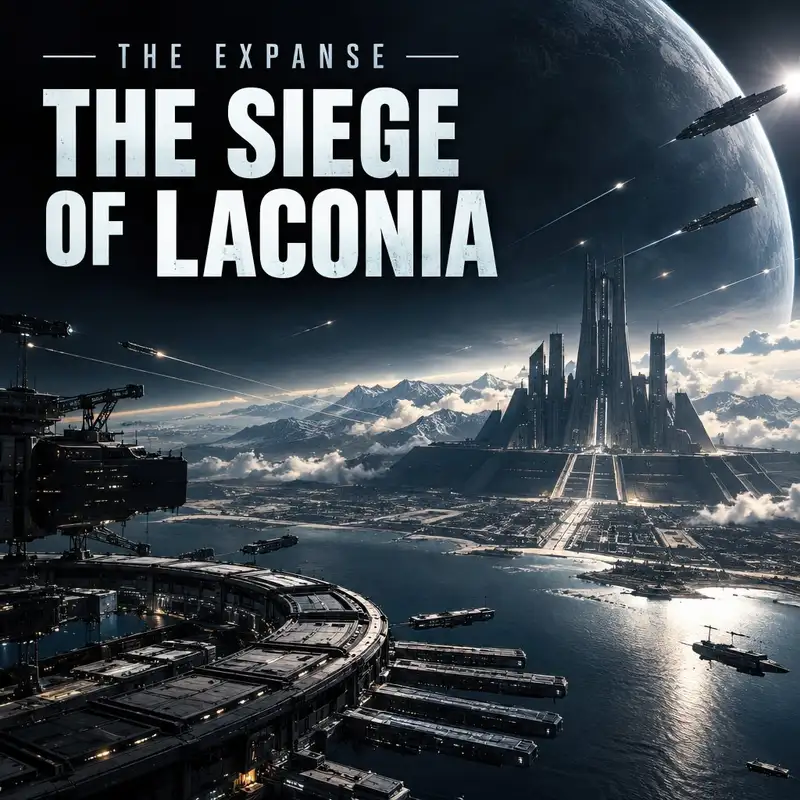
The Siege of Laconia
To Laconian defenders, the Underground’s movements around the home system looked like evidence of weakness. Small groups appeared, probed defenses, exchanged fire, and withdrew when stronger forces responded. The pattern seemed to confirm the empire’s preferred story about its enemies: brave enough to raid, too weak to stand. Naomi Nagata needed the defenders to believe exactly that. The siege depended on making a scattered resistance look strategically incoherent until Laconia committed its mobile strength in the wrong places.
To the officers tracking those contacts, that seemed like success. The Underground could raid. It could irritate. It could force defensive launches and consume ammunition. But when Laconian ships moved against it, the resistance withdrew. The lesson appeared obvious: the enemy understood the difference between courage and suicide.
Naomi Nagata needed Laconia to believe exactly that. The Siege of Laconia was not a siege in the old terrestrial sense. No army surrounded a city. No fleet closed every route to the planet. The Underground could not starve Laconia into surrender, and it had neither the political unity nor the military strength for a planetary invasion. Laconia remained the imperial capital, defended by advanced ships, orbital weapons, trained personnel, and the institutions of a state built for war.
What Naomi created instead was a campaign of pressure and deception against a capital system. She made Laconia’s defenders spend ships, missiles, attention, and confidence against threats that looked important but were not decisive. Then, when the defenders had learned the wrong habits, she struck the one target that mattered more than any single warship.
The question was not whether the Underground could defeat the Laconian Empire in one battle. It could not. The question was whether a dispersed resistance movement, operating without a stable central government and with generally inferior technology, could remove the basis of Laconia’s long-term military superiority.
Naomi’s answer was that Laconia did not need to be destroyed all at once. It needed to lose the ability to replace what it had already spent.
By the time of the siege, Laconia’s empire rested on more than occupation troops and frightening warships. It rested on organization. The Laconian state had emerged from Martian defectors who carried with them military discipline, technical expertise, strategic patience, and access to protomolecule-derived systems that the rest of humanity could not match. For decades, it prepared in isolation. When it returned through the Ring gates, it returned with ships and weapons that made the older powers look provincial.
That superiority mattered. A Magnetar-class battleship was not merely another large hull with bigger guns. It represented a different level of industrial capacity, alien-derived manufacturing, and military intimidation. Laconia’s advanced ships could overmatch the vessels available to local governments and resistance groups. They allowed a relatively small imperial fleet to impose obedience over a vast number of systems.
But the empire’s strength had a narrow foundation. Its most advanced capability came from specialized infrastructure concentrated in its home system. Laconia possessed ships. More importantly, it possessed the means to build more ships like them. It could lose a vessel, accept the cost, and expect replacement. It could expand its fleet over time. It could make defeat in one system seem temporary because its industrial future remained secure.
That was the true center of gravity. A warship is inventory. A shipyard, a construction platform, a trained industrial workforce, and the knowledge embedded in a production system are regeneration. A fleet can be damaged and rebuilt. The machinery that makes rebuilding possible is often harder to replace than the ships it produces.
Laconia’s construction platforms were not ordinary human shipyards with a few unusual components. They were alien-derived systems that humanity could operate only through incomplete understanding. Laconian scientists and engineers had learned enough to exploit them. That was already an extraordinary achievement. It did not mean they could reproduce them from first principles if they were destroyed.
The distinction was decisive. The empire could endure the loss of ships. It might not endure the loss of its capacity to create the next generation of ships.
Laconia’s position had already been damaged before Naomi brought the Underground into the home system. The operational window opened in the aftermath of catastrophe in ring space. Winston Duarte, the ruler around whom the empire had been built, had tried to confront forces connected to the ancient destruction of the gate-building civilization. His effort produced disaster on a scale no conventional military staff could have anticipated.
The consequences reached far beyond the immediate loss. Medina Station, the critical hub of human transit through the Ring network, was destroyed. Ships in the central transit space died with it. The event disrupted movement, communications, command relationships, and the assumption that Laconia could observe and direct the empire from one central position.
The gates still connected human systems, but the machinery of empire had been badly shaken. Information no longer moved through a secure and predictable center. Reinforcements could not be dispatched with the same confidence. Local commanders had to make decisions with delayed reports, incomplete intelligence, and uncertainty about what had happened elsewhere.
Duarte himself became incapacitated. That created a crisis at the heart of a state designed around his authority. Laconia still had institutions. It still had officers, scientists, security services, ships, and a disciplined military culture. But its ruler’s condition was politically sensitive, strategically important, and not fully transparent even inside the government.
Admiral Anton Trejo became the practical military authority in this damaged system. He commanded a powerful state under conditions no Laconian plan had intended. He had to preserve the capital, manage an empire stretched across the gates, contain uncertainty about Duarte, and respond to resistance activity that was becoming more coordinated by the day.
Trejo was not dealing with a defeated enemy. He was dealing with an enemy that had found a moment when Laconia’s reach was longer than its grasp.
The destruction of the Heart of the Tempest made that moment visible. Bobbie Draper and Alex Kamal’s attack on the Laconian flagship had been an extraordinary operation, built on intelligence, nerve, timing, and a weapon that could not simply be ordered from an ordinary naval magazine. Bobbie died in the attack. The loss was personal for those who knew her, but it was also operationally important.
The Heart of the Tempest had been more than a battleship. It had been evidence. It demonstrated that Laconian military superiority was not theoretical. It was real, immediate, and frighteningly effective. As long as ships like it appeared untouchable, resistance to Laconia carried the odor of futile sacrifice.
Its destruction did not make the Underground equal to Laconia. It did not erase the empire’s remaining fleets, garrisons, or security apparatus. It did not solve the political problem of governing the systems after Laconian rule weakened. But it broke the myth that the empire’s most powerful ships could not be killed.
That changed morale. It changed recruitment. It changed the willingness of local groups to take risks. It also changed Laconian calculations. An empire that believes itself invulnerable can make aggressive plans. An empire that has watched one of its premier warships die must begin protecting what remains.
Bobbie’s operation did not win the Siege of Laconia. She did not participate in its final assault. What she did was create the psychological and military conditions in which Naomi’s larger plan could work. The empire had fewer irreplaceable ships, and everyone now knew those ships could be destroyed.
Naomi’s problem was that the Underground was not a navy in the conventional sense. It had no settled capital, no unified legislature, no secure industrial base, and no officer corps that had spent decades training to operate together. It was a coalition of survivors, local resistance groups, former military personnel, Belter networks, independent crews, captured assets, sympathetic authorities, civilian support organizations, and people who had reached the same conclusion for different reasons.
They were united against Laconia. None of that meant they agreed on what should replace it.
Some had lost governments. Some had lost families. Some had lost ships, careers, homes, or entire futures to imperial occupation. Some fought because they believed in local autonomy. Others fought because there was no safe way to remain neutral. A few were experienced professionals. Many were not. Their ships varied in age, condition, armament, and crew quality. Their political commitments varied even more.
Naomi could not command them as an admiral commands a national fleet. She could not assume every unit would receive orders at the same time, interpret them the same way, or accept the same risk. She had to build coordination without pretending that coordination was unity.
Her answer was communication, persuasion, and a clear strategic purpose. With Medina destroyed, the old assumptions about information flow through the gates no longer held. Naomi helped establish a distributed communication network using transmitters launched through the gates in torpedoes. The method was improvised, dangerous, and limited. It did not restore the centralized command system that had been lost. It created something different: enough connectivity for separated resistance groups to share information, organize movement, and act with greater coherence.
That mattered because the Underground’s real advantage was dispersion. Laconia saw that dispersion as weakness. It saw scattered ships and local cells that could be isolated, hunted, and intimidated. Naomi saw a network spread across many systems. Every system could provide some combination of supplies, intelligence, crew, maintenance, shelter, political legitimacy, or opportunity.
The Underground did not need to concentrate all power in one place until the moment concentration served the mission. Until then, its scattered nature made it difficult to destroy.
This was not a romantic vision of insurgency. Dispersal also meant confusion. It meant shortages, unreliable ships, different command cultures, competing priorities, and arguments over risk. It meant that a damaged transport or missed message could affect an entire operation. It meant that many participants had homes and dependents they could not casually abandon.
Naomi’s achievement was not turning this coalition into a perfect fleet. It was giving it a plan that made its imperfections useful.
The force that assembled for Laconia included hundreds of ships drawn from dozens of systems. It contained combat vessels, transports, cargo ships, support craft, older warships, and improvised assets. The Rocinante was there. So was the captured Laconian destroyer Gathering Storm. Other ships carried weapons, supplies, crews, and the unglamorous material without which an offensive becomes a collection of stranded hulls.
The exact roster matters less than the strategic fact. This was not one government sending its fleet across the map. It was a many-system coalition bringing together whatever it could sustain.
That gave the Underground a peculiar form of logistical depth. Water could come from one system. Ammunition from another. Spare parts, medical supplies, trained mechanics, replacement crews, and political support could come from still others. Not every source was large. Not every route was secure. But the network was broad.
Laconia, by contrast, faced the campaign from one home system. It had formidable defenses and a concentration of exceptional industrial assets. It also had finite magazines, finite defensive ships, and a limited number of assets that could not be replaced quickly, if at all.
The siege therefore became a contest between many sources and one center. The Underground did not have to win a single exchange of fire by overwhelming force. It needed to make Laconia spend resources in ways that could not be recovered. Every missile intercepted consumed ammunition and attention. Every defensive launch imposed maintenance demands and crew fatigue. Every pursuit shifted ships away from some other responsibility. Every alarm forced commanders to choose which contact mattered most.
None of that meant Laconia was helpless. It had the advantage in technology, training, and home-system defenses. It could punish mistakes. A resistance force entering that system could not assume safe retreat, and it certainly could not assume that civilian cargo ships would survive contact with Laconian weapons.
But Laconia had to defend everything important at once. The Underground only had to make the defenders uncertain about which threat was real.
The early stages of the campaign were designed to create that uncertainty. Resistance groups entered in separate formations rather than moving as one obvious armada. They approached defended areas, withdrew under pressure, and created a pattern of visible activity throughout the system. They moved supplies openly enough to be noticed. They launched attacks that did not necessarily achieve destruction but did force a response.
Some of those attacks were beaten back. That was part of the design.
An operation can lose a tactical exchange and still advance its campaign objective. A missile barrage that fails to destroy a target may still force point-defense guns to fire, compel ships to maneuver, reveal defensive habits, and persuade an enemy commander that he understands the attacker’s intentions.
The Underground appeared wasteful. It appeared aggressive enough to be dangerous, but not disciplined enough to be patient. Its ships seemed to be probing for weakness, taking risks, and retreating when the Laconian response became serious.
That picture was persuasive because it contained enough truth. The Underground did have uneven forces. It did have vulnerable supply ships. It did have crews with different experience and different willingness to die. Naomi was not fabricating weakness out of nothing. She was arranging real weakness into a pattern the enemy would misread.
The central deception was behavioral. Naomi needed Laconian commanders to expect that resistance ships would run when pursued. More than that, she needed them to expect that chasing resistance ships was safe.
That required discipline from the Underground. There were moments when resistance forces could have damaged or destroyed Laconian pursuers. Doing so might have felt satisfying. It might have produced a local victory and a memorable report. Naomi restrained those impulses because a dead escort could expose the larger plan.
If Laconian commanders began losing ships every time they pursued a retreating formation, they would stop pursuing. The trap depended on preserving the belief that the enemy was evasive rather than lethal.
This is one of the least glamorous forms of military command. It is easier to order an attack than to order a force not to take an available shot. Restraint can look like timidity from the deck plates of a ship that has spent years surviving by firing first. But in this campaign, restraint was a weapon.
Naomi was not trying to win every encounter. She was trying to teach the empire a lesson it would act upon at the wrong moment.
Trejo’s dilemma was real. It is tempting to treat a deceived commander as foolish, especially when the audience knows the plan in advance. Trejo did not have that advantage. He faced contacts throughout a large system. He could not ignore threats simply because they might be feints. A raid that looked minor could be targeting infrastructure, intelligence facilities, supplies, or political symbols. A loose resistance formation might be an actual attack force, or it might be bait.
Meanwhile, he could not move every major asset toward every contact. The capital had to be defended. The construction platforms had to be defended. The state’s remaining high-end ships could not be scattered carelessly, because each one carried military value far beyond its hull.
The Voice of the Whirlwind, Laconia’s remaining Magnetar-class battleship, was especially important. It was not merely a powerful ship. It was one of the empire’s surviving statements of force. Its presence could stabilize a defensive sector. Its movement could intimidate attackers. Its loss would deepen the political shock already created by the destruction of the Heart of the Tempest.
Naomi’s feints created a threat that appeared to demand the Whirlwind’s attention away from the primary objective. The details mattered less than the pattern that preceded them. Laconian commanders had been trained by repeated experience to believe that the Underground would approach, provoke, and flee. A force moving outward looked like another problem to chase down before it could become more serious.
The Whirlwind committed outward. That was the turning point. The resistance had not destroyed the ship. It had not rendered Laconia defenseless. It had drawn the most dangerous mobile defender away from the place where Naomi intended to strike. In a system as large as Laconia, distance still mattered. The Epstein drive made rapid travel possible by human standards. It did not allow a battleship to be everywhere at once, and it did not erase the time required to reverse course, accelerate, and return to a threatened orbit.
A reserve that is moving toward the wrong emergency is not a reserve. It is an asset temporarily removed from the decision.
Once the Whirlwind was committed away from the planet, the Underground’s strike force turned inward. The approach to the construction platforms was not a clean dash toward a defenseless target. Laconia still possessed orbital defenses, planetary defenses, escort ships, sensors, weapons, and crews who understood that the attackers had finally revealed a serious objective. The strike force had to survive acceleration, incoming fire, evasive maneuver, and the practical limits of its own weapons and ammunition.
The ships did not fly like atmospheric fighters. They maneuvered through changing vectors, using thrust, timing, and geometry. They had to keep weapons oriented where they could be used, preserve enough control to avoid collisions and defensive fire, and protect vulnerable hulls full of people, pressure systems, electronics, ammunition, and life support.
Point-defense fire mattered because incoming missiles had to be defeated before they could reach the ships. Railguns mattered because fixed targets and defensive vessels could become vulnerable when an attacker achieved the right line and timing. Evasion mattered because even advanced defenses cannot engage every threat perfectly when attacked from multiple directions.
But the tactical problem had a simple strategic core. The Underground did not need to destroy every defender. It did not need to control the planet. It did not need to land troops and raise a new flag over the State Building. It needed to destroy the construction platforms before Laconian defenses could recover, before the Whirlwind could return, and before the cost of remaining in the system became fatal.
Fixed infrastructure has a weakness that warships do not. A ship can maneuver. It can retreat, change vector, hide behind distance, or alter its position in response to a threat. A construction platform exists where production requires it to exist. It may have defenses, escorts, redundancy, and armor, but it cannot simply leave orbit when the enemy arrives.
The resistance strike succeeded in destroying the five construction platforms. The immediate result was straightforward. The attackers had reached the objective, destroyed it, and escaped with their core force intact enough to leave the system. That was tactical success.
Operationally, the result was much larger. Laconia had lost the industrial basis for replacing and expanding its most advanced naval capability. The empire still possessed warships. It still possessed officers, soldiers, technicians, occupation authorities, and state institutions. The Voice of the Whirlwind still existed. Other military assets remained available. A single campaign had not erased an empire.
But every remaining advanced asset had become more precious. A surviving Magnetar-class ship was no longer part of a growing force backed by secure replacement capacity. It was a finite resource. Its destruction, damage, or even extended maintenance requirement now carried a different meaning.
This is why the siege mattered more than a battle in which the Underground might have destroyed several conventional ships. Ships are visible. They make headlines, frighten populations, and dominate tactical planning. Production capacity is quieter. It lives in platforms, materials, maintenance systems, specialized labor, and the hard-won knowledge that makes extraordinary machines possible.
Destroying those platforms took away Laconia’s future more effectively than trying to destroy all of Laconia’s present. The assault also included an extraction that was politically important, even though it was not the campaign’s main military objective. James Holden had been held within the Laconian State Building. His importance was not that he could command the Underground fleet from captivity. Naomi was doing that work outside the system. Holden’s value lay in his position inside the heart of Laconian power and in his ability to influence people whose decisions might alter the regime.
Teresa Duarte was one of those people. As Duarte’s daughter and heir, she occupied a unique place in the empire’s political structure. She had been raised inside its assumptions, protected by its institutions, and connected to the man whose authority gave Laconian rule its central legitimacy. But she was also confronted with the gap between the empire’s stated purpose and the violence, secrecy, and fear required to preserve it.
When the moment came, Teresa chose to free Holden. Amos Burton played a role in the escape, though his condition required its own caution. He had been reconstructed through alien repair systems after his death. He was not simply restored to ordinary human life, and the process was not evidence that Laconia fully understood or controlled the technology involved. He remained recognizably Amos in important ways, but he had been altered by an intervention beyond ordinary medicine and beyond reliable human mastery.
During the pursuit, Amos killed the security personnel trying to stop them. The immediate purpose was escape. The larger significance was that the empire’s internal control was beginning to fail under pressure. A regime can survive the loss of a battle more easily than it can survive uncertainty inside its own command structure, especially when its ruler is incapacitated and his heir is no longer obedient.
The Rocinante came down to collect Holden and Teresa. Landing a ship during an assault on an enemy capital was not an act of casual heroism. It was a calculated risk, undertaken because the political value of extraction had become worth the danger. The strike force had already accomplished its primary industrial objective. The rescue did not replace that objective. It added a second wound to a regime already struggling to explain what had happened.
Teresa then identified herself over the communications system as Duarte’s heir. That declaration created a problem no weapons system could solve cleanly. Laconian commanders were no longer deciding whether to fire on an enemy ship carrying a prisoner. They were deciding whether to fire on the vessel carrying the emperor’s daughter and designated successor. Trejo’s authority was immense, but it was not unlimited. His choices existed inside a political system built around Duarte’s family, Duarte’s status, and the claim that Laconia represented order rather than arbitrary violence.
The commander who chose not to destroy the Rocinante made a military decision under political constraint. It allowed Holden and Teresa to escape. It also demonstrated that even at the empire’s capital, command could hesitate when legitimacy, succession, and personal authority collided.
The Underground left Laconia having achieved far more than its material strength seemed to promise. It had destroyed the construction platforms. It had extracted Holden and Teresa. It had forced the empire to reveal that its defenses could be manipulated, its premier ship could be drawn away, and its political command could be paralyzed at a critical moment.
But the victory had limits, and those limits mattered. Tactically, the operation succeeded. The strike force reached the platforms, destroyed them, and escaped. The rescue succeeded as well. These were concrete achievements, not symbolic gestures.
Operationally, the campaign was even more important. Laconia’s ability to regenerate its most advanced military power had been crippled. The empire could still deploy its existing forces, but it could no longer regard losses as replaceable. Its naval advantage had become an inheritance being spent rather than a production line expanding.
Strategically, however, Laconia was not finished. It still controlled territory. It still possessed a professional military. It still had security institutions, loyalists, occupied systems, weapons, and people with a strong interest in preserving the empire. The Underground had proved that Laconia could be hurt. It had not yet created a durable political settlement for the human systems that would remain after Laconian power weakened.
That distinction is essential. Resistance can destroy the machinery of coercion without immediately building institutions capable of replacing it. A coalition can agree that an empire must be opposed while disagreeing profoundly about law, representation, security, property, local autonomy, and the use of force afterward.
The political impact on Laconia was severe. The empire’s claim to inevitability had depended on the sense that its power was not only overwhelming but permanent. The Heart of the Tempest had been destroyed. The construction platforms were gone. Duarte was incapacitated. Teresa had escaped. The capital system itself had been penetrated by a coalition the empire had dismissed as scattered and weak.
An empire can survive defeat. What it struggles to survive is the public discovery that defeat is possible.
For civilians on Laconia, the campaign avoided the immediate catastrophe of general planetary bombardment or invasion. The Underground targeted orbital military-industrial infrastructure rather than treating the capital’s population as the objective. That restraint did not make the event painless. The loss of the platforms threatened industries, careers, political expectations, and the economic order built around imperial expansion. Families inside the capital faced uncertainty about leadership, security, and the future of a state that had promised them durable control.
The siege also left scientific and political dangers unresolved. Elvi Okoye moved to shut down the facility associated with protomolecule experimentation and redirected attention toward understanding the Adro diamond and the deeper history of the gate builders. This was not a victory lap. The destruction of Laconia’s construction capacity did not remove the larger threat beyond human politics. Humanity had damaged an empire while still living inside a network of alien technology it did not truly understand.
That is what gives the Siege of Laconia its lasting importance. Naomi Nagata did not defeat Laconia by discovering a stronger weapon or assembling a fleet that could simply overpower the empire in open battle. She defeated Laconia’s assumption that superior ships guaranteed strategic control.
The Siege of Laconia succeeded by making dispersion useful. Naomi’s forces accepted local weakness, fed the empire a believable picture of scattered resistance, and drew defensive strength away from the industrial target that mattered most. When the construction platforms were lost, Laconia still possessed territory and weapons. It no longer possessed the same future. The siege proved that an empire can lose the machinery that sustains its dominance before it loses the ground beneath its feet.