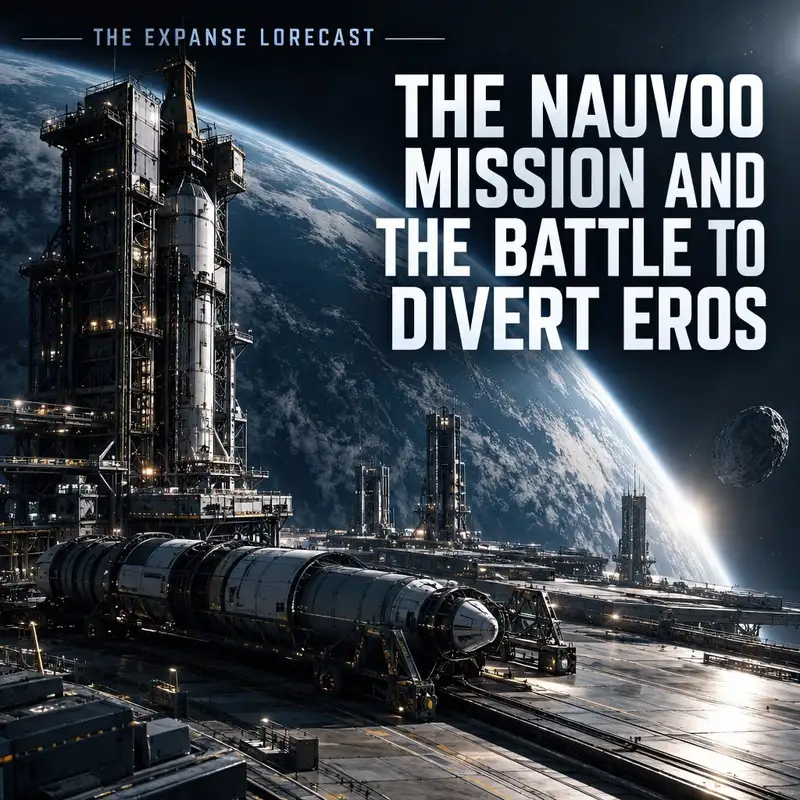
The Nauvoo Mission and the Battle to Divert Eros
The Nauvoo left Tycho Station carrying the weight of a future that no longer belonged to it. It had been built for a religious community’s journey beyond the Solar System, a generation ship meant to preserve families, faith, education, agriculture, and social order through a voyage so long that its first passengers would never see the destination. Now its destination was Eros. Its mission was not settlement, but collision.
That change was possible because the Nauvoo was enormous, heavily built, and equipped to push a vast enclosed habitat through interstellar distances. Those qualities did not make it a warship. It had no naval doctrine, no combat role, and no reason to exist in a battle plan. But in an emergency, mass and propulsion can become weapons whether their owners intended that use or not. A ship designed to carry a community across centuries could also be aimed at an asteroid with enough force to alter its course.
The seizure of the Nauvoo was therefore more than an act of improvisation. It was an assertion of emergency authority. Fred Johnson’s Tycho-based Outer Planets Alliance network had the industrial access, engineering personnel, and political reach to take control of the unfinished vessel. The Mormon owners had financed a civilian future. Tycho converted that future into a one-use instrument of planetary defense. The justification was grave. The act was still a seizure of property from people who had not built their ship to become anyone’s ammunition.
And even that extraordinary decision rested on one assumption. Eros had to behave like an asteroid. It had to remain on a predictable trajectory long enough for a calculated interception to matter. Human planners understood how to strike a stationary or coasting body. They understood momentum, acceleration, impact angles, and the immense difficulty of changing the path of a massive object. What they did not yet understand was that Eros had stopped being an object in any ordinary military sense.
By the time the Nauvoo began its run, Eros was the aftermath of a crime on a scale too large for conventional investigation. Protogen had used the station as an experiment. The protomolecule had been released among a civilian population that had no meaningful warning, no chance to consent, and almost no possibility of escape. What followed was not merely an epidemic, even a catastrophic one. The station and its inhabitants were transformed into part of an alien process whose purpose humans could observe only in fragments.
Eros had been a Belt station before it became a threat. It was a workplace, a transit point, a place where families lived within the constraints of recycled air, paid water, crowded corridors, and unequal power. Its people mattered before the experiment, and their deaths mattered after it. Treating Eros as an empty rock made the later military problem easier to describe, but it concealed the civilian atrocity at its center. The station was not naturally hostile terrain. It was made hostile by corporate science, secrecy, and the decision to use human beings as expendable material.
Protogen’s wider project was not limited to one station. The organization and the network around Jules-Pierre Mao sought knowledge, leverage, and strategic advantage from the protomolecule. Their work also helped intensify mistrust among Earth, Mars, and the Belt. In a divided Solar System, uncertainty could be weaponized. If one faction believed another possessed alien technology, a scientific discovery could become a military crisis before anyone understood what had been discovered.
For the people trying to stop Eros, the immediate problem was simpler and more terrible. The station could not be allowed to reach Earth. It could not be allowed to become a prize for a government, corporation, or faction that believed it could manage the protomolecule safely. It could not be allowed to remain available for study in the ordinary sense, because ordinary study assumes a laboratory can contain its subject. Eros had already shown that containment had failed.
Josephus Miller understood this with unusual clarity. He had begun as a detective on Ceres, investigating the disappearance of Julie Mao. By the end of the Eros crisis, he had become one of the few people willing to accept that the normal categories of law, evidence, property, and jurisdiction had already been overtaken by events. His proposal was harsh, but it was not irrational. Use the Nauvoo to strike Eros. Push it away from Earth, ideally toward the Sun. Then use demolition charges to ensure that no one could casually reclaim the station, dock with it, or extract whatever remained of the protomolecule.
The distinction between those goals matters. Diversion meant changing Eros’s path. Destruction meant breaking apart the station or disabling the mechanism that moved it. Denial meant making Eros too dangerous to capture or exploit. Containment meant preventing the protomolecule from spreading beyond the station. These objectives overlapped, but they were not identical. A successful impact might divert Eros without destroying it. A nuclear detonation might make salvage difficult without ending the alien activity. A destroyed station might still scatter contaminated debris. In a crisis, military language can make such distinctions sound academic. They are not. They decide whether a plan has actually succeeded.
Miller’s plan was designed as a layered operation because no one trusted a single strike to solve the problem. The Nauvoo would follow a calculated path and hit Eros from an angle intended to change its course. The hope was that the ship’s mass and velocity would push the station sunward, away from Earth. The plan did not depend on the Nauvoo somehow vaporizing Eros. It depended on enough momentum being transferred in the right direction to turn a planetary threat into a solar disposal problem.
That was already an act of desperation. Diverting a large asteroid is difficult even when it is inert, well tracked, and understood. Eros was contaminated by an alien system that had consumed its population and altered its internal structure. The planners could not know how much of the station remained mechanically normal, how much had been transformed, or whether any human weapon would have the effect expected of it. But uncertainty did not eliminate the need for action. It made the need more urgent.
Fred Johnson supplied the industrial means to attempt it. He was not the commander of a unified Belt government, because no such government existed. The Outer Planets Alliance was an umbrella of factions, crews, political movements, local communities, and armed networks with competing interests. Fred’s authority rested on his position at Tycho, his reputation, his access to resources, and the willingness of others to cooperate under pressure. That gave him real power. It did not make every Belter his subordinate or every OPA faction a participant in the operation.
Tycho’s contribution included more than the Nauvoo. Five OPA freighters were fitted with fusion bombs and docked around Eros. These ships were not elegant military platforms. They were available hulls transformed into demolition infrastructure because that was what the emergency required. In a system where transport, fuel, air, docking access, and skilled labor are always strategic resources, civilian ships can become part of a war plan very quickly.
The freighters served a purpose beyond simple explosive force. They were intended to deny access. If the Nauvoo failed to finish the job, the bombs would help make Eros too dangerous for a rival government, a corporate recovery team, or an opportunistic OPA faction to board and claim. That was important because the fight over Eros was not only about survival. It was also about custody. Whoever controlled the evidence, the samples, the wreckage, and the scientific narrative could claim influence over the next stage of the crisis.
Earth had reasons to seek access. Mars had reasons to seek access. Corporate interests had reasons to seek access. Belter leaders had reasons to fear that access would become another form of Inner control. None of those motives were identical, and none made the protomolecule safe to possess. The question was not simply who had the legal right to inspect Eros. The question was whether anyone had the technical and political capacity to do so without repeating Protogen’s crime under a different flag.
While the demolition ships established their perilous perimeter, the Rocinante was assigned a more immediate task. A United Nations science ship, the Lyell, was approaching Eros under the protection of the United Nations Navy vessel Ravi. Their presence presented a direct challenge to Tycho’s attempt to control the situation. The Rocinante’s mission was to keep them from docking.
That was not a straightforward battle between enemy fleets. The Lyell was a science vessel, and the Ravi was its escort. The United Nations government could plausibly describe its effort as an investigation into a catastrophe that threatened Earth. Fred Johnson’s people could plausibly describe the same approach as a bid to seize alien technology before anyone else could stop them. Both interpretations contained part of the truth. Eros was a contaminated crime scene, a potential weapon, a source of evidence, and a strategic prize. Those categories were colliding in the same patch of space.
James Holden and the Rocinante crew entered this confrontation without the clean authority of a state navy. They were aligned with Fred’s immediate objective, but they were not simply Tycho officers following a conventional chain of command. Their strength lay in speed, combat capability, local knowledge, and their willingness to act when larger institutions hesitated. Their weakness was that every action could be interpreted as provocation. A shot fired to prevent docking might also widen the political rupture between Earth and the Belt.
The Ravi’s captain, McBride, did not possess a complete picture of Eros’s condition. Neither did Holden. Neither did Fred Johnson. The people nearest the station knew that something incomprehensible had happened. They knew Protogen was involved. They knew Eros had become dangerous. But the exact nature of the danger remained uncertain. This uncertainty shaped the confrontation. Both sides were maneuvering around a target that neither side could safely approach and neither side fully understood.
The Rocinante’s task was therefore political as much as tactical. It had to prevent a docking attempt, preserve distance from the contaminated station, avoid needless escalation, and maintain enough awareness to support the larger operation. In space combat, the objective is not always to destroy the opposing ship. Sometimes the objective is to deny it access, force it to change course, delay its arrival, or make its commander reconsider the mission. The result may look indecisive to an observer who counts wrecks. It can still be decisive in terms of control.
Then Eros moved.
The Nauvoo had been aimed at a target whose future position could be calculated. Its strike depended on orbital mechanics behaving as human experience said they should. When Eros evaded the ship, the problem was not that Tycho’s engineers had forgotten how trajectories worked. The problem was that their target had acquired a capability no conventional asteroid should possess. Eros changed its motion. It escaped the path laid for it.
The significance of that moment was larger than the loss of one interception attempt. The Nauvoo was not easily redirected for another run. It had been committed to a specific maneuver and a specific impact geometry. Its original civilian mission had already been sacrificed to make that one chance possible. When Eros moved away, the operation’s central weapon became a massive, expensive ship traveling past the target it had been built to strike.
It is tempting to call the miss a failure of aiming. That is too simple. No human commander could reasonably have assumed that a station transformed by alien technology would be able to maneuver in ways that challenged every familiar model of propulsion and crew tolerance. The Nauvoo plan failed because it treated Eros as an inert body. That assumption had been reasonable before Eros demonstrated otherwise. Afterward, it was no longer defensible.
Eros did more than evade. It accelerated in a manner human ships could not comfortably match. The novel does not provide a complete engineering explanation for what was happening inside the station. It establishes the result. A vast transformed mass was moving under control of an alien system, and the acceleration involved appeared to exceed what human crews could survive under ordinary conditions. The protomolecule had not merely contaminated a habitat. It had made Eros into an active strategic actor.
That discovery destroyed every plan based on passive orbital behavior. The defenders could no longer assume Eros would remain at a predicted point long enough for a conventional strike. They could no longer rely on the idea that mass alone guaranteed inertia in the familiar human sense. They could not calculate the threat away. They had to observe it, pursue it, and improvise against it.
The Nauvoo mission did, however, produce critical intelligence. It revealed the true scale of the danger. A failed operation can still change the campaign if it proves that the original threat assessment was disastrously incomplete. Before the miss, Eros might still have been understood as a contaminated station requiring demolition. After the miss, it had to be treated as a maneuvering alien system on a trajectory that could threaten Earth.
That did not make the loss of the strike irrelevant. Tycho had spent its most dramatic improvised asset without resolving the crisis. The Mormon community had lost control of the ship it had commissioned. The OPA had demonstrated that it could mobilize industrial power at extraordinary speed, but it had also exposed the limits of that power. Possession of a large hull and a powerful drive did not mean possession of a solution.
As Eros accelerated away, conventional tracking also began to fail. Radar and lidar, the tools that allow ships and stations to identify and predict moving objects, no longer provided the confidence defenders needed. This was a cruel inversion of ordinary naval logic. Eros was immense. It was not a small stealth craft hiding in debris. Yet it became tactically difficult to track because the human sensor systems designed to define its position and motion no longer worked as expected.
A threat does not need to be physically invisible to become hard to target. It only needs to disrupt the chain between detection, identification, prediction, and fire control. If a defender cannot determine where an object will be when a missile arrives, then the object’s apparent size is less useful than it seems. If its acceleration is unpredictable, a calculated intercept becomes an argument with outdated information.
The OPA freighters docked around Eros suddenly acquired a second importance. Their transponders could provide reference points. They were not perfect guides to the alien station’s behavior, and they did not turn the situation into a clean targeting problem. But in a crisis where direct tracking had become unreliable, the signals from human-made ships offered a way to estimate where Eros was and where incoming weapons needed to search.
This was an improvised intelligence system built from assets that had originally been intended for demolition. The freighters had been sent to deny access and help destroy Eros. After the Nauvoo missed and human sensors failed, they became beacons. It was not an elegant solution. It was a reminder that warfare often depends on repurposing the tools already in place because there is no time to build the tools one wishes existed.
The pursuit that followed forced another change. The Rocinante and the Ravi had begun as opponents in a struggle over access to Eros. They now faced a common threat moving toward Earth. Holden had to persuade Captain McBride and the United Nations personnel around him that the political contest over Eros had become secondary to planetary defense. This was not instant reconciliation between the Belt and Earth. It was a practical convergence of interests.
The Ravi’s cooperation mattered because no single ship possessed enough information or capability to manage the crisis alone. The Rocinante could pursue. The Ravi could pursue. Together they could observe, relay, and support a broader response. Neither could simply catch Eros and force it to stop. Human ships could burn hard, but their crews were still human. Acceleration couches and medical drugs could raise tolerance. They could not erase the risk of pain, unconsciousness, stroke, organ damage, or death.
Eros appeared able to sustain movement that human crews could not match indefinitely. The pursuit therefore was not a race in the ordinary sense. The Rocinante and Ravi were not trying to pull alongside and make an arrest. Their mission became observation, communication, and the preservation of a usable picture of the threat. A ship that cannot intercept may still matter if it can identify, warn, coordinate, or provide the last reliable reference point for another weapon.
The limits of centralized command became painfully clear during this phase. Messages across the Solar System travel at the speed of light. That sounds impressive until the situation is changing faster than the message can arrive. In one exchange, the delay between the local ships and fleet command is on the order of twenty-three minutes. By the time a superior headquarters receives a report, considers it, issues instructions, and sends them back, the circumstances that generated the report may already be gone.
That delay fragments authority. Political leaders on Earth can make policy, but they cannot direct a fast-moving engagement around Eros in real time. Fleet commanders can issue broad orders, but they must depend on captains and crews operating close to the threat. Holden, McBride, Fred Johnson, and Miller are all making decisions from different positions, using different information, under different legal and political pressures. Their actions are coordinated only imperfectly because the system itself prevents perfect coordination.
This is not a failure of discipline. It is a condition of space. A captain who acts before receiving updated orders is not necessarily disobedient. A government that hesitates is not necessarily indifferent. A message that arrives too late may still be useful for the next decision, but it cannot change the previous one. The people nearest Eros had to exercise judgment because no distant authority could do it for them.
Earth’s response took shape within that uncertainty. The United Nations prepared nuclear weapons for the incoming threat. The decision was both necessary and frightening. Eros was moving toward Earth, carrying an alien system whose effects no government could reliably predict. Waiting for complete certainty would have meant waiting until the last possible moment. Yet firing nuclear weapons at a moving, poorly understood target did not guarantee destruction, containment, or even a predictable outcome.
The freighter transponders gave Earth’s weapons something to navigate toward. They supplied reference points in a situation where direct tracking had become unreliable. But a reference point is not control. The missiles could be directed into the vicinity of Eros. They could not guarantee that a detonation would disable the station, separate the protomolecule from its host, or prevent the alien system from adapting.
The nuclear strike should therefore be understood as planetary defense under conditions of radical uncertainty. Earth had a legitimate obligation to protect its population from an Earthward threat. At the same time, the response occurred within a larger struggle over alien power, Belt mistrust, and the fear that any surviving sample might become a strategic weapon. These motives were intertwined. Defense did not erase politics. Politics did not erase the reality of the threat.
Nuclear weapons in vacuum do not behave like the familiar images of atmospheric explosions. There is no rolling pressure wave moving through open space. Their effects depend on proximity, radiation, heat, debris, and the vulnerability of the target’s systems. Against an ordinary ship or station, such a strike could be devastating. Against Eros, already transformed by an alien technology no one understood, the outcome could not be assumed. The weapons were an attempt to stop the threat, not proof that humanity had mastered it.
By that point, the external plans had reached their limit. The Nauvoo had missed, Eros had demonstrated controlled movement, and Earth’s nuclear response still depended on guidance against a target whose behavior remained uncertain. Force remained necessary, but force alone no longer offered a reliable solution.
Miller’s return to Eros represented a different kind of risk. He carried a fusion bomb, but his purpose shifted from simple demolition toward contact once he concluded that Julie Mao remained connected to whatever was directing the station. The evidence was incomplete and deeply personal, yet the operational crisis left little room for a safer experiment.
What followed cannot be reduced to a normal command decision. Miller reached the transformed environment associated with Julie and appealed to the part of her that still seemed capable of response. The exact mechanism remains uncertain, but the effect is not: Eros changed destination and ultimately struck Venus instead of Earth.
That outcome did not turn Miller’s intuition into a general doctrine. It showed only that, in this crisis, the human pattern preserved inside the protomolecule could be reached in a way missiles and orbital calculations could not. Miller died on Eros, and the station carried the alien process onward to Venus.
The Nauvoo mission therefore needs to be judged at several levels. Tactically, it failed. The Nauvoo missed Eros. The impact did not occur. The fusion bombs did not provide the clean destruction or denial their planners had wanted. The nuclear response did not eliminate the alien system. If success is defined only as destroying the target, the operation was unsuccessful.
Operationally, the picture is more complicated. The mission revealed that Eros could maneuver. The freighters became tracking references when ordinary sensors failed. The Rocinante and Ravi preserved observation and communication during the pursuit. Local commanders acted despite the delays that prevented real-time centralized direction. These improvised actions did not solve the crisis by themselves, but they kept the crisis visible and kept options open.
Strategically, Earth survived the immediate threat. That was the central result. Yet the survival came through diversion, not victory. Eros was redirected to Venus, where the protomolecule remained active. The larger contest over alien technology, political authority, and the future relationship among Earth, Mars, and the Belt was not settled. It was intensified.
Politically, the operation showed that Tycho and Fred Johnson’s network could exercise independent strategic power. They could mobilize ships, explosives, personnel, and industrial infrastructure without waiting for Earth or Mars to approve. But that power carried consequences. The Nauvoo did not return to its original owners and its original mission. Its later transformation into the Behemoth, and eventually Medina Station, would stand as a durable reminder that emergency measures have a way of becoming institutions.
The Nauvoo mission failed as a conventional strike, but it succeeded in exposing the truth that human doctrine had missed. Eros was not an asteroid, not a station, and not a prize that any government could safely capture. Earth survived because improvised civilian infrastructure, decentralized coordination, imperfect intelligence, and Miller’s contact with Julie Mao kept one narrow path open when every planned solution had broken down. It was not a clean victory over the protomolecule. It was a diversion of catastrophe, purchased with Eros, Miller, the Nauvoo’s original purpose, and the last illusion that human power had brought the alien threat under control.