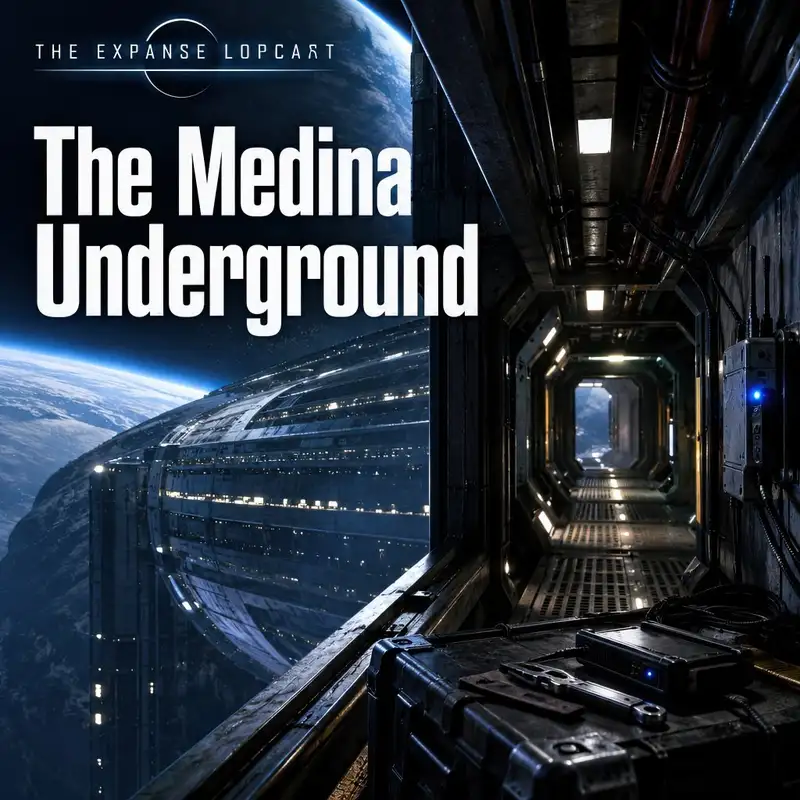
The Medina Underground
Medina Station changed hands quickly, but conquest did not make it simple. Laconian Marines could hold docks, corridors, communications offices, and the formal machinery of government. They could replace flags and issue orders. They could not instantly replace the technicians, traffic controllers, maintenance crews, local relationships, and decades of improvised knowledge that made the station work. The Medina Underground grew inside that gap between occupying a chokepoint and actually understanding the society built around it.
But Medina was not a fortress in the ordinary military sense. It was a living transport system. It needed technicians to keep its machinery working, dock crews to bring ships in safely, traffic controllers to prevent desperate captains from turning a crowded transit hub into wreckage, and residents who understood which systems had been patched, modified, bypassed, or quietly kept alive through decades of improvised use. Laconia could seize the command deck. It could not seize all the knowledge that made the station function. The Medina Underground grew out of that distinction. Its achievement was not to retake the station in open battle. It was to turn an occupied chokepoint into a place of escape, dispersal, and survival.
Medina had begun life as the Nauvoo, a vast generation ship intended to carry a religious community on a voyage beyond the Solar System. That mission ended when the hull was commandeered and converted into the Behemoth, an improvised vessel built to survive the crisis around the Ring. Later, after the Ring gates transformed human geography, the same structure became Medina Station. Its earlier identities mattered. The station had been designed to sustain a large population over long periods. It had been altered for military use, then altered again for traffic control, commerce, governance, and communications.
By the time Laconia returned, roughly three decades after the Free Navy war, Medina was the practical center of the Transport Union’s world. Ships passed through the Ring space and then through individual gates toward more than a thousand human systems. Medina did not rule those systems simply by existing. A colony could be weeks or months from its gate, and still farther from any useful reinforcement. But the station organized traffic, carried messages, regulated movement, and served as the one place where the network’s scattered societies had to acknowledge one another.
That made Medina strategically valuable in a way that was both obvious and misleading. Whoever controlled it could inspect traffic, restrict passage, collect information, and make every government and colony consider the risk of defiance. But the same concentration of routes also made it difficult to occupy. Medina was a hub because people came and went through it. Its workforce was cosmopolitan, mobile, technically skilled, and accustomed to working around distant authorities. The station’s political memory included the Belt’s long experience of being governed by institutions that needed Belter labor while discounting Belter lives.
Laconia understood the first half of that equation very well. It wanted the Ring Network under a single authority. The old order, with Earth, Mars, the Belt, the Transport Union, and independent colonies all bargaining over access, was too fragmented for the empire Duarte had built in secret. Medina would be the handle by which Laconia could grasp humanity’s new frontier. Control the Slow Zone, control the routes between worlds, and opposition would lose much of its strategic depth.
The immediate goal was not merely to replace the Transport Union with a new administrator. Laconia intended to demonstrate that the old political settlement had ended. The Union had been created because no single Inner power could legitimately govern the gates after the Free Navy conflict. Laconia rejected that compromise. It offered order, unity, and security under imperial command. In practice, that meant a Navy capable of enforcing its decisions, Marines capable of taking stations intact, and governors tasked with converting military success into daily obedience.
The first stage went almost exactly as Laconia intended. The Magnetar-class battleship Heart of the Tempest emerged from the Laconia gate with the smaller warship Gathering Storm. The Tempest was not simply a more advanced ship than anything at Medina. It represented an industrial and technological advantage built on Laconia’s access to alien-derived systems and decades of preparation. The defenders possessed fixed railgun emplacements intended to make the Slow Zone dangerous for an attacker. Against ordinary fleets, those defenses mattered. Against the Tempest, they were neutralized before they could become the center of a prolonged engagement.
The Tempest used its magnetic-field weapon to destroy Medina’s defensive railguns and disable the station’s capacity to resist. The details mattered less than the operational result. Laconia did not need to fight a fair battle. It needed to eliminate the defenses that made Medina difficult to seize, then board before the defenders could create a broader political or military response. The attack demonstrated a core truth about fixed defenses. They can be formidable when an enemy must approach within their expected envelope. They become liabilities when the attacker possesses a capability that invalidates the assumptions behind their design.
Tactically, the result was decisive. Medina’s organized defense was broken. The Transport Union could not protect its central station. Laconian Marines occupied the installation, and the Heart of the Tempest moved on to participate in the wider campaign against the old powers of the Solar System. At Medina, Laconia had established physical control over the routes, the official infrastructure, and the visible instruments of authority.
That victory was real. It was not, however, complete. Destroying guns removed one kind of resistance. It did not answer the harder question of how to govern a hostile population living inside a complex industrial habitat. A station cannot be run from checkpoints alone. Air must continue circulating. Water and food must be distributed. Docking schedules must remain intelligible. Repairs must happen before small failures become lethal ones. The occupier can threaten the people who perform those tasks, but threats do not manufacture replacement engineers, traffic coordinators, welders, mechanics, medical staff, and systems specialists overnight.
Santiago Jilie Singh arrived as Laconia’s governor. He possessed formal authority, access to military force, and the prestige of the empire that had taken Medina in a single blow. He did not possess deep experience governing a population that had no reason to trust him. His position was difficult from the start. The Heart of the Tempest was the instrument that had made conquest possible, but it was also needed elsewhere. It departed to support Laconia’s larger campaign. The Gathering Storm remained as the principal local warship, and Laconian security personnel remained to enforce the occupation.
That arrangement exposed the difference between conquest and control. The Tempest could crush fixed defenses. The Gathering Storm could threaten ships and support station security. Neither could place an armed guard beside every airlock, machine bay, maintenance terminal, cargo transfer point, or private conversation. Medina had too many spaces and too many people whose work required access to systems the occupiers did not fully understand. Laconia could see the station’s official maps and procedures. It could not immediately understand the informal network of favors, grudges, family ties, labor loyalties, former OPA connections, and practical habits that allowed Medina’s residents to work around formal authority.
Singh’s administration faced an intelligence problem before it faced a military one. He knew resistance existed. He knew weapons had been hidden, loyalties were uncertain, and the former Transport Union order had not simply vanished because a new flag was hanging over the station. What he did not know was where resistance ended and ordinary civilian life began. In an occupied station, that distinction can become nearly impossible to draw. A person repairing a power relay may also know which security sensors are unreliable. A dockworker may have access to manifests. A traffic controller may notice a patrol pattern. A medic may hear more than any interrogator.
The Medina Underground was not a conventional army. It had no fleet capable of challenging the Heart of the Tempest. It did not hold territory in the normal sense. It could not mass openly, because massing would offer Laconian surveillance and Marines a target. Its strength came from decentralization. It included station residents, people with old Outer Planets Alliance ties, technical workers, sympathizers, prisoners, ship crews, and individuals who had no single ideology beyond the belief that foreign occupation should not be allowed to become permanent.
Saba was one of the important local organizers. In this novel continuity, he was Camina Drummer’s husband, and his connection to the station’s political networks gave the resistance a human anchor. But the Underground was larger than any one leader. It depended on people who could move through Medina without attracting notice, who could recognize the difference between an equipment failure and a deliberate disruption, and who could keep a secret without expecting a complete picture of the larger plan.
That was why the word underground should not be taken too literally. Medina was not a buried city with a single hidden tunnel system beneath an occupying army. The Underground was an organizational condition. It existed in neglected workspaces, closed compartments, unofficial channels, ordinary shifts, and relationships that the Laconian administration could not chart from above. It was hidden because the occupation’s information about the station was incomplete, not because resistance members had discovered a magical invisible realm within the hull.
Its goal was also more limited than romantic language sometimes suggests. The Underground was not planning to liberate Medina by defeating the empire in a climactic fight. It understood the imbalance too well for that. Its objective was to preserve people, ships, intelligence, technical skill, and the ability to resist somewhere else. That may sound like retreat. Militarily, it was a recognition of reality. When a stronger force holds the terrain and can destroy fixed defenses at will, survival can be the only path to future action.
The Rocinante crew became part of this problem after Laconia seized Medina and stripped them of their normal freedom of movement. They were not simply another resistance cell. James Holden carried political significance far beyond the station. He had been central to many earlier crises, and Laconia had a particular interest in his experience with Ring-builder artifacts. That made him useful, visible, and dangerous to keep close. His presence could attract attention that an underground network preferred to avoid.
Meanwhile, Holden helped overcome suspicion. The people already organizing against the occupation had every reason to be cautious around outsiders, particularly famous outsiders. Fame brings allies, but it also brings surveillance, divided loyalties, and people who assume reputation is a substitute for local knowledge. Amos Burton’s contacts and practical manner helped establish communication with Saba’s network. Holden’s willingness to work within a plan that was not his own made it possible for the Rocinante group to become useful rather than disruptive.
Each member of that group brought a capability, but none of them could solve the occupation alone. Naomi Nagata understood ships, station systems, communications, and the fragile relationship between a technical plan and the people required to execute it. Alex Kamal could fly the Rocinante under pressure. Bobbie Draper had the combat judgment to recognize what a boarding action required and what it could not accomplish. Amos understood machinery, violence, and the unglamorous work of getting through a dangerous physical space. Clarissa Mao carried technical skill and the implanted combat modifications that had already extracted a terrible price from her body.
The resistance needed those abilities because escape from Medina was not a matter of opening a hatch and accelerating away. The gates made the station a central transit point, but they also made it a place where traffic could be controlled, watched, delayed, or trapped. A ship leaving in isolation might be identified and pursued. A large group moving without coordination might collide, reveal the plan, or create a bottleneck that Laconia could exploit. The operation would require timing, pilots, dock access, ships with sufficient supplies, routing decisions, communications discipline, and a way to confuse the systems designed to track departures.
Before they could act, the Underground needed information. It found an advantage not by defeating Laconian sensors, but by listening. A passive signal sniffer was installed on the data connection between Medina and the Gathering Storm. The device did not break Laconian encryption or provide a neat window into every imperial decision. It collected traffic. It revealed patterns, timing, and the fact that the occupiers had to communicate and coordinate just as everyone else did.
Passive intelligence collection mattered because it reduced the Underground’s own exposure. An active transmitter can give away position, intent, and association. A resistance group under occupation cannot casually conduct an emissions contest against a superior military force. But an occupier still generates information whenever it moves personnel, changes schedules, requests support, warns a ship, or prepares for an incoming asset. The Underground did not gain omniscience. It gained warning. In a struggle where the weaker side needed only one opening, warning was enough to reshape its options.
The most important warning concerned the Eye of the Typhoon, another advanced Laconian warship expected to arrive at Medina. The approach of a second capital asset did not mean the Underground knew every detail of Laconia’s intentions. It meant that the occupation was about to become harder to disrupt and escape from. The Gathering Storm was dangerous, but it was also one ship whose position, communications, and relationship to the station could be studied. Another major warship would expand Laconia’s surveillance, firepower, and ability to intercept fleeing vessels.
The resistance therefore had a limited window. It had to act before Laconia could thicken its local control beyond the point where a mass departure was possible. This was not a question of courage alone. It was a scheduling problem under occupation. Every day spent preparing improved the plan, but every day also increased the chance of discovery, arrest, equipment failure, or the arrival of reinforcements. Underground movements often live inside that tension. Move too early, and the plan is weak. Wait too long, and the opportunity disappears.
Singh’s response to resistance made the situation worse. He began with the language of orderly government. Laconia would restore security. The station would function. Those who obeyed would have little to fear. This was a familiar occupation promise. It depended on the assumption that most people wanted stability more than they resented the change in authority. For some residents, exhausted by uncertainty and wary of more violence, that may have been true. But stability offered at the point of a rifle is fragile when the new authority cannot distinguish cooperation from submission.
As attacks, sabotage, and unrest continued, Singh escalated. Curfews, censorship, weapons sweeps, arrests, interrogation, surveillance, and collective suspicion became tools of administration. Each measure had a short-term logic. A curfew could limit movement. A weapons search could recover arms. Arrests could disrupt a known network. Surveillance could identify contacts. But each also imposed costs on a station population already living under foreign military rule. Every inspection delayed work. Every arbitrary detention created fear and resentment. Every official lie or humiliating search taught residents that the administration saw them as a threat rather than as people whose cooperation it required.
This was not simply a story of an inexperienced governor making foolish decisions. Singh’s errors reflected a larger institutional weakness. Laconia’s military system had trained its people for discipline, secrecy, preparation, and decisive action. Those qualities had helped produce an extraordinary opening victory. But an occupied society does not reveal its loyalties in clean military formations. A person may comply because they need to keep their family supplied with air and food. Another may cooperate publicly while quietly helping the resistance. A third may resent the Underground’s risks while still refusing to inform for the occupiers.
Singh treated resistance as a discrete criminal organization that could be located, identified, and removed. In reality, the Underground drew strength from a political condition. Medina’s residents understood that the empire needed their labor. They also understood that Laconia’s claims of unity had arrived through the destruction of their defenses and the displacement of their government. Weapons seizures and arrests could identify some genuine threats. They could also enlarge the number of people with personal reasons to hide information, evade patrols, or help someone disappear.
The civilian burden was constant. Someone still had to maintain life support. Someone still had to run traffic. Someone still had to repair damage and distribute supplies. The same people were expected to perform those tasks while accepting that their workspaces, homes, and private communications might be searched at any moment. Occupation often depends on this contradiction. The ruler demands perfect order from a population treated as permanently suspect. The more coercion expands, the more the ruler must rely on people who have learned that obedience offers neither dignity nor safety.
The Underground’s escape plan used that contradiction. It did not concentrate its forces for a battle against the station. It created too many problems for Laconian security to solve at once. Saba’s people would release prisoners, forcing guards and administrators to respond to a sudden expansion of disorder. Prisoners released into a tense station were not merely bodies in motion. They created uncertainty. Were they armed? Were they part of the plan? Which sectors were compromised? Which reports were real? In a security crisis, uncertainty consumes command attention faster than ammunition.
Meanwhile, Naomi and Clarissa worked to disrupt Medina’s sensors and tracking systems. Their task was not to make ships invisible forever. That was impossible. The goal was more practical. If the occupation could not accurately identify every departure, connect each vessel to a known resistance member, and build a reliable pursuit picture, then the escaping ships might gain enough confusion to scatter through different gates. In a network built around transit control, temporary uncertainty could have strategic value.
Alex would use the Rocinante to create pressure against the Gathering Storm. The Rocinante was not expected to destroy a Laconian warship through force of personality or heroic optimism. Its role was to complicate the local tactical picture. A warship facing a credible threat must maneuver, track targets, protect itself, and decide which danger matters first. That creates openings for other actions. The plan was not a duel for honor. It was an effort to pull the occupier’s attention and resources away from the escaping ships.
Bobbie, Amos, and their Belter allies would board the Gathering Storm. Boarding was always an ugly form of combat. It required getting close enough to a hostile ship, controlling relative motion, breaching a pressure vessel full of defenders, and fighting in spaces where every damaged system could become a hazard. The objective was not simply to kill enemy personnel. It was to seize a ship that represented local Laconian combat power and prevent it from stopping the dispersal.
The larger movement would involve civilian and resistance-linked ships departing through different gates. Dispersion was central to the plan. A single convoy might be easier to defend against ordinary piracy, but against a superior military power it also becomes a single target. Many vessels leaving by multiple routes forced Laconia to choose. Pursue whom? Search where? Assume which ship carries the leaders, the intelligence, the technicians, or the future command structure? The Underground was using Medina’s centrality against its occupiers. The hub that Laconia hoped to use for control became a point from which resistance could scatter beyond easy reach.
This was an evacuation under hostile control, not a conventional fleet victory. Its logistics were as important as its firefights. Ships needed functioning drives, supplies, crews, clear access to docking areas, and routes that could be used before Laconian systems recovered. Pilots needed enough information to leave without turning the station’s traffic lanes into chaos. Communications had to be sufficient for coordination, but limited enough to avoid exposing the whole plan. The people preparing the escape were not operating in a clean command environment. They were working in a station where every routine action could be watched.
Then Jordao betrayed the plan. Betrayal is a permanent danger in clandestine organizations, especially under pressure. It should not be read as proof that resistance movements are inherently unreliable or corrupt. Underground networks survive by compartmentalizing information. That protects them when someone is captured, frightened, bribed, or turned. But compartmentalization also limits trust. People do not know the whole plan. Leaders cannot always verify every loyalty. A movement built from civilians, workers, prisoners, old political networks, and displaced crews will always contain people with different fears and different breaking points.
The betrayal led to an ambush that threatened Naomi and Clarissa. Clarissa responded with the implanted combat modifications that had shaped so much of her life. Those modifications gave her bursts of physical capability beyond what an ordinary human body could sustain. They also carried a brutal cost. Her body had never escaped the consequences of the coercive experimentation and violence that had made those abilities possible. The implants were not a gift. They were an injury that could sometimes be turned into a weapon.
Clarissa’s final action was not a triumphant display of superhuman strength. It was the death of a person who had spent years living with damage, guilt, and the effort to become more than the worst thing she had done. In the immediate moment, she protected Naomi and kept the operation from collapsing around them. But the cost was final. The Underground’s escape preserved lives and capabilities, yet it did not do so without loss. Resistance is often described in abstractions like morale, legitimacy, and strategic depth. Those words can conceal the fact that survival frequently depends on someone paying a price they cannot survive.
The broader operation succeeded because Laconian control fractured under simultaneous demands. Prisoners were released. Sensors and tracking were disrupted. The Gathering Storm was drawn into combat and then boarded. Ships began departing through different gates. The occupation had enough force to dominate individual encounters, but not enough time, local knowledge, or command capacity to resolve every crisis at once. That was the Underground’s operational insight. It did not have to defeat Laconia everywhere. It needed to make Laconia briefly unable to control the one moment that mattered.
About twenty ships escaped in the confusion, carrying people who could become the nucleus of continued resistance. The Gathering Storm was captured. That was a major material gain, though it did not suddenly equalize the balance between the Underground and the empire. The ship had to be concealed, maintained, supplied, and crewed. Capturing a warship is not the same as possessing a sustainable navy. Still, it denied Laconia a local asset and gave the resistance something rare: a capable vessel built by the enemy’s own industrial system.
Holden did not escape. Laconia captured him and sent him toward Laconia itself, where his knowledge and experience with Ring-builder technology made him strategically valuable. His capture was a severe loss. It also demonstrated the limits of the operation. The Underground could create a corridor of escape. It could not guarantee the survival of every person it valued. Naomi and Alex would later hide with the Rocinante on Freehold. Bobbie, Amos, and their allies would conceal the captured Gathering Storm near another colony. The resistance survived by dispersing, not by remaining together under a single banner.
Medina, meanwhile, remained under Laconian control. That point matters. The Underground did not liberate the station. The empire retained the physical chokepoint, the official administration, and the ability to regulate much of the traffic through the Ring Network. Tactically, the resistance won local actions and created enough confusion to escape. Operationally, it preserved trained people, ships, information, and the capacity to organize elsewhere. Strategically, Laconia still held the hub, but it failed to destroy the opposition that hub was meant to contain.
Politically, the escape damaged the occupation’s credibility. Laconia had promised control and demonstrated unmatched military power. Yet a decentralized network inside its most important captured station had removed people, vessels, and expertise from under its nose. The lesson was not that Laconia had become weak. It had not. The lesson was that superiority in weapons does not automatically produce reliable governance. The empire could seize a station, but it could not immediately replace the social systems that allowed the station to operate, communicate, and resist.
Singh reacted to the escape with a desire for collective punishment. His response revealed how completely the occupation had become detached from the population it was trying to govern. When a governor sees an entire civilian society as an enemy reservoir, the temptation is to inflict enough fear that future resistance seems impossible. But on Medina, such punishment would have been self-defeating even by the empire’s own harsh logic. The people threatened with punishment were not outside the station’s life-support system. They were the people who maintained it.
Major Overstreet refused to carry out Singh’s most extreme order. Under standing Laconian safeguards, he killed the governor rather than allow him to turn the counterinsurgency into indiscriminate slaughter. That action should not be mistaken for evidence that Laconia was a liberal or humane government. The empire remained authoritarian. It had conquered Medina by force, displaced its institutions, censored its people, arrested opponents, and used coercion as the foundation of rule.
What Overstreet’s action demonstrated was narrower and colder. Laconia understood that an occupation can destroy itself through uncontrolled brutality. An empire that wants to rule must preserve enough population, infrastructure, and administrative credibility to make rule possible. The safeguard was designed to protect the occupation’s function and the empire’s authority, not to recognize the political rights of Medina’s residents. It was restraint in service of domination.
The Medina Underground never had to prove that occupation was unreal. It had to prove that occupation was incomplete. By moving people, knowledge, ships, and trust beyond Laconia’s immediate reach, the resistance transferred its center of gravity away from a station the empire could hold. Medina could be conquered and later destroyed, yet the relationships built inside it could survive both outcomes. Territory was lost. The capacity to resist was not.