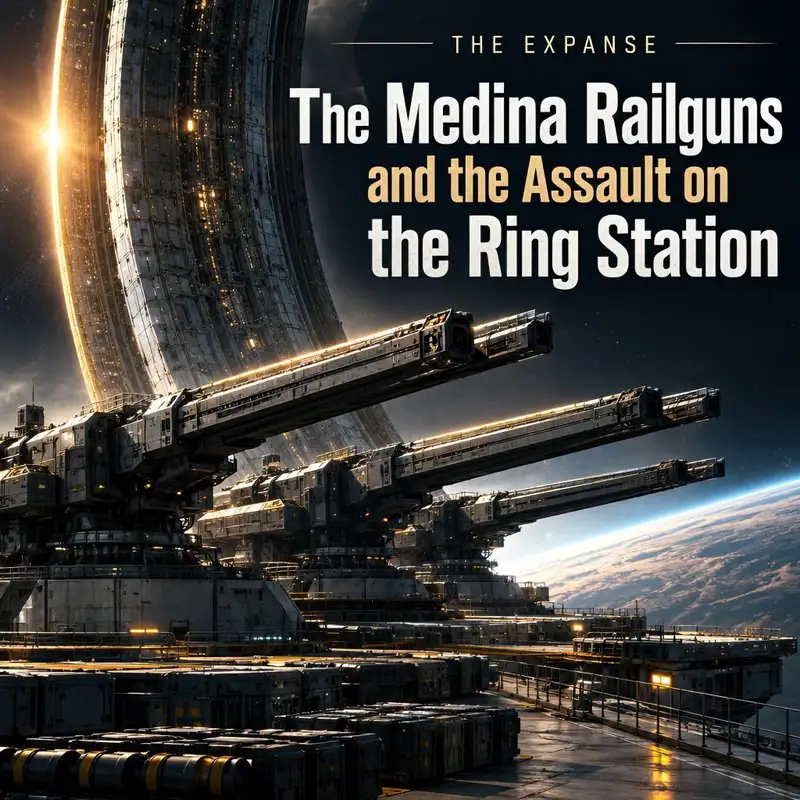
The Medina Railguns and the Assault on the Ring Station
A ship coming through the Sol Ring did not arrive in open water. It arrived in a firing lane. The moment of transit placed it in the Slow Zone, close enough to the alien Ring Station that a prepared defender could see it, identify it as hostile, and put a railgun round through it before its crew had time to understand the geometry around them. The ship would still be moving. It would still need to orient itself. It would still need time to bring up sensors, establish communications, and decide whether to accelerate, evade, or fire. The defender needed none of that time. The guns were already there.
That was the operational contradiction facing the coalition against Marco Inaros. Medina Station was the prize, but the route to Medina was also the fortress’s killing ground. Sending more ships did not solve the problem. More ships would simply emerge through the same gate, in the same vulnerable condition, and present the defenders with more targets. A direct assault by a conventional fleet was more than dangerous. It appeared to be a method for delivering warships into an execution chamber.
Medina was the human station at the center of the crisis, but the heavy railguns were mounted on or around the alien Ring Station nearby. The shorthand 'Medina's railguns' described the political objective, not the physical structure. The Free Navy held the human hub and used weapons positioned around alien infrastructure to turn the fixed exit geometry of gate transit into a lethal chokepoint.
The railguns did not need to control every corner of the Slow Zone. They did not need to defeat every conceivable fleet formation. Their purpose was narrower and more effective than that. They had to dominate the first moments after hostile ships passed through the Sol gate. Gate transit created predictability. A ship could choose its burn profile before arrival. It could prepare its crew. It could carry weapons, troops, and clever plans. But it could not choose a different exit point. It emerged where the gate put it.
Fixed defenses are often dismissed as inflexible. In ordinary circumstances, that criticism is fair. A fixed gun cannot pursue an enemy, withdraw from danger, or appear unexpectedly somewhere else. But a fixed defense becomes formidable when geography forces the enemy to come to it. A harbor battery can command a channel. A minefield can close a strait. A fortress can dominate a mountain pass. The Ring Station railguns performed that old military function in a new environment. The Sol Ring was not a road, but it was a doorway. The guns watched the doorway.
Medina mattered because the Ring network had changed the map of human civilization. The gates opened routes to more than a thousand systems, but those routes converged through the Slow Zone. Every colony ship, trade vessel, scientific expedition, relief convoy, military force, and political delegation moving between systems had to pass through that central space. The gates did not remove distance within each solar system. A ship still had to travel from a gate to a planet, moon, station, or settlement under conventional propulsion. But the hub controlled access to the interstellar road network. Whoever held Medina could influence who moved, what moved, and under what terms.
That was more than a military advantage. It was economic leverage, political leverage, and symbolic leverage. A government that could regulate Ring traffic could shape colony development, control trade, restrict rivals, and decide which communities received help or remained isolated. It could influence the flow of machinery, seed stock, medicine, people, weapons, and information. In a civilization that had suddenly gained access to hundreds of new worlds, Medina was not just a station at a crossroads. It was the customs office, port authority, communications node, and strategic capital of the frontier.
It was also a place where people lived and worked. Medina required technicians to keep its systems functioning, crews to maintain docks and traffic lanes, workers to repair machinery, and administrators to keep a fragile human settlement operating in an alien environment. The station’s residents did not experience the Free Navy’s control or the coalition assault as abstract arguments about strategic geography. They experienced them through work orders, security rules, access restrictions, shortages, uncertainty, and the persistent concern that somebody else’s military decision might damage the systems keeping them alive.
Marco Inaros understood Medina’s political value. His movement had used the destruction of Earth and the wider chaos of the Free Navy conflict to challenge the old balance of power between Earth, Mars, and the Belt. Control of the Ring network let him do more than threaten his enemies. It let him isolate them. If the coalition could not safely reach Medina, it could not reliably communicate its power into the colony systems. It could not protect trade. It could not credibly promise that Marco’s control was temporary. The Free Navy did not need to conquer every colony directly if it could dominate the routes that connected them.
Yet Marco’s hold on Medina also revealed a weakness inside the apparent strength of the Free Navy. The railgun defenses were more than the product of Belt industry or Free Navy improvisation. They depended on aid from the separate Martian breakaway associated with Winston Duarte and the emerging project on Laconia. The arrival of the Proteus, the first ship built in the Laconia system, demonstrated that this was more than a black-market transaction. A new military-industrial power was preparing itself beyond the gates.
That did not mean Marco and Duarte shared one political program. They did not. Marco needed weapons, support, and strategic leverage against the Inner planets. Duarte and his followers had their own ambitions, their own secrecy, and their own long-term interests. Their relationship was useful precisely because each side believed it could gain from the other without surrendering control. Such arrangements are common in war. They are also dangerous. The supplier gains influence. The recipient gains capability. Neither necessarily understands what the other intends to do once the immediate crisis has passed.
The railguns were evidence of that arrangement. They gave the Free Navy a weapon system that transformed the tactical balance in the Slow Zone. A direct Martian challenge to Medina demonstrated the danger. Ships emerging through the gate could be destroyed before they formed a coherent attack, before they could spread out, and before their commanders could establish the kind of maneuver space that naval combat normally requires. The lesson was clear enough even without precise technical figures. The guns could kill ships at the moment when those ships were least capable of saving themselves.
A railgun is a kinetic weapon. It does not need an explosive warhead to be devastating. It launches a projectile at enormous velocity, and its effectiveness depends on fire control, timing, trajectory, and the target’s inability to move out of the path in time. In open space, a target that detects the shot early enough may maneuver. A ship may change its vector, alter its orientation, deploy countermeasures, or use the geometry of the engagement to reduce the attacker’s chance of a hit. But a vessel emerging from a Ring gate had very little room for such choices. Its position was known. Its situation was constrained. The defenders had prepared for exactly that moment.
This did not make the guns magical, and it did not make them invulnerable. They still depended on sensors to identify threats, communications to coordinate the defense, power to operate, crews or support personnel to maintain them, and a workable firing solution. They were fixed in place. They could not just relocate if an attacker found a weak approach. They could not board an enemy vessel, inspect a suspicious contact, or occupy a station. Most important, they could not fire without regard for what lay beyond the target. A railgun round follows a line. In a crowded tactical environment, that line can pass through something the defender needs to preserve.
The coalition’s problem, then, was not how to win a fair artillery duel with the Ring Station. It was how to make the duel unfair. The railguns were optimized against a particular kind of attack: warships arriving through the gate in recognizable formations, attempting to survive long enough to maneuver and fight. The coalition needed to present a different problem. It needed to deny the defenders a clean target set, overload their ability to distinguish important contacts from expendable ones, and get a small assault force through the killing zone.
That required a coalition, and the word should not be mistaken for harmony. Earth, Mars, and the surviving factions of the Outer Planets Alliance had powerful reasons to oppose Marco. They also had reasons to distrust one another. Earth had been devastated and was struggling to survive. Mars was politically shaken, militarily divided, and still reeling from the loss of personnel and equipment to the Laconian breakaway. Belter factions had their own grievances, their own constituencies, and their own memories of Inner exploitation. Many opposed Marco without agreeing on what should replace him.
Chrisjen Avasarala’s strategic task was therefore more difficult than simply gathering ships under one flag. She had to build enough cooperation to strike at the Free Navy while concealing the operation that mattered most. The coalition needed Marco to believe that it was reacting broadly to his dispersed forces, fighting for surviving stations, supply routes, and political influence across the Solar System. Those wider operations were not a distraction from the Medina assault. They were part of its camouflage. A deception works best when the enemy can see real threats elsewhere.
This was an intelligence contest as much as a naval one. The coalition correctly identified Medina as the center of gravity. Marco’s fleet could raid, threaten, and disrupt, but control of the gate hub gave his movement strategic reach. At the same time, the coalition understood that it could not openly assemble a conventional invasion force and hope that secrecy would survive. Too many ships moving toward the Sol Ring would announce the objective. Too many preparations would produce too many messages, manifests, crews, maintenance requests, fuel transfers, and opportunities for information to leak.
The decisive force therefore had to be small enough to conceal inside the larger pattern of coalition activity. It would not look like a grand battle fleet. It would look, at least in part, like logistics. That was appropriate. In the Expanse, logistics was often the hidden form of strategy. Warships attracted attention. Cargo hulls moved the things that made warships useful. They carried fuel, parts, food, ammunition, repair equipment, troops, and, in this case, the material of deception.
The Rocinante was central to the assault, but not because one small warship could overpower the Ring Station. The Rocinante brought combat capability, experienced personnel, command discipline, and a crew trusted by more factions than most military units in the conflict. It could escort the operation, coordinate action under pressure, and provide a recognizable political voice once the defenders were forced to consider surrender. But it was not a battleship designed to trade shots with a fixed railgun array. Its strength lay in being part of a plan that did not ask it to do the impossible.
The other essential vessel was the Giambattista, an ice hauler repurposed for war. That choice captured the logic of the operation. The Giambattista was not valuable because it could win a gunfight. It was valuable because it had volume, carrying capacity, and the practical usefulness of a logistics hull. It could transport the small craft, assault teams, equipment, and expendable material required to turn the defenders’ firing problem into chaos. An ice hauler was built to move mass. The coalition used that mass as a weapon.
The operation’s decoys were not glamorous. They were small craft and vehicles sent through the gate in a swarm. Their purpose was not to defeat the railguns through firepower. Their purpose was to force choices. Every contact demanded attention. Every apparent attacker had to be classified, tracked, and prioritized. Which one carried troops? Which one carried explosives? Which one was merely empty mass? Which one was heading toward the station? Which one was a threat to the guns? Which one was trying to draw fire away from the real assault element?
The decoys were expendable, but they were not free. Somebody had to build or assemble them. Somebody had to load them, maintain launch systems, calculate their trajectories, and accept that much of the material would be lost. The Giambattista had to carry them. The operation had to provide enough reaction mass, enough crew support, enough communications planning, and enough timing precision to make the swarm credible. Even disposable equipment represents industrial capacity. A force capable of wasting material on deception has already solved a substantial logistical problem.
The swarm also created hazards for the attackers. A cloud of small craft in the confined geometry around Medina could become debris. Wreckage could threaten friendly vehicles, damage station infrastructure, or complicate later movement. A plan built around confusion can easily confuse its own side. The coalition had to control enough of the operation to ensure that the decoys created a temporary tactical problem for the defenders without creating a permanent disaster for the station it hoped to capture.
The other part of the plan was geometry. The Rocinante and the Giambattista did not become invisible. They did not acquire a shield. They used the presence of Medina itself to complicate the defenders’ firing solutions. A railgun projectile that missed, or that passed through an attacking craft, could continue toward the station. That mattered because the Free Navy’s mission was more than to destroy every hostile contact. It was to hold Medina. The station was its political prize, its transit hub, its workplace, and its base of authority. Destroying it in the course of defending it would be a peculiar kind of success.
This is where fixed defenses reveal a recurring dilemma. A weapon can be extremely effective along a clean line of fire. It becomes harder to use when friendlies, civilians, infrastructure, or politically important assets occupy the same space. The railguns could kill ships entering through the Sol gate. They could not fire carelessly through Medina. The coalition did not need to prove that the guns were weak. It needed to place the defenders in a situation where using their strength risked destroying what that strength was supposed to protect.
For the people aboard Medina, this restraint was not an abstract tactical calculation. A station hit by a high-velocity projectile could suffer damage far beyond the immediate point of impact. Hull breaches, shattered equipment, severed power or data systems, casualties among workers, and damage to life support could all follow. The defenders could not assume that every compartment was empty, every system redundant, or every civilian safely out of the way. A fortress in space is also a pressure vessel. Its commander has to think about the people inside it.
The decoy swarm arrived and transformed the defenders’ problem. The railgun crews saw what appeared to be a mass attack. From their perspective, responding made sense. The defense had been designed to stop intruders coming through the gate, and now the gate was producing a flood of incoming craft. The mistake was not simple incompetence. The garrison was reacting to the threat it believed it faced, using the system available to it. The failure lay in the mismatch between the defense’s assumptions and the attackers’ method.
A choke-point defense works best when it can identify the enemy’s valuable assets faster than the enemy can pass through the choke point. The coalition broke that relationship. It diluted the value of each target. A railgun round spent on a decoy did not stop an assault craft. A moment spent tracking one contact was a moment not spent understanding another. A gun crew facing a handful of warships can assign priorities. A gun crew facing a swarm of uncertain contacts must make judgments under pressure, with incomplete information and little time to recover from an error.
The assault was not invisible within the swarm. It did not need to be. It needed to survive long enough to reach the emplacements. That was a lower standard, but still a difficult one. Once the first assault elements got close, the character of the battle changed. The decisive contest was no longer between fleets at range. It became a close operation against hardened infrastructure, defended by people who understood what they were protecting.
Bobbie Draper led the critical assault element. In the novel continuity, she was a former Martian marine whose experience had taught her the practical realities of combat in pressure suits, armor, confined spaces, and environments where a damaged wall could be as dangerous as an enemy weapon. Amos Burton was part of the assault as well, bringing his own experience with violence and survival. But this was not a story of two individuals defeating a fortress through personal toughness. Their presence mattered because the larger coalition plan had put them in a position where close combat could decide the result.
The defenders were more than Free Navy technicians improvising around alien equipment. The assault teams encountered disciplined Martian personnel associated with Duarte’s faction. That fact changed the character of the fight. The coalition was not attacking a poorly guarded power station. It was attacking a defended military installation whose personnel understood weapons, security, and the value of the system under their control. The railgun array had human vulnerabilities, but those vulnerabilities were protected by trained people.
That is why the assault could not be reduced to a matter of reaching a switch and turning it off. Infrastructure has layers of defense. It has barriers, access controls, protected equipment, people with weapons, and operators who may destroy their own systems before allowing them to be captured. The assault force had to move through a hostile environment where the objective was more than to survive but to prevent the railguns from continuing to function. Time mattered. Every minute the guns remained active was another minute in which the coalition’s entry force could be destroyed or trapped.
Bobbie recognized the critical fact. Capturing the railguns intact was no longer a reasonable objective. A seizure operation requires time, control, specialists, and enough security to prevent defenders from retaking or sabotaging the installation. It requires the attackers to understand the system well enough to operate it safely. None of those conditions existed. The weapons were alien-adjacent defenses supported by a faction whose technical preparation exceeded the coalition’s immediate knowledge. Trying to preserve them would turn a raid into an extended battle under conditions favorable to the defenders.
The mission therefore changed from seizure to destruction. That was not a failure of imagination. It was operational judgment. Military forces often prefer to capture useful equipment intact, especially when the equipment is advanced and difficult to replace. But a weapon system that cannot be secured quickly is not an asset. It is a continuing threat. In this case, disabling the railguns mattered more than understanding them, more than salvaging them, and more than claiming the prestige of taking them undamaged.
Bobbie used a landing craft in a deliberate one-way attack on the power complex supporting the guns. She and the others ejected before impact. The essential effect was straightforward. The railguns lost the power they required to operate. The details of the facility, its exact internal design, and the scale of its destruction matter less than the decision behind the strike. The coalition did not need to destroy every gun barrel individually. It needed to break the system that allowed the guns to function as a coordinated defense.
This was the decisive moment of the operation. Tactically, the railguns went silent. Operationally, the Sol gate became passable for coalition forces. Strategically, the Free Navy could no longer enforce its control of Ring transit by threatening to kill incoming ships at the gate. The destruction of the power source did not solve every problem in the Slow Zone, but it removed the weapon that had made a direct approach appear suicidal.
The decision also demonstrated the difference between possessing a weapon and controlling the conditions that make it useful. The Free Navy had advanced guns, favorable terrain, and a prepared defensive position. It did not have an all-purpose fortress. It had a system that depended on assumptions about how an enemy would attack. Once the coalition broke those assumptions, the railguns became only one part of a larger, more vulnerable installation.
With the guns disabled, the coalition still had to take Medina. This was where James Holden’s role mattered. The Rocinante had survived the approach and provided more than firepower. It provided command presence and a channel for communication. Holden was not universally trusted, and no figure in the conflict could claim that distinction. But he had credibility across political lines that few commanders possessed. Earth, Mars, and many Belter factions knew him. They knew he was more than an officer carrying out the policy of one government. That made him useful in a moment when military success had to become political compliance.
Medina’s commander, Christina Huang Samuels, faced a changed situation. The railguns that had made the station defensible were gone. The coalition’s forces had entered Ring space. The apparent scale of the attack, combined with the broader coalition offensive, made resistance look increasingly futile. Surrender was not automatic, and it was not necessarily an act of cowardice. It was a decision made under the reality that a prolonged battle could destroy the station, kill its inhabitants, and leave no meaningful military objective intact.
A commander responsible for a habitat has obligations different from those of a commander defending an empty fortification. Medina could not just be fought over until one side ran out of ammunition. Its docks, systems, workers, and residents were part of the prize. The coalition’s ability to offer surrender, and to make that offer credible, gave Samuels a path that preserved lives and infrastructure. The alternative was a station battle in which pressure loss, fires, damaged machinery, and panic might do as much harm as gunfire.
The coalition’s victory at Medina was therefore military and political at once. The decoys and assault teams had disabled the defense. But the operation succeeded fully only because the garrison decided not to turn the station into a wreck. Holden’s communication mattered because it helped transform a breach into a transfer of control. A warship can force a surrender only when the defeated side believes that surrender offers a better future than continued resistance. In Medina’s case, the survival of the station itself gave that calculation weight.
But taking the hub did not end the Free Navy conflict. In some respects, it created the next crisis immediately. The destroyed railguns had protected Medina from attack. Once they were gone, the coalition inherited an exposed station in the middle of the Slow Zone. Marco could no longer use the guns to bar entry, but he could still send forces toward Medina. The coalition had opened the door. It now had to hold the room on the other side.
This was the enduring limitation of the assault. Tactical success meant the railguns were disabled. Operational success meant coalition forces entered Ring space and seized Medina. Strategic success meant Marco lost exclusive control over the network’s central transit point. But political success required something harder. The coalition had to decide how Medina would be governed, how Ring traffic would be regulated, how former enemies would be treated, and how the new authority would gain legitimacy among populations that had learned to distrust distant powers.
The station also had to keep functioning. Somebody had to maintain life support, organize traffic, repair damage, feed residents, manage docks, and prevent the newly captured hub from becoming another source of coercion. The coalition could not just replace a Free Navy flag with its own and declare the problem solved. Medina’s workers, residents, visitors, and technical systems would determine whether the victory could endure. A military occupation can seize infrastructure. It cannot make that infrastructure legitimate, safe, or productive by command alone.
The Medina assault succeeded because the coalition understood what the railguns really were. They were not an all-purpose fortress. They were a lethal answer to one predictable problem: hostile ships emerging through a gate. By using diversion, decoys, careful geometry, infiltration, and the destruction of the power system, the coalition forced the defenders into a different kind of war. But breaking the chokepoint only opened the harder task ahead: defending, supplying, and legitimately governing the infrastructure on which the new human frontier depended.