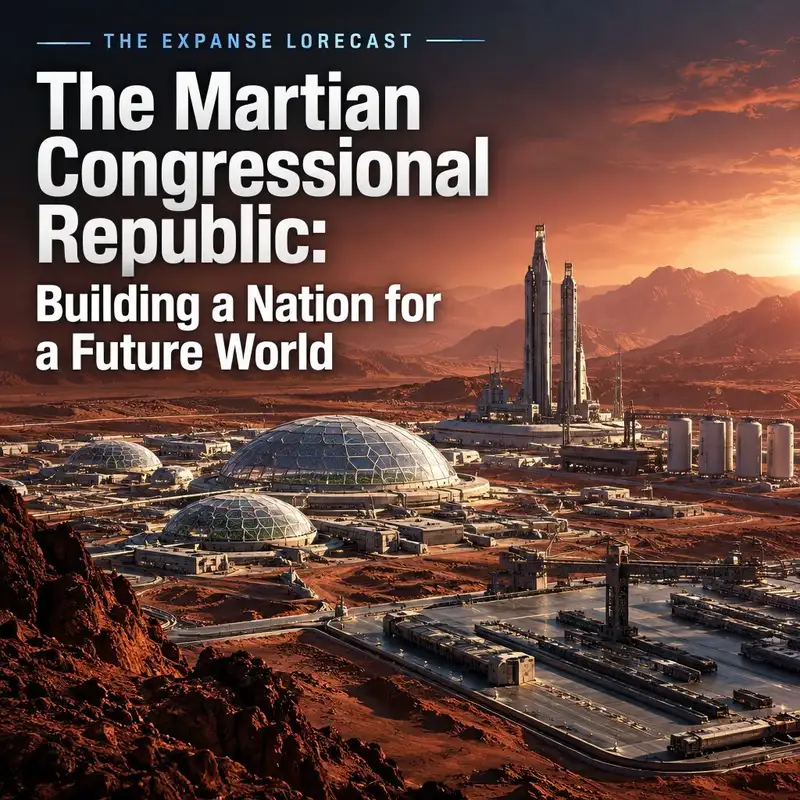
The Martian Congressional Republic: Building a Nation for a Future World
For generations, Martians lived inside a promise. Beneath sealed domes, in pressurized corridors, and under skies that could kill an unprotected person in minutes, they invested in a future Mars that none of them expected to see completed. The reward was not comfort in the present. It was a blue-and-green world, with open water, breathable air, and a human civilization no longer dependent on machinery for every breath. Mars built a nation around deferred reward. That was its great strength. It gave engineers, teachers, soldiers, miners, families, and administrators a common destination. It also created a dangerous dependency. When humanity later found thousands of new worlds beyond the Ring gates, Mars faced a question no military doctrine could solve. Why spend generations remaking one difficult planet when another future might be only one gate transit away?
Mars began as an Earth colony, but it could not remain a simple extension of Earth indefinitely. Distance made that impossible in more ways than one. A government on Earth could issue orders, collect revenue, and claim legal authority, but it could not instantly solve a Martian emergency. Messages crossed interplanetary distances at the speed of light. Ships required time, fuel, reaction mass, trained crews, and carefully planned trajectories. Reinforcements sent from Earth would arrive after delays measured in days or longer, depending on the positions of the planets. A distant colony could be supervised. It could not be managed as if it were a province across an ocean.
The environmental reality made the political problem sharper. Mars was not a place where settlers could simply arrive, build homes, and allow ordinary economic life to take over. Every habitat depended on systems that had to work. Air had to be recycled. Water had to be protected. Food had to be grown, imported, or processed. Pressure seals, power systems, medical care, transport, and maintenance were not luxuries. They were the conditions of survival. A colony making that kind of permanent investment needed confidence that its future would not remain subordinate to priorities set on another planet.
Earth itself was not a single actor. The United Nations government, corporations, military institutions, and Earth’s enormous civilian population did not necessarily want the same things. But from Mars, the distinction could be less important than the practical fact of dependency. Martian settlers were expected to build a world under conditions of extraordinary risk while ultimate sovereignty remained elsewhere. That arrangement could function only as long as Martians believed their sacrifices served a future they could control. Once that belief weakened, colonial administration became politically unstable.
The decisive shift came through propulsion. Solomon Epstein was a Martian engineer working on a drive modification when he discovered a way to make fusion propulsion far more efficient and sustained than the systems available before it. The result became known as the Epstein drive. Its importance was not that it made space travel effortless. It did not. Ships still needed reaction mass. Crews still had to endure acceleration. Routes still depended on orbital mechanics, braking, and timing. A vessel could not simply point toward a destination and arrive whenever its captain preferred.
What the drive changed was the practical scale of interplanetary movement. It made long burns more useful, sustained acceleration more achievable, and travel through the Solar System more economically and militarily significant. Commerce could expand. Mining operations could reach farther into the outer system. Warships could patrol and respond across distances that had previously imposed much harsher limits. A colony with access to that technology possessed more than an engineering advantage. It had leverage.
The details of the negotiations between Earth and Mars are not fully preserved in the historical record. The broad result is clear enough. Mars gained independence and shared the Epstein drive technology, avoiding an Earth-Mars war that would have been costly, uncertain, and destructive for both sides. This was not merely a bargain over a machine. It was a recognition that Mars had become too strategically important, and potentially too expensive to coerce, to remain a colony in the old sense.
The exchange also reshaped the Solar System. The drive opened the way for faster growth beyond Mars, including the expansion of mining, shipping, and settlement throughout the Belt and outer planets. But mobility did not create equality. The same transportation revolution that gave Mars the means to negotiate independence also made possible a wider economy in which workers far from Earth and Mars could be exposed to extreme risk while remaining dependent on Inner-controlled markets, shipping routes, finance, and political decisions.
Martian independence created the Martian Congressional Republic, a sovereign state with civilian institutions, technical agencies, political structures, and armed services. The novels do not provide a complete constitutional chart, and there is no reason to invent one. What matters is the state’s governing logic. Mars had to build durable institutions because it was trying to do something no short-lived administration could complete. Terraforming demanded continuity across generations. Defense required professional forces. Industry needed skilled labor. Research needed public investment and stable planning. The republic’s legitimacy rested on proving that Martians could govern themselves well enough to keep that immense project moving forward.
Earth remained much larger in population and aggregate resources. Mars could not expect to match the United Nations ship for ship, factory for factory, or person for person. Its strategic answer was specialization. Mars invested in technical sophistication, disciplined personnel, readiness, and the ability to make aggression expensive. It did not need to conquer Earth. It needed to convince Earth that attempting to conquer Mars would cost too much and solve too little.
Interplanetary geography assisted this deterrent strategy. Mars was difficult to invade because any attacking force had to cross vast distances, expose itself in transit, preserve enough supply to continue operations after arrival, and then somehow sustain control over a hostile planet. But distance cut both ways. Mars could not ignore its own vulnerabilities. It depended on shipping, industrial infrastructure, trained workers, and access to materials moving through a system it did not entirely control. A navy could defend routes and deter rivals, but no fleet made Mars self-sufficient in every respect.
The Martian Congressional Republic Navy therefore served several purposes at once. It was an instrument of national defense. It protected Martian strategic interests beyond the planet itself. It provided deterrence against Earth. It safeguarded transport and helped preserve Mars’s status as an independent power. It also became a visible symbol of the republic’s competence. A modern warship was not just a weapon. It was evidence that a society living under domes and artificial skies could master advanced industry, train disciplined crews, and operate at the highest level of interplanetary competition.
That military reputation was valuable, but it was not free. A navy requires far more than impressive hulls. It needs shipyards, electronics, reactors, ammunition, repair facilities, intelligence systems, replacement crews, instructors, medics, logistics officers, transport capacity, and a political system willing to sustain all of it. Torpedoes have to be manufactured and transported. Damaged ships require parts and dry docks. A skilled technician lost in an accident or battle cannot be replaced by a speech about national pride. Mars’s military power rested on the same dense network of education, industry, and labor that supported the terraforming project.
This created a permanent tradeoff. Every resource committed to defense was a resource not committed directly to civilian construction, atmospheric engineering, habitat expansion, or other parts of the long Martian project. The navy protected the future. It also consumed some of the future’s most valuable resources. Mars could manage that tension because the two missions were presented as inseparable. Without security, there would be no terraforming. Without a viable society worth defending, there would be no reason for the navy to exist.
Terraforming was therefore more than a technical program. It was Mars’s social contract. It translated hardship into purpose. The planet’s atmosphere, water, soil, radiation environment, and temperature were not abstract scientific issues. They shaped the daily lives of everyone born there. A Martian child learned early that the world outside the walls was unfinished. The ordinary functioning of society depended on expertise that on Earth might be taken for granted or hidden behind infrastructure. On Mars, systems were visible because failure was visible.
The project required environmental science, energy production, industrial capacity, transport, mining, chemistry, agriculture, medicine, and long-term administration. It demanded continuity not only in machinery but in institutions. A government that abandoned planning for a few years could impose costs on people decades later. A shortage of trained specialists could delay work that took generations to organize. A political crisis could redirect investment from the atmosphere to the fleet, or from civilian expansion to emergency security. Mars could not afford to think only in election cycles or quarterly profits, even if private enterprise and ordinary personal ambition still existed within the republic.
That made terraforming an unusually powerful civic idea. A researcher studying planetary systems, a worker maintaining habitat equipment, a teacher preparing students for technical careers, and a marine defending Martian interests could all understand themselves as contributing to the same future. The project gave sacrifice a destination. It also made duty emotionally intelligible. People were not merely asked to endure difficult conditions. They were asked to ensure that later generations would not have to endure them.
There was, however, a coercive side to this arrangement. Any national mission large enough to organize society can also narrow the range of acceptable choices. If the future of Mars depends on collective discipline, then departure can look like abandonment. Personal ambition can be described as selfishness. Dissent can be treated as irresponsibility. Short-term comfort can be framed as theft from people not yet born. None of this means that Mars was simply a dictatorship in another name. It means that a society built around deferred reward inevitably places moral pressure on those who question the schedule, the sacrifice, or the destination.
Technical competence carried unusual civic importance on Mars because competence was directly tied to survival. A failed system could be more dangerous than a bad day at work. A careless repair could threaten an entire habitat. A poor calculation could cost a ship its fuel margin, its cargo, or its crew. This did not make every Martian an engineer, and it did not turn technical knowledge into a substitute for politics. But it encouraged a culture in which education, training, and expertise held special prestige.
The Martian ideal was not simply intelligence in the abstract. It was usefulness. Can you maintain the system? Can you improve it? Can you solve the problem without wasting scarce resources or endangering others? Can you serve a collective project larger than yourself? Those questions shaped the republic’s institutions and self-image. In that sense, Mars can be understood as something close to a military meritocracy, though not as an official constitutional description. Rank, training, performance, and technical achievement carried social weight because the entire planet depended on people who could do difficult jobs correctly.
The civilian society shown in the Martian stories is more complex than the image of a uniformly disciplined military state. Mars has families, schools, young people, researchers, workers, private anxieties, political pressures, and illicit markets. It has people who believe deeply in the national mission and people who experience that mission as an expectation placed upon them before they are old enough to choose it. It has institutions of the state, but also private enterprise and informal networks. It has social prestige, but also the resentments that prestige creates.
For ordinary Martians, opportunity and pressure often arrived together. A technically capable young person could find education, status, and meaningful work. That same person might also find that every obvious path was already tied to the needs of the republic. The nation promised participation in a great achievement. It also made it difficult to imagine an honorable life entirely outside that achievement. A society can be cohesive without being emotionally simple. Indeed, cohesion is often strongest when people feel both pride in the mission and fear of failing it.
The military was woven into this wider system. Martian service members were not defending a settled, comfortable homeland that happened to possess a navy. They were defending a civilization under construction. The Martian Congressional Republic Navy and the Martian Marines protected a planet whose strategic value came from what it might become as much as what it already was. That gave military service a particular moral weight. A Martian sailor or marine could see defense not merely as state employment, but as protection for the accumulated labor of generations.
Military service translated those social habits into doctrine. Martian crews trained for high acceleration, damage control, technical specialization, and the reality that a smaller republic could not afford to waste either people or ships. The MCRN’s reputation came from combining advanced equipment with maintenance, discipline, and crews expected to understand their systems rather than rely on technology as a substitute for judgment.
That strength still had limits. Mars could build excellent ships and highly trained forces, but it could not match Earth simply by counting hulls. Deterrence depended on making any attempt at coercion costly enough that Earth would prefer restraint, which meant preserving readiness, institutional credibility, and the political support required to sustain them.
Civil-military relations mattered because the fleet consumed resources, talent, and public trust that ultimately belonged to the wider society. Mars was not merely a junta in uniform. It had civilian government and a broader political society. But the armed services carried exceptional authority because defense appeared inseparable from survival and national purpose. The institutions responsible for protecting Mars also held specialized knowledge, controlled sophisticated assets, and attracted ambitious people trained to think in long time horizons. That concentration of prestige and expertise created capability. It also created risk. A republic can rely on its military without fully controlling every ambition that develops within it.
The cost of Mars’s shared future was most visible in everyday life. The terraforming project promised eventual abundance, but Martians lived in the present inside controlled environments, working around physical limits that did not yield to optimism. A habitat could be safe, functional, and even prosperous by the standards of the Solar System, yet still remind its inhabitants that survival was engineered. The landscape beyond the walls did not offer the casual freedom of an Earthlike world. It offered work, danger, and the long horizon of transformation.
Families carried this burden across generations. Parents could believe that their children would live better lives than they had. Their children could be told that their own labor would serve descendants they would never meet. That kind of intergenerational faith can create real solidarity. It can also create frustration. A young Martian might look at the national project and see meaning. Another might see an inherited obligation. Another might see a future permanently delayed by people who had already chosen the terms.
The presence of black markets and private tensions does not mean that Martian society was failing. It means it was human. Scarcity generates informal economies. Ambitious people seek shortcuts. Families worry about status, money, education, and reputation. Young people test the boundaries of the world they inherit. A civilization built on discipline still produces people who want more autonomy than its official institutions are prepared to grant. The question is whether those pressures can be absorbed without weakening the shared project that holds the society together.
Mars’s independence also did not make the Solar System fair. The Epstein drive enabled outward expansion, but the benefits and risks of that expansion were distributed unevenly. Earth and Mars emerged as major political powers. The Belt became essential to the system’s economy, supplying resources, transport labor, and dangerous work that Inner societies depended on but rarely valued equally. Belters were not one people in a political sense. They lived across stations, ships, moons, and asteroids, under many different local conditions. Nor were they all members of the Outer Planets Alliance.
But the larger pattern was clear. Mars had escaped colonial subordination while participating in an interplanetary economy that continued to constrain Belter autonomy. Martian ships, industries, and institutions depended in part on resources and routes made possible by labor beyond Mars itself. The republic’s own national success rested within a system of unequal exposure to danger. Mars could see itself as a hard-won independent nation and still benefit from arrangements that denied others comparable control over their lives.
That contradiction did not erase the legitimacy of Martian independence. It did reveal its limits. A people can free itself from one hierarchy while remaining embedded in another. Mars had solved the problem of Earth’s direct political authority over the planet. It had not solved the wider problem of who controlled transport, resources, labor, and security across the Solar System. Like Earth, Mars had reason to fear instability in the Belt. Like Earth, it also had reason to preserve a system from which it benefited.
Before the Ring gates opened, Mars appeared formidable. It possessed advanced military capability, skilled personnel, strong technical institutions, a coherent national purpose, and enough strategic independence to stand beside Earth as a great power. But beneath that strength were vulnerabilities that became clearer only later. The first was the dependence on a single organizing mission. Terraforming gave Mars meaning, discipline, and direction. It also made the republic vulnerable if people stopped believing Mars was the indispensable future of humanity.
The second vulnerability was the burden placed on skilled workers and military professionals. Mars asked a great deal from people with valuable knowledge. It trained them carefully, gave them status, and relied upon them to operate systems of immense importance. But expertise does not guarantee loyalty. An engineer, officer, scientist, or shipyard worker may serve a national project sincerely and still become dissatisfied with its limits. A state can invest heavily in its elite only to discover that the elite possess both the means and the confidence to pursue another future.
The third vulnerability was institutional concentration. Military and technical organizations necessarily held secrets, strategic knowledge, and control over expensive assets. This was not evidence that Mars had been secretly doomed, or that every Martian institution was inherently authoritarian. It was a familiar problem of state power. The same compartmentalization that protects a republic from foreign intelligence can make it harder for civilian authorities to recognize dissatisfaction within their own professional class. An institution may conceal its weaknesses from enemies and from itself.
The opening of the Ring network transformed the context in which those vulnerabilities existed. The gates offered access to more than a thousand other systems. They did not make travel within a system instantaneous. A colony world could still lie far from its gate. Settlers still needed ships, supplies, expertise, shelter, medicine, agriculture, and political organization. Many new worlds were dangerous, poorly understood, or only potentially habitable. The gates did not create easy abundance.
They did, however, create competing horizons. For centuries, Mars had asked its people to endure difficult conditions because one day Mars itself would become a true second home for humanity. Now another argument was available. Why wait? Why devote a lifetime to changing a hostile planet if other worlds might already offer air, soil, water, space, and the possibility of a more immediate beginning? The attraction was not only economic. It was emotional. The gates made the future seem less distant.
This change did not instantly make Mars irrelevant. A functioning republic, industrial base, population, and military tradition do not disappear because new territory becomes available. But the gates weakened terraforming’s monopoly on hope. They turned the Martian national project from humanity’s most ambitious frontier undertaking into one future among many. That was a profound political change. It affected migration, investment, recruitment, family plans, and the willingness of talented people to spend their lives maintaining a promise whose payoff remained generations away.
The Free Navy crisis exposed these pressures at their most dangerous. During the events surrounding that conflict, Admiral Winston Duarte and allied Martian officers defected with ships, personnel, knowledge, and resources that had belonged to the Martian state. Their departure helped establish the foundation for Laconia, a separate imperial project that would later become one of the greatest threats in human history. But Duarte’s faction must not be confused with Mars itself. His choice was not the hidden truth of every Martian officer, every soldier, or every civilian.
Duarte redirected Martian strengths toward a different purpose. The expertise, discipline, secrecy, and military capability that had been developed to defend a republic and sustain terraforming became assets for building an authoritarian power beyond the gates. This was not inevitable. Mars did not create Laconia simply by being ambitious, technically capable, or militarily prepared. Laconia emerged from specific acts of conspiracy, defection, and political choice. Yet those choices were possible because Mars had produced highly capable institutions and people who no longer believed the old national future was sufficient.
The tactical effect of the defections was the loss of valuable military assets. The operational effect was deeper. Mars lost part of a trained professional core, including personnel whose knowledge could not be replaced quickly. The strategic effect was more severe still. The Solar System’s balance of power was altered by forces that had been built inside the Martian order and then removed from its control. Civilian authority discovered that formal ownership of ships and institutions does not guarantee permanent loyalty from everyone entrusted to operate them.
The Ring era also intensified the republic’s internal crisis of purpose. Migration offered alternatives. Colonial ventures drew investment and talent away from the old center. The dream of terraforming Mars had not become false, but it had become less exclusive. In a world with only Earth, Mars, and the harsh industrial spaces of the Belt, Mars could claim a special role as humanity’s planned second home. In a network of thousands of possible destinations, that claim became harder to sustain.
Decades after the Free Navy conflict, the old Martian bargain is still visible in what survived and in what broke away. The republic endures, but Laconia carries Martian habits of planning, technical discipline, and military professionalism into an authoritarian project stripped of republican accountability.
That contrast matters because it shows how much of Mars’s strength had come from more than efficiency. The terraforming project worked as a civic promise because generations believed their sacrifice belonged to a shared future. Once that future fragmented, the same skills and institutions could be redirected toward very different political ends.
Its weakness was not that terraforming had been a fraud. Its weakness was that the project depended on Mars being seen as humanity’s indispensable future. Once the gates offered thousands of competing futures, Martians could choose migration, private opportunity, new colonies, or, in the case of Duarte and his followers, an imperial alternative. National power can be built through discipline, expertise, and shared sacrifice. National legitimacy endures only while enough people still believe that the future being promised is worth the price.