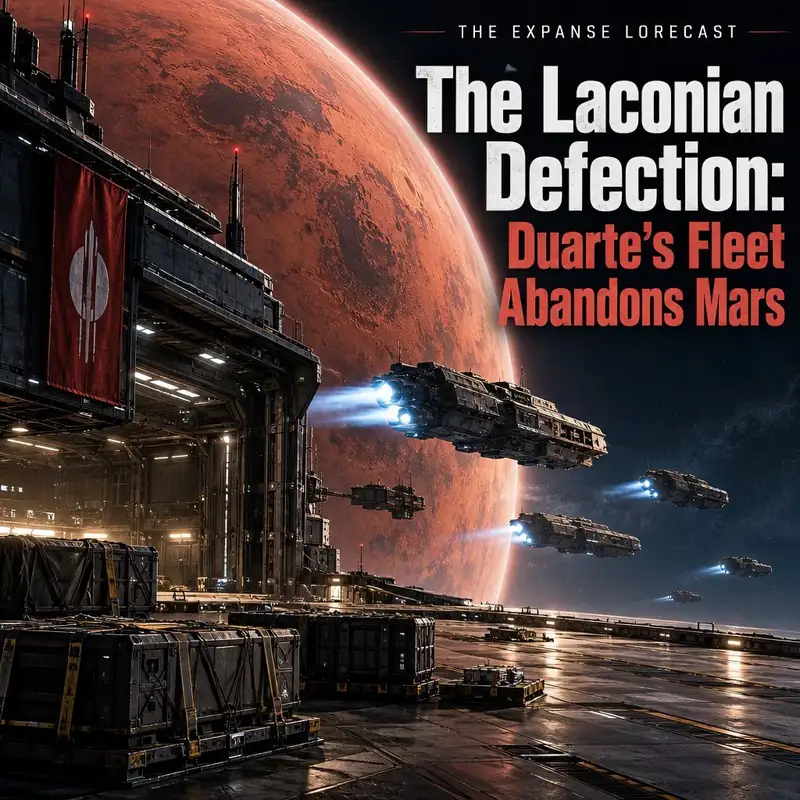
The Laconian Defection: Duarte’s Fleet Abandons Mars
The Barkeith entered the Laconia gate carrying men and women who believed they had crossed the final boundary of Martian authority. Behind them lay a republic in crisis, a Solar System at war, and a conspiracy that had transferred ships, weapons, specialists, and one of humanity’s most dangerous scientific assets beyond the reach of any lawful government. Ahead lay a habitable world, alien infrastructure, and the possibility of building something that Mars could no longer supervise.
Captain Emil Sauveterre, in the novel continuity, commanded the Barkeith during that transit. What happened next was not a battle. No enemy fleet appeared on sensors. No conventional weapon struck the ship. The transit became abnormal in ways the crew could neither predict nor understand, and the Barkeith was lost to a phenomenon associated with the Ring network. The exact mechanism and agency remain unresolved. What matters here is the irony. The first visible passage of Duarte’s breakaway force into its promised refuge demonstrated that its leaders had escaped human control only to enter a domain they did not control at all.
The Laconian defection was therefore never just a theft of Martian warships. It was a civil-military secession conducted under wartime conditions. Winston Duarte and the officers who followed him did more than abandon Mars because they saw an opportunity for private enrichment or military adventure. Some may have had motives that simple. But the scale, preparation, and long-term direction of the operation point to something larger. They treated the opening of the Ring gates as proof that the Martian republic’s original project was failing. Their answer was not to reform that project or accept its decline. Their answer was to carry part of Mars away, remove it from constitutional restraint, and build a new state around military discipline, secrecy, and alien technology.
That decision became possible because the Ring gates changed more than the map. They changed the political economy of the entire human species.
Before the gates, Mars had a difficult but coherent national purpose. It was a world built around a promise measured in generations. Terraforming Mars required patience, technical expertise, public sacrifice, and a willingness to invest present resources in a future that most citizens would never fully see. The project gave meaning to hardship. It also helped organize Martian politics, industry, education, and military culture.
Mars was more than a fortress with a flag. It was a society that had made discipline into a civic virtue because discipline appeared necessary for survival. Its people lived under domes, managed limited resources, and worked toward the transformation of an entire planet. That experience produced a strong sense of collective identity. It also produced hierarchy, pressure, and a political culture in which the military held exceptional prestige. The Martian Congressional Republic Navy was not just a fighting force. It was one of the republic’s clearest claims to competence and independence.
The navy deterred Earth, defended Martian space, supported the wider national security system, and embodied the technological achievement of the Martian state. Its ships, marines, engineers, and officers were products of a society that believed technical skill and collective sacrifice could buy a future. For many Martians, the fleet was evidence that Mars had become more than an Earth colony. It was a sovereign power with the capacity to protect its own long-term project.
That project was always expensive. Terraforming did not proceed by heroic speeches. It required infrastructure, scientific institutions, trained workers, political continuity, and a population willing to accept that prosperity remained tied to a distant objective. Mars had built a national story around delayed gratification. The reward was supposed to be a habitable world and a fully independent civilization.
Then humanity found more than a thousand doors to other systems.
The Ring network did not make travel effortless. A ship still had to reach a gate. It still needed crew, reaction mass, maintenance, food, water, replacement parts, and a destination that could sustain settlement. A colony on the far side of a gate still faced distance, disease, unfamiliar ecosystems, hostile geography, and the basic difficulty of turning imported equipment into a functioning society. The gates did not erase logistics. They rearranged it.
But politically, the effect was immediate. Mars had asked its citizens to spend centuries making one harsh world livable. The gates suddenly offered worlds where people could imagine starting with breathable air, open water, soil, or resources that did not require generations of planetary engineering. Even when those hopes were exaggerated, and often they were, the comparison was devastating. A difficult future on Mars now competed with many possible futures elsewhere.
The result was not that every Martian lost faith overnight. Many remained committed to Mars, its institutions, and its terraforming project. Others saw the gates as an opportunity for trade, research, or controlled expansion. But the old consensus weakened. Capital could leave. Skilled workers could leave. Young people could leave. The most dangerous loss was not material alone. It was the loss of confidence that Mars remained the best place to invest a lifetime of sacrifice.
A republic can survive hardship more easily than it can survive the collapse of its shared purpose. Mars still had factories, shipyards, military capability, and a formidable population. What it increasingly lacked was certainty about why its people should remain bound to the old plan. The gates had not destroyed Mars directly. They had made Mars’s defining promise less convincing.
For Winston Duarte and the faction that gathered around him, this crisis appears to have been decisive. The novels do not provide a single public manifesto in which Duarte announces that Mars has become obsolete. His full ambitions are deliberately concealed during the period of the defection. What later events establish is more practical and more troubling. Duarte wanted a loyal military force. He wanted separation from Martian jurisdiction. He wanted access to the surviving protomolecule sample and to Paolo Cortázar, the scientist associated with it. And he wanted a secure base in the Laconia system, where alien infrastructure might be turned to human use.
That was already enough to make him more than a disgruntled officer. It made him the architect of a state-building project.
A conspiracy of this scale cannot be reduced to one commander giving one unlawful order. Ships have crews. Crews have families, loyalties, and questions. Weapons move through supply chains. Maintenance records exist. Personnel transfers require paperwork. Fuel, ammunition, technicians, medical staff, and communications networks all leave traces. A fleet does not disappear merely because its leader is persuasive. It has to be prepared to leave.
Duarte’s operation depended on compartmentalization. Some participants may have understood the full purpose. Others likely understood only their part: a transfer, a deployment, a classified assignment, a resupply mission, an unusual order from trusted superiors. The more distributed the conspiracy became, the more it could hide inside the ordinary complexity of a military system already coping with strategic change. Mars had ships moving, matériel changing hands, personnel under pressure, and political leaders struggling to understand what the gates meant for the republic’s future.
That environment gave a determined faction room to work. It also meant that the eventual defection was not spontaneous. By the time the crisis became visible, much of the essential preparation had already happened.
A hidden fleet, however, still needed an operational window. It needed the rest of the Solar System to be too distracted, too divided, or too damaged to respond in time. Marco Inaros and the Free Navy provided that window.
Marco’s political project was not Duarte’s project. Marco drew on real Belter grievance, rooted in exploitation, unequal exposure to danger, economic dependency, and a long history in which the Inner planets treated Belt labor and Belt lives as expendable inputs. The Belt had never been a single nation, and the Outer Planets Alliance had never been a unified government. It included local movements, organizers, station communities, armed factions, criminal networks, workers, moderates, radicals, and people who wanted little more than secure employment and enough air to get through the week.
The Free Navy was one armed coalition within that fractured political landscape. It was not the Belt as a whole, and it did not represent every Belter or every Outer Planets Alliance faction. Marco’s appeal came partly from the fact that he identified real injustice. His danger came from what he chose to do with it. He pursued power through coercion, spectacle, and mass violence against civilians. The grievances were real. The deliberate attacks on Earth’s population were still atrocities.
Duarte’s faction supplied the Free Navy with capabilities it could not have developed so quickly on its own. Martian ships, weapons, stealth technology, trained personnel, and other military support flowed into Marco’s war effort through covert channels. The full inventory is not established, and it does not need to be. The strategic fact is clear. A substantial internal Martian conspiracy had transferred military power to an insurgent force whose attacks would throw the entire existing order into crisis.
Marco benefited immediately. His forces gained material strength, prestige, and the ability to threaten opponents who had assumed that the old balance of power still existed. Duarte benefited differently. Marco’s war compelled Earth, Mars, Tycho Station, independent crews, and the emerging political order around the Ring gates to focus on survival. Every emergency meeting, every diverted warship, every interrupted investigation, and every conflicting report widened the gap through which Duarte could move.
It is reasonable to interpret the Free Navy war as operational cover for the Laconian escape. The later outcome supports that interpretation. Duarte’s faction received what it needed while Marco’s campaign shattered the attention of the Solar System. But caution matters. The novels do not give us a formal agreement in which Marco knowingly accepts the role of expendable diversion for a future Laconian empire. Marco was a partner, a beneficiary, and eventually an instrument in a broader strategy. Whether he understood the ultimate hierarchy of that relationship is less certain.
The two men also wanted different futures. Marco sought a Belter-led order in which the Inner planets would no longer dictate the terms of human expansion. Duarte sought an order governed by a disciplined military elite, armed with technologies beyond the control of any existing state. Marco wanted to overturn a hierarchy. Duarte wanted to replace it with one of his own.
The Free Navy attacks produced destruction on a scale that demanded immediate response. Earth had to confront catastrophe, infrastructure loss, political shock, and the needs of a wounded population. The United Nations government could not treat the crisis as one more naval contingency. Mars faced a different emergency. It had lost confidence in its strategic future just as it discovered that elements of its own military had been arming an enemy. The struggle against Marco became inseparable from the question of whether Martian institutions could still trust themselves.
Tycho and its allies faced their own fragmented picture. The Ring space was becoming a political and military center. Medina Station mattered because it sat at the hub of the gates, but authority over transit did not by itself mean control over every system beyond it. The Free Navy was operating openly. Martian equipment was appearing where it should not have been. Governments were issuing orders across light-speed delays. Intelligence officers and commanders were trying to distinguish rumor, sabotage, theft, political betrayal, and organized war.
This is where the discovery made by Bobbie Draper and Alex Kamal becomes strategically important. Their investigation into Martian matériel transfers helped establish that the problem was more than black-market leakage or opportunistic arms trafficking. There was an internal Martian conspiracy. Military equipment had been moved with access, knowledge, and coordination that ordinary criminals could not plausibly command.
That recognition did not instantly solve the problem. Knowing that a conspiracy exists is not the same as knowing who belongs to it, where its ships are, what orders it has received, or which officers remain loyal. Institutions in crisis often suffer from a cruel delay between suspicion and action. During that delay, every command decision becomes harder. Arrest the wrong people, and you paralyze your own service. Trust the wrong people, and you help the conspiracy complete its work.
The audience, with access to multiple viewpoints, sees more than any one commander could know. Earth sees an attack. Mars sees theft, defection, and strategic humiliation. The Free Navy sees opportunity. Duarte’s people see a departure schedule. Those perspectives do not arrive in the same briefing room at the same time.
Compartmentalization made the operation resilient. Duarte did not need every participant to understand the final destination. He needed enough people to follow orders, enough ships to move, enough supplies to sustain transit, and enough confusion among his opponents to prevent coordinated interception. The Free Navy war created that confusion. It fractured the attention of every power capable of stopping him.
Once the scale of the Martian defection became clear, the crucial question was no longer whether Mars had suffered a betrayal. It was whether Mars could stop a force already moving beyond the Solar System.
What defected from Mars was more than hardware. Later descriptions commonly suggest that Duarte took a large fraction of the Martian navy, perhaps roughly a third in broad terms. The exact order of battle is not established. There is no reliable, complete public census of every ship, crew member, marine, engineer, or support specialist who departed. Precision would create an illusion of knowledge the record does not support.
But even without exact totals, the military damage is clear. A navy’s strength is not the number of hulls painted in official colors. It is the trained people who operate them, maintain them, arm them, repair them, and command them under stress. It is institutional memory. It is shared procedure. It is the experienced technician who knows which system fails first after a hard burn, the officer who understands fleet communications, the specialist who can turn a damaged ship into a ship that still reaches port.
Duarte’s faction took trained crews and trusted command relationships. It took high-value military equipment and the knowledge required to use it. It took a portion of Mars’s future capacity at precisely the moment when Mars needed confidence, cohesion, and credible force. The loss was therefore political as well as operational. It proved that the Martian state could not fully rely on the institution most closely associated with its national competence.
This was not an abandonment by all Martians. Most Martian civilians did not vote to leave their planet. Most Martian personnel did not join Duarte. Mars remained a functioning society, and the Martian military did not vanish. But a large organized faction had rejected the authority of the republic and carried away assets that could not be quickly replaced.
Saying that Duarte’s fleet abandoned Mars is useful shorthand, but it can hide the actual crime. Duarte did not lead a national migration. He led a military secession. He took public resources, trained personnel, and dangerous research out of the political system that had created them. He converted shared Martian capacity into the foundation of a private state.
The destination was not empty space. Duarte’s faction was heading for Laconia.
Laconia mattered because it offered more than distance. It was a habitable world with earlier colonists, scientific activity, and Ring-builder infrastructure. The system contained resources and artifacts that made it strategically distinct from an ordinary remote refuge. Most important, it offered access to an alien orbital shipyard. To a military faction looking for independence, industrial capacity, and a way to escape the limitations of Solar System power, that combination was enormously valuable.
Still, Laconia was not a finished empire waiting to be activated. An alien shipyard is not a human factory with labels on the controls. A habitable world does not by itself supply enough food, medicine, trained labor, spare parts, or political stability for a large military force. A fleet arriving in a distant system has to become more than a fleet. It has to establish maintenance, supply, security, administration, housing, medical care, and a durable relationship with the people already living there.
That last point is easy to lose when history is told from the bridge of a warship. Laconia already had colonists. They had come to a new world under conditions of uncertainty, building households and communities around the difficult work of settlement. The arrival of Duarte’s soldiers did more than strengthen their society. It changed sovereignty. It introduced a new armed authority with its own secrets, hierarchy, and plans.
For the colonists, this was more than a matter of flags or uniforms. A military government changes daily life. It changes who controls transport, communications, labor, security, access to information, and the use of local resources. It changes which questions are safe to ask. The transformation of Laconia into a strategic base was also the transformation of a colonial community into the population of an emerging authoritarian state.
The Barkeith’s fate was a warning embedded in the operation itself. Duarte had chosen Laconia partly because it contained alien infrastructure, yet the transit showed how little human beings understood about the Ring network and its dangers. The unknown event that consumed or erased Sauveterre’s ship did not halt the broader project. Other elements of the defecting force reached Laconia and established themselves. But the loss should have made one fact impossible to ignore. The new state was being built around systems whose creators, purposes, and limits remained profoundly unknown.
Duarte’s faction pressed forward anyway, because it had acquired something even more consequential than a protected base.
It had acquired the surviving protomolecule sample and Paolo Cortázar.
The protomolecule was more than a powerful weapon. It was an engineered alien system with capabilities humanity had observed but never mastered. It had transformed Eros, built the Ring, created interfaces with human minds, activated ancient infrastructure, and opened access to a network that remade human geography. Possessing a sample did not mean understanding it. Understanding part of its behavior did not mean controlling its behavior. But the sample represented access to the most strategically significant technology in human history.
Cortázar increased that value. He was not a guarantee of success, and he was not a source of complete knowledge. No human scientist possessed a full theory of the Ring builders or their surviving systems. But he carried expertise, experience, and a willingness to pursue research outside ordinary ethical boundaries. In Duarte’s hands, the combination of scientist, sample, isolated base, and alien infrastructure created an opportunity that no public government in the Solar System could easily match.
That was the real transformation. Duarte had not merely fled with ships. He had assembled the elements of a long-term technological state-building project. Military force could secure territory. Scientific expertise could investigate the alien systems. The Laconian world and shipyard could provide a base for experimentation and eventual industrial development. Distance could shield the work from oversight.
None of this meant instant mastery. Laconia did not emerge from the gate with an invincible fleet or a complete understanding of alien engineering. The later military power of the Laconian Empire should not be projected backward as if it had existed from the beginning. The initial achievement was more patient and more dangerous. Duarte obtained time. Time to study. Time to build institutions. Time to select loyal personnel. Time to let the rest of humanity exhaust itself in wars and political reconstruction.
The secrecy that protected this project also removed the usual restraints on it. Research involving the protomolecule had already demonstrated the danger of allowing private ambition, military urgency, and scientific curiosity to operate without public accountability. Duarte’s state was built on the belief that oversight was an obstacle. That belief made certain kinds of progress easier. It also made catastrophe easier to hide.
A government can make mistakes in public and still be forced to answer for them. A closed military regime can make mistakes in secret and call silence stability. Laconia’s early history was shaped by that difference.
Duarte did not remain entirely passive behind the Laconia gate. His faction began influencing the war around Medina Station, the central transit hub of the Ring network. Medina was strategically important because it sat in the space through which intersystem travel passed. But controlling a station at the hub did not mean controlling the far ends of more than a thousand systems. It meant controlling access, shaping traffic, and holding a potentially decisive chokepoint.
Laconian-aligned personnel and matériel appeared in the contest around Medina. The Proteus carried advanced railgun equipment and support personnel associated with the emerging Laconian industrial effort. The episode matters because it shows that Duarte’s project was more than an isolated refuge. It was already capable of affecting the strategic center of human expansion.
The railgun installations around Medina were not evidence that Laconia had solved every military problem. They were evidence of something more specific. Duarte’s faction could combine stolen Martian military competence, protected development in Laconia, and access to the Ring network’s geography. It could intervene selectively. It could choose when to reveal a capability and when to remain hidden.
This intervention also clarified the real relationship between Duarte and Marco. Their alliance was temporary, conditional, and hierarchical. Marco’s war had been useful because it weakened old institutions and consumed the attention of Earth and Mars. But Duarte did not intend to create a permanent partnership with the Free Navy. He did not intend to subordinate Laconia to Marco’s political vision, and he did not intend to keep providing support once the benefits no longer outweighed the risks.
When Duarte refused Marco further assistance and closed the Laconia gate to him, the meaning was unmistakable. Marco had helped create a strategic crisis. Duarte had used that crisis to establish a separate center of power. The Free Navy had been a partner while it was useful, but it was never the polity Duarte meant to preserve.
This did not mean Marco’s war was unreal or merely theatrical. The people killed, displaced, starved, and frightened by it were not diversions in anyone’s lived experience. Earth’s disaster was real. Belter political desperation was real. The Free Navy’s coercion was real. But at the strategic level, the conflict created conditions under which another project could mature beyond public sight.
Duarte’s success lay in seeing that destruction could be used as concealment. When every government is responding to immediate catastrophe, few have the capacity to investigate the slow construction of a future threat.
The Free Navy war eventually ended. A new political arrangement emerged around the Ring network. The Transport Union took responsibility for managing transit and balancing the interests of Earth, Mars, the Belt, and the expanding colony worlds. It was an imperfect arrangement, but it recognized a basic reality. The gates had created a shared infrastructure that no single old power could govern alone without provoking resistance.
Laconia remained outside that settlement. It had withdrawn into silence.
For roughly twenty-eight years, the hidden state developed. Its later emergence in Persepolis Rising can make the process look inevitable, but it was not. Duarte’s tactical escape had succeeded when the fleet reached a system beyond Martian pursuit. His operational success came from securing a defensible base, maintaining cohesion, and protecting the people and knowledge required for development. His strategic success came from gaining time while the rest of humanity dispersed across the network and struggled to build new institutions.
Political success is more complicated. Duarte founded a state, but he did so by rejecting the consent and accountability of the society whose resources he had taken. He preserved a part of Mars’s military culture, then radicalized it. The values of discipline, technical competence, sacrifice, and long-term planning were detached from the Martian republic and placed in service of an unaccountable elite.
Laconia’s eventual power rested on more than alien technology. It depended on human organization. It depended on secrecy, command unity, ideological selection, military training, protected research, and the ability to impose purpose on a population. Alien infrastructure gave the project possibilities that Mars never possessed. But it did not eliminate the need for labor, administration, technical education, and political control.
The same is true of its vulnerabilities. An authoritarian system can coordinate rapidly, but it also narrows the flow of information. It can demand loyalty, but it may confuse obedience with belief. It can centralize dangerous research, but it may ensure that a small number of leaders make errors no subordinate is free to challenge. Laconia’s later strength should not obscure the risk built into its founding assumptions.
The Barkeith had shown that risk at the beginning. Sauveterre’s crew crossed into a realm of alien systems and unknown forces expecting to enter a future they could command. Instead, they encountered evidence that their knowledge was partial and their plans rested on fragile understanding. Duarte’s project continued because other ships survived and because the faction had prepared alternatives. But the warning remained. The new state was founded not on mastery, but on the decision to act as if mastery would eventually be achieved.
That distinction is central to understanding the Laconian defection.
Mars did not disappear. The Martian Congressional Republic did not collectively choose to leave its world behind. The entire Martian navy did not become Laconian, and Martian civilians did not consent to have their institutions stripped for a secret empire. The title’s shorthand is useful only if it is corrected. Duarte’s fleet abandoned Mars. It did not speak for all Mars.
What it did carry away was a particular Martian future. It carried officers who believed the republic had lost its purpose. It carried ships, weapons, trained crews, technical specialists, and command relationships created by generations of public investment. It carried the surviving protomolecule sample, a scientist willing to work beyond ordinary restraint, and the belief that distance from oversight was a strategic advantage rather than a moral danger.
The Ring gates made this possible by destabilizing the old Martian bargain. They offered alternatives to terraforming and weakened the shared story that had justified sacrifice. The Free Navy war made it practical by fragmenting attention, authority, and military response across the Solar System. Duarte’s conspiracy turned those conditions into an escape route.
The defection succeeded because it combined ideology with logistics. It was not enough to believe Mars was finished. Duarte needed ships that could leave, crews who would follow, equipment that could be sustained, a destination that could support settlement, scientific assets worth protecting, and enough confusion among his enemies to prevent interception. He acquired all of those things, then used Laconia’s distance and alien infrastructure to transform a breakaway fleet into the foundation of a state.
Laconia did not begin as an inevitable empire, and it did not begin as an alien miracle. It began as a human decision by military officers who faced uncertainty, saw democratic limits as weakness, and concluded that a disciplined minority had the right to redesign humanity.