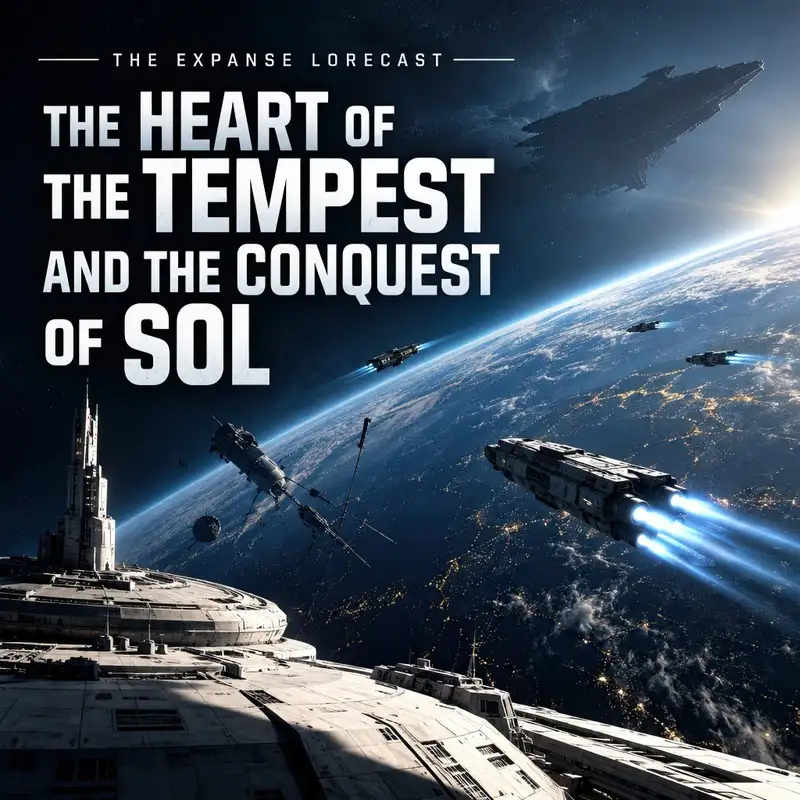
The Heart of the Tempest and the Conquest of Sol
At Point Leuctra, the defenders of Sol possessed more ships, more population, more accumulated industrial depth, and more familiar territory than the force confronting them. None of those advantages guaranteed a usable military solution. The Heart of the Tempest belonged to a different technological regime. It could survive punishment that would cripple a conventional capital ship, threaten infrastructure defenders could not afford to lose, and force Camina Drummer’s coalition to decide how much of civilization it was willing to spend merely proving that it had resisted.
But numbers only matter when the weapons on both sides belong to the same military world. The Tempest did not. It had already destroyed infrastructure that the defenders believed was too valuable, too dispersed, or too well protected to be removed in a single campaign. It had survived attacks that should have crippled a conventional capital ship. Its weapons had produced effects that Sol’s commanders could observe without fully understanding. The coalition had gathered because it could not allow Laconia to dictate the future of humanity through intimidation. It also had to decide whether another engagement would defend that future, or merely add crews, ships, and civilian communities to the cost of losing it.
Camina Drummer, president of the Transport Union, stood at the center of that decision. Her authority was real, but it was not absolute. She was not the commander of one unified empire with one legislature, one navy, and one unquestioned chain of command. She was coordinating governments and institutions that had learned, painfully, to cooperate after decades of conflict. The battle at Leuctra Point would test whether that cooperation could survive contact with an enemy prepared for a kind of war none of them had expected.
The decisive battle had been shaped long before the first missiles moved toward the Tempest. It had been shaped at Medina Station, at the center of the Ring Network, where Laconia chose to begin its return.
Nearly three decades had passed since the defeat of the Free Navy. Humanity had not become peaceful in the simple sense. It had become more interdependent. The Ring gates opened access to more than a thousand systems, and that abundance changed the map of human power. Colonists left the old system for new worlds. Trade routes multiplied. Old shortages did not disappear, but they changed form. The question was no longer only who controlled water, food, rock, fuel, and labor in the Solar System. It was also who controlled the routes between systems, who regulated settlement, and who could keep a transport dispute from becoming a war.
The Transport Union emerged from that settlement as the institution responsible for managing movement through the Ring gates. Medina Station became its headquarters and its most important practical asset. It was a port, a traffic-control center, a political symbol, and a chokepoint that connected the old powers to the colony worlds. Earth, Mars, and the Belt all depended on it, even if none of them had forgotten the reasons they distrusted one another.
That arrangement was a genuine achievement. Earth and Mars had once been rivals armed for planetary war. The Belt had endured generations of extraction, neglect, and political exclusion. The Free Navy conflict had shown what could happen when real grievance, military technology, personal ambition, and mass violence became entangled. The postwar order did not erase those injuries. It created institutions capable of managing them without immediately returning to open conflict.
But cooperation is not the same thing as integration. Earth retained its government, population, industry, and military traditions. Mars retained its own political identity, technical culture, armed services, and increasingly uncertain future. The Transport Union was powerful because it regulated transit and represented broad interests beyond the old Inner planets. It was not a conventional nation-state with unlimited authority over every fleet, dockyard, or government ministry.
The resulting security structure could respond to familiar threats. It could coordinate patrols, settle disputes, protect shipping, and assemble forces when a crisis demanded it. It was not built for an imperial invasion by a hidden state whose weapons exceeded the military assumptions on which that order rested. The old system had learned how to cooperate. It had not prepared itself to become one command, one war economy, and one political community overnight.
Laconia spent those same decades preparing for precisely that weakness.
Winston Duarte’s followers had begun as a breakaway Martian project. They took ships, personnel, technical knowledge, and stolen access to protomolecule research beyond the Ring gates. In the Laconia system, isolated from the political compromises and public scrutiny of the old Solar System, they built something more ambitious than a refuge. They built a state designed for return.
Laconia’s strength did not come from a single artifact or a fortunate discovery. It came from time, secrecy, discipline, and institutional continuity. The regime could concentrate resources on military development because it did not need to negotiate with rival governments, persuade a free press, or defend its plans before an opposition legislature. It could select personnel for loyalty as well as competence. It could shape education, industry, command culture, and scientific work around a single political objective.
Duarte’s commitment to centralized rule produced a military system with unusual advantages. Laconia had commanders trained within a unified hierarchy. It had an industrial base developed around alien-derived platforms and materials. It had specialized scientists and technicians who could operate systems unavailable to the rest of humanity. It had decades to test doctrine away from hostile observation. And it had a leadership prepared to use overwhelming force at the beginning of a campaign rather than gradually escalate through the diplomatic habits of the old order.
None of that meant Laconia possessed complete mastery of Ring-builder technology. Its scientists and operators could activate, adapt, and build with systems whose deeper principles remained obscure. They had learned enough to create extraordinary weapons and ships. They had not solved every mystery embedded in the technology they used. The difference mattered. A state can use a tool without understanding every consequence of using it. Laconia would discover that distinction later. For the opening campaign, however, partial understanding was more than enough.
The first target was not Earth. It was not Mars. It was Medina Station, the hinge on which interstellar human geography turned.
Medina’s defensive systems reflected the logic of the postwar settlement. The station had weapons, including railgun defenses, because any government controlling Ring transit needed protection against attack. But its defenses existed within a political order that assumed hostile forces would remain within recognizable human limits. A raid, a mutiny, a blockade, or even a conventional fleet attack could be met through familiar calculations of range, ammunition, reinforcement, and damage.
The Tempest changed those calculations almost immediately. Its advanced weaponry generated effects that disabled and destroyed Medina’s defenses with startling speed. Fixed railgun positions and nearby vessels that might have formed the core of a station defense were neutralized before they could establish an effective answer. To the defenders, the important fact was not a complete technical explanation. They did not have one. The important fact was that the weapons protecting the central hub of the Ring Network had failed against a threat outside their previous experience.
Laconia’s opening move was therefore not simply a battle for a station. It was an attack on the institutional architecture of post-Ring humanity. The regime had placed its hand on the valve that connected more than a thousand human settlements, then announced that the old order was over.
Taking Medina was easier than ruling it.
Santiago Singh, commander of the Gathering Storm, became governor of the occupied station. His appointment made sense within the Laconian system. He was disciplined, loyal, trained to respect authority, and committed to Duarte’s vision of ordered human unity. He understood the principles of imperial administration as Laconia taught them. He understood that occupation required rules, schedules, security procedures, and visible confidence.
What he did not understand was Medina itself.
Occupiers can seize control rooms. They cannot instantly seize local knowledge. They can impose new rules. They cannot make those rules trusted. They can guard the docks, censor communications, and establish checkpoints. They cannot turn fear into consent merely by giving it a uniform and a timetable.
An attack within the occupation administration, including the death of a trusted official, intensified Singh’s insecurity. His response followed a familiar pattern in inexperienced occupation governments. Faced with uncertainty, he demanded visible control. Curfews expanded. Checkpoints multiplied. Censorship tightened. Detention became a substitute for reliable intelligence. Every act of resistance looked like evidence that stronger coercion was required, while every coercive measure produced new reasons for the population to conceal information and assist the underground.
Singh’s conflict with Colonel Tanaka revealed the difference between formal authority and competent security judgment. Laconia had given Singh legal power. That did not automatically give him the experience to distinguish a real threat from an imagined one, or a necessary security measure from an action that would make the station harder to govern. In an occupation, intelligence is never merely a collection of reports. It depends on who speaks, who remains silent, who trusts the authorities, and who has learned that a careless word can cost someone air, work, or freedom.
Medina exposed Laconia’s first weakness. Its military superiority could establish obedience. Its political methods could make obedience brittle.
That weakness might have encouraged a cautious commander to consolidate. Secure the station. Wait for reinforcements. Build a durable administration. Ensure that the gate hub could not be retaken. The original logic of the campaign pointed in that direction. But Admiral Anton Trejo, commanding the Heart of the Tempest, chose momentum.
The Tempest departed for the Solar System ahead of the slower and more careful timetable that consolidation would have required. The Gathering Storm remained behind at Medina. Another Magnetar-class ship, the Typhoon, was on its way from Laconia, but it was not part of the immediate assault on Sol. Trejo accepted a temporary risk at Medina in exchange for a greater strategic advantage. He would strike the old system before Earth, Mars, and the Transport Union could turn warning into a coherent defense.
It was a calculated gamble. Leaving Medina with a smaller occupation force created an opening for resistance. But every day spent waiting also allowed Sol to gather ships, relocate industrial assets, coordinate governments, and learn from Laconia’s capabilities. Trejo understood that the Tempest’s greatest value was not merely its firepower. It was initiative. It forced the defenders to respond in sequence, from one crisis to the next, rather than allowing them to choose the place and time of a campaign.
His targets made the Laconian objective clear. The campaign was not only against fleets presently in space. It was against the capacity to resist in the future.
Pallas was one of those targets. It mattered because it was an industrial and labor center, a place tied to shipbuilding, repair, transport, and the skilled work that keeps fleets alive after the first battle. A shipyard is not just steel frameworks and docking berths. It is engineers who understand an aging drive system, technicians who can rebuild damaged sensors, workers who know a station’s machinery, stores of components, supply contracts, cargo routes, and the accumulated experience that allows a damaged ship to sail again.
Destroying a ship in combat removes one hull. Destroying a major industrial complex attacks the possibility of replacing that hull, repairing the next one, or sustaining the crews who depend on both. It converts a military problem into an economic and social one.
Drummer understood this. The Transport Union could not defend every facility against the Tempest, but it could try to preserve what made those facilities valuable. Evacuations mattered. Moving personnel mattered. Saving technical records, equipment, ships, and skilled workers mattered. A dockyard could sometimes be rebuilt. The people who knew how to operate it, and the networks that had fed it parts for decades, were harder to recover.
The Tempest demanded surrender. The demand was backed by the evidence of Medina and by the obvious fact that conventional defenses had not stopped the Laconian ship. When resistance did not produce the result Laconia required, the Tempest destroyed Pallas.
The immediate military fact was the loss of the target. The deeper effect spread outward. Sol’s defenders had just watched a major node of their industrial capacity disappear. Repair schedules, production plans, evacuation routes, employment, housing, family networks, and future fleet maintenance were all damaged at once. The attack demonstrated that rear areas were not safely behind the front. Under Laconian conditions, the front could appear wherever the Tempest chose to arrive.
The destruction was accompanied by another deeply alarming event. Across the system, people lost consciousness for several minutes. The experience was broad, sudden, and frightening. In the immediate crisis, no one had a settled explanation. The relationship between the Tempest’s weapon, the destruction at Pallas, and the larger phenomenon remained uncertain. What mattered to commanders and civilians at the time was that an attack on one target seemed to produce consequences far beyond it.
That uncertainty had military value for Laconia even before anyone understood it. A weapon is frightening because of what it destroys. It can be more frightening because of what it might do next. Sol’s governments were not only facing damage they could measure. They were facing evidence that their enemy’s technology could produce effects outside their established threat models.
Pallas proved that Laconia could destroy military capacity. The Tempest’s next major act demonstrated that it was also prepared to destroy civilian communities in order to make political resistance seem hopeless.
Independence was a mobile civilian settlement, part of the dispersed human landscape that had grown after the opening of the Ring Network. Its very existence represented a form of autonomy. It was not an imperial capital or a grand naval base. It was a community whose people had made lives beyond the older centers of planetary power. Such places depended on transport, maintenance, trade, and political stability. They also depended on the belief that distance offered some degree of safety.
The destruction of Independence was not important because it provided a dramatic body count. The exact human cost is less useful here than the nature of the target. A civilian settlement was removed by a government that claimed to be restoring order to humanity. Homes, work, family connections, and the practical security of an entire community were treated as expendable instruments in a campaign of submission.
That was coercion in its clearest form. Laconia was not merely asking its opponents to recognize superior force. It was demonstrating that no habitat, no workforce, and no community could assume it lay outside the reach of imperial punishment. The message was meant for governments, but it was delivered through civilians.
Terror can produce immediate political effects. It can discourage resistance, divide coalitions, accelerate surrender, and make officials calculate how many people will die before a military plan has any chance of success. It can also produce the opposite result over time. It can teach occupied populations that obedience offers no real security. It can transform reluctant critics into active enemies. It can make every maintenance tunnel, shipping manifest, and private conversation part of a resistance network.
For the moment, however, the immediate effect favored Laconia. Pallas and Independence had changed the meaning of the coming battle. The coalition was no longer asking only whether it could destroy the Tempest. It was asking whether any credible defense remained before the Tempest destroyed more of the system it was supposed to protect.
That question brought the fleet to Leuctra Point.
The force assembled there was large by any ordinary standard. Contemporary summaries often describe it as more than two hundred ships drawn from the Earth-Mars Coalition and the Transport Union. The exact tactical count matters less than the composition. This was not a handful of desperate vessels improvising an attack. It was the concentrated military strength of the established human order, assembled because every participant understood that allowing the Tempest to continue unopposed would mean accepting Laconian supremacy.
The coalition possessed serious advantages. Its crews knew the Solar System. Its ships had access to established routes, ports, supply networks, and local intelligence. Earth and Mars retained deep stores of military experience. The Transport Union brought ships, personnel, transit knowledge, and an understanding of the infrastructure that connected the old system to the colony worlds. The fleet also had nuclear weapons and the capacity to coordinate attacks from multiple directions. Against any conventional capital ship, this combination should have created an overwhelming threat.
But coalition strength is not simply the sum of hulls on a display. The force had been assembled from institutions with different command cultures, political responsibilities, service traditions, and legal authorities. Earth, Mars, and the Union shared an immediate interest in stopping Laconia. They did not become one state merely because they faced one enemy. Their commanders had to coordinate under pressure while protecting crews whose governments would bear the consequences of failure.
They also lacked an adequate intelligence picture. The Tempest had revealed immense durability, unfamiliar weapon effects, and some form of damage recovery beyond the known standards of human warships. The defenders could observe results. They could not yet define the system’s limits. They did not know with confidence what volume of fire would disable it, what its vulnerabilities were, how long it could sustain combat operations, or which apparent damage was genuinely significant.
This is where conventional doctrine becomes an experiment conducted with lives. Military planning depends on assumptions about what weapons can do. A missile salvo is designed around expected defensive capacity. A nuclear attack is planned around expected survivability. A fleet commander can accept risk when the likely effect on an enemy hull is reasonably understood. At Leuctra Point, Sol’s commanders were forced to test the boundaries of an unknown system while the enemy remained capable of firing back.
Their choices should not be mistaken for incompetence. They used the tools available to them against the threat in front of them. The problem was that the Tempest had been built for a war whose baseline had changed.
The engagement did not unfold like an atmospheric dogfight, with ships twisting around one another at visual range. Space combat is governed by distance, relative motion, detection, missile guidance, firing geometry, acceleration limits, and the time it takes for an order to become an action. The coalition’s task was to bring coordinated fire onto a single enemy vessel without allowing the Tempest to exploit gaps in the formation, destroy key units, or force ships into maneuvers that broke their mutual support.
The defenders used missiles and nuclear weapons because those were the tools expected to threaten a heavy warship at range. A coordinated attack could overwhelm point defense, force a target to maneuver, consume defensive ammunition, or produce enough damage that follow-on strikes would achieve a kill. Against conventional fleets, the logic was sound. No ship can remain intact forever under sufficient accurate fire. Armor can be breached. Sensors can be blinded. Radiators, drives, weapons, and pressure compartments can be damaged. Even a vessel that survives may become unable to continue its mission.
The Tempest did not behave like a conventional vessel. It absorbed punishment that should have been decisive. Damage that would have ended the combat effectiveness of another ship did not produce a reliable disabling effect. Its alien-derived construction and regenerative capacity allowed it to remain in the fight when the defenders expected it to be breaking apart, losing systems, or withdrawing under damage-control limitations.
None of that meant the Tempest was literally immune to harm. It was not a magical object beyond all vulnerability. But the coalition did not know its vulnerabilities in time, and it could not convert observed damage into a dependable kill before its own losses became unacceptable. In war, an enemy does not need to be invulnerable to win. It only needs to survive long enough that the other side cannot find a successful method before its own ability to fight collapses.
The Tempest’s offensive power compounded that advantage. Its weapons could destroy ships and impose consequences on formations that had been designed around human capabilities. Every loss reduced more than the number of hulls available. It removed crews, trained specialists, command experience, ammunition, repair capacity, and confidence. It also imposed new burdens on the surviving ships. They had to rescue personnel when possible, reorganize formations, account for damaged units, and decide whether continuing to close with the Tempest would achieve anything except another round of losses.
Battle damage assessment became a central problem. Coalition commanders needed to know whether the Tempest was truly weakened, whether a new salvo might finish it, or whether apparent damage was being repaired faster than conventional sensors and doctrine could interpret. They did not have the luxury of later knowledge. They could not pause the battle, disassemble Laconian technology, and revise their plans. They had to make decisions with partial data while an enemy ship continued to demonstrate that their previous assumptions were wrong.
The intelligence failure was therefore not simply that Sol had failed to predict Laconia’s return. It was that Sol had no mature framework for understanding the military systems Laconia brought with it. The coalition learned, in real time, that its threat model was obsolete. But learning that fact did not build new ships, produce new weapons, train new crews, or create a replacement industrial base while the battle was still underway.
The tactical result at Leuctra Point was clear enough. The coalition failed to destroy or reliably disable the Heart of the Tempest. Operationally, the result was worse. Losses mounted while the enemy retained the ability to continue its campaign. Strategically, the result was that Laconia had shown it could defeat the combined conventional military power of Earth, Mars, and the Transport Union in open battle.
At that point, the central decision was no longer a matter of fire control. It was a matter of responsibility.
Drummer’s surrender did not represent admiration for Laconian rule. It did not mean that she accepted Duarte’s political claims, believed the Transport Union had failed morally, or concluded that resistance to empire was pointless. It was a command judgment made after the military conditions for a successful defense had disappeared.
A commander has an obligation to fight when fighting protects the people and institutions placed under her care. That obligation changes when continued combat no longer offers a plausible path to protection. At Leuctra Point, the coalition had not demonstrated a reliable way to defeat the Tempest. Its industrial base had already been damaged. Its ships had been destroyed or exhausted. Its remaining forces faced an enemy still capable of attacking military and civilian targets. There was no immediate second defensive line waiting in reserve with a solution the first fleet lacked.
Continuing the battle could have expressed defiance. It could not, at that moment, produce a credible defense of the system. It would have consumed more crews and more ships while leaving Earth, Mars, stations, and habitats exposed to the same methods used against Pallas and Independence. Drummer had to weigh the political value of refusing Laconian demands against the immediate human cost of proving that refusal through additional destruction.
Earth and Mars followed the same military fact. Their governments had not suddenly ceased to be rivals in history or identity. Their separate institutions remained. But neither government possessed an answer that Drummer had overlooked. The combined fleet had already tested the available conventional options. No government could responsibly claim that sending more people into the same engagement would reverse the result.
This is why Sol’s surrender was political without being merely ceremonial. Laconia did not conquer through a document alone. It conquered by demonstrating battlefield dominance, destroying the capacity to rebuild quickly, exposing civilian populations to further attack, and forcing the established powers to acknowledge that their current military instruments could not protect those populations.
Surrender in those conditions was not the opposite of resistance. It was recognition that resistance had to change form. A warship battle had failed. That did not prove that Laconian rule would endure. It proved only that the old system could not defeat Laconia by continuing the same battle under the same conditions.
Laconia won control of Sol’s political order. It imposed a transition narrative in which the old powers would submit to centralized authority for the supposed security of humanity. It gained the strategic center of the old human civilization, the prestige of victory, and the ability to use its military advantage to reshape institutions that had taken decades to build.
But it did not win consent.
At Medina, the occupation had already shown the limits of formal authority. The station could be seized, its communications monitored, its population searched, and its leaders replaced. Yet the people who operated its systems, moved through its corridors, maintained its machinery, and remembered its political history did not become Laconian simply because Laconia declared them subjects. Underground resistance survived because occupation creates practical opportunities for those who know the place better than the occupier does.
The same problem existed across Sol. Destroyed habitats did not create loyalty among survivors. The loss of Pallas did not make displaced workers grateful for imperial order. The destruction of Independence did not persuade other communities that obedience made them safe. Fear could compel compliance, especially when the Tempest remained in the system. But compliance under overwhelming threat is not the same as legitimacy, and an empire that confuses the two begins to misread its own position.
Later events would establish that the Tempest had vulnerabilities and that Laconian power could be challenged. Those developments do not diminish the scale of the initial defeat. They clarify its meaning. Sol had not encountered an invincible force. It had encountered a force for which it had not prepared, and it had been compelled to surrender before it could discover how to fight back effectively.
The civilian cost outlasted the fleet battle. People lost homes, jobs, relatives, stations, and the confidence that familiar institutions could protect them. Skilled labor was scattered. Industrial capacity was erased. Surveillance and political subordination became ordinary facts of life. Some people adapted, some collaborated, some waited, and some resisted. None of those choices can be understood apart from the violence that made them necessary.
The Heart of the Tempest conquered Sol because Laconia had built a military problem its opponents could not solve with courage, numbers, or conventional concentration alone. The fleet battle exposed the technological gap, but the campaign was larger than the ship. Laconia paired alien-derived capability with preparation, command unity, infrastructure attacks, and coercion against targets the defenders could not protect. The Tempest could compel surrender. What it could not create was the belief that Laconian rule deserved to last.