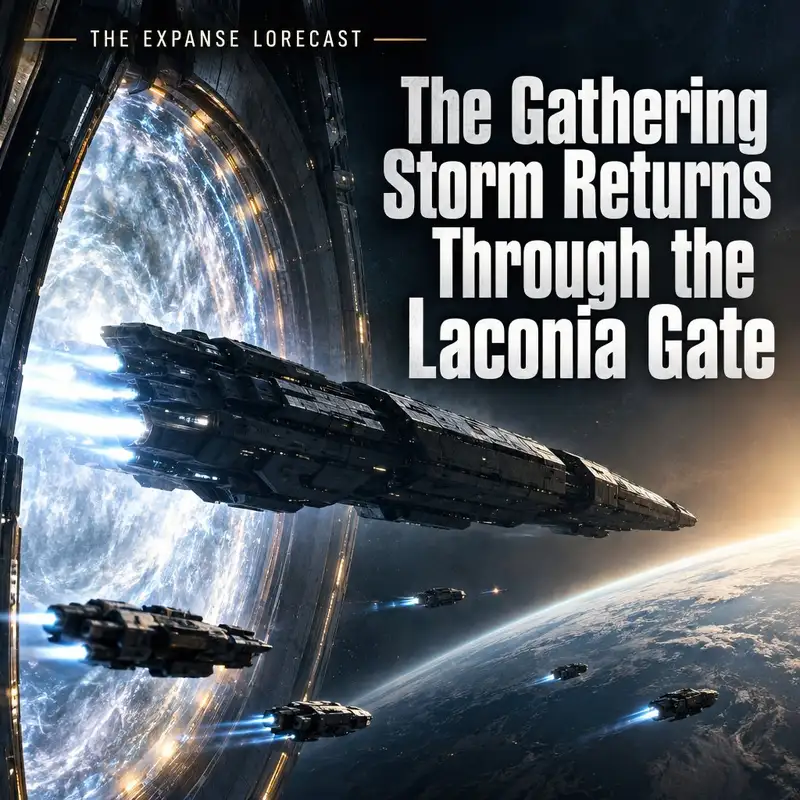
The Gathering Storm Returns Through the Laconia Gate
For thirty years, the Laconia gate marked an absence. Martian defectors had vanished through it with ships, personnel, and a political project, then stopped participating in the human order beyond. When the gate finally became active again, it did not release diplomats or traders. The Heart of the Tempest and the Gathering Storm emerged as instruments of conquest. Yet the smaller destroyer would eventually reveal something the flagship could not: imperial hardware could be captured, repurposed, and made to serve people the empire expected to frighten into submission.
Then the gate opened. What emerged was not a delegation seeking to rejoin the postwar order. The Magnetar-class battleship Heart of the Tempest came through first, carrying a level of alien-derived capability no established power could match. The smaller Gathering Storm came with it. Beside the Tempest, the Storm was not the instrument meant to awe the system into submission. It was something more useful for the work that followed. It was an imperial destroyer, a ship built to patrol, escort, threaten, board, and remain behind after the great weapon moved on.
The Laconian return was presented as a political settlement. In practical military terms, it was a fait accompli. Laconia had spent decades beyond the gate building an armed state around the remnants of a Martian breakaway force, disciplined institutions, and access to alien infrastructure humanity understood only in fragments. Its leaders claimed that the old human governments had proved too divided, too shortsighted, and too weak to manage the danger represented by the Ring Network. Their answer was unity imposed by force.
That argument was not merely propaganda. The old order had real weaknesses. Earth, Mars, the Transport Union, Medina Station, and the colony systems were dependent on one another without agreeing on who should rule whom. The Ring gates had opened enormous territory, but they had not created enough trained engineers, food systems, repair yards, administrators, or political trust to govern it. The network made human civilization larger. It also made it more exposed.
Medina was the obvious first objective. It sat at the center of the gate network, controlling the traffic lanes through the Slow Zone and serving as the administrative heart of the Transport Union. But Medina’s strategic importance also created a dangerous illusion. It had authority over transit, schedules, docking, customs, communication, and the everyday machinery of interstellar movement. It did not possess the military power to stop an enemy arriving through one of the gates with a battleship unlike anything in its defensive plans.
The Heart of the Tempest demonstrated that difference quickly. Its alien-derived magnetic weapon neutralized Medina’s central defensive capacity. The details mattered less than the operational effect. Systems intended to protect the station were rendered unable to protect it. A force that had planned around known human weapons, known firing solutions, and known vulnerabilities found itself confronting a capability it could observe but not counter. The battle for Medina, in the narrow military sense, was brief.
The occupation was not. Destroying defenses can break resistance at a point in time. Governing a station means controlling a population that must keep breathing, eating, repairing equipment, moving cargo, treating injuries, maintaining spin, and settling disputes after the weapons fire ends. Medina was not an empty fortress. It was a crowded transit hub full of Transport Union personnel, station technicians, cargo crews, prisoners, merchants, families, political operatives, and people who had spent their lives learning how to survive under institutions they did not entirely trust.
The Gathering Storm became important at that moment because empires require more than a flagship. The Tempest could compel obedience with its presence. It could destroy defenses and make the price of open resistance obvious. But the Tempest could not inspect every freighter, respond to every security alarm, escort every important shipment, patrol every approach, or remain permanently above Medina while Laconia expanded its authority elsewhere. That work fell to ships like the Storm.
The Gathering Storm is generally identified as a Laconian destroyer, part of the force structure that made alien-enabled superiority usable at the local level. Its significance was never primarily a matter of measurements or armament lists. Its significance was that it carried Laconian systems into ordinary operational space. It was the sort of ship that could enforce an occupation after the great demonstration of power had passed. It could put troops where they were needed, make a threat credible, and remind every smaller vessel that the new regime had teeth close at hand.
Its captain, Santiago Jilie Singh, became a useful example of the gap between military command and political rule. Singh was a Laconian officer formed by a system that valued discipline, clarity, obedience, and the certainty of lawful hierarchy. Those are not trivial virtues aboard a warship. A captain has to make decisions with incomplete information, preserve a crew, protect a vessel, and execute a mission under pressure. But Medina was not a destroyer. Its inhabitants had not enlisted in Laconia’s navy. They could not be organized through command orders alone.
Singh’s appointment as governor joined two demanding roles that should have remained distinct. He was expected to administer a hostile, complicated station while maintaining the security posture of an occupying power. He inherited commercial networks, prison populations, political grudges, labor systems, informal information channels, and people who had learned through long experience that authority often arrived from far away but air leaks happened close to home. Laconia’s superior technology did not give him a map of those relationships.
The occupation’s first weakness was not that every resident of Medina wanted to rebel. Many did not. Some were frightened. Some calculated that cooperation was safer than defiance. Some believed that the old Transport Union order had failed and that Laconia might at least bring predictability. Others had families, jobs, debts, medical needs, or vulnerable crewmates that made overt resistance impossible. A station under occupation contains more than collaborators and heroes. It contains people trying to survive until they know what survival will cost.
That complexity was exactly what made Medina difficult to control. Laconian surveillance depended on technicians operating systems, workers moving supplies, crews accepting inspections, and local people reporting what they knew. The occupiers could impose rules, but they could not manufacture local knowledge at the pace they needed it. Every arrest, restriction, confiscation, and public punishment might solve one immediate security problem while creating three quieter ones. An occupation can expand its security apparatus faster than it expands trust. It usually does.
The Underground understood this better because it was not one organization trying to command the entire station. It was a loose network of people with different loyalties and different reasons to resist. Some came from the old Outer Planets Alliance. Some were connected to the Transport Union. Some had personal ties to the Rocinante’s crew. Some had no ideological program at all beyond refusing to let Laconia decide the future of every human system. Their strength was not uniformity. Their strength was that they knew where authority depended on ordinary cooperation.
They also understood that Medina was not the place to win a conventional war. The Underground could not line up ships against the Laconian Navy and expect endurance, numbers, or industrial capacity to carry the day. It did not possess a secure fleet base, a replacement pipeline, or the ability to absorb losses in open battle. Its immediate objective was more limited and more realistic. It needed to create an exit. It needed to free people, preserve knowledge, disrupt Laconian control long enough for key personnel and assets to escape, and keep the possibility of future resistance alive.
That objective shaped the preparation. Naomi Nagata and others studied Laconian systems not because they believed they had suddenly mastered alien technology, but because an occupying force always contains seams. A system can be formidable and still rely on authentication routines, command assumptions, software links, maintenance procedures, and human habits. The Underground identified a way to exploit a specific vulnerability in Laconian powered armor. That did not turn the resistance into equal masters of Laconian technology. It gave them a short-lived advantage at a critical point.
The difference is important. Capturing one weakness is not understanding an entire weapons system. A technician may learn how to disable a lock without knowing how to build the door. A resistance cell may find a way to interrupt a command network without possessing the industry needed to reproduce it. The Underground’s achievement was not technological parity. It was disciplined opportunism. It found the place where centralized superiority had become dependent on an assumption, and it struck before that assumption could be revised.
When the Medina uprising began, it did not resemble a clean fleet engagement with neatly separated fronts. It was a coordinated rupture inside a living station. Prisoners were released. Security systems were disrupted. Sensors and communications were interfered with. Diversions forced Laconian personnel to react to multiple threats without knowing which one was the decisive effort. Congestion, confusion, and the ordinary complexity of station life became part of the battlefield.
That was dangerous for everyone involved. Civilian movement could conceal resistance activity, but it could also expose civilians to gunfire, panic, retaliation, and catastrophic mistakes. A damaged bulkhead or a failed life-support system did not care whether the person caught nearby supported Laconia, the Underground, or neither. The resistance could not treat the station as a disposable target if it hoped to preserve a future worth fighting for. The occupiers could not treat every resident as an enemy without proving the resistance’s case for it.
The Rocinante crew played different roles in this effort, and none of them mattered alone. Bobbie Draper brought the instincts of a Martian Marine veteran into a boarding operation against a ship that should have been beyond the reach of ordinary resistance forces. Amos Burton brought a practical understanding of close operations, access, machinery, and the unpleasant fact that a vessel remains dangerous even after its command structure has been disrupted. Alex Kamal’s ship handling helped keep the Rocinante active in a fight where timing and position mattered more than theatrical displays of courage. Naomi’s systems knowledge and resistance work helped make the wider plan possible.
The target was the Gathering Storm. Capturing it was an extraordinary gamble. Destroying a Laconian destroyer would have been a useful symbolic victory. Taking it intact offered something far more valuable, but it also increased the risks. A captured vessel had to be boarded, cleared, controlled, and made mobile before Laconian reinforcements could restore the situation. The attackers had to deal with unfamiliar layouts, unfamiliar systems, trained defenders, and the possibility that damage to the ship could kill the very prize they were trying to seize.
The Storm was not taken because Laconian technology proved fragile. It was taken because occupation forces were overloaded at the decisive moment. Laconia’s commanders had to respond to an uprising across Medina, protect their governing apparatus, manage prisoners, maintain security, and understand attacks that were arriving faster than their local intelligence picture could stabilize. The Underground did not defeat the entire Laconian military system. It created a temporary failure of coordination, then used it with remarkable precision.
For Bobbie, the boarding was not simply a matter of personal combat skill. She understood that a warship is a system before it is a weapon. It has control points, crew routines, pressure boundaries, power distribution, communication nodes, defensive habits, and people trying to make decisions under stress. Capturing the ship meant breaking those systems in the right order while preserving enough of the vessel to get away. That required discipline as much as aggression.
Amos’s contribution was equally unromantic and equally necessary. An unfamiliar vessel does not become usable because its defenders have been removed. Doors have to open. Pressure has to remain where it belongs. Power has to be routed. Damage has to be assessed. A captured console may reveal information, or it may reveal that the person touching it has just made a very expensive mistake. The difference between a prize and wreckage often comes down to people willing to do patient technical work while alarms are still sounding.
The escape that followed was not a victory parade. James Holden was captured by Laconia, becoming both a political hostage and an intelligence asset for a regime trying to understand its enemies and the larger dangers beyond the Ring Network. The Rocinante’s people were scattered. Medina remained under imperial occupation. The Underground had saved some personnel and acquired an extraordinary ship, but it had not liberated the station or broken Laconian control of the gates.
The Gathering Storm itself had to pass through the Laconia gate under new command. That movement was one of the most audacious consequences of the uprising. The ship had entered the Ring Network as part of an imperial expedition. It returned through the same gate as stolen property, carrying people Laconia had failed to kill or capture. The route that had allowed Laconia to project force outward now carried a piece of that force inward, beyond the immediate reach of the empire that built it.
The Underground concealed the ship near Freehold in the Laconia system. Hiding an imperial destroyer inside the empire’s own protected space was not the same as making it invisible. The Storm still produced heat. Its movements still had to be planned. Its systems still required care. A ship with an unfamiliar signature could become a danger to its own crew if it transmitted at the wrong time, arrived at the wrong port, or left evidence in the wrong traffic record. Concealment in space is usually a matter of reducing opportunities for detection, not escaping physics.
The greater problem was logistics. A captured destroyer is a maintenance burden before it becomes a weapon. It needs trained operators, medical support, food, air, water, reaction mass, ammunition, replacement electronics, repairs, secure docking, and people capable of understanding systems that were never designed to be serviced by insurgents. Its alien-derived components may function reliably while remaining difficult to reproduce, difficult to modify, and dangerous to troubleshoot.
The Underground could not simply order new parts from a public supplier. Every repair required trusted people, concealed networks, careful procurement, and decisions about what risk was acceptable. A civilian cargo crew might be willing to move food or machine components without knowing their final destination. A sympathetic technician might help adapt a system but become vulnerable if Laconian investigators noticed the gap in station records. A safe harbor might remain safe only until another person learned about it. Resistance logistics is rarely glamorous. It is mostly people making difficult arrangements and hoping no one talks under pressure.
That dependence limited the Storm’s use. The Underground could not employ it as a conventional navy would employ a destroyer. It could not keep it on constant patrol, send it into every fight, or risk it for a minor tactical gain. The ship had to be preserved for operations where its unusual capabilities mattered. Its value lay in selectivity. It could appear where Laconia did not expect it, gather information, threaten a target, extract personnel, or force an imperial commander to reconsider an assumption.
Possession of the Gathering Storm also gave the resistance something that could not be measured in ammunition. It gave them access to a living example of Laconian military architecture. Its systems could reveal maintenance practices, procedural habits, signatures, communications assumptions, and the ordinary rhythms of Laconian naval operations. A captured ship did not disclose every secret of the empire, but it gave the Underground a better basis for asking the right questions.
Intelligence is often less dramatic than a weapon launch. It may be a pattern in how a ship authenticates a message, a clue in which components fail first, an understanding of what Laconian commanders consider normal traffic, or the realization that an enemy’s confidence depends on a narrow information channel. Such knowledge does not guarantee success. It does, however, reduce the number of times a resistance force has to gamble blind.
Politically, the Storm became evidence that Laconia could lose. That mattered to communities scattered across the Ring Network. An empire that arrives with invulnerable weapons wants opponents to conclude that resistance is irrational. The destruction of Medina’s defenses had served that purpose. The capture of the Gathering Storm complicated it. A regime can explain away a setback, but it cannot entirely erase the fact that a ship built by its own industrial system was now operating under enemy command.
The symbol had limits. One destroyer did not make the Underground equal to Laconia. It did not restore the independence of Medina, free occupied worlds, or replace the industrial base Laconia had built in isolation. Symbols become strategically meaningful only when organizations can use them. The Storm mattered because it could be maintained, crewed, moved, supplied, and integrated into a growing network of resistance. Without those people and those systems, it would have been a powerful but increasingly inert relic.
Several years later, during the Underground war in the Sol system, the Gathering Storm had become a different kind of asset. It was no longer simply a captured prize from Medina. Under Bobbie Draper’s command and with Alex Kamal’s support, it became a raiding ship, a reconnaissance platform, and a problem Laconia could not ignore. Its Laconian construction and operational profile made it useful in ways an ordinary Transport Union vessel or surviving Martian ship could not easily duplicate.
The Underground used mobility rather than mass. It moved through the spaces between major formations, relied on dispersed support, and tried to choose engagements where local advantage could compensate for strategic weakness. The Storm could exploit Laconian expectations. A contact that looked like a Laconian ship might receive a moment of hesitation from an opponent. A vessel equipped to understand Laconian systems could get closer to a target before revealing its true allegiance. In a war of limited resources, a few seconds of uncertainty can be worth more than a larger gun.
But covert movement carried costs beyond the crew of the destroyer. Resistance forces sometimes depended on commercial routes, cargo traffic, and civilian infrastructure to move unseen or obtain supplies. That did not make civilian shipping a harmless disguise. Every use of commercial patterns as cover increased risk for cargo crews and neutral populations. If Laconia responded by searching, delaying, or attacking suspected traffic, ordinary people paid the price first. Asymmetric war often pushes danger down the chain toward those who have the least control over strategy.
The Jupiter convoy raid showed both the value and the danger of the Storm’s new role. The Underground struck a Laconian-protected convoy in the region of Jupiter, seeking supplies that could not be acquired through normal channels. Among the material taken was antimatter connected to Laconian weapons systems. The raid demonstrated that Laconia’s supply network, however advanced, was still a supply network. It depended on movement, transfer, protection, schedules, crews, and routes.
The immediate result was a tactical success. Valuable material was captured, and the Underground showed that it could strike inside the Solar System rather than merely survive in hiding. The operation also produced intelligence. It revealed something about what Laconia needed to move, what it valued enough to escort, and where its technological advantage remained dependent on ordinary logistics. No military system is above the requirement to transport dangerous equipment from one place to another.
The costs were real. People died in the action, including personnel connected to the convoy’s political and security structure. The raid forced hard moral questions that resistance movements cannot avoid by calling themselves resistance. A target can support an occupying power and still contain people whose individual control over the wider system is limited. A ship carrying strategic material can also carry crew members who will never decide imperial policy. Military necessity may explain why an attack is undertaken. It does not make the human consequences abstract.
Operationally, the raid made the Gathering Storm too important to ignore. Before Jupiter, Laconia had reason to hunt the captured destroyer. After Jupiter, it had reason to make the hunt a priority. The ship was not merely an escaped embarrassment. It had become a platform capable of obtaining material that could threaten Laconia’s own most advanced assets. It had shown that the Underground could turn captured technology and local intelligence into offensive action.
That is why the Heart of the Tempest was drawn into the effort against it. The decision was not only about revenge, although institutions often call revenge something more respectable when writing official reports. The Tempest had to address an intelligence breach, a propaganda problem, and a challenge to imperial deterrence. If one stolen Laconian destroyer could raid protected logistics in the Solar System and remain at large, then the empire’s claims of complete control began to look conditional.
The confrontation between the Tempest and the Storm was radically unequal on paper. The Tempest was the larger and more powerful vessel, an emblem of Laconia’s alien-enabled military advantage. It possessed capabilities the Underground could not reproduce and could not confront through a straightforward exchange of fire. But raw superiority does not remove operational constraints. The Tempest was conspicuous. It was politically valuable. It carried the burden of proving that Laconian power remained decisive. And it was pursuing a target that had been built by the same system and now understood some of its habits.
The Gathering Storm could not overpower the Tempest. It could only make itself useful as bait, as a source of information, and as a platform around which a trap could be built. The Underground had captured antimatter at Jupiter because conventional weapons alone were unlikely to solve the problem. Even then, antimatter was not a magic answer. It had to be transported, secured, positioned, and employed under battle conditions. A weapon is only as useful as the plan that brings it to the target.
The engagement near Jupiter was therefore not a simple duel between two ships. It was a test of whether Laconia’s expectation of control could be turned against it. The Storm’s mobility, the Underground’s understanding of its own limitations, the captured antimatter, and the willingness of people to accept terrible risk all mattered. The objective was not to demonstrate bravery. It was to destroy a strategic asset whose continued existence helped hold the empire’s military narrative together.
Bobbie Draper’s role in the final action was central, but it should not obscure the larger organization behind her. She had the experience, nerve, and tactical judgment to operate at the edge of what the plan could bear. She also had a crew, support personnel, intelligence, technical preparation, and allies who made the attempt possible. No individual, however formidable, carries a destroyer through years of covert war alone. Heroism may decide a moment. Institutions determine whether there is a moment worth deciding.
The Heart of the Tempest was destroyed. The loss was a major military and symbolic blow to Laconia. The ship that had announced the empire’s return, broken Medina’s defenses, and embodied the promise of irresistible force was gone. Bobbie did not survive the action that made that destruction possible. The Gathering Storm was left badly damaged by the confrontation, another reminder that resistance victory in this war rarely meant walking away intact.
The destruction of the Tempest did not end the Laconian Empire. Laconia still possessed territories, occupied systems, institutions, factories, military personnel, and strategic depth. It retained the capacity to inflict enormous harm. The Underground did not suddenly become a conventional force able to liberate every world through open battle. What it gained was an opening. It proved that the empire’s most advanced weapons could be defeated when superior technology met superior information, careful preparation, and an opponent willing to refuse the terms of battle.
The Gathering Storm’s history explains why that opening existed. Laconia had built the ship as part of a system designed to make control routine. It was meant to serve beside overwhelming force, then remain behind to perform the ordinary labor of empire: escorting, patrolling, intimidating, and enforcing. Once captured, that same design became a liability. Its systems offered intelligence. Its movement created uncertainty. Its existence challenged deterrence. Its crew turned it into a mobile problem that the empire had to answer.
The Gathering Storm mattered because its capture broke the psychological monopoly behind Laconian technology. The Underground had not built an equal navy, and it had not erased the empire’s larger advantage. It had done something more useful at that stage of the war. It had taken one of Laconia’s own instruments, learned from it, and carried it back through the gate under new command. The empire could still dominate battles. It could no longer assume that every tool of domination would remain exclusively its own.