The Free Navy Seizes Medina and the Ring Network
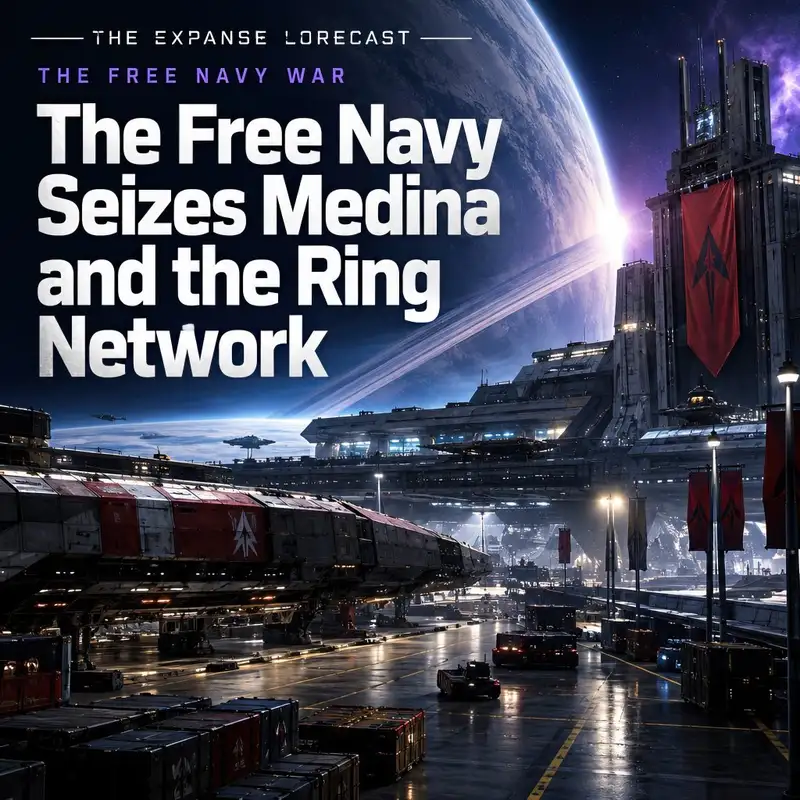
A ship approaching Medina no longer entered an open crossroads. It approached a border. Beyond the gate lay the slow zone, the artificial pocket of space at the center of the Ring network, with more than a thousand human destinations arranged around it. Near its center sat Medina Station, once the generation ship Nauvoo, then the improvised Behemoth, now a working hub for the largest transportation system humanity had ever built. Whoever controlled that station could delay ships, restrict messages, inspect traffic, and isolate colony systems from one another. Marco Inaros had not conquered the worlds beyond the gates. He did not need to. By seizing the station that connected them, the Free Navy placed a hand around the throat of the network that connected them.
That was the strategic revolution created by the Ring gates. They opened immense territory, but they did not distribute access evenly. Every colony world had its own distances, hazards, resources, and local politics. A gate might lead to a promising planet, but it did not deliver food to its settlers, repair a damaged water recycler, train a doctor, or build a replacement drive coil. Ships still had to pass through the central transit space. Messages, passengers, machinery, medicines, seeds, spare parts, and military reinforcements all depended on routes that crossed Medina’s jurisdiction. The gates multiplied destinations, but Medina concentrated movement.
Medina and the alien Ring Station were separate structures. The Ring Station was the immense nonhuman mechanism at the center of the Slow Zone, once capable of imposing the speed limit on every ship in that space. Medina was human-built and human-inhabited, a converted generation vessel with docks, workshops, communications, traffic control, administration, and all the machinery required to keep a settlement alive. The alien structure defined the geometry of the network; Medina made that geometry usable by human beings.
That usefulness gave the station military value, but military language can obscure what was actually at stake. Medina was more than a naval base waiting for a fleet commander. It was a workplace. It depended on technicians who kept systems running, crews who moved ships safely, administrators who reconciled schedules and claims, mechanics who repaired equipment, and support workers who maintained food, air, water, and habitable space. A station’s flag mattered less than who controlled its systems, who could issue orders, and who expected those orders to be obeyed. In the Free Navy conflict, Medina became a demonstration of how quickly an infrastructure hub could become a weapon.
Before Marco Inaros seized it, the political map of the Solar System was already unstable. Earth and Mars had spent generations balancing rivalry, deterrence, trade, and mutual suspicion. The Belt remained indispensable to both Inner planets while receiving neither equal political standing nor equal protection. Belter labor extracted resources, transported ice and ore, maintained stations, and carried much of the physical risk of life beyond planetary gravity wells. The grievances created by that system were real. So were the divisions among Belters over how to respond to them.
The Outer Planets Alliance was not a unified state. It was a broad and often contested political identity, a web of local movements, station interests, ship crews, mutual-aid networks, criminal organizations, labor activists, military cells, and competing leaders. Some factions sought accommodation with Earth and Mars. Some wanted autonomy through negotiation. Some believed armed struggle was unavoidable. Others simply wanted air, wages, water, and the ability to make decisions without distant governments or corporations treating them as expendable. Marco’s Free Navy drew strength from that accumulated anger, but it never represented the entire Belt.
Marco’s project was more centralized than his rhetoric suggested. He spoke in the language of Belter liberation, yet his practical method was coercion. He required ships, crews, weapons, discipline, intelligence, propaganda, and obedience from communities with their own interests. He used the language of a common people while building a command system centered on his authority. That contradiction would matter at Medina. A revolutionary movement can use a chokepoint to force attention. It cannot automatically use that chokepoint to create consent.
The Free Navy also did not stand alone. Behind its sudden military reach lay stolen and transferred Martian matériel, personnel willing to defect, black-market connections, and the covert support of Winston Duarte’s rogue Martian faction. Duarte was more than supplying an ally out of ideological fellowship. He had his own strategic project. He needed the old powers distracted, damaged, and divided while his followers built capacity beyond the Ring network. Marco’s war offered him time, secrecy, and cover. Marco gained ships and specialized support. Duarte gained a Solar System too consumed by its own crisis to watch what was being prepared elsewhere.
The opening phase of the Free Navy war was therefore not a conventional invasion in which one fleet sought decisive battle against another. It was a coordinated political and military shock. Earth was struck. Tycho Station was attacked. Other targets were threatened or disrupted. Communications fractured. Governments struggled to determine what had happened, which reports were reliable, and where the next attack might fall. The objective was more than destruction. It was to make every opponent feel alone.
That distinction explains why the opening offensive was so effective. A government may possess ships, weapons, personnel, and industrial capacity, but those assets matter only when leaders can identify the problem, communicate priorities, issue credible orders, and trust that subordinate commands share the same picture. Marco’s campaign attacked the system that made coordinated response possible. Earth had to confront catastrophe at home. Mars faced its own political and military instability. The Outer Planets Alliance was divided between factions that opposed Marco, factions that feared him, and factions that believed his success might finally force the Inners to recognize the Belt’s power.
In that confusion, Medina became vulnerable for reasons that were as institutional as they were military. The novels do not present its takeover as a fully described station assault. There is no reliable basis for inventing a heroic boarding action, a precise order of battle, a casualty total, or a sequence of breached compartments. What the record establishes is more revealing. During the opening offensive, Medina passed into Free Navy control. Captain Christina Huang Samuels, the station’s commander, switched allegiance to Marco Inaros.
That act was not a minor administrative detail. It was central to the seizure. A station cannot function through external force alone. Its systems are complex, its people are dispersed, and its work depends on continuous cooperation. Command access, traffic authority, maintenance crews, docking procedures, communications channels, and routine compliance all matter. Medina fell because the Free Navy gained not only access to the station, but also a local command structure prepared to recognize Marco’s authority. The change in allegiance converted a human institution into a strategic asset.
The seizure demonstrated a hard truth about infrastructure. A bridge, port, rail junction, or station may appear to belong to the government whose insignia is painted on the wall. In practice, it belongs to the people who operate it and to the political order that they believe will protect them, reward them, or punish them. Marco’s forces could threaten Medina. Samuels’s decision made their control practical. Once the station’s personnel and systems were brought under a new chain of command, the Free Navy could turn possession into policy.
That policy was transit control. The Free Navy restricted movement through the slow zone and controlled or cut communications between Medina and the systems beyond the gates. This did not grant Marco sovereignty over every colony world. A settlement on a distant planet could still govern itself, resist him, ignore him, or collapse under pressures he could not directly manage. Medina could not make a remote colony’s crops grow or compel every local militia to obey. But it could interfere with connection. It could decide which ships passed, which messages traveled, which cargoes arrived, and which communities were left to wait.
For prosperous and well-supplied settlements, delay might be painful but survivable. For newer colonies, mining outposts, research installations, and stations dependent on regular traffic, the same delay could be existential. Replacement parts did not arrive. Medical supplies became uncertain. Contracts could not be fulfilled. Passengers were stranded on the wrong side of the network. Families lost contact. A community that had planned its food reserves around a scheduled shipment might suddenly discover that strategic geography had become a problem in its hydroponics bay.
The effects were uneven, and that unevenness was part of the coercion. Marco did not need every colony to suffer equally. He needed enough uncertainty that local leaders, ship owners, merchants, workers, and residents would make decisions under pressure. A world with stores of food and functioning industry might endure isolation. Another world might possess valuable resources but lack the machinery to use them without imported components. One colony might have a stable government and organized defenses. Another might have only a few hundred people, a fragile settlement, and a ship that could not safely leave. Medina’s power lay in turning those differences into leverage.
The Ring network was often described as a road to new worlds. During the Free Navy conflict, it became clear that it was also a supply chain. Roads have gates, traffic rules, repair crews, customs offices, accident reports, and people whose lives depend on the next shipment arriving. The strategic value of Medina was not that it commanded abstract lines on a map. It commanded the conditions under which human communities could remain part of a larger civilization.
Marco understood the political theater of this. Holding Medina allowed him to claim that the Belt had taken control of humanity’s future. Earth and Mars had once controlled access to markets, technology, and security. Now a Belter-led force stood at the hub of the new interstellar order. That symbolism mattered. It answered generations of exclusion with a visible reversal. But symbolism could not solve the practical problem. A movement that had seized the transit hub still needed to provide order, safety, maintenance, and a credible reason for people to accept its authority.
The Free Navy’s control also depended on a defense that Marco could not create from local improvisation alone. Duarte’s faction supplied assistance that revealed the deeper architecture of the conflict. The Laconian-built Proteus arrived as evidence that Duarte’s followers had already begun to convert a remote colony system into an industrial and military base. Its significance was more than that it was another ship on Marco’s side. It showed that the Free Navy had access to specialized personnel and capacity outside the normal balance of Solar System power.
With Laconian assistance, heavy railgun defenses were installed on or around the alien Ring Station. Medina remained the human station that organized traffic and housed the personnel of the hub. The Ring Station was the alien structure positioned at the center of the slow zone. By placing defenses there, Marco’s side transformed the geometry of the transit space itself. The Free Navy occupied the administrative center. Duarte’s people helped turn the central alien infrastructure into a weapon.
The railguns did not make Medina invulnerable by magic. Fixed defenses always have limits. They require power, targeting, maintenance, personnel, and a way to distinguish threats from traffic. They can fail, be bypassed, be surprised, or be overwhelmed. But in the slow zone, they created a serious area-denial problem. Any force entering through a gate would arrive in a space whose central geometry favored the defenders. A fleet could not just assemble at leisure, maneuver freely, and demand surrender while hostile guns occupied the center of the operational picture.
The advantage was especially important because the coalition opposing Marco could not afford casual losses. The United Nations Navy, the Martian Congressional Republic Navy, and anti-Marco Outer Planets Alliance forces each brought different ships, doctrines, political obligations, and grievances. They could not replace trained crews or specialized vessels without cost. Nor could they risk losing access to the Ring network in a reckless attempt to recover it. The railguns forced them to confront the problem on Marco’s terms. Any direct assault risked ships, personnel, and the strategic future of every settlement beyond the gates.
For Duarte, that arrangement was ideal. Marco’s regime could present the defenses as protection for Belter independence. Duarte could use them to keep Earth and Mars out of the central transit space while Laconia continued to develop beyond their reach. The partnership was useful precisely because its aims were not identical. Marco wanted power now, recognition now, and a Belt-centered order now. Duarte wanted the existing system exhausted and divided while he built something that would eventually eclipse all of it.
That difference made the Free Navy’s apparent strength more fragile than it looked. A military force dependent on external suppliers and covert partners can gain sudden capabilities, but it may also inherit obligations it does not fully understand. Marco had railguns, Martian ships, and a strategic chokepoint. He did not control the entire industrial system that made those advantages possible. He was using the tools of a future imperial project while claiming to build an independent revolution. The contradiction would not defeat him immediately, but it limited what his victory could become.
The response to Marco’s offensive was slow because it had to be. Earth had suffered devastation on a scale that distorted every political calculation. Mars was reeling from defections, theft, and internal uncertainty. The Belt’s political landscape had become more dangerous, not more unified. Yet the very fact that Medina controlled access to the colony systems gave the fractured opponents a common objective. They did not need to agree on every question of history, justice, or postwar governance. They needed to recognize that no faction could allow Marco to retain the gatehouse indefinitely.
The Consolidated Fleet emerged from that necessity. It brought together elements of the United Nations Navy, the Martian Congressional Republic Navy, and Outer Planets Alliance forces opposed to Marco. This was not a sudden outbreak of trust. Earth had long treated the Belt as subordinate. Mars had its own reasons to fear both Earth and Belter power. Anti-Marco factions had to cooperate with institutions that many Belters regarded with justified suspicion. Fred Johnson’s death had also removed a figure who had served, however imperfectly, as a bridge among competing interests.
Coalition warfare begins with agreement on an objective, not with confidence in one another. The objective at Medina was clear enough. If the Free Navy controlled the transit hub, it retained strategic depth beyond the Solar System and leverage over colonies that might otherwise become sources of resistance, refuge, or support. If the coalition reopened the Ring space, Marco would lose the ability to isolate the worlds beyond it and to present himself as the master of humanity’s routes. Medina was more than one target among many. It was the point where military access, political legitimacy, and economic connection met.
The coalition could not solve Medina by sending a conventional fleet straight through the Sol gate. The railgun defense rewarded the side already in position, so the attackers dispersed Free Navy attention with pressure elsewhere and used deception to hide the decisive effort. Marco's centralized command made that uncertainty especially costly because his authority depended on appearing able to read the strategic picture better than everyone around him.
The Giambattista, an ice hauler repurposed for war, became the transport at the center of the assault. Escorted by the Rocinante and supported by a much larger coalition effort, it carried decoys, assault craft, people, and equipment toward a mission whose real purpose was narrow: disable the fixed defenses that made entry into Ring space prohibitive.
Bobbie Draper and Amos Burton took part in the assault on the Ring Station defenses, where the attackers encountered Martian personnel aligned with Duarte's breakaway faction. The coalition could not count on capturing the railguns intact. Bobbie's force destroyed the power source instead, trading the value of a captured weapon for the immediate operational necessity of making the guns unable to fire.
Once the fixed defenses were gone, Medina's commander could no longer rely on the shield that had kept the coalition outside the hub. The station surrendered, giving the coalition access to Ring space and stripping Marco of the infrastructure that had made his transit regime credible. Victory immediately created a new responsibility: Medina still had residents, docks, life support, communications, and traffic systems that had to keep working under new authority.
Marco still had ships and could still counterattack, which meant the fall of Medina was not the war's final event. Naomi Nagata's analysis of unexplained transit disappearances supplied the next possibility. She had not mastered the gates; she had identified a dangerous pattern involving traffic, mass, and energy. The coalition used that incomplete understanding in desperation when Marco moved to retake the hub, turning the network's own lethal behavior against the force approaching through it.
The result ended Marco's immediate attempt to recover Medina while exposing a larger danger. Humanity had learned enough about the Ring system to exploit one threshold under extreme conditions, but not enough to explain the mechanism or control the consequences. Medina was back in coalition hands. The infrastructure connecting human civilization was open again, and everyone now knew that the infrastructure itself could kill them.
Recovering Medina also exposed the coalition's own legitimacy problem. The station could no longer be treated as a trophy or a captured fortress. It was a populated transportation hub whose residents, dock crews, maintainers, traffic controllers, and administrators kept the network usable for everyone else. Earth and Mars could provide ships and emergency support, but simply replacing a Free Navy flag with Inner military rule would have reproduced the political imbalance Marco had exploited. The hub needed security without becoming an occupied prize, and authority that could keep traffic moving without pretending that one government now owned humanity's new frontier.
The Laconian connection made that settlement more urgent. The Martian personnel found around the fixed defenses were evidence that Marco's strongest position had depended on a breakaway project operating beyond the immediate war. Medina could be recovered from the Free Navy while the deeper source of that support remained outside the coalition's reach. The victory therefore closed one campaign and exposed another strategic problem: the network was too important to leave under a warlord, yet too vast and politically contested to be governed safely as the possession of any single old power.
Medina’s seizure had begun as a triumph of synchronized surprise. Marco struck a divided system, used local allegiance, exploited external support, and transformed a working station into a blockade instrument. He showed that a force too weak to defeat Earth, Mars, and every rival Belter faction in open conventional war could still seize the place that connected all of them. He understood that geography could compensate for limited numbers, especially when geography was reinforced by fear, communications control, and the political paralysis of his enemies.
But the same strategy contained its own limits. Control of access was not control of people. Medina could isolate colonies, but it could not make them loyal. It could delay supply, but it could not create food, repair trust, or govern distant communities through local crises. The Free Navy could claim to have liberated the future of the Belt while depending on Duarte’s hidden industrial power and enforcing its authority through coercion. It could occupy the central station without building an order that workers, colonists, and rival factions would accept as legitimate.
The coalition won Medina because it eventually recognized that the station was more than a prize. It was infrastructure. It was the practical connection among worlds that had become dependent on one another without first becoming politically equal. The Free Navy proved that the Ring network had created a new center of power. Its defeat proved that no fleet could hold that center securely through fear alone. A gatehouse can be seized in a crisis. Governing the civilization that passes through it requires something more durable than possession.