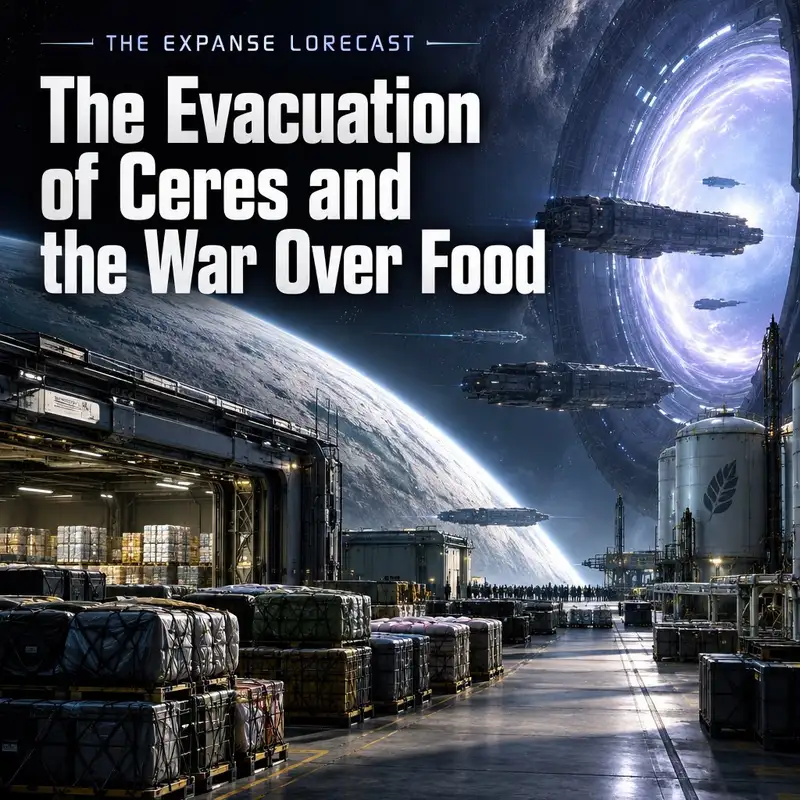
The Evacuation of Ceres and the War Over Food
The coalition fleet came to Ceres expecting a fight. It had every reason to. Ceres was not just another Belt station. It was a population center, a port, a political symbol, and one of the places where whoever claimed to speak for the Belt could most visibly demonstrate that claim. A defending force could have used its docks, its traffic, its civilian density, and its local knowledge to make an assault costly. Instead, the arriving ships found something more troubling than a prepared defense. The Free Navy had gone. Its warships, personnel, weapons, and useful stores had withdrawn. Much of the machinery needed to make the station function had gone with them, been stripped for parts, or been left degraded beyond immediate use.
Marco Inaros described this kind of withdrawal in the language of war. He had denied assets to an advancing enemy. That was true, as far as it went. But Ceres was home to millions of people who did not leave with the Free Navy. The military evacuation was real. The humanitarian evacuation was not. The distinction mattered because the station Marco abandoned was not an empty fortress. It was a complex habitat whose population depended on power, water, air systems, medicine, cargo traffic, technicians, and food arriving on schedule. The coalition took Ceres without a battle, then inherited a crisis large enough to shape the rest of the war.
That was Marco’s calculation. A fleet can flee. A station cannot. The Free Navy could preserve its mobile forces while forcing Earth, Mars, and Marco’s Belter opponents to spend ships, supplies, and political attention on a wounded civilian population. The maneuver was not senseless cruelty. It had a coercive logic. Make the enemy choose between pursuing the war and keeping Ceres alive. Make relief expensive. Make the old Inner powers return to a major Belt station as occupiers and providers, where every shipment of food could be presented as proof of dependence.
But the maneuver also exposed a problem at the heart of Marco’s project. He could seize food. He could capture cargo ships. He could threaten the routes that carried supplies through the Solar System. He could not rapidly build an agricultural base, restore a damaged food network, train replacement specialists, or create a stable government capable of managing scarcity without terror and theft. Ceres became the clearest evidence that possession was not the same thing as capacity.
Food had always been political in the Belt. It was also industrial, agricultural, medical, logistical, and technical. A cargo hold full of packaged meals could keep a crew alive for a while. It could relieve a station during an emergency. It could be traded, rationed, withheld, or stolen. It was not, by itself, food security. Food security required growing infrastructure, water, nutrients, lighting or solar input, processing equipment, storage, transport, repair crews, data, trained agricultural workers, and a public authority able to distribute supplies before panic, hoarding, or armed coercion broke the system apart.
The Belt had never been fully separate from the economies of Earth and Mars. Its stations and ships produced minerals, ice, fuel, transport services, maintenance work, and the labor that kept much of interplanetary civilization moving. In return, many Belt communities depended on imports, contracts, and systems controlled elsewhere. That dependence was not an accident of geography alone. It reflected generations of unequal development. The people who lived in low gravity, worked dangerous jobs, and kept distant stations habitable often had less political power than the governments and corporations that profited from their labor.
That inequality gave Belter political movements their force. It also made the Belt vulnerable in war. A station could have skilled mechanics, experienced pilots, independent crews, local farms, recyclers, and stubbornly capable people, while still lacking the industrial depth to survive a prolonged rupture in system-wide trade. The same was true of ships. A vessel might carry enough supplies for its crew, but a whole population required regular movement of bulk goods, spare parts, medical supplies, and food. The Epstein drive made that movement practical across the Solar System. It did not make it free, automatic, or immune to blockade and sabotage.
This was why the language of liberation could become dangerous when it treated supply as a simple matter of ownership. Seizing a shipment changed who had it today. It did not answer who would grow the next harvest, repair the next recycler, fuel the next freighter, or protect the route that moved food from production to the people who needed it. War could rearrange cargo. It could not ignore the calendar of crops, machinery failures, and human hunger.
The Ceres crisis had roots well before Marco’s withdrawal. One of the most important was Ganymede. In the years before the Free Navy War, Ganymede was a major agricultural center, particularly important to food supply in the outer planets. It was not the sole source of food for humanity, and the Solar System was not sustained by one moon alone. But Ganymede represented something that much of the Belt could not easily replace: large-scale agricultural infrastructure built to produce food under controlled conditions and distribute it through established trade networks.
The fighting around Ganymede during the events of the earlier crisis damaged that infrastructure badly. Agricultural domes, mirrors, habitats, power systems, and the surrounding social order all suffered. The military event was immediate and visible. The food consequences were slower. A damaged warship might be repaired, cannibalized for parts, or replaced by a yard with enough resources. A damaged agricultural system required time. It required stable conditions. It required growers, engineers, biologists, transport crews, and administrators who could coordinate recovery while everyone around them argued about security, money, jurisdiction, and blame.
Praxidike Meng understood this better than most military commanders because he worked inside that system. Prax was an agricultural scientist, not a fleet admiral or political leader. His importance lay precisely there. He represented the kind of expertise that becomes strategically decisive during a shortage and is often ignored until the shortage arrives. Agricultural data, crop conditions, soil and nutrient systems, recovery plans, and the knowledge held by specialists could matter as much as a captured ship. A war could destroy the physical systems of food production in hours. Rebuilding them required years of careful work.
Ganymede’s damage did not guarantee famine on its own. Systems have reserves. Governments can divert cargo. Stations can ration. Other production centers can compensate, at least for a time. But the destruction removed margin from a civilization that depended on narrow margins. It made every later disruption more dangerous. When one agricultural center loses output, the burden shifts elsewhere. When cargo traffic becomes uncertain, reserves become harder to move. When workers flee or are killed, machinery becomes less reliable. When governments begin treating food as leverage, every shipment becomes a political event.
Then the Free Navy struck Earth. Marco’s attacks were intended to do more than kill. They were meant to demonstrate that the old powers could not protect their own populations, could not guarantee security, and could not maintain the political order that had placed the Belt beneath them. The attacks created devastation on Earth and immense fear across the system. They also forced the United Nations government to focus on planetary survival, emergency response, and the possibility of further strikes. For a time, that strategic shock gave Marco room to maneuver.
The Free Navy used that opening to seize influence across Belt space, raid shipping, gather supplies, and present itself as the armed expression of Belter independence. Medina Station and the Ring network gave the war another strategic dimension. Control over the routes through the gates could shape who moved where, which colonies received support, and what future political order might emerge beyond the old Solar System. Marco’s movement was more than a fleet of raiders. It had captured ships, access to Martian military technology, political allies, propagandists, administrators, and enough armed power to make every government in the system take it seriously.
Its grievances were not imaginary. Belters had endured exploitation, neglect, discrimination, and political exclusion for generations. Earth and Mars had both benefited from systems that demanded Belt labor while denying Belt communities equal influence over their own lives. Marco’s appeal drew strength from that history. Many people who did not share all of his ambitions still understood why his message found an audience. A historian has to keep that distinction clear. The reality of the grievance does not make every strategy built upon it sound, and it does not make the Free Navy identical with the Belt.
Marco’s war had a contradiction from the beginning. He sought independence by attacking the interconnected system that sustained the people in whose name he claimed to fight. Earth was more than an enemy capital. It was also part of the larger production, transport, and technical network on which the Belt still depended. Mars was a rival power, but Martian industry, ships, trained personnel, and commerce were similarly embedded in the system. Ganymede’s agricultural disaster had already weakened food supply. Earth’s bombardment damaged not only lives and cities, but government capacity, transport, industry, and the ability to help stabilize shortages elsewhere.
Marco could argue that dependence itself was the problem, and in a sense he was right. The Belt’s dependence on Inner-controlled systems was politically intolerable. But breaking dependence is not the same as breaking the systems of exchange overnight. A revolution that destroys its supply base before building a replacement has not achieved autonomy. It has created a new form of vulnerability. The Free Navy’s answer to that vulnerability was seizure, intimidation, and redistribution under military command. Those methods could produce immediate gains. They could not substitute for a durable political economy.
The Free Navy’s internal structure made that weakness worse. Marco Inaros held military authority through personal charisma, ideological appeal, fear, patronage, and a record of spectacular violence. Around him stood people with very different interests and functions. Anderson Dawes represented an older style of Belt politics, rooted in station governance, negotiation, and the difficult practice of keeping communities alive under pressure. Michio Pa commanded ships and crews that had joined Marco’s cause but retained their own judgment and loyalties. Rosenfeld Guoliang served as an important political and organizational presence within Marco’s circle. Nico Sanjrani dealt with the financial and administrative reality behind the rhetoric.
This was not a stable state apparatus. It was a coalition held together by momentum. Some supporters believed in Marco. Some feared him. Some hoped the war would finally secure real power for the Belt. Some saw opportunities for advancement, revenge, or survival. Captured military equipment could strengthen such a coalition, but it could not make its authority impersonal or reliable. A government can survive the loss of one shipment if it has institutions. A movement organized around one leader’s will must keep demonstrating success, because failure encourages rivals to ask whether the leader’s orders still deserve obedience.
Warships made the Free Navy dangerous. Captured Martian matériel gave it capabilities that many Belter factions had never possessed. But warships did not produce food. Torpedoes did not repair water systems. A captured supply vessel did not train doctors, maintain agricultural habitats, or establish public confidence that rationing would be fair. The Free Navy had weapons and mobility. It did not have enough administrative depth to govern a population-scale emergency across the Belt, Earth, Mars, and the newly opened worlds beyond the gates.
That distinction became sharper after the capture of the Azure Dragon. The operation mattered because the ship was connected to the Free Navy’s ability to coordinate the threat of further asteroid strikes against Earth. As long as the United Nations government believed another catastrophic bombardment might be directed with little warning, much of its attention and military capacity had to remain tied to planetary defense. The problem was more than finding hostile ships. It was understanding the network that made the attacks possible and interrupting it before another weapon was sent inward.
The loss of the Azure Dragon weakened that immediate coercive mechanism. It did not end the war, and it did not make Earth safe in any absolute sense. The damage already done could not be undone by one successful operation. But it gave the coalition more freedom to act. United Nations, Martian, and OPA-aligned forces could begin shifting attention toward Free Navy positions that had been too dangerous or too politically difficult to confront while Earth remained under the shadow of additional strikes.
Ceres was one of those positions. The coalition’s movement toward the station threatened Marco with the loss of a major political center and logistical hub. A conventional commander might have chosen to defend it, accept battle, and try to make the attackers pay heavily for every kilometer of approach and every dock secured. Marco chose a different course. He would not allow the coalition to capture a working Ceres. He would make it capture the consequences.
The withdrawal was systematic. Free Navy ships and personnel left before they could be trapped. Weapons, ammunition, useful military stores, and defensive matériel were removed. Communications and sensor equipment, medical supplies, logistics assets, and other infrastructure with value to the departing force were taken where possible. Other systems were dismantled, sabotaged, or degraded. The purpose was more than to deny the coalition a convenient base. It was to make the station harder to stabilize, harder to defend, and harder to use as a platform for further operations.
The exact condition of every system on Ceres is less important than the pattern. A station does not become helpless only when its hull is breached. It can be crippled by the loss of power capacity, maintenance equipment, replacement parts, medical stores, trained personnel, traffic control, security systems, or the machinery that moves water and supplies through daily life. A habitat survives through layers of routine labor. Strip enough of those layers away, and the failure begins to spread. Pumps need power. Power systems need technicians. Technicians need food, sleep, medicine, and confidence that their families will remain alive long enough for the work to matter.
The novel’s account places Ceres at roughly six million residents during this period. It suggests that perhaps one and a half million people escaped before the coalition arrived. Those figures should be understood as approximate measures of scale within the story, not a certified census. What matters is the implication. Several million civilians remained behind. They were not all Free Navy supporters. They were not all political actors. They were station workers, families, traders, technicians, patients, children, people with no ship access, and people who had nowhere else to go.
Calling this an evacuation concealed more than it explained. The Free Navy evacuated its own capacity to fight. It did not evacuate Ceres. It abandoned Ceres’s population after removing much of what would allow that population to endure the next phase of the war. Marco had transformed a strategic node into a hostage without physically remaining to guard it. If the coalition diverted resources to relief, he could claim it had been forced to spend its strength saving the Belt. If it failed to do so, he could present the suffering as evidence that Earth and Mars had never cared about Belter lives.
The tactical result favored Marco in one narrow sense. His ships escaped. His personnel avoided capture. His military stores did not fall intact into coalition hands. The operational result was more complicated. Ceres became difficult for the coalition to use immediately, and the arriving forces had to devote time and resources to emergency stabilization. But the civilian result was catastrophic in principle even where the exact damage remained uncertain. Millions of people faced a future shaped by shortages, failing systems, fear, and the knowledge that the force claiming to defend Belter independence had taken what it could carry and left them behind.
The coalition’s victory at Ceres was therefore not a triumphal occupation. It was an emergency administration. United Nations, Martian, and OPA-aligned forces had to secure docks and infrastructure, establish order without treating the population as an enemy, assess damaged systems, arrange medical care, find food, restore transport, and coordinate workers who had every reason to distrust the governments now arriving with soldiers and supplies. War had turned a military objective into a humanitarian responsibility.
Chrisjen Avasarala understood the political danger. Earth had suffered an extraordinary disaster. Its own population needed food, shelter, medical support, and reconstruction. The United Nations government did not have unlimited ships or unlimited public patience. Mars had its own political strains and its own reasons to question how much it should spend saving a Belt station. Yet leaving Ceres to collapse was not a viable strategic option. It would have been a human catastrophe. It would also have confirmed Marco’s story that the Inner powers cared only about control.
Relief had to arrive, but relief was never politically neutral. Food sent from Earth or Mars was life-saving aid. It was also a visible return of Inner authority to a station with a long history of resentment toward Inner rule. Security forces could prevent looting, violence, and further sabotage. They could also look like occupiers. Cargo inspections could protect scarce supplies. They could also feel like domination to people who had spent their lives being inspected, regulated, and exploited by distant institutions. The coalition could not just win Ceres with ships. It had to govern its own conduct.
That required restraint as well as competence. A station population cannot be bullied into trust by a fleet. It can be frightened into temporary compliance, but fear does not repair pumps or persuade hungry workers to accept a ration system they believe is corrupt. The coalition needed local knowledge, local labor, and political partners who could speak to Ceres as a community rather than a conquered prize. It needed to show that the Free Navy’s departure had not left civilians with only two choices: submit to Marco’s ideology or return to old forms of Inner subordination.
This is where Marco’s calculation began to reverse itself. He had correctly understood that the coalition would have difficulty ignoring Ceres. He had not fully understood what a successful relief effort could mean. Every repair crew, food shipment, and restored service was evidence that his movement had chosen destruction where others had chosen responsibility. The coalition’s aid did not erase the historical grievances that had made Marco powerful. It did not make Earth or Mars innocent. But it created a practical comparison between competing claims to represent the Belt’s future.
Michio Pa saw that comparison from inside the Free Navy. She had joined the struggle against the old order, and she had commanded ships in Marco’s coalition. She was not an outsider who failed to understand Belter anger. Her break with Marco came because she recognized what the abandonment of Ceres meant. The war was no longer merely forcing the Inners to acknowledge Belter power. It was consuming the people and communities that any genuine Belter future would require.
Her mutiny aboard the Connaught was therefore more than a personal revolt. It was a challenge to Marco’s right to define the cause. Pa and those who followed her turned toward the redistribution of supplies to threatened Belt stations. In the immediate emergency, that mattered. A cargo vessel redirected to a hungry population could mean the difference between survival and death. A shipment seized from the Free Navy could keep a station operating long enough for another source of aid to arrive. Redistribution was not a small thing in a crisis.
But Pa’s campaign also revealed the limits of what raiding could accomplish. Captured food could delay starvation. It could not restore Ganymede’s agricultural capacity. It could not replace the experienced workers scattered by war. It could not guarantee that the next shipment would arrive or that a damaged station system would keep functioning. A movement that redistributed goods more fairly was morally and politically different from one that hoarded them for military power. Still, fairness in distribution was not the same as production. Survival required both.
Marco understood the threat Pa posed. He could tolerate disagreement only so long as it did not interrupt his command. A commander who loses ships, crews, and legitimacy to a rival cannot dismiss the problem as a private argument. Pa’s mutiny turned an internal moral objection into an operational fact. Ships that had served the Free Navy were now moving supplies outside Marco’s control. Crews who had fought under his banner were demonstrating that Belter identity did not require obedience to him.
His response was familiar to authoritarian movements under pressure. Defectors became collaborators. Dissent became betrayal. The language simplified a complicated political reality into a test of loyalty. It was useful because it avoided the actual question. Had Marco’s war become a threat to the Belt? If the answer could not be debated, then the debate had to be recast as treason. But coercion could preserve obedience only where fear remained stronger than the evidence of failure. Ceres gave that evidence a station-sized form.
The fight over food was therefore also a fight over legitimacy. A leader who controlled a shipment could reward allies and punish rivals. A captain who redirected that shipment could prove that another kind of authority existed. A government that organized relief could gain trust, even if its past conduct made that trust reluctant. The politics of hunger were never abstract. They appeared in who got medical supplies, whose station received cargo, which dock workers were believed, whose family could leave, and whether a commander saw civilians as citizens or as burdens.
Nico Sanjrani’s calculations put a colder frame around the same problem. His assessment suggested that the resources still available might sustain Earth, Mars, and the Belt for roughly three years, perhaps three and a half, before the combined effects of damaged agriculture, disrupted recycling, failing infrastructure, and supply breakdown drove the crisis toward something far worse. That was not a prophecy delivered from outside the story. It was an in-universe assessment, subject to incomplete data and changing conditions. Even so, it showed that the people handling the Free Navy’s material reality understood the scale of the danger.
Three years of reserves would sound like abundance to a starving person. At the level of civilizations, it was a deadline. Reserves are not a solution if the systems that replenish them are damaged. A stockpile declines. A recycler wears out. A cargo route is interrupted. A station loses qualified maintenance workers. A political dispute blocks a shipment. A crop fails. Each event may be survivable in isolation. Together, they create compounding risk. The shortage becomes worse not only because there is less food, but because there is less capacity to respond when something else goes wrong.
Marco’s public rhetoric could promise a new order built on Belter strength. Sanjrani’s arithmetic pointed toward a harsher truth. The war was consuming the productive base of every faction. Earth had been devastated. Mars was destabilized. Ganymede had been damaged. The Belt’s supply network had been broken into armed fragments. The Free Navy could seize what remained, but it could not make consumption into production. It could only decide who suffered first.
That is one of the central limits of revolutionary war finance. Raiding can fund a campaign. It can provide ammunition, ships, and political leverage. It can even redistribute wealth from an old elite to a new coalition. But it is parasitic on an economy that must continue functioning somewhere. The more completely a movement wrecks the system it raids, the more it turns military success into a countdown. Marco’s strategy needed a constant flow of captured goods and frightened obedience. It had no demonstrated path to rebuilding the system on which those goods depended.
Prax’s work on agricultural recovery offers the opposite model. It was slow, technical, and nearly invisible beside fleet actions and political speeches. It involved information, expertise, and cooperation across damaged institutions. Data from Ganymede could help people understand what remained viable, what had failed, and how recovery might begin. That kind of work did not provide the emotional satisfaction of a captured warship or a defeated enemy. It did something more important. It made a future conceivable.
The people who keep a civilization alive rarely appear in its victory parades. They are growers, water technicians, cargo crews, station engineers, medical workers, recyclers, mechanics, cooks, planners, and the people who know which system will fail if a replacement part does not arrive before the end of the week. Their work can look ordinary until it stops. Then governments discover that no amount of martial language can replace a person who knows how to keep a food processor running under emergency conditions.
This did not mean the military struggle had become irrelevant. The Free Navy still had ships. It could still kill, raid, threaten, and force dangerous choices. But Ceres had stripped away a central claim behind Marco’s leadership. He had promised that armed Belter power would secure a livable future. Instead, he had demonstrated that his command would sacrifice a major Belter population to preserve its own military freedom. His war could still compel attention. It could no longer easily claim to be building the institutions that survival required.
The Free Navy was eventually defeated, but the military conclusion alone did not solve the problem exposed at Ceres. A defeated fleet did not by itself repair Ganymede. It did not rebuild Earth. It did not restore trust between Belt communities and Inner governments. It did not settle the question of who would control the transport routes, labor systems, and gate traffic that connected the Solar System to the new worlds beyond the Ring network. A return to the old arrangement would have invited the next war.
About six months after the conflict, Ceres became the setting for a political settlement that tried to address the structural issue Marco had exploited and then worsened. The Transport Union gave the Belt formal authority over the intersystem transport network. Transport was more than an economic service. It was the movement of food, water, people, repair parts, medicine, fuel, and opportunity.
The new arrangement recognized that the people who operated the routes needed real authority over them. It converted Belter knowledge of ships, stations, traffic, and survival in space into political power and created, at least in principle, a way to regulate gate access without simply handing that leverage back to Earth or Mars.
Ceres showed the difference with brutal clarity. Marco Inaros did not fail there because he lost a station. He failed because he treated civilians, workers, infrastructure, and food supply as expendable instruments in a war for personal command. He could remove ships from Ceres. He could not remove the obligations of governing the people left behind. By abandoning them, he proved that independence without production, distribution, and political responsibility was only another form of domination.