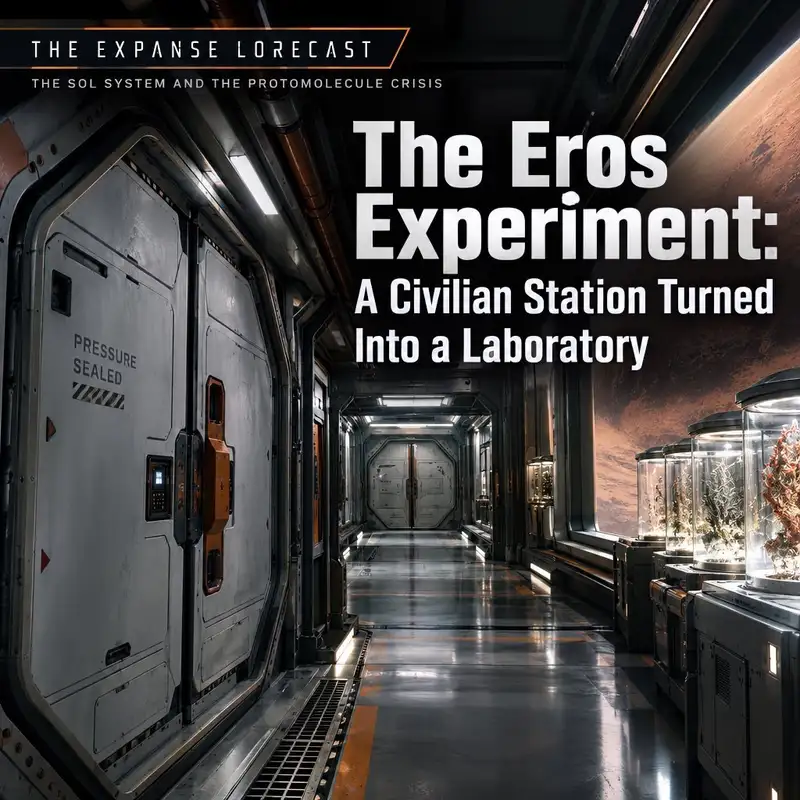
The Eros Experiment: A Civilian Station Turned Into a Laboratory
The radiation alarm did not ask the people of Eros to be brave. It asked them to be practical. Go to the shelters. Follow the transit instructions. Collect iodine. Wait for medical guidance. On a station carved into an asteroid, those were not abstract civic rituals. They were survival habits. A pressure failure, a fire, a radiation leak, or a contaminated water line could kill people far from any hospital or rescue ship. Eros had taught its residents to trust certain signals because the alternative was chaos, and chaos on a crowded station could be lethal before anyone understood what had gone wrong.
That was the mechanism Protogen exploited. The warning system was real. The shelters were real. The personnel directing people through checkpoints and transit corridors were real. But the emergency was staged, and the protections offered to civilians were part of the attack. Eros was turned into a laboratory not by replacing civilian life with an obvious military occupation, but by converting the ordinary systems that made civilian life possible into tools of concentration, exposure, and observation. A station built to keep people alive became a controlled environment in which roughly one and a half million human beings could be used as experimental material.
The scale matters. In the novel continuity, Eros is home to approximately one and a half million people. That population includes miners, dockworkers, technicians, merchants, service employees, families, travelers, and people caught between contracts or transport routes. It is overwhelmingly Belter, but it is not an armed political bloc and it is not synonymous with the Outer Planets Alliance. Like any large human community, Eros contains competing loyalties, local institutions, informal networks, criminal groups, people with political commitments, and many people trying to keep their jobs, raise children, and maintain enough air, water, and credit to survive another month.
Its vulnerability came from the nature of station life. Eros had controlled docks, monitored internal transit, limited exits, dense habitation, and life-support systems managed through institutions most residents could not personally inspect. In a terrestrial city, a frightened civilian might leave a neighborhood, find another road, or simply walk away from a police line. On Eros, escape required access to a ship, clearance through a dock, fuel, money, and somewhere to go. A person could resist an order. A population trapped inside an asteroid could not easily evade the infrastructure enforcing it.
That did not make Eros uniquely helpless, and Protogen did not choose it for one simple reason. The station was valuable precisely because it was populated, functional, and connected to the wider economy. But its peripheral political position made the operation easier to conceal. Belter communities lived under unequal protection. Their labor was indispensable to the Solar System, yet their security was often treated as negotiable by Inner governments, corporations, and local authorities. That imbalance did not cause every crime in the Belt. It did create conditions in which a private organization could imagine sacrificing an entire station and expect the political consequences to remain manageable.
Protogen’s interest in Eros began with something humanity did not understand. The protomolecule had been discovered on Phoebe, where evidence suggested that it was not a conventional pathogen, not merely an exotic organism, and not a human weapon. It was an engineered alien system. It could use biological material, alter it, organize it, and build with it. That much was evident. What it was built to do, who had made it, and what conditions would activate its deeper functions remained uncertain. For a cautious scientific institution, that uncertainty would have been a reason for containment. For Protogen, it became an argument for escalation.
The organization wanted to know what the protomolecule would do when exposed to a large, complex human population. It wanted data on its behavior, its rate of transformation, its ability to incorporate human biology, and perhaps its military potential. Those aims existed inside a wider contest for power. Whoever understood the protomolecule first might acquire not only scientific knowledge, but leverage over Earth, Mars, the Belt, and any future rival. The danger was real. The response was monstrous. Protogen treated the lack of knowledge as permission to create more victims.
Julie Mao became the bridge between the hidden research program and Eros. She had joined an Outer Planets Alliance-linked effort connected to the investigation or seizure of a protomolecule-related operation. Her involvement brought her aboard the stealth ship Anubis, where she was captured and infected. She escaped, badly injured and already undergoing changes she could not comprehend. By the time she reached Eros, she was isolated, frightened, and dying. She checked into the Blue Falcon Hotel under the false name Lionel Polanski, trying to survive long enough to understand what had happened to her.
Julie was not the first human being ever exposed to the protomolecule in any meaningful sense. Phoebe came before her, and the hidden program had already produced death, secrecy, and experimentation. But her arrival on Eros created a critical opportunity. Her infected body became a viable source of material for Protogen’s researchers. After her death, the people hunting her no longer had to rely on remote samples, uncertain containment, or limited observations. They had evidence that the protomolecule could act on human biology in ways that were horrifying, active, and potentially scalable.
The transition from Julie’s death to the Eros experiment reveals the character of the operation. There was no public declaration of emergency. No accountable government admitted responsibility. No medical authority asked for consent. Instead, a corporate network moved from clandestine research to population-scale experimentation behind the cover of private security, commercial jurisdiction, and political confusion. It did not need to persuade the people of Eros that they were participating. It only needed to control the systems through which they received information, medicine, transportation, and instructions.
Protogen was more than a laboratory. It was a corporate-scientific-security apparatus connected to Jules-Pierre Mao’s resources and influence. It could finance research, move personnel and equipment, employ private armed forces, construct or acquire military-grade assets, conceal information, and manipulate the political environment around its work. It had the advantages of a state without the full obligations of a state. Its personnel could claim they were contractors, researchers, guards, or specialists. Its sponsors could deny direct involvement. Its crimes could be dispersed across compartments until no individual office appeared to own the entire operation.
That fragmentation was not accidental. Modern institutions often distribute responsibility because distributed responsibility is efficient. A security contractor can say it followed emergency orders. A researcher can say the sample came from another department. A logistics officer can say only that equipment was shipped under sealed authorization. A sponsor can say the details were handled by experts. In ordinary administration, that division of labor can make a complex organization function. In a covert atrocity, it can make a complex organization difficult to confront. Everyone holds one part of the machine, while the machine’s purpose remains visible only from a distance.
Antony Dresden stood near the center of that machine. He was the senior scientific advocate associated with the Eros experiment and the research program at Thoth Station. Later, when confronted, he argued that humanity faced an alien threat and that the protomolecule had to be understood before someone else used it first. There was a strategic logic inside that fear. The Solar System had encountered technology from a civilization vastly older and more capable than humanity. Ignoring it would not make it disappear. But Dresden’s conclusion did not follow automatically from the premise. A threat can be real and still be answered with methods that are reckless, criminal, and strategically self-defeating.
Protogen’s security layer made the experiment operational. CPM personnel, including people drawn from criminal networks around Ceres, provided surveillance, intimidation, movement control, and local coercive capacity. Their presence mattered because a research plan could not infect a million and a half people by itself. Someone had to control access points. Someone had to monitor transit routes. Someone had to secure equipment, isolate witnesses, direct frightened civilians, and ensure that resistance remained fragmented. The company did not need to deploy a national army. It needed enough armed and connected people to turn a civilian station’s routines into a controlled process.
The use of criminal and private-security personnel also reduced political visibility. A national military deployment would have raised alarms. Warships, uniforms, and formal orders create records and provoke countermeasures. Contractors and local enforcers could blend into the station’s existing insecurity. They could be explained away as additional security during a crisis. They could operate under commercial authority rather than public law. That did not make them less responsible. It made the chain of responsibility easier for their employers to obscure.
Once the operation began, Eros itself became the apparatus. Surveillance systems identified movement. Checkpoints restricted it. Internal transit helped channel residents toward designated areas. Shelters became collection points. Medical distribution became a means of exposure. Dock control limited escape. Lockdowns separated groups that might otherwise share information or organize resistance. Communications could be monitored, interrupted, or directed through channels that served Protogen’s needs. The station’s architecture did not merely contain the victims. It provided the geometry of the experiment.
The false radiation emergency was particularly cruel because it used knowledge acquired through ordinary life in space. Residents knew that radiation could be invisible. They knew that delay could be fatal. They knew that medical instructions might have to be followed before the danger was fully explained. Protogen counted on that. The promise of iodine and protection encouraged compliance. The shelter system concentrated people. The result was exposure to the protomolecule alongside lethal radiation. The public language of safety remained in place while the actual function of the operation had been inverted.
This was not simply a takeover by force. Force was present, and the threat of force mattered. But deception was more efficient than constant violence. People went where they were told because the instructions resembled the procedures that had kept them alive in previous emergencies. A station population cannot function if every alarm is assumed to be a conspiracy. Protogen weaponized that necessary trust. The victims were denied informed consent, denied a reliable account of the danger, denied meaningful access to escape, and denied treatment for an exposure their supposed protectors had arranged.
For a brief period, Protogen achieved something resembling tactical control. It controlled the timing of the emergency, the movement of much of the population, the delivery of contaminated materials, and the collection of data. But tactical control is not the same as command. The company could arrange conditions. It could not predict the full behavior of the protomolecule. The experiment was based on an arrogant assumption: that an alien system could be activated, observed, and eventually used without first being understood. Eros would demonstrate that human institutions could manipulate the beginning of a process without owning its end.
Josephus Miller and James Holden encountered that reality from different directions. Miller arrived on Eros because he was investigating Julie Mao’s disappearance. He was a detective, not a scientist or a fleet commander. His pursuit of Julie began as a missing-person case shaped by personal fixation, professional frustration, and the fractured politics of the Belt. But the evidence on Eros transformed the investigation. The dead woman in the Blue Falcon Hotel was no longer only Julie Mao. She was evidence of a hidden program, an infected human being, and a link between a vanished ship, private power, and a threat no police department was prepared to investigate.
Holden and the crew of the Rocinante arrived with their own reasons to search for Julie and understand the events surrounding the Canterbury and the Donnager. Their presence did not give them command of the crisis. It gave them mobility, technical capability, and eventually a way out. Holden could recognize that the situation was larger than a local criminal case. Naomi Nagata could help interpret systems and risks. Amos Burton could keep people moving through a deteriorating security environment. Alex Kamal could get the Rocinante clear of a station becoming increasingly dangerous. Their importance lay in what they witnessed and survived, not in any fantasy that one small ship could impose order on Eros.
Inside the shelters, the shape of the crime became unmistakable. The civilians gathered there were not receiving protection. They were infected, dying, transformed, or already beyond help. The station’s emergency systems had become a delivery mechanism for mass exposure. At the same time, the social order on Eros began to break down. Lockdowns created panic. Security personnel were compromised or openly hostile. Riots and desperate movement made reliable information scarce. People tried to flee a disaster whose nature they could not see and whose architects had every reason to keep them confused.
Radiation added a cruel operational clock. Holden and Miller could not simply remain on Eros until they had solved every mystery. Exposure produced a time-sensitive medical emergency. The Rocinante’s medical resources gave them a chance that most station residents did not have, but even advanced treatment did not make radiation harmless. The contrast is important. The survivors escaped not because they were immune, morally superior, or uniquely capable. They escaped because they had access to a ship, a crew, medical support, and an exit route. Most of Eros had none of those things.
The evidence also revealed that the massacre was not an uncontrolled accident abandoned by frightened researchers. Eros was transmitting information to Thoth Station. Somewhere away from the dying population, Protogen personnel were receiving data from the experiment. That link was one of the most important discoveries in the entire crisis. It converted suspicion into a trail. A station-wide catastrophe could be described as an outbreak, a sabotage attack, an accident, or a consequence of war. A live research connection demonstrated that someone was watching.
Remote observation insulated the experimenters from the human reality of their work. They did not have to walk through shelters filled with dying families. They did not have to hear every alarm or see every person forced through a checkpoint. They could receive results as measurements, transmissions, and reports. Distance made the science possible in a narrow administrative sense. It also made moral evasion easier. The people running the experiment had physically separated themselves from the population whose deaths they had ordered, then treated that separation as professionalism.
That separation also protected the project politically. The people handling security, station access, communications, and data collection did not all need the same knowledge or the same motive. Some could believe they were enforcing an emergency. Others could treat the task as a contract. Researchers farther away could focus on results. Compartmentalization reduced the number of people capable of exposing the whole operation, but once the data link to Thoth was discovered, the same architecture became a map. The experiment had left a trail from the victims back toward the institution that designed their deaths.
The data escaping Eros pointed investigators toward Thoth Station, where Protogen’s research network could be confronted more directly. That raid mattered because it shifted the crisis from observing an atrocity to identifying the people and institutions that had designed it. Captured records and personnel helped strip away the idea that Eros was an accident produced by one failed experiment.
Antony Dresden’s defense of the project made the logic explicit. Protogen believed the protomolecule represented a discovery so consequential that normal ethical restraints could be suspended until humanity understood it. The argument acknowledged the scale of the unknown while using that very uncertainty to justify mass human experimentation. Miller’s decision to kill Dresden ended the interrogation and created a separate moral and political dispute over whether information had been lost in the act.
Exposing Protogen still did not contain Eros. Earth and Mars possessed conventional military power on a scale no private corporation could match, but neither government had a prepared doctrine for a station transformed by alien technology. The political climate made cooperation harder because every major actor had reason to suspect that someone else might try to seize the result.
Fred Johnson and his allies therefore turned to industrial improvisation. The Nauvoo, a generation ship built for a civilian religious expedition, was commandeered and aimed at Eros as a kinetic weapon. The plan was drastic, but it rested on familiar physics: if the transformed station still behaved like a massive object on a predictable path, enough momentum could change that path.
Then Eros moved. It evaded the Nauvoo and demonstrated that the entire planning assumption had been wrong. Whatever the protomolecule was doing, the station could no longer be treated as passive terrain. A target capable of altering its own trajectory at that scale made every conventional containment plan suddenly provisional.
Earth prepared nuclear force because the threat had become planetary. Even that option depended on tracking and guidance against something whose behavior no human military understood. The crisis had moved beyond a question of how much explosive power could be applied and into a question of whether human weapons could still reach a target that chose not to cooperate with human expectations.
Miller remained inside Eros and pursued a different possibility. His earlier investigation of Julie Mao had convinced him that some recognizable pattern connected her to the transformed station. The evidence did not support a complete scientific theory, but it gave him a reason to attempt contact when external force was failing.
What Miller encountered appeared to retain enough of Julie for communication to matter, even though the exact nature of that presence remains uncertain. His appeal changed the immediate operational outcome: Eros abandoned the path toward Earth and ultimately struck Venus instead.
That result saved Earth from the immediate catastrophe without destroying the protomolecule. Venus became the next stage of the mystery, and the political consequences of Eros continued to spread. Protogen’s secrecy had failed, the engineered rush toward Earth-Mars war had been disrupted, and every major power now had to reckon with technology that had already escaped the people who thought they controlled it.
The political shock was magnified by how ordinary the machinery of the massacre had looked from the inside. Protogen did not need to conquer Eros with a fleet. It used station procedures, hired personnel, communications controls, medical claims, and the population’s own survival habits to move people where the experiment required them. That made the atrocity difficult to recognize until it was already underway, because the first instructions sounded like the instructions residents were supposed to trust.
The operation also depended on distance between decision and consequence. Researchers and managers could observe data through instruments and reports while security personnel controlled the people being measured. Compartmentalization allowed individuals to perform limited tasks without confronting the whole design. Eros turned that administrative structure into a weapon: no single corridor checkpoint explained the project, but together the checkpoints, shelters, sensors, and communications system enclosed an entire population for observation.
For civilians, the meaning was more direct. Nearly all of a population of roughly one and a half million people was sacrificed. They were not soldiers who had accepted military risk. They were not volunteers in a dangerous experiment. They were residents of a station who responded to procedures designed to preserve life. Their deaths were incorporated into research data by an institution that believed its goals justified the scale of the crime. The horror of Eros lies not only in the alien transformation that followed, but in the ordinary administrative systems that delivered people into it.
Eros was not merely a massacre enabled by alien technology. It was the logical extreme of a political economy in which a peripheral population could be enclosed, deceived, and consumed by institutions that expected no immediate consequence. Protogen gained data, but the experiment proved the opposite of mastery: human beings could activate the protomolecule, observe it, and exploit fragments of its effects, yet they could not command what it became.