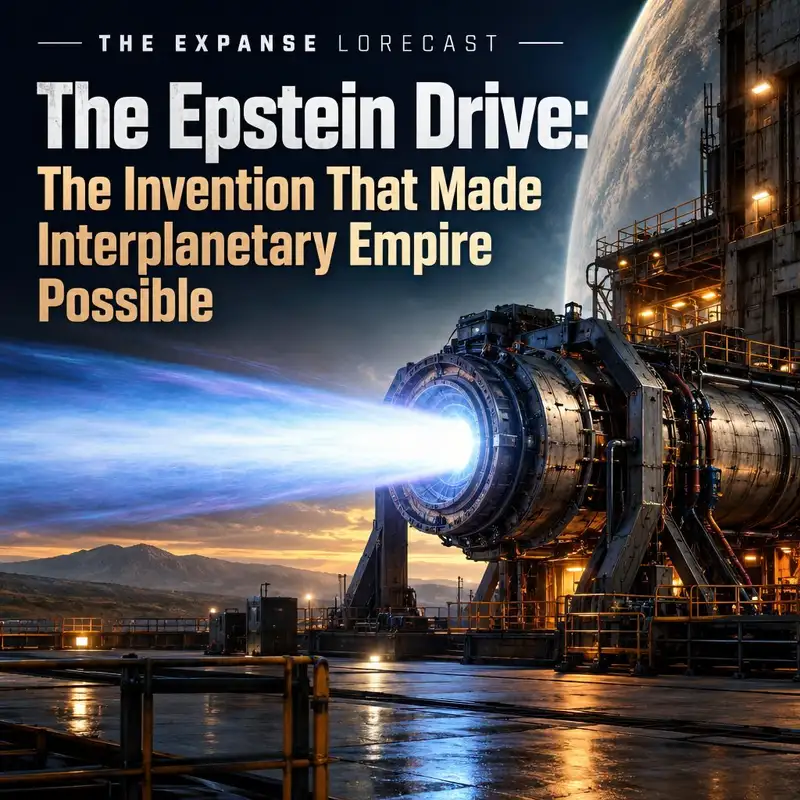
The Epstein Drive: The Invention That Made Interplanetary Empire Possible
Solomon Epstein did not set out to remake human civilization. He set out to test an engine.
Roughly a century and a half before the events of Leviathan Wakes, Epstein was a Martian engineer working on a modified fusion drive in his personal spacecraft. The test was not a government program, a naval trial, or a carefully managed industrial demonstration. It was private, improvised, and far more successful than its designer expected. The engine delivered sustained acceleration at an efficiency beyond anything available before it. For a few terrible moments, Epstein understood what he had done. He had found a way to make the Solar System smaller.
Then the practical problem asserted itself. The ship kept accelerating. He could not safely shut the engine down. He could not return to Mars. The more completely the drive proved itself, the less likely he was to survive the proof.
The irony of the Epstein drive begins with that fatal success. Its first successful flight was also a fatal one. Solomon Epstein did not die in combat, did not command a fleet, and did not negotiate Mars’s independence. He was an engineer caught inside the consequences of an experiment that worked too well. His achievement outlived him because other people could study it, copy it, build around it, and use it for purposes far larger than the technical problem he had been trying to solve.
The drive’s historical importance was never simply that ships could go faster. Speed matters, but it matters because of what it does to distance. Distance determines whether trade is profitable, whether a settlement can be supplied, whether a patrol can arrive before a crisis becomes a disaster, whether workers can migrate, whether a government can enforce a contract, and whether a colony can plausibly decide that it no longer needs its parent world’s permission.
Before Epstein, humanity had reached Mars. Mars was inhabited, developing, and already carrying the beginnings of a distinct society. But the Solar System was still too large, too costly, and too slow for the later pattern of routine movement to exist at scale. The Belt and the outer planets were not empty in the absolute sense. Human beings could reach them. Machines could work there. Expeditions could be mounted. But reaching a place once is not the same as integrating it into a civilization.
A distant outpost becomes politically meaningful only when people, tools, food, data, repair crews, and replacement parts can get there often enough to sustain ordinary life. A mine becomes an economy only when its product can reach a buyer at a cost someone is willing to pay. A colony becomes more than a flag on a map only when it can survive illness, accident, equipment failure, bad harvests, labor disputes, and the steady erosion of machinery by use.
Without regular transport, every remote settlement is partly an emergency. It must stockpile more, improvise more, and accept a greater chance that help will arrive too late to matter. Its connection to the larger human world is real, but fragile. A government may claim it. A corporation may own rights to it. A map may color it in reassuring national colors. None of that changes the physical fact that distance limits authority.
Distance is political because distance limits response. A distant population can be ignored more easily, but it can also be controlled less reliably. A distant resource may be coveted, but it may not be economically reachable. A distant military threat may seem remote until propulsion improves enough to make its arrival plausible. Before the Epstein drive, the Solar System offered destinations. After it, the Solar System began to offer routes.
The drive did not abolish orbital mechanics. It did not give ships faster-than-light travel. A vessel still had to cross the space between worlds. It still had to accelerate, coast when necessary, turn, and decelerate before reaching its destination. A captain could not point a ship at a planet and expect to arrive by force of enthusiasm. Space remained large, bodies remained fragile, and mistakes in navigation remained expensive.
What changed was the practical value of sustained acceleration. A ship under thrust could create apparent gravity for the people inside it. Down became the direction opposite the engine’s push. This was not artificial gravity in the sense of a science-fiction hotel with a permanent floor and a convenient elevator. It was acceleration, paid for by an engine powerful enough to make continuous or extended burns useful rather than exceptional.
That changed the experience of travel. Crews could live under thrust gravity for portions of a journey instead of enduring every voyage as a long period on the float. Ships could build velocity, reverse orientation, and burn again to slow down. The familiar flip-and-burn maneuver became part of the operating logic of interplanetary travel. A spacecraft could arrive not merely somewhere near its destination, but in a condition to work, dock, fight, unload, or continue onward.
The distinction is important. A ship that spends most of a journey barely able to move efficiently has limited commercial and military value. It arrives late, with less flexibility, and often with fewer options. A ship that can sustain useful acceleration can reshape schedules, cargo planning, patrol patterns, rescue operations, and the confidence people place in a route. It can connect places not only physically, but institutionally.
Still, the Epstein drive was not a machine that made every problem disappear. A ship required reaction mass. It required fuel, maintenance, cooling, spare parts, trained personnel, life support, medical supplies, navigation, and a place to dock at the far end. High acceleration remained dangerous. The juice and acceleration couches could help crews survive stress that would otherwise incapacitate or kill them, but neither made the human body indifferent to physics. A long hard burn was never merely a line on a flight plan. It was a medical decision.
Nor did the drive make war simple. It gave warships more mobility, but mobility brought new demands. A ship that could accelerate hard also revealed itself through its drive plume. A vessel that could reach a target faster still had to detect that target, identify it, decide whether it was hostile, and calculate what would happen after weapons were launched. Missiles required guidance. Point-defense ammunition ran out. Railguns depended on geometry and timing. Damage control still depended on frightened, exhausted people working inside a damaged pressure vessel.
The engine was revolutionary precisely because it did not replace the rest of civilization. It made the rest of civilization worth building farther from Earth.
That process took time. An invention becomes infrastructure only when it can be reproduced. Someone had to understand the design well enough to manufacture it. Shipyards had to incorporate it into new hulls or adapt older ones. Engineers had to learn how to maintain it. Navigators had to revise routes and operational assumptions. Crews had to train for new acceleration profiles. Ports, refueling points, repair facilities, traffic systems, and insurers had to accommodate a greater volume of movement across wider distances.
The historical record does not provide a tidy account of who held the first patent, which company obtained the first production contract, or how every early drive design moved from laboratory insight to industrial standard. That absence is useful. It reminds us that great technological transitions are rarely the work of one inventor alone, even when one inventor provides the decisive breakthrough.
The Epstein drive depended on a chain of people whose names history usually loses. Machinists who made components to specification. Dock crews who installed and inspected them. Technicians who diagnosed failures no one had encountered before. Pilots who learned what the new propulsion system could do without repeating its inventor’s last mistake. Administrators who approved procurement. Investors who accepted risk. Workers who built the ports and stations required by more frequent traffic. Somebody also had to sign the maintenance budget, which has ended more ambitious projects than enemy action ever managed.
A reliable transportation system is not just a collection of engines. It is a collection of expectations. A cargo owner expects a shipment to arrive. A station expects water deliveries before reserves run low. A shipyard expects parts from another orbit. A family expects a person who left for work to return. A government expects that it can move inspectors, soldiers, investigators, or negotiators when a crisis develops. Those expectations create commerce, law, and politics. They also create vulnerability when the routes fail.
Mars benefited from the drive before anyone else could fully grasp what that benefit would become. The Martian settlement had begun as a colonial project under Earth’s immense demographic and economic shadow. Mars had its own people, its own labor, and its own emerging sense of purpose, but independence requires more than identity. It requires the ability to sustain institutions without relying entirely on a distant capital.
The Epstein drive strengthened Mars’s position because it changed the meaning of separation. Mars was no longer simply a difficult and expensive off-world dependency. It became a place more capable of supporting industry, trade, movement, and organized self-government. The planet’s distance from Earth remained real, but distance no longer served Earth in quite the same way as a protective wall or a tool of administrative leverage.
That did not make Mars instantly equal to Earth. Earth retained vastly greater population, deeper established wealth, and the accumulated power of being humanity’s original center. The Martian Congressional Republic did not emerge fully formed from one test flight with a fleet waiting behind the next ridge. States are built through institutions, education, factories, taxation, political organization, and the willingness of people to imagine a common future.
But propulsion changed the terms under which those things could develop. An independent Mars became more credible because Mars could be more connected without being more subordinate. It could exchange goods, people, and knowledge on terms less dictated by the slowness and expense of old transport. It could build a distinct industrial base. It could sustain a long-term social project, including the immense work of terraforming, with greater confidence that Mars would not remain permanently isolated or permanently dependent.
Martian independence was therefore not an automatic mechanical consequence of an engine. It was a political achievement made more plausible by new material conditions. The exact diplomatic sequence is not preserved as a complete constitutional drama. What matters is that the invention gave Mars leverage. It made the prospect of self-rule harder for Earth to dismiss and more dangerous for Earth to resist.
For Earth, this created a problem familiar to every dominant power. The technology that expands commerce also expands the capacity of peripheral regions to organize themselves. A stronger connection can mean stronger control. It can also mean a stronger rival.
Once Mars became capable of acting as a more independent economic and political center, Earth could no longer treat the red planet as merely a remote possession. It had to deal with Mars as a future power with its own interests, anxieties, technical culture, and strategic requirements. The old relationship was not erased. Earth remained larger and richer in aggregate. But the balance had changed enough that distance could no longer settle the argument by itself.
The drive became military technology because it made sustained power projection practical. Patrols could reach farther, warships could be stationed where earlier fleets would have struggled to remain, and reinforcements could move across the system on timelines that made deterrence credible. At the same time, greater mobility widened the number of places commanders were expected to watch and defend.
Communication did not improve at the same rate. Orders and reports still moved at light speed, so a ship could maneuver far faster than political authorities could supervise every decision. The Epstein drive therefore increased both reach and the need for delegated judgment, standing orders, and commanders able to act before complete information arrived.
The drive made the Solar System more connected. It also made its misunderstandings move faster.
Its greatest transformation, however, was economic. The Belt and the outer system became reachable often enough, reliably enough, and profitably enough to become necessary. Asteroids held metals and industrial resources. Ice and volatiles mattered to every habitat, ship, and agricultural system dependent on water and air. The outer planets and their moons offered sites for research, extraction, manufacturing, transport, and settlement. None of those resources had meaning merely because they existed. Resources become wealth only when labor can extract them and transport can deliver them.
The Epstein drive made that labor system possible at a new scale. Mining operations could be supplied. Haulers could move cargo between stations and larger markets. Construction materials could reach new habitats. Repair crews could travel where they were needed. A settlement could receive enough regular support to survive beyond its founding moment. The Belt stopped being only a scattering of difficult destinations and became a working frontier of human civilization.
That frontier was not a place without people. It was built by people. Miners, riggers, mechanics, pilots, recyclers, dockworkers, cooks, medics, navigators, and station technicians created the practical reality of life away from planetary gravity wells. Their work was hazardous because space does not forgive neglected seals, exhausted filters, contaminated water, damaged hulls, or poor maintenance. It was also politically vulnerable because much of the wealth generated by that work flowed toward institutions based elsewhere.
Belter society grew out of these conditions, but it was never a single unified community. Different stations had different economies, histories, languages, employers, local authorities, family networks, and relationships with Earth and Mars. Some people worked directly for large corporations. Some served aboard transport ships. Some mined, salvaged, traded, organized labor, governed stations, or survived at the edge of legal commerce. Others had little political power at all beyond the ability to keep a fragile life-support system running another day.
The later Outer Planets Alliance emerged from this world, but it should not be projected backward as though the Belt had always been one organized political force. In Epstein’s time, the decisive development was not a unified movement. It was the creation of the conditions from which distinct Belter identities, grievances, institutions, and forms of resistance could grow.
The drive made Belt resources accessible to Earth and Mars. It also made the Belt accessible to Earth and Mars as a zone of administration, contract enforcement, policing, corporate security, taxation, and military concern. The same ship that carried replacement parts could carry inspectors. The same route that moved ice could move armed escorts. The same mobility that enabled settlement could extend the reach of authorities whose political legitimacy did not extend equally to the people doing the work.
This was not an inevitable moral outcome of fusion propulsion. Engines do not write labor law. Drives do not determine who receives representation, who owns a habitat, or who has the right to refuse a dangerous contract. Those are political choices. But technology defines the space in which those choices are made. By turning the Belt into a functioning part of the Solar System’s economy, the Epstein drive created a much larger field in which unequal power could operate.
The resulting order was built on interdependence without equality.
Earth required off-world materials, transport networks, technical inputs, and the labor of people who did not share Earth’s gravity, wealth, or political influence. Mars required trade, imported resources, industrial connections, and security against a larger neighboring power. The Belt required markets, machinery, medicine, water, food systems, safe ports, legal access to shipping lanes, and repair capacity often controlled or regulated by Inner institutions.
No part of that system was truly independent in the ordinary sense. Earth could not simply look inward and remain the same civilization. Mars could not pursue terraforming and national development without complex exchange. Belt stations could not live on rhetoric or asteroid rock alone. Everyone depended on someone else. The problem was that dependence was not distributed evenly.
Those closest to the hazards of extraction often had the least control over the terms of extraction. Those who depended most directly on air recyclers, imported supplies, and passing ships often had the smallest margin for political defiance. A planetary government could survive a bad policy for some time through its broad economic depth. A small station could be driven toward crisis by a delayed shipment, a failed water recycler, or the loss of a single contract.
The human consequences reached far beyond trade figures. The drive made permanent life away from Earth possible for millions of people over generations. It allowed families to form on stations and ships. It made migration a regular fact rather than an extraordinary leap. It created occupations that belonged to the spacefaring economy rather than to any single planet. It helped produce communities whose members were shaped by low gravity, confined habitats, industrial danger, and the knowledge that air, water, and food were services maintained by human labor.
Physical adaptation followed social adaptation. People raised in low gravity did not always share the same bodies or medical expectations as people raised on Earth. But this variation was never absolute. It depended on upbringing, nutrition, healthcare, genetics, treatment, and circumstance. The important point is not that one population became biologically simple and another remained normal. The important point is that human beings began living under radically different physical conditions while remaining tied to one political economy.
The Epstein drive made that divergence possible. It moved humanity outward without freeing humanity from hierarchy.
By the time of Leviathan Wakes, the consequences are visible everywhere. Earth remains the demographic and economic center of human civilization. Mars stands as an independent military-industrial power, disciplined by its long national project and wary of Earth’s greater mass. The Belt is indispensable to the system’s functioning, yet its people live under conditions of political inequality and material precarity that fuel resentment across generations.
This arrangement can look stable from a distance. Goods move. Stations operate. Governments issue statements. Corporations sign contracts. Ships travel between worlds. But it is not a stable equilibrium in the deeper sense. It depends on populations accepting risks and burdens that they do not all share equally. It depends on Earth and Mars competing without allowing competition to become catastrophic war. It depends on Belt communities supplying the system while being asked to trust institutions that have often treated them as labor before citizens.
The drive intensifies this instability because mobility gives every faction more options. A ship can carry freight, refugees, contraband, weapons, investigators, saboteurs, or political organizers. A changed route can be a business decision or a warning sign. A drive plume can reveal movement, but not always purpose. A ship going dark may be hiding, malfunctioning, avoiding debt, or preparing an attack. In a system shaped by mistrust, even ordinary traffic can become intelligence.
Propulsion and politics are inseparable in The Expanse. The ability to move quickly enough to matter makes distant events part of everyone else’s security calculation. Mars watches Earth’s naval posture. Earth watches Martian shipbuilding. Belt communities watch both Inner powers and the corporations that depend on their labor. A local crisis can acquire system-wide significance because ships can now reach it, intervene in it, exploit it, or publicize it.
The Epstein drive sits beneath every later conflict in the Solar System, though it does not explain any of them by itself. Earth-Mars rivalry comes from history, fear, ideology, industrial competition, and the unresolved question of who has the right to arm themselves against whom. Belter resistance comes from real exploitation, unequal representation, cultural identity, and anger at being treated as disposable. Corporate abuses come from secrecy, profit, legal ambiguity, and the willingness of powerful institutions to transfer risk downward.
The drive enables the movement that makes those conflicts operational. It carries warships, supply convoys, humanitarian aid, smugglers, strike teams, refugees, and political messages across the system. It permits a navy to threaten a station, but it also permits a station to receive relief. It supports blockades and evacuations. It allows governments to project power, but it also allows dissidents and insurgents to move through the same vast geography.
The drive also never made ships equal. Hull design, crew training, maintenance, reaction mass, sensors, weapons, and access to repair facilities continued to separate a capable navy from a vessel that merely possessed efficient propulsion. Mobility expanded the field of competition; it did not erase the industrial and human systems behind military power.
That remains true after the Ring gates open. The gates create new routes and eventually new imperial projects, but ships still have to cross ordinary space to reach them, supply them, and govern what lies beyond. The old transport technology survives inside the new strategic order, carrying the same questions about who controls movement, who bears risk, and who benefits from the worlds made reachable.
That is why Solomon Epstein’s final flight remains such a fitting origin story. He experiences the invention at its most personal scale. One man, one ship, one engine, and the realization that success has carried him beyond the point where he can safely return. The tragedy is not that he failed. He succeeded in a way that made the old assumptions about travel obsolete.
His engine did not make humanity interstellar by itself. It did not abolish scarcity. It did not end colonial rule, prevent war, or make distant populations equal partners in the civilization they sustained. It did not solve the problem of political legitimacy. In some ways, it made that problem harder by allowing more people, institutions, and armies to reach one another often enough to become entangled.
Technically, the Epstein drive enabled sustained and efficient interplanetary movement. Operationally, it made regular routes possible. Strategically, it made Mars a credible independent power and made the Belt central to the survival of the larger system. Economically, it connected extraction, industry, transport, and settlement across distances that had previously resisted routine control. Militarily, it made mobility a permanent feature of rivalry. Civilianly, it made enduring life away from Earth possible while binding that life to networks of supply and authority that were often controlled elsewhere.
The engine was, in the end, an argument about power. It converted the Solar System from a collection of distant destinations into a connected political economy. States, corporations, workers, settlers, and fleets could reach one another often enough to trade, govern, exploit, defend, resist, and threaten. That dependence made Mars independent, made the Belt indispensable, and made later conflict structurally possible because access expanded much faster than equality, legitimacy, or trust.
The Epstein drive shortened the journey between worlds, but it did not shorten the moral distance between those who benefited from the system and those asked to keep it running.