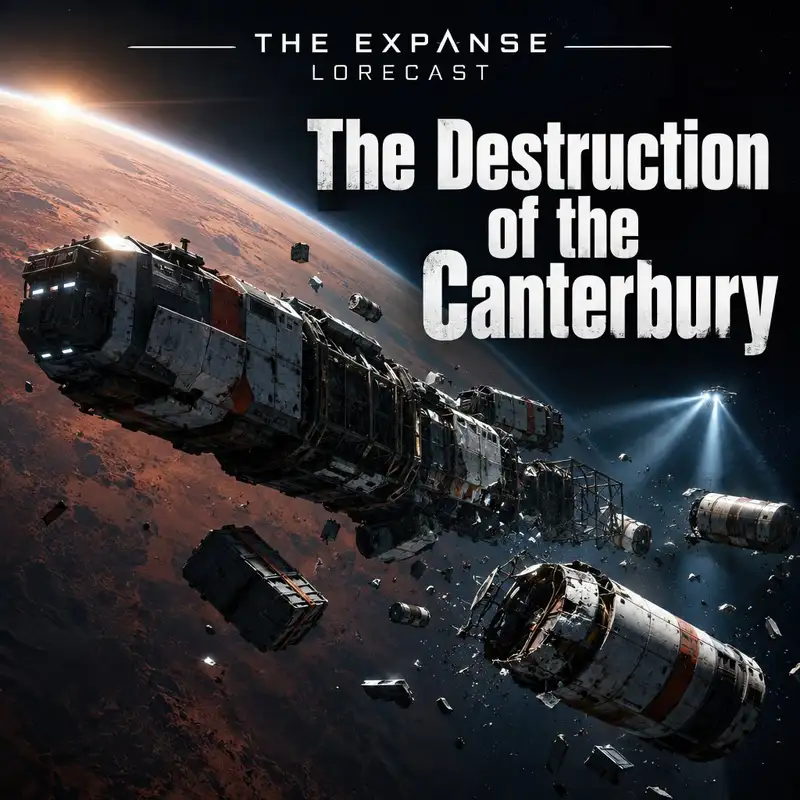
The Destruction of the Canterbury
The Canterbury was on an ice run to Ceres when the distress call arrived. That detail matters. The ship was not hunting pirates, carrying troops, or patrolling a disputed border. It was hauling water from the Saturnian system toward the Belt, moving one of the ordinary cargos that made ordinary life possible in space. Ice became drinking water, industrial feedstock, agricultural support, and reserve life support. It was not glamorous work, but it was necessary work, and the Canterbury carried roughly fifty people whose lives depended on completing that work on schedule.
The call threatened to interrupt all of it. Investigating a distress beacon meant delay. Delay meant a late delivery. A late delivery could mean lost compensation for a crew that did not have the luxury of treating pay as an abstraction. It also meant altering course toward an unknown contact in deep space, with no escort, no military intelligence support, and no reason to assume that a rescue obligation might conceal a hostile operation. On the Canterbury, the first argument was not about grand strategy. It was about duty, money, risk, and whether a working ship could afford to stop.
Captain McDowell held formal command, and his hesitation was not evidence of cowardice. A commercial captain had obligations to the cargo, the owner, the crew, and the schedule that kept the entire operation viable. A distress signal could be genuine. It could also be corrupted, obsolete, fraudulent, or simply too dangerous to approach without support. In an economy where workers absorbed much of the cost of disruption, caution was rational. The Canterbury’s crew had every reason to understand that a rescue could become an unpaid hazard.
James Holden saw the question differently. A former United Nations Navy officer, he retained a strong belief that a distress call could not simply be ignored because it was inconvenient. He forced the signal into the ship’s official record. That changed the character of the decision. What had been a discretionary commercial calculation became a documented emergency. Once the Canterbury had formally acknowledged the call, leaving it behind became harder to justify legally, morally, and politically.
That was the first success of the ambush. The attackers did not need to seize the Canterbury’s controls or threaten its captain directly. They only needed to present information that would push the crew toward a predictable decision. A believable distress signal exploited rescue norms. It also exploited the crew’s conscience. No captain wanted to discover later that a real emergency had been ignored because a delivery bonus mattered more than stranded people.
The signal drew the Canterbury away from its commercial route and toward the Scopuli, an apparently abandoned vessel near an otherwise unremarkable asteroid. From the crew’s perspective, this was an unwanted diversion. From the attackers’ perspective, it was operational geometry. The Cant would alter course, reduce the predictability of its civilian schedule, and enter a location selected by someone else. The crew did not know they were moving into a killing ground. They knew only that somebody might need help.
This distinction matters because the destruction of the Canterbury was not caused by a failure of courage or professionalism aboard the ship. The crew lacked the intelligence picture needed to recognize the trap. They had no warning that a distress call had been manufactured as bait. They had no reason to believe that a civilian ice hauler would be selected for an attack designed to destabilize relations among Earth, Mars, and the Belt. Judging them by information revealed later would confuse history with hindsight.
A civilian freight vessel was especially vulnerable to this kind of manipulation. The Canterbury had no escort screen, no intelligence staff, no dedicated reconnaissance craft, and no mission preparation for an encounter with a stealth-equipped military attacker. It was a pressure vessel, refinery, cargo carrier, workplace, and home for its crew. It could maneuver, communicate, and perform emergency procedures. It was not built to exchange missiles with a warship that had chosen the place and time of contact.
The rescue decision also created a second advantage for the attackers. The Canterbury sent its shuttle, the Knight, to investigate the Scopuli. Holden led the team. Naomi Nagata went as the ship’s chief engineer. Amos Burton provided mechanical expertise. Alex Kamal, a former Martian pilot, flew the shuttle. Shed Garvey came as the medic. It was a practical group for examining a damaged vessel and helping survivors. It was not a boarding force, a naval reconnaissance detachment, or a team equipped to establish who had staged an interplanetary provocation.
The Knight’s departure divided the Canterbury’s people and capabilities. Five crew members were physically separated from the ship that employed them. The shuttle team became the investigative element, while the Cant remained the vulnerable target. That separation would prove essential. Had everyone stayed aboard, the attack might have left no witnesses with a coherent story to tell. Had the attackers destroyed the Knight as well, they might have removed evidence, but they would also have removed the people best positioned to spread it.
The Scopuli offered fragments, not answers. It appeared abandoned. Its condition suggested violence and concealment, but not a complete chain of events. The Knight’s crew found evidence associated with a beacon or transponder that included components recognizable as Martian in origin. Naomi’s technical knowledge made that observation meaningful. Alex’s Martian military background made the military implications difficult to ignore. But neither expertise turned a recognizable component into proof that Mars had ordered an attack.
That is one of the oldest problems in intelligence work. Physical evidence can be real and still be misleading. A weapon can be manufactured by one state, purchased by another, stolen by a third, planted by a fourth, or left behind specifically because investigators will recognize it. Attribution requires more than identifying hardware. It requires chain of custody, corroboration, motive, command authority, alternative explanations, and time. The Knight’s crew had almost none of those things.
What they did have was evidence that looked politically legible. Martian technology meant something in the Solar System. Mars was a military power with advanced warships, disciplined armed forces, a history of rivalry with Earth, and a reputation for keeping its most capable systems close to state control. To people already inclined to fear Martian power, a Martian-associated beacon did not look like an ambiguous clue. It looked like an answer.
The evidence landed in a political environment already primed for suspicion. The Belt was not one bloc and the OPA was not one command structure, but long experience with Inner power made accusations involving Mars immediately combustible. The attackers did not need every listener to accept the same explanation. They only needed enough people to react before verification could catch up.
While the Knight’s crew searched the abandoned ship, the main attack began elsewhere. The Canterbury detected an unidentified stealth-capable military threat. Stealth in this context did not mean magical invisibility. It meant that the attacker had delayed detection, reduced the quality of the target’s information, and reached a favorable position before the civilian ship fully understood the danger. By the time the Cant recognized that something was wrong, the attacker had already gained the initiative.
The Canterbury was not engaged in a fair battle. There was no exchange between comparable forces, no attempt to contest a strategic orbit, and no fleet commander balancing formations across a theater. The attacker had surprise, weapons intended to destroy ships, and a prepared political narrative. The Cant had an ice cargo, a commercial crew, limited options, and a shuttle away from the ship. The operational problem was not how to win. It was how to survive an attack for which it had not been designed or prepared.
The unidentified vessel or force launched nuclear torpedoes at the Canterbury. The exact details of the attack are less important than its effect. A ship is not merely a hull moving through vacuum. It is a life-support system, power network, communications platform, cargo carrier, and collection of pressurized compartments containing human beings. Catastrophic missile damage could rupture the hull, destroy machinery, cut power and data connections, scatter debris, expose crew to vacuum and radiation, and eliminate any organized ability to save the ship.
There was no realistic prospect of a civilian ice hauler conducting a successful defense under those conditions. The Canterbury was destroyed. Everyone remaining aboard died. The number is commonly understood as roughly fifty people, but the historical meaning is not found in the precision of the count. They were engineers, technicians, deck crew, officers, workers, friends, family members, and wage earners. They had not enlisted in a war. They had been moving water through an interdependent economy when somebody decided their deaths could be made politically useful.
Tactically, the attack achieved the immediate objective. The Cant was removed as a functioning ship. Its cargo was lost. Its crew was killed. A civilian supply route had been interrupted. But the larger operation was not simply about destroying a hull. If the attackers had wanted only to erase the Canterbury, they could have treated the Knight as a threat and attempted to eliminate it as well. Instead, the shuttle team survived.
That survival was part of the design. The Knight carried witnesses who had found apparent Martian evidence aboard the Scopuli. They had been separated from the Canterbury before the attack. They could not provide a complete sensor record or establish the attackers’ command chain. But they could report what they had seen, what they believed they had found, and what had happened to their ship. In other words, they could carry the accusation.
The Knight’s crew now faced a crisis with no clean answer. Their ship was gone. Their friends and colleagues were dead. They were isolated in a smaller craft, uncertain of the attacker’s identity and unsure whether further danger was close at hand. Grief was immediate, but so was responsibility. The survivors possessed information that could matter far beyond their own survival. They also possessed too little information to know what it truly meant.
Their evidence formed a credible pattern. There was the abandoned Scopuli. There was the beacon with Martian-associated components. There was a stealth-capable military attacker. There was the destruction of a civilian vessel shortly after the Knight departed. From inside the shuttle, those facts did not look random. They looked connected. The mistake was not that Holden and the others noticed the connection. The mistake was believing that a plausible connection had become a proven attribution.
Later events reveal that the Canterbury attack formed part of a wider conspiracy tied to Protogen and to the emerging crisis around the protomolecule. But that knowledge did not exist for the Knight’s crew when they needed to act. They did not know the full relationship among the Scopuli, the attackers, the corporate networks behind the operation, and the deeper project that would soon threaten the entire system. They were not withholding certainty. They did not have certainty.
Holden’s response was to broadcast. He identified himself as a survivor of the Canterbury and reported that the ship had been destroyed after his team found evidence that appeared to connect the incident to Mars. His wording retained qualifications. He did not possess a signed order from Martian command. He did not claim to have watched a Martian navy crew launch the weapons. But political audiences rarely hear a cautious conclusion with the same care that a witness intends it.
What many listeners heard was simple. Mars had destroyed a civilian ship.
Holden also transmitted identifying information about the dead. That choice was morally understandable. A lost ship could become a line in a traffic report, a disputed insurance claim, or an official statement about unexplained hostilities. Named crew members became people. Their deaths acquired families, employment histories, relationships, and a human scale. The broadcast made it harder for anyone to treat the Canterbury as an anonymous technical loss in deep space.
It also made the accusation more powerful. Public grief is not easily separated from public anger. Once listeners could imagine the dead as workers and neighbors, the pressure for a response increased. The Cant’s destruction no longer looked like a distant incident involving obscure commercial traffic. It became a visible act of violence against civilians. That was exactly the kind of event that could push already suspicious populations toward panic, retaliation, and demands for protection.
In a Solar System governed by light-speed communication, information does not move instantaneously. Messages take time to cross the vast distances between planets, stations, and ships. But a public broadcast can still move politically faster than a formal investigation. Intelligence services need time to compare sensor records, identify hardware, assess deception, question witnesses, and determine who benefits from a provocation. Diplomats need time to contact governments. Military commands need time to distinguish an actual attack from a manufactured crisis.
Holden’s message did not wait for that process. It reached people before institutions could produce a competing account. It entered a political environment already prepared to interpret ambiguity as evidence of hostile intent. His transparency came from outrage and distrust of systems that might conceal the truth. Those instincts were not irrational. But releasing incomplete attribution during a strategic crisis was operationally reckless. It allowed the first credible story to become the ground on which every later fact would have to fight.
That does not make Holden a villain who casually chose war. He had watched his ship and crew die. He believed he had evidence of a state-sponsored attack. He feared that silence would allow powerful institutions to bury the incident. His decision was shaped by real moral urgency. The problem was that moral urgency is not the same thing as intelligence certainty. A witness can be honest, traumatized, technically informed, and profoundly wrong about who ordered the attack.
Mars could not ignore the broadcast. The Martian Congressional Republic faced a public claim that Martian technology had been used to destroy a civilian vessel. The government had to investigate, protect its interests, and prevent the incident from hardening into an unquestioned accusation. It dispatched the Donnager, one of its major naval warships, to recover the Knight’s survivors and determine what had occurred.
That response created a second layer of suspicion. From a Martian perspective, retrieving the witnesses could be a reasonable security action. The survivors might possess physical evidence. They might provide firsthand testimony. They might also be in danger from whoever had actually destroyed the Canterbury. From the perspective of frightened observers, however, a Martian warship moving to seize the only survivors could look like an effort to silence them or control the story.
This was the security dilemma in its most dangerous form. Mars could not remain passive without appearing evasive or weak. But every visible military action risked confirming the fears created by the original accusation. A navy built to protect state interests became, in public perception, evidence of those interests’ guilt. The attackers had done more than destroy a civilian ship. They had made normal investigation look like conspiracy.
The incident succeeded because several elements worked together. The distress signal was believable enough to compel action. The Canterbury was constrained by commercial pressure and rescue norms. The Knight departed with witnesses who could later spread an interpretation. The Scopuli contained evidence that appeared to point toward Mars. The attacker possessed enough stealth and firepower to strike before the civilian ship could respond effectively. And the Solar System was already full of populations primed to see enemies in one another.
None of those elements alone would have been enough. A false beacon without a vulnerable target would have been a mystery. A destroyed freighter without witnesses might have become an unresolved disappearance. Martian-associated hardware without a public crisis might have been examined more carefully. Holden’s broadcast without pre-existing distrust might have received a more skeptical hearing. The operation worked because it combined deception, violence, survival, and narrative.
It also weaponized transparency. The attackers did not hide all evidence. They curated it. They allowed the Knight’s crew to find clues that were genuine enough to be persuasive but insufficient to establish responsibility. They preserved witnesses who could transmit those clues. The deception was not a blank absence of information. It was an abundance of selected information, delivered in the right order to people under pressure.
This is what made the Canterbury incident an intelligence failure rather than merely a failure of detection. The crew was not defeated only because the attacker was hard to see. They were defeated because the information they received was designed to produce the wrong interpretation. The true attacker understood the trap. The Canterbury crew understood only the emergency. The wider public understood less than either, but reacted most quickly.
The attack did not require universal agreement. Some people would doubt Mars. Some would suspect a provocation. Some would insist that the evidence was incomplete. But a destabilizing operation does not need perfect persuasion. It needs momentum. It needs enough anger to produce riots, enough fear to pressure governments, enough uncertainty to complicate diplomacy, and enough visible military movement to make every side prepare for the possibility that war has already begun.
The Canterbury’s identity as an ice hauler is central to the case. It was part of a distributed supply system that kept stations alive, which meant its destruction carried economic and political effects far beyond the crew it killed. A civilian transport became a strategic target because attacking ordinary infrastructure could produce fear, shortages, public anger, and pressure on governments without first defeating a navy.
The ambush worked because it exploited the political economy of civilian life in space. The people aboard the Canterbury were workers before they became symbols. Their ship moved a necessity, their pay depended on schedules and deliveries, and their decision to answer a distress call arose from the rules of civilian life in space. The conspiracy succeeded by turning those ordinary habits into vulnerabilities.
The consequences spread quickly. Mars faced an accusation it could not ignore. Earth confronted the possibility that a rival or a hidden actor was trying to trigger escalation. Belters saw another civilian ship destroyed inside a political order they already distrusted. Later evidence would tie the attack to Protogen and the wider protomolecule crisis, but those revelations came after the first reactions had already begun reshaping the system.
Tactically, the attackers destroyed the Canterbury. Operationally, they stranded witnesses with carefully selected clues. Strategically, they created a crisis of attribution in which several powers could make dangerous decisions for understandable reasons. That layered effect is what made the ambush more consequential than the loss of one ship.
Tactically, the attackers destroyed the Canterbury. Operationally, they left survivors aboard the Knight who carried the intended evidence and accusation. Intelligentially, they used credible fragments to frame Mars without establishing Martian responsibility. Strategically, they intensified mistrust among the major powers. Politically, they forced Mars to respond under suspicion and gave fear new force across the Belt and Earth. Logistically, they removed a civilian supply vessel and an experienced crew from an interdependent economy. Civilianly, they killed roughly fifty people and left others to inherit grief, insecurity, and fear.
The destruction of the Canterbury demonstrates that the most effective weapon in the opening crisis was not the nuclear torpedo, but controlled attribution. Unknown attackers used a false rescue signal to place a civilian ship where it could be destroyed, left evidence designed to point toward Mars, and depended on Holden’s honest but unverified broadcast to complete the operation. The Cant’s loss became politically explosive because the Solar System was already built on unequal risk, fragile logistics, and distrust among populations that depended on one another. The ambush killed a ship’s crew, but its larger purpose was to make every government, worker, and station wonder whether the next act of protection would actually be an act of war.