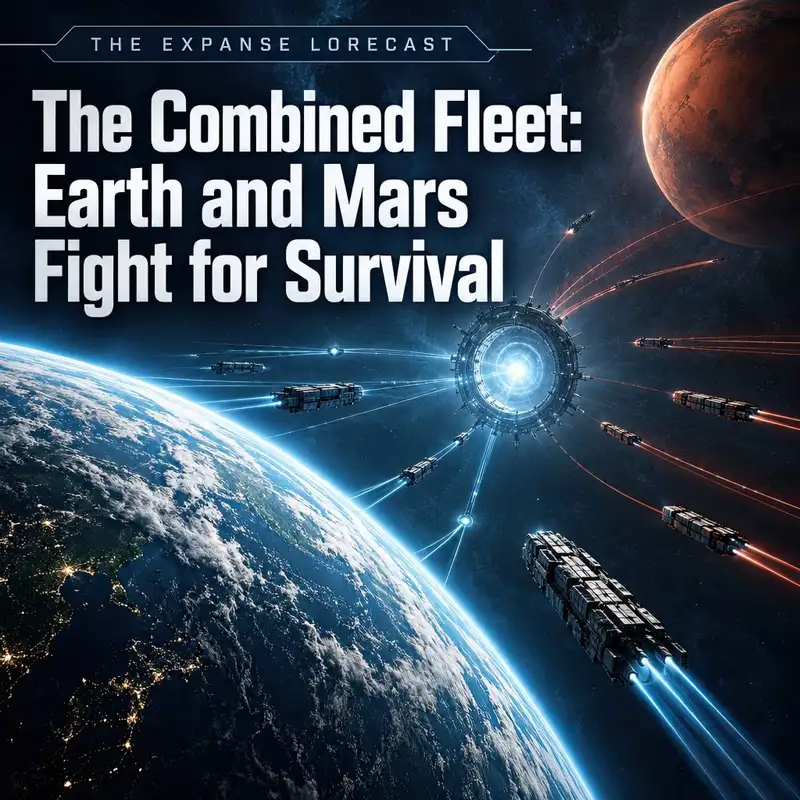
The Combined Fleet: Earth and Mars Fight for Survival
Earth had ships. Earth had shipyards, trained crews, industrial depth, and a population so large that even after catastrophe it remained one of the central powers of human civilization. None of that solved the immediate problem. After Marco Inaros’s asteroid bombardment, the United Nations Navy could not just gather its strongest vessels and hunt the Free Navy. Another rock might already be inbound. Another stealth-coated delivery system might still be hidden in the dark. Earth was a planet, not a warship. It could not change course, evade, or flip and burn. A weaker enemy had used that fact to pin a stronger force into a defensive posture.
That was the Free Navy’s first great strategic achievement. Marco did not need to destroy every United Nations warship. He needed to make the United Nations government fear that every offensive deployment left Earth less protected. The damage from the bombardment was physical, political, and psychological. Millions were dead or displaced. Infrastructure had been shattered. Food systems were under strain. The government still had to govern a wounded planet while explaining why the navy that was supposed to defend it had failed to prevent the attack. Every patrol sent outward carried an implicit question from the people below. If another strike comes, who will stop it?
Mars entered this crisis with its own wounds. The Martian Congressional Republic had long built its identity around technical competence, military discipline, and the vast collective project of terraforming a world. Its navy was one of the most capable military institutions in the system. Its crews were trained, its ships were sophisticated, and its officers had spent generations preparing for rivalry with Earth. But the war exposed a fracture that military excellence could not repair. Important Martian personnel, ships, and technology had vanished into the conspiracy that became Laconia. The state had not merely lost assets. It had lost confidence in its own institutions.
Mars could contribute warships and expertise to a campaign against Marco Inaros, but it could not arrive as the unquestioned senior partner. The Martian government was trying to stabilize itself while confronting evidence that members of its own military establishment had enabled the system’s greatest disaster. The Martian Congressional Republic Navy remained formidable, but the political authority behind it was damaged. Earth and Mars therefore joined forces not as reconciled rivals, but as two powers confronting dangers neither could manage alone.
Their old competition had never been only about fleets. Earth possessed population, established industry, and the accumulated weight of an old civilization. Mars had built a more concentrated military culture around sacrifice, education, and a future-oriented national project. Both depended on the Belt for resources, shipping, labor, and the practical work of keeping a dispersed industrial system alive. Yet both had repeatedly treated Belter communities as subordinate participants in an order designed elsewhere. The Free Navy weaponized the resentment created by that arrangement, even as Marco Inaros made clear that he intended to rule the Belt rather than liberate it.
The alliance that emerged after the bombardment was therefore not a clean Earth-Mars coalition in the conventional sense. It was an improvised network of governments, naval commands, stations, factions, independent crews, and political intermediaries. Chrisjen Avasarala, acting as the United Nations Secretary-General, had to preserve Earth’s survival while finding a way to act beyond Earth’s orbit. The Martian provisional leadership had to commit forces without appearing to surrender Martian autonomy. Fred Johnson and his faction within the Outer Planets Alliance provided contacts, infrastructure, and credibility that neither Inner government could manufacture on demand.
Fred’s role was essential precisely because he did not represent all Belters. The Outer Planets Alliance was not a single state with a capital, a uniform, and one unquestioned chain of command. It was a broad and uneven political world. Some factions wanted reform. Some wanted independence. Some were rooted in station politics, labor networks, or ship crews. Some were criminal enterprises using political language when it proved useful. Some had joined Marco. Others opposed him, sometimes for moral reasons, sometimes because they distrusted his ambitions, and often because they understood that his campaign was starving the very people whose cause he claimed to serve.
The first challenge was not assembling every available ship into one neat formation. It was interoperability. Earth, Mars, and allied Belter forces did not share a common command culture or political purpose. They had different intelligence channels, different assumptions about lawful authority, and different reasons to distrust one another. A United Nations officer could not assume that a Belter captain accepted Earth’s priorities. A Martian commander could not assume that an OPA faction recognized Martian authority. A Belter leader had every reason to ask whether an alliance formed in wartime would vanish once the emergency passed.
The Rocinante occupied an awkward but useful place in this arrangement. James Holden commanded a small warship with an exceptional record, an experienced crew, and relationships across political boundaries. That did not make him a fleet admiral. It made him a valuable connective figure in a system where the formal chains of command did not always reach the places where decisions had to be made. The Rocinante could take missions that regular forces found politically difficult, operationally risky, or simply too urgent to pass through layers of committee review. In a crisis, that kind of flexibility is valuable. It is also an uncomfortable substitute for a settled command structure.
The immediate operational problem was the continuing threat to Earth. The Free Navy had already demonstrated that it could turn asteroid impacts into a strategic weapon. The coalition needed to find and neutralize the machinery supporting further strikes before it could shift substantial forces from defense to offense. That brought attention to the Azure Dragon, a Free Navy ship tied to the coordination of ongoing attacks. The vessel was not the headquarters of the entire Free Navy, and taking it would not end the conflict. Its importance was more specific. It helped sustain the pressure that kept Earth’s navy tied down.
The mission against the Azure Dragon showed what the emerging coalition could do when intelligence, specialized personnel, and a clear objective aligned. The Rocinante was assigned to the operation. Holden remained captain of his ship, but Bobbie Draper brought Martian military skill and an understanding of how to make a mixed political mission function under pressure. The task was not a matter of charging into a visual-range duel. In space, intercepting a target requires detection, prediction, acceleration, and the ability to survive whatever the target does once it knows it has been found.
A ship that is coordinating attacks may be more valuable intact than destroyed. Its records, communications, navigation data, and operating procedures can reveal a network that a wreckage field cannot. That creates a different tactical problem. The attackers must close with the target, control relative motion, survive defensive fire, and preserve enough of the vessel to exploit what they capture. Every choice carries risk. A missile may solve the immediate danger while destroying the intelligence that justified the mission. A boarding action may secure information while exposing personnel to armed defenders, pressure hazards, and damaged systems.
The coalition’s success against the Azure Dragon did not produce a dramatic end to the war. It did something more operationally important. It reduced the immediate pressure of the continuing bombardment campaign. Earth could not become safe in any absolute sense, and the United Nations Navy still had to defend the planet. But the balance of risk changed. Avasarala could begin shifting from a purely defensive posture toward operations intended to recover initiative. That was the first step in transforming a collection of frightened partners into an offensive coalition.
The next major objective was Ceres. Militarily, Ceres mattered because it was a large and strategically located station with deep connections to Belt commerce, labor, and political identity. Politically, it mattered even more. Marco had made it part of the Free Navy’s claim to represent a new order in the outer system. If the coalition could take Ceres, it would demonstrate that the Free Navy could not hold every important station through rhetoric and intimidation alone. But a station is not an empty fort. It is a pressure vessel, a life-support system, an economy, and a community of people dependent on systems that cannot be allowed to fail.
Marco avoided giving the coalition the kind of battle it might have preferred. Rather than defending Ceres in a conventional stand-up fight, Free Navy forces stripped and abandoned it. The incoming coalition did not find a clean military victory. It found a population facing scarcity, disrupted services, damaged administration, and profound uncertainty about who would protect them. This was not incidental to the campaign. It was the campaign. The coalition had to show that it could do more than retake territory. It had to keep people alive after the flags changed.
Ceres exposed the difference between seizing an objective and governing it. A naval force can compel a surrender, control docking approaches, and patrol nearby space. None of that automatically restores air, water, food, maintenance crews, medical care, or public trust. The station’s people had reason to fear both Marco’s followers and the Inner powers arriving behind them. Many had lived their entire lives under systems where Earth and Mars made decisions while Belters absorbed the risk. The fact that the Free Navy had become brutal and predatory did not erase the history that made its message attractive to some listeners.
Anderson Dawes became important in the post-capture political environment around Ceres because civilian administration required local legitimacy as well as military security. The coalition needed people who understood the station, its networks, and its political memory. It also needed to accept that those people would not necessarily be obedient clients of Earth or Mars. A station administrator who could speak to Belter interests was useful precisely because he had leverage. That was inconvenient for governments accustomed to treating the Belt as a logistical problem. It was also unavoidable.
The same lesson appeared in the question of supplies. Earth had been struck so badly that food, transport, and material support became strategic concerns in a way they had not been before. Belter-controlled shipping and logistical networks could move resources where Earth needed them. This was not a sentimental gesture of unity. It was proof of material interdependence. The Belt was more than a zone from which piracy and rebellion emerged. It was part of the infrastructure that connected worlds, stations, farms, mines, refineries, and populations. The people who moved cargo had political power because civilization stopped functioning when cargo stopped moving.
That reality made cooperation with Michio Pa politically difficult. Pa had begun within Marco Inaros’s movement before breaking with him. She commanded a Belter force shaped by improvised ships, uneven readiness, local knowledge, and personal loyalty. It was not a conventional navy with a standardized supply system, a secure industrial base, and a stable hierarchy. Her ships could contribute to the war, but they were vulnerable to attrition and dependent on the same fragile networks that the war was tearing apart. To Avasarala and many on Earth, cooperation with Pa looked uncomfortably close to rewarding piracy and rebellion.
From Pa’s perspective, the suspicion was not entirely unfair, but it was incomplete. Marco’s movement had turned against the material needs of the Belt. He had taken ships, supplies, and labor in the name of freedom while leaving ordinary Belters to face shortages and insecurity. Pa’s break with him was therefore both moral and practical. A movement that cannot feed the people it claims to represent is not building independence. It is building dependence on the will of its leader. Her fleet became important because it represented a part of the Belt willing to fight Marco without accepting a return to Inner domination.
The coalition remained fragile because every participant saw the others as both necessary and dangerous. Earth needed Belter transport and local intelligence, but feared strengthening Belter political autonomy. Mars needed a successful coalition to recover some strategic credibility, but could not ignore its own internal instability. Moderate OPA factions needed protection from Marco, but could not let themselves become proof that the old order had won without changing. These were not misunderstandings that a single speech could resolve. They were structural conflicts, and war had merely made them impossible to ignore.
The cost of that fragility became brutally clear during the attack on the Rocinante while Fred Johnson was in transit. Marco’s flagship, the Pella, and accompanying Free Navy vessels ambushed the Rocinante. The engagement was not an old naval broadside exchanged across calm water. It was a contest of detection, acceleration, missile defense, maneuver, and endurance. A ship under hard thrust turns acceleration into gravity, but that gravity can become lethal. Every high-gee maneuver imposes a cost on the people inside it, even when the hull survives.
The Rocinante endured because of training, discipline, equipment, and the skill of its crew. Bobbie Draper’s contribution was especially important. Her military judgment helped turn an ambush into a fight the Rocinante could survive. But her performance should not be mistaken for a substitute for institutional strength. A coalition cannot build its strategy around the hope that every crisis will contain one exceptional officer, one unusually capable crew, and one ship able to absorb punishment beyond what ordinary planning would permit. The battle demonstrated the value of individuals. It also demonstrated the danger of relying on them.
Fred Johnson did not survive the engagement. The acceleration that the Rocinante required to escape and fight inflicted a fatal stroke. His death was not a battlefield casualty in the simple sense of a weapon strike, but it was a direct consequence of war conducted in an environment where the human body remains one of the system’s hardest limits. Ships can be repaired. Components can be replaced. A political intermediary with decades of experience, credibility, grudges, contacts, and hard-earned trust cannot be ordered from a shipyard.
The battle also left Holden with a decision that did not fit cleanly into tactical doctrine. The Pella was within reach, but Filip Inaros was aboard it. Holden’s choice not to destroy Marco’s ship carried personal, political, and military consequences. It denied the coalition a possible chance to eliminate its central enemy. It also reflected the fact that warfare does not remove private loyalties, grief, and moral hesitation from command decisions. The choice was neither a simple act of weakness nor a neat assertion of virtue. It was a reminder that even sound operational systems are operated by human beings whose personal histories enter the battle with them.
Fred’s death created a vacuum at precisely the moment the coalition needed someone who could bridge its divisions. He had been a former Earth military officer, a figure of authority at Tycho Station, and a Belter political actor trusted by people who distrusted nearly every formal institution around them. Those identities made him controversial. They also made him useful. Without him, the coalition had to confront its own legitimacy problem more directly. Earth and Mars could provide capital ships, but neither could command allegiance across the Belt merely by arriving in greater numbers.
Tycho became the place where emergency cooperation began to turn into something more formal. Holden’s role in those negotiations was not to command the fleet. He did not possess the office, staff, or institutional authority for that. His importance was that he could speak across lines that were otherwise closing. He had earned trust in some places and suspicion in others, but he was difficult to dismiss as simply an agent of Earth, Mars, or one OPA faction. In a coalition built from wary partners, that kind of political credibility can matter as much as a weapons platform.
The bargain that emerged was not based on affection. Earth and Mars needed Belter participation, intelligence, ships, transport networks, and political access. Non-Free-Navy Belter factions needed security against Marco and assurances that the end of the war would not simply restore the old hierarchy under a new military occupation. The resulting combined fleet was therefore a political arrangement with military functions. It coordinated forces against a common enemy, but it did not erase separate chains of command, competing goals, or the memory of generations of exploitation.
This distinction matters because coalitions often fail when their strongest members assume that contribution should equal obedience. Earth and Mars had more conventional military power than their Belter partners. That did not mean they had more useful knowledge in every theater. Belter crews understood local routes, station politics, repair networks, informal commerce, and the practical habits of survival in the outer system. They knew which promises had meaning and which were merely the polished language of an Inner bureaucracy. The coalition could use that knowledge only by accepting that its holders were partners, not hired auxiliaries.
Marco Inaros remained dangerous throughout this process. He still had loyal crews, captured Martian capabilities, propaganda appeal, and the initiative that came from fighting a dispersed war. His forces could raid, intimidate, seize infrastructure, and exploit every delay in coalition coordination. He had shown that spectacular violence could reshape the entire strategic environment. But his strategic weakness grew from the same ambition that had made him powerful. He wanted domination, not shared governance. He treated supplies, stations, and people as instruments of personal authority rather than as systems that had to be sustained.
That made his movement increasingly brittle. A force can survive on grievance for a while. It cannot feed a population on grievance. It cannot maintain stations, distribute scarce goods, protect commerce, and build durable legitimacy if its leadership treats civilian hardship as useful pressure. Marco’s command style rewarded loyalty and spectacle while punishing dissent. This gave him cohesion among committed followers, but it pushed away people who wanted the Belt to survive rather than merely watch the Inners suffer. Pa’s break from him was one expression of that larger failure.
The strategic center of the war then shifted toward Medina Station. The Ring Network had changed human geography. More than a thousand systems were accessible through the gates, but access was not the same thing as effortless control. Ships still had to travel within each system. Colonies still required food, medicine, equipment, and people. Yet Medina sat at the central transit point through which traffic passed between Sol and the wider network. Whoever controlled it held influence over the principal chokepoint linking humanity’s old home system to its new frontier.
Taking Medina would not grant instant control over every colony. No station could command obedience across more than a thousand distant worlds by decree alone. But control of Medina could regulate transit, influence trade, and deny an enemy the ability to use the Ring space as a secure strategic base. That made it more important than the destruction of any individual Free Navy ship. Marco could lose vessels and continue raiding. If he lost Medina, he would lose the central position from which he could turn the Ring Network into a weapon of political control.
The coalition’s final offensive depended on deception and distributed pressure. Allied forces attacked or threatened Free Navy positions across the system, compelling Marco to respond to multiple dangers. These operations were not random raids. Their purpose was to create uncertainty about the coalition’s true objective and to divide Free Navy attention. A successful attack on Medina required surprise, timing, and a willingness to accept that the station’s defenses had been built to make direct assault extremely costly.
The central problem was Medina’s railgun defenses. A direct approach by major ships would expose them to devastating fire along predictable lines. The coalition therefore needed a way to overwhelm or disable those defenses before the principal assault force arrived. The Rocinante and the ice hauler Giambattista played roles in an operation involving large numbers of small unmanned craft. The purpose was functional rather than theatrical. The attackers needed to saturate the station’s defensive capacity, force its weapons to engage too many targets, and create an opening for the forces that would seize control.
This was combined operations in the most literal sense. It required coordination among vessels with different capabilities, crews from different political worlds, intelligence about the target, and an understanding of the Ring environment that nobody fully controlled. The plan also required trust, or at least enough trust for people to commit themselves to a dangerous operation whose benefits would be shared unevenly. Belter crews were asked to take risks in a campaign led in part by the same Inner powers that had long denied them equal standing. Earth and Mars were asked to depend on allies they had once treated as peripheral.
The assault succeeded, but it was not cheap. Allied Belter forces, including Pa’s fleet, took crippling losses. That cost is central to the meaning of the victory. The Belt did more than provide political cover while Earth and Mars won the war. Belter crews paid in ships, injuries, dead friends, and diminished future capacity. A coalition’s casualty list is also a political document. It records who was asked to bear the greatest risk, whose losses were treated as regrettable, and whose sacrifice later becomes part of the argument over power.
With Medina’s defenses neutralized and the station compelled to surrender, the coalition achieved operational control of the Ring transit hub. Marco attempted a counterstroke with the forces he had left. His final defeat depended in part on the strange and dangerous conditions associated with Ring transit. The entities involved remain fundamentally unknown. Their actions cannot be reduced to a human military doctrine, and no commander could claim to have mastered the mechanism. But alien uncertainty did not erase the coalition’s achievement. Marco could only be placed in that vulnerable position because the coalition had taken Medina and shaped the battlespace around it.
The war’s ending therefore unfolded on several levels at once. Tactically, the coalition had overcome the defensive systems protecting Medina. Operationally, it had denied Marco the central transit base he needed. Strategically, it broke the Free Navy’s ability to dominate the system through fear, raiding, and control of key infrastructure. Politically, however, the victory left the most difficult question unresolved. Who would govern the routes between worlds? Who would decide who passed through the gates, on what terms, and for whose benefit?
An Earth-Mars restoration of the old order would have answered that question badly. It would have told Belters that their labor and knowledge were indispensable during war but negotiable after it. It would have recreated the conditions in which resentment could again be mobilized by ambitious men promising dignity while preparing catastrophe. The defeat of Marco Inaros did not remove the grievances that had made his movement possible. It removed a leader whose answer to those grievances had become mass murder, coercion, and personal rule.
The Transport Union emerged from that recognition. It was not perfect justice, and it was not a sentimental reconciliation among former enemies. It was an institutional answer to a military fact. The people most experienced in moving cargo, maintaining stations, managing transit, and surviving beyond the protection of planetary governments had to possess real authority in the system that connected human worlds. The Belt could not remain merely a source of labor and a battlefield for Inner strategic competition. It had to become part of the governing structure.
Holden’s support for Michio Pa as the head of the Transport Union was politically explosive because it transferred meaningful power to a Belter leader whom many Inner politicians distrusted. That distrust was not invented. Pa had commanded armed ships, operated outside formal Inner law, and emerged from a conflict in which loyalties were complicated. But the alternative was worse. Giving transit authority exclusively to Earth and Mars would have made the new order look like a military occupation of the future. A transportation system depends on compliance, expertise, and legitimacy as much as it depends on guns.
The Union did not solve every problem. Earth remained devastated by the bombardment. Mars remained diminished and uncertain about the future of its national project. Belter civilians had endured shortages, displacement, violence, and the knowledge that the Free Navy had used their cause as a justification for atrocities. The colonies beyond the gates created opportunities, but they also scattered populations and resources across an immense new geography. Administration, trade, law, security, and communication all had to be rebuilt for a civilization suddenly far larger than its institutions.
That was the real achievement of the combined fleet. It did not prove that Earth and Mars had overcome their rivalry. It proved that their rivalry had become strategically obsolete in its old form. Neither could secure the system alone. Earth had population and industrial resilience, but could not defend a planet against every threat without help. Mars had military sophistication, but its own political fracture showed the limits of technical competence without a shared future. Belter factions had local knowledge, transport networks, and hard-won experience, but needed a political settlement strong enough to prevent the outer system from being ruled by whoever could seize the most ships.
The coalition defeated Marco because it combined capabilities that no single faction possessed. It brought together Inner naval power, Martian training, Belter intelligence, independent crews, station infrastructure, logistics, and political bargaining. But its survival depended on recognizing that these were not temporary supplements to Earth and Mars’s authority. They were the foundations of a new order. The people who moved cargo, maintained stations, and understood the outer system could not be treated as expendable labor in peace and irrelevant auxiliaries in war. Earth and Mars survived because they combined their fleets. The system endured because the peace required them to share power.