The Belt: Colonial Labor, Life-Support Dependency, and a New Human Identity
Ganymede’s crisis made an old truth impossible to ignore. The outer planets’ principal food-producing moon was not a distant convenience. It was part of the life-support system for people spread across stations, ships, moons, and industrial settlements. When fighting and the wider disaster on Ganymede disrupted that agricultural network, the immediate result was fear, displacement, and a rush to account for food stocks and transport capacity. The longer result was political. A population that mined rock, moved cargo, repaired docks, and maintained habitats could still be brought to the edge of insecurity by the failure of farms it did not control.
That was the Belt’s central condition. Mineral wealth did not make a society self-sufficient. Air had to be scrubbed. Water had to be recovered. Food had to be grown, shipped, refrigerated, and distributed. Medicine had to arrive. Parts had to reach the right dock before a failing pump, cracked seal, or damaged recycler became a local emergency. Ganymede showed that scarcity in the outer system was not simply a consequence of living far from Earth. It was produced by infrastructure, ownership, transport, and political authority. A food crisis could become a security crisis because every link in the chain had an owner, a schedule, a price, and, somewhere behind it, an armed institution.
The Belt was therefore never just a collection of rocks between planets. It was a working civilization built inside systems that could kill its inhabitants when neglected. That fact helped create a distinct Belter identity. It also ensured that identity would remain divided by station, employer, ship, faction, and access to the very necessities on which everyone depended.
The development of the Epstein drive made sustained movement across the Solar System more practical and transformed what could be extracted, transported, and settled. It did not create the Belt by itself, and it did not make distance meaningless. Ships still required reaction mass, maintenance, trained crews, safe ports, and time. A station in the Belt or around one of the outer planets was still far from the institutions that made laws, issued contracts, financed industry, and deployed major military force.
Human expansion into asteroids, industrial habitats, and outer-system moons unfolded as a process rather than a single founding moment. The published history does not offer one first Belter generation, one universal labor contract, or one constitutional event that turned scattered workers into a people. What emerged instead was a dispersed network of mines, docks, refineries, cargo routes, repair yards, spin stations, and ships. Earth and Mars gained resources, strategic reach, and economic opportunity from that network. Belters gained work, homes, communities, and technical expertise. They also inherited exposure to risks that decision-makers on Earth or Mars could often treat as distant abstractions.
This was a colonial political economy, though not a simple copy of an old terrestrial empire. The Belt possessed industry, knowledge, and internal trade. Its workers were not passive objects moved about by governments. But the larger structure placed much of the dangerous extraction and maintenance work far from political power. Decisions made in Inner offices could determine employment, access to supplies, policing, shipping priorities, and the terms under which a station lived or declined. Wealth moved inward. Risk remained distributed among people who could not easily vote out the authorities making those decisions.
The Belt was built as a working environment before it became a political identity. Its first great lesson was that survival required coordination. Its second was that the people doing the coordination were not the people with the strongest formal claim to rule.
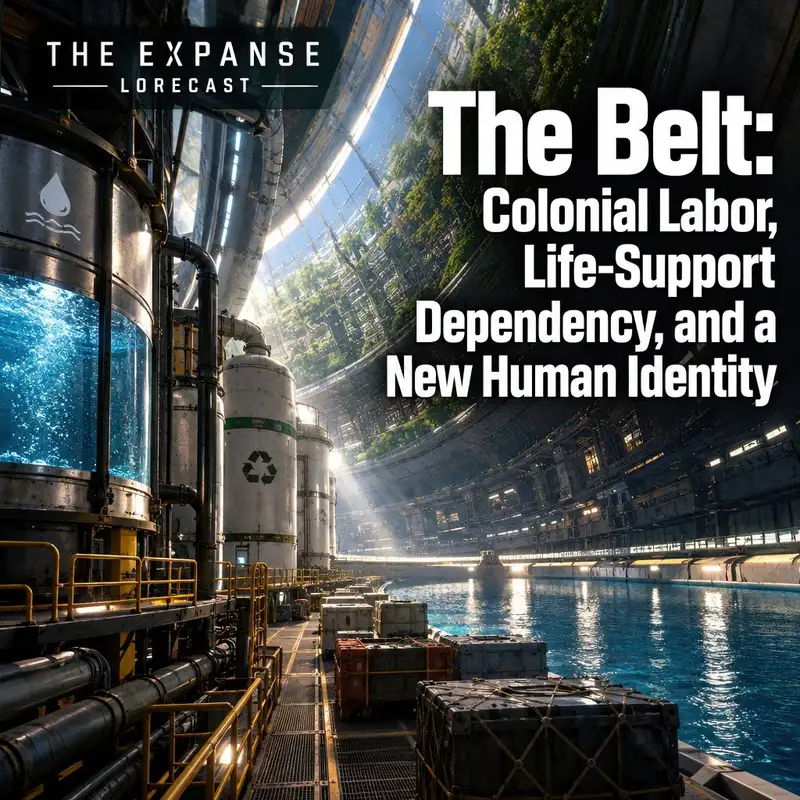
On a planetary surface, people can forget how much invisible labor sits behind ordinary life. In a station, the machinery is harder to ignore. Air is not an atmosphere. It is a managed system. Water is not a river or a public utility taken for granted. It is captured, recycled, tested, rationed, moved through pipes, and protected from contamination. Heat must be managed. Waste must be processed. Hulls must be inspected. Seals must hold. Power must remain available. Every routine task has an operational consequence because a failure can turn a workplace or apartment block into a pressure emergency.
That reality gave technicians, dockworkers, mechanics, pilots, and station crews a practical authority that did not always match formal political authority. A distant corporation might own a facility. An Earth-linked legal system might claim jurisdiction. A Martian contract might define production quotas. But when an air recycler failed, the people who knew the machine mattered more than the people whose names appeared on the paperwork. When a ship arrived low on supplies, docking control mattered. When a fire spread through a compartment, the emergency crew mattered. When an aging habitat required a shutdown for repairs, the people who decided whether work could pause held power over everyone dependent on that habitat.
This did not mean every shortage was deliberate coercion. Equipment fails. Cargo is delayed. Accidents happen. Some station authorities were more capable or less exploitative than others. The Belt was too large and varied for one universal story of suffering. But dependence gave economic and political decisions an unusually sharp edge. A bad contract could mean debt. A delayed shipment could mean hunger. A labor dispute could threaten operations that no one could safely abandon. A security crackdown could interrupt the people responsible for keeping the station alive.
For Belters, life support was not merely a symbol of oppression. It was the material proof that political power had to be judged by who kept people breathing. That made local authority important, but it also made local authority dangerous. A station administrator, a corporate manager, a dock syndicate, a security contractor, or an armed faction could all gain leverage by controlling the systems that turned a metal structure into a habitable place.
The work itself was skilled. Mining in the Belt was not a romantic frontier occupation, and hauling cargo through interplanetary space was not simply a matter of pointing a ship toward its destination. Both required training, maintenance, risk management, and crews able to make decisions far from immediate supervision. Ship repair demanded knowledge of pressure systems, drives, power distribution, sensors, structural stress, and the practical habits that separate a functional vessel from a drifting hazard. Cargo handling, habitat construction, refinery work, and agricultural support all depended on labor that could not be replaced by a speech from a distant capital.
Automation existed, but it did not abolish dangerous work. The political economy of the Solar System still found uses for people with limited alternatives. It remained cheaper, or more convenient, or more politically acceptable to send workers into hazardous environments than to eliminate every risk through machines. That was one of the setting’s most familiar and most uncomfortable continuities with older extractive societies. Advanced propulsion changed the scale of commerce. It did not automatically change who bore the danger.
Belter labor was not uniform. Some people were born into station families. Some arrived through employment. Some worked under harsh contracts. Some found opportunities that could not have existed on Earth. Some gained status as captains, engineers, traders, managers, or local officials. Some lived in relative stability. Others lived with debt, insecurity, and the knowledge that injury could end a career. It would be false to describe every Belter as forced labor, and equally false to ignore the structural pressure that made bad choices look like the only choices available.
Shared work did not erase local differences. It did create a common language of risk. Belters understood that an Inner politician could praise industrial growth while never having to trust a worn suit seal. They understood that an Earth corporation could call a shortage a market adjustment while a station crew counted days of water. They understood that workers who knew how to repair a dock, run a hauler, or stabilize a habitat possessed strategic value, even when the larger system denied them equal political standing.
This is where class consciousness in the Belt came from. Not from a single manifesto, and not from universal agreement, but from repeated experience. People recognized themselves in one another because they recognized the work, the danger, and the thin margin between routine hardship and catastrophe.
Low gravity deepened that distinction. Generations of life in stations and ships created physical differences among populations raised under different conditions. Belters were not all built alike, and no simple biological rule described every person from the outer system. Health, nutrition, medical treatment, local gravity, family history, and individual circumstance all mattered. Some Belters could travel to planets with assistance or endure conditions that would be difficult for others. Some could not. The point was not that one population had become a separate species. The point was that the human body itself had become entangled with geography, class, and political status.
Gravity could determine where someone could work, where they could safely travel, what kind of medical care they required, and whether a military institution considered them useful. Planetary prejudice could convert physiological difference into social hierarchy. Earthers and Martians could look at Belters as fragile, alien, unhealthy, or permanently subordinate to space. Belters, in turn, had reason to see people raised under deep gravity as beneficiaries of systems that demanded outer-system labor while denying its workers equal respect.
The Belt’s identity was also cultural. Lang Belta, local customs, shipboard habits, station loyalties, and shared references developed across a scattered population. That culture should not be reduced to an accent or a collection of colorful phrases. It was a way of recognizing people who understood the physical and social realities of life away from a planet. A Belter identity could emerge in the gap between many local languages, employers, habitats, and political affiliations because people still shared an environment that required mutual dependence.
In that sense, Belter identity was not based on blood or a fixed biological destiny. It was based on lived conditions and mutual recognition. A person became part of the Belt through work, survival, kinship, knowledge, and political experience. The same conditions that built solidarity also produced tension. Those who had access to better contracts, safer stations, shipping ownership, technical education, or political connections did not experience the Belt in exactly the same way as those who did not.
A people was forming, but it was forming under unequal conditions and without one uncontested institution to define its interests.
Ceres showed what that looked like in civilian life. It was a major urban and commercial station, a place of business, housing, transit, policing, entertainment, political organizing, and quiet exhaustion. It was also a place where sovereignty was divided. Corporate authority, Earth-linked legal power, private security, local custom, criminal enterprise, and Outer Planets Alliance activity all overlapped. None of them completely controlled the station’s social reality.
Josephus Miller’s position in the early events of Leviathan Wakes makes this clear. Miller was a Belter working for Star Helix, a private security company. He enforced order inside a structure tied to interests beyond the Belt, but he was not outside Belter society. He knew its people, its resentments, and its informal rules. His role demonstrates one of the central errors outsiders often make when looking at colonial labor systems. They assume the oppressed are always outside the institutions that constrain them. In reality, people survive by working inside those institutions, policing them, trading with them, repairing them, and sometimes resisting them.
Private security on Ceres could enforce contracts, investigate crimes, contain unrest, and protect commercial order. It could not manufacture legitimacy merely by wearing a badge. Local residents judged authority through its behavior. Did it protect people, or did it protect property? Did it understand station conditions, or did it impose distant priorities? Did it treat Belters as citizens, workers, suspects, or disposable labor? Those questions shaped how every investigation, arrest, shortage, and public disturbance was interpreted.
The Canterbury crisis exposed how rapidly information could become a weapon in that environment. James Holden’s broadcast accusing Mars of destroying the Canterbury did not create Belt anger from nothing. It struck a population already accustomed to distrust, unequal power, and conflicting accounts from institutions that had often failed them. Rumor moved faster than verification. Political factions interpreted events through their own interests. Security forces had to manage unrest without possessing a complete picture of what had happened. Distant governments faced communications delays and limited local credibility.
The episode on Ceres was not simply a riot caused by false information. It was an intelligence and legitimacy failure. When people do not trust the institutions that claim to protect them, uncertain news can become more destabilizing than confirmed news. The question is no longer only whether a report is true. It becomes who benefits from it, who is hiding something, and whether anyone with authority can be believed.
Ceres revealed the Belt’s political fragmentation, but it also revealed why that fragmentation did not mean apathy. Belters cared intensely about power because power was never abstract for long.
Anderson Station gave that political memory a harsher edge. Before becoming a major figure in Belter politics, Fred Johnson had been a United Nations Marine officer. His assault on Anderson Station was a military operation carried out in the name of restoring order. The tactical objective was achieved. The station was retaken. United Nations authority was enforced.
But the later revelation that an effort to surrender had been withheld during negotiations transformed the meaning of that operation, especially for Johnson himself. The novella presents his experience and moral reckoning, not a complete archive of every Inner-Belter conflict. Even so, the event matters because it demonstrates the gap between tactical success and political consequence. A command may complete its mission while destroying the legitimacy it claims to defend.
From the perspective of the chain of command, Anderson Station could be understood as an armed challenge that required a response. From the perspective of many Belters, it became evidence that distant authority could treat station lives as expendable when control was at stake. Those interpretations were not merely propaganda inventions. They emerged from a world in which people had already learned that air, food, labor, and security were often governed by institutions beyond their meaningful control.
Johnson’s later political role did not erase the suspicion attached to his earlier service. He became important at Tycho and within Belter networks because he brought resources, organizational ability, and access to the political language of the Inner planets. He also remained an Inner-born former officer whose relationship with Belter causes could never be free of mistrust. That ambiguity was not a personal flaw that better messaging could solve. It reflected a larger reality. The Belt needed allies, industrial capacity, and strategic connections, but dependence on outside patrons could reproduce the very hierarchy Belters were trying to escape.
Anderson Station became part of the Belt’s political memory because it condensed a larger experience into one event. The force that could save a station could also destroy it. The government that spoke of law could still conceal a surrender. Order imposed from outside was not necessarily order accepted by the people expected to live under it.
That memory helped fuel the Outer Planets Alliance, but the Outer Planets Alliance was never a single government waiting to take its rightful place.
The Outer Planets Alliance grew from that political memory, but it never erased the Belt’s localism. It linked organizers, armed cells, station leaders, smugglers, workers, moderates, and radicals who could share grievances without sharing one doctrine or one chain of command. That breadth made the OPA difficult to destroy, yet it also made representation permanently contested.
Tycho Station became important because Fred Johnson could connect political ambition to industrial capacity, communications, and ships. Even then, practical influence was not the same as universal legitimacy. No station, faction, or leader could simply declare itself the voice of every Belter and expect the rest of the Belt to agree.
Then the Ring appeared, and the old frontier found itself looking suddenly provincial.
Before the Ring, the Belt, the Moon, and the outer planets represented the far edge of human expansion. They were dangerous, industrial, contested places, but they were also central to humanity’s future because there was nowhere else to go. The Ring changed that geography. It offered access to more than a thousand systems beyond the Solar System, and with that access came a new political imagination. People who had spent their lives arguing over rights within an overcrowded and unequal system could now imagine leaving it.
For the Belt, this was both opportunity and threat. Belters had the shipboard skills, survival knowledge, and frontier habits that made them well suited to early settlement. They understood confined environments, limited supplies, technical improvisation, and life far from immediate rescue. New systems could offer escape from Inner-controlled labor structures. They could provide land, resources, and the possibility of communities built on different terms.
But the gates did not create functioning societies. They did not provide medicine, agriculture, trained administrators, spare parts, ships, or political trust. A colony still had to travel from its gate to its destination under conventional propulsion. It still needed shelter, food, labor, security, and a way to resolve disputes. New territory relieved some pressure while creating new routes for exploitation, migration, and conflict.
The Ring also threatened the Belt’s older strategic place. If every new system could become a frontier, then the Belt was no longer humanity’s only bridge to the outer reaches of civilization. Investment and ambition began to move outward. Mars, whose identity had long been tied to the immense project of making one planet habitable, faced a particularly severe challenge. Why devote generations to terraforming when a gate might lead to a world that required less transformation? The resulting uncertainty weakened old institutions and altered the balance of power throughout the Solar System.
For Belters, the new frontier sharpened an old question. Was freedom found by winning fair terms in the system that already existed, or by leaving that system behind? The answer differed by station, family, faction, and available transport.
Ilus, also known as New Terra, proves that leaving the old Belt does not automatically leave Belter politics behind. Settlers carry memories of unequal contracts, displacement, and insecurity into a new world, while corporate representatives arrive with legal claims and resources backed by institutions far away. The dispute becomes a frontier version of the same older question: who gets to decide whose labor, risk, and presence count as legitimate?
The stakes are material before they are ideological. Food, shelter, transport, medical support, security, and access to off-world markets determine whether a settlement can survive. The new frontier therefore widens Belter opportunity while reproducing many of the pressures that helped create Belter political identity in the first place.
As migration expanded, those grievances became available to leaders who promised unity through force. Marco Inaros and the Free Navy drew strength from real Belter anger. They understood the bitterness created by decades of inequality, Inner condescension, insecure labor, and political exclusion. They also exploited the disruption created by the Ring era. Mars was destabilized. Military equipment entered black markets. Old loyalties weakened. The balance that had kept Earth, Mars, and the Belt in an uneasy relationship began to fracture.
The Free Navy was not the Belt. It was not the entire Outer Planets Alliance. It was a coercive military and political coalition that recruited from genuine grievance while claiming a monopoly on Belter representation. That distinction is essential because its methods shaped its political meaning. The Free Navy used piracy, captured or illicit military assets, intimidation, strategic disruption, and deliberate mass violence against civilians. It did not merely seek recognition. It sought to impose a new order through terror and coercion.
Its attacks achieved real tactical and operational effects. They created shock. They damaged infrastructure. They disrupted Inner logistics and forced governments to confront vulnerabilities they had preferred to ignore. The old powers could not simply rely on superior fleets if their food, transport networks, political cohesion, and civilian confidence were under attack. The Free Navy demonstrated that an insurgent force with access to ships, intelligence, and strategic ruthlessness could alter the entire system’s calculations.
But tactical shock was not the same as durable political legitimacy. The deliberate targeting of civilians and the destruction of the systems on which ordinary people depended did not liberate the Belt. It deepened suffering and created a coalition against the Free Navy. Marco’s movement turned a demand for dignity into a justification for mass atrocity. That choice mattered morally, but it also mattered strategically. It narrowed the movement’s claim to represent Belters and made cooperation with it impossible for many who shared the underlying grievances.
The Free Navy’s rise should not be used to dismiss those grievances. A population can be exploited without every person who speaks of exploitation being trustworthy. A movement can identify a real injustice and still become a vehicle for domination. The Belt’s tragedy was that the conditions which made solidarity necessary also made people vulnerable to leaders who promised protection, revenge, and unity at the price of everyone else’s freedom.
The defeat of the Free Navy did not answer the question that had produced it. It only made that question impossible to ignore.
The postwar settlement created the Transport Union and gave Belters a recognized role in managing transit through the Ring network. This was not symbolic. Control over movement between systems meant control over schedules, shipping, docking, access, inspection, fees, and the practical rules that could determine whether a colony received supplies or whether a government could move power across the gates. The Ring network had created a new chokepoint at the center of human expansion. The Transport Union gave the Belt institutional leverage over that chokepoint.
That was a major political achievement. Belters who had long been treated as labor providers, security problems, or junior partners became necessary to the governance of intersystem civilization. The arrangement recognized a basic strategic fact. Earth and Mars could not simply claim authority over a network whose daily operation depended on people with the experience, ships, stations, and political relationships of the Belt.
But the Transport Union was a compromise, not a final emancipation. It could regulate transit. It could not instantly eliminate unequal development, repair the trauma of war, restore destroyed communities, guarantee food security, or resolve every conflict between stations, colonies, corporations, and governments. Its authority depended on infrastructure, enforcement, and the willingness of powerful actors to accept rules when those rules became inconvenient. Belters gained leverage, but leverage was not the same as complete sovereignty. A gate authority could shape commerce without controlling every shipyard, agricultural system, financial network, or local political dispute.
The Belt had become politically powerful because its people had learned a hard lesson through work and survival. No one lived alone in a pressure vessel. No ship crossed the system without crews, docks, fuel, repairs, and supply chains. No station remained habitable because a distant government declared it important. Belter identity grew from the daily knowledge that collective labor kept civilization alive, even when civilization refused to treat that labor as equal.
Yet the same distributed system that created solidarity prevented simple unity. Belters could build commerce, mutual aid, insurgency, institutions, and a new claim to political authority. They could not escape the continuing argument over who controlled the air, the ships, the gates, and the right to speak in the Belt’s name.