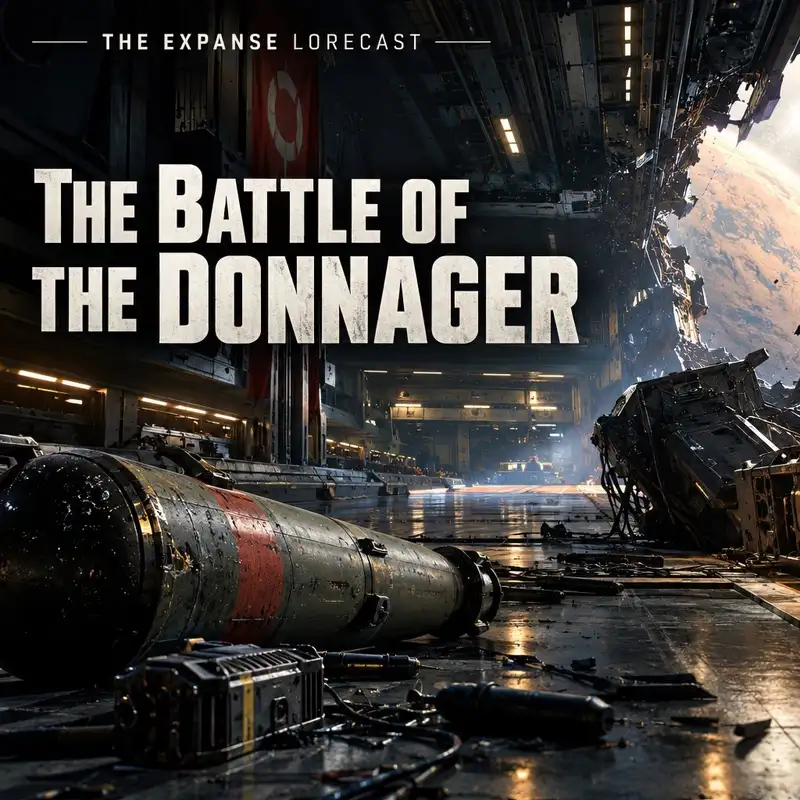
The Battle of the Donnager
The Martian battleship had recovered five survivors from a disaster that was already becoming a diplomatic crisis. James Holden, Naomi Nagata, Alex Kamal, Amos Burton, and Shed Garvey had escaped the destruction of the Canterbury in a damaged shuttle. Holden had then made the decision that turned private testimony into system-wide provocation. He broadcast his belief that Mars had attacked the Canterbury. The message traveled farther and faster than any correction could. Across the Belt, people heard an Earther accuse Mars of murdering an ice hauler and its civilian crew. On Mars, naval officers heard a former United Nations officer make an accusation that could justify retaliation. By the time the survivors came aboard the Donnager, they were no longer merely castaways. They were evidence, suspects, and political hazards.
Captain Theresa Yao did not have the luxury of treating them as innocent until proven otherwise. The survivors had been found near the wreckage of the Knight, the shuttle they had taken after abandoning the Canterbury. They had connections, however indirect, to the Scopuli, a vessel carrying Martian military equipment under circumstances that made very little public sense. Holden’s broadcast had made Mars look guilty before Martian command had established what had happened. Lieutenant Lopez, working the interrogation, had to consider possibilities that ranged from conspiracy to manipulation. Were these people victims? Were they accomplices? Had someone placed them in the path of Martian forces to create an incident? Or were they bait for a larger operation?
That uncertainty mattered because a warship is not a courtroom. A naval commander must act before every fact is available. The Donnager’s officers had to preserve the ship, protect classified information, report to higher command, and determine whether the people in their custody had helped ignite a war. They could not wait for a civilian investigation to assemble a complete record. Earth and Mars had armed fleets, old grievances, competing industrial systems, and enough suspicion to turn an ambiguous event into a catastrophe. The Belt, where the Canterbury had been destroyed, had even less reason to trust official explanations from either Inner planet.
Then the Donnager detected an approaching contact. What had begun as an intelligence problem aboard a Martian warship became a combat problem, and then something worse. The approaching threat did not fit a familiar pattern. It did not arrive with a transponder identity that could be trusted. It did not behave like a commercial vessel asking for assistance or a conventional military force making a visible show of strength. The contact picture was incomplete, then deceptive, and then suddenly far more dangerous than the Martians had reason to expect.
The Donnager was built for the kind of fight Mars expected to win. It was a capital ship of the Martian Congressional Republic Navy, part of the force that gave Mars its reputation as the Solar System’s most disciplined military power. That reputation was not empty theater. Mars had spent generations building a state around technical education, industrial discipline, military readiness, and the long project of transforming an inhospitable planet into a permanent home. Its navy was one expression of that national effort. A Martian warship represented shipyards, laboratories, training pipelines, supply chains, naval doctrine, and the political decision to spend scarce resources on deterrence rather than comfort.
A battleship like the Donnager carried heavy armor, guided torpedoes, railguns, point-defense cannons, sensors, secure communications, marines, and the internal systems needed to keep fighting after damage. It was not simply a large gun platform. It was a pressure vessel, power plant, computer network, hospital, barracks, weapons magazine, command post, and workplace for a large crew. Its survival depended on compartmentalization, trained damage-control teams, redundancy, discipline, and the ability of exhausted people to make correct decisions while alarms were sounding and the ship around them was losing pieces.
Its defensive systems were formidable, but formidable is not the same as invulnerable. Point-defense cannons could engage incoming missiles and close threats. They were not invisible walls around the hull. Every incoming weapon still had to be detected, tracked, prioritized, and engaged. Every defensive system had limits of ammunition, fields of fire, mechanical reliability, and timing. A railgun could deliver devastating kinetic force when geometry favored the firing ship, but it was not a solution to every tactical problem. Guided torpedoes could strike across great distance, but they required target information, time, and a firing opportunity. The Donnager had powerful tools. What it lacked was a reliable understanding of the force approaching it.
The initial contact resolved into six smaller vessels. Their reduced signatures had delayed certainty, not made them supernatural. They had used stealth, timing, and deception to arrive close enough that the Donnager could not calmly identify them, classify their weapons, and establish the range at which Martian doctrine was most comfortable. The attackers had already won an important part of the engagement before the first exchange of fire. They had forced Captain Yao to make decisions without a usable model of the enemy.
That is one of the enduring problems of military power. A force can possess excellent ships and sound doctrine, yet still be vulnerable when an opponent changes the assumptions beneath that doctrine. The Martians knew how to fight Earth. They knew how to track conventional ships, assess drive signatures, identify weapons profiles, and estimate what another established navy could do. They did not know who these six ships belonged to, where they had been built, what systems they carried, or what their commanders wanted. The attackers were not simply a smaller force challenging a larger one. They were an unknown force shaping the encounter around uncertainty.
The first attacks came with torpedoes and coordinated maneuver. At long range, a guided weapon is not merely an explosive device. It is a demand on the defender’s attention. It forces sensor crews to distinguish genuine threats from decoys. It forces weapons officers to decide which targets matter most. It forces the defending ship to maneuver, and maneuver can alter firing arcs, expose damaged sections, disrupt planned actions, and consume the narrow margins on which an orderly battle depends. A warship under missile attack is not only trying to destroy incoming weapons. It is trying to keep its own tactical picture from collapsing.
The attackers’ guidance and weapons behavior were unfamiliar to the Donnager’s crew. That did not mean the Martians suddenly became incapable, nor did it mean the attackers possessed magic. It meant that a weapon system designed around expectations can be stressed by a threat that behaves outside those expectations. The six ships continued to press the attack, changing the geometry and preventing the battleship from settling into a clean exchange where its greater mass and conventional firepower could be applied at maximum advantage.
Their objective did not need to be the immediate destruction of the Donnager. A capital ship can survive damage that would kill a smaller vessel, especially when its crew is trained and its compartments are built to isolate failure. But survival is not the same as control. If incoming attacks can strain point defense, damage sensors, disrupt communications, force emergency maneuvers, and create casualties inside the hull, they can make a battleship vulnerable to the next stage of an operation. The attackers were not trying to win a duel according to Martian assumptions. They were trying to force the Donnager into a crisis from which no ordinary victory could fully recover.
The Donnager fought back hard. Its return fire showed why Mars had invested so heavily in ships like it. Torpedoes went out against the attacking force. Point-defense cannons engaged threats at closer range. As the distance narrowed, railguns became more relevant, turning the battle into a brutal contest of position, timing, and survival. The Martian crew inflicted severe losses. Much of the attacking force was destroyed or disabled before the battle ended. The exact accounting is less important than the operational reality. The Donnager did not die because it was helpless. It died after demonstrating that it could kill a great deal of what had come for it.
The difference shaped Captain Yao’s remaining choices. If the battle is remembered only as a smaller force destroying a larger warship, it becomes a simple story about technological surprise. The actual lesson is harsher and more useful. The attackers accepted losses because they had designed their operation around an objective that did not require every one of them to survive. They had to create enough damage, enough confusion, and enough proximity to make the battleship’s survival politically and militarily dangerous. Their sacrifice was part of the plan, not proof that the plan had failed.
The range collapsed. At close distances, a warship’s size becomes both an advantage and a burden. Its weapons remain dangerous, but its hull presents a large target. Damage that might be manageable during a distant missile engagement becomes more consequential when enemy ships can press close, fire rapidly, and attempt to attach themselves to the vessel. A capital ship can carry armor and redundancy, but it cannot make the people inside it invulnerable. Every breach threatens pressure, wiring, access routes, wounded crew, and the ability of officers to know which parts of their own ship remain secure.
The Donnager began to suffer the kind of damage that changes a battle from an external contest into an internal emergency. Systems failed. The ship’s artificial gravity, created by thrust rather than any magical field, became unreliable as the battle disrupted normal operations. People moved through damaged passages on the float, using handholds and improvised routes through a vessel designed for orderly service, not sudden chaos. Pressure boundaries, sealed compartments, wounded personnel, and damaged communications all complicated movement. A warship can retain guns and still become difficult to command if its internal circulation breaks down.
For Holden’s crew, the battle ended any remaining illusion that they were merely prisoners waiting for an interrogation to conclude. They had been civilians and contract workers before the Canterbury died. Holden had once served in the United Nations Navy, but he had not come aboard the Donnager as a Martian officer. Naomi, Alex, Amos, and Shed had no reason to expect they would be trapped inside the opening phase of a clandestine naval attack. Yet once hulls begin rupturing, distinctions between military personnel, detainees, passengers, and workers become painfully thin. Everyone depends on the same air, the same pressure seals, the same medical care, and the same people keeping the ship from coming apart.
Shed Garvey died in that chaos. His death was abrupt, the result of penetrating fire reaching into a space that should have been protected by the mass and armor of a Martian battleship. There was no strategic lesson that made the loss less personal. He had survived the destruction of the Canterbury, survived the escape in the Knight, and survived being detained aboard a foreign warship. Then the Donnager’s compromised hull turned a distant naval engagement into immediate lethal danger. His death was a reminder that in space combat, a weapon does not need to destroy a ship outright to kill the people inside it.
With Shed dead, the surviving Canterbury crew was reduced to Holden, Naomi, Alex, and Amos. Their importance, however, had increased rather than diminished. They had witnessed the Canterbury’s destruction. They had seen enough of the Scopuli incident to make their testimony valuable. They had lived through the attack on the Donnager. If someone was manufacturing a conflict between Earth, Mars, and the Belt, independent survivors were a problem. They could contradict official narratives. They could connect events that others wanted kept separate. And they could carry evidence beyond the control of whichever institution had expected them to vanish.
The attacking ships were not content to trade fire at range. They moved toward boarding. That changed Captain Yao’s calculation completely. Destroying an enemy vessel is one problem. Preventing an enemy from entering a damaged capital ship is another. A boarding force can seek command spaces, data systems, communications equipment, intelligence records, prisoners, or technical samples. It can capture a ship rather than merely wreck it. It can turn local damage into a broader collapse of internal security. And in a battle where the enemy’s identity remains uncertain, commanders must assume that any classified system might be a target.
The attackers’ full purpose was not known to Yao in that moment. It would be a mistake to give her certainty she did not possess. She did not know every link in the chain that had led from the Scopuli to the Canterbury, from the Canterbury to the Knight, and from the Knight to her own ship. She did not know who financed the six attackers or what political authority, if any, stood behind them. But she knew enough. An unknown force had taken extraordinary risks to reach the Donnager. It had demonstrated unfamiliar capabilities. It had suffered heavy losses without withdrawing. And it was trying to get inside.
A captured Donnager would have been more than a lost hull. Its computers, sensors, communications systems, operational records, and intelligence files could expose Martian capabilities and ongoing investigations. Its surviving crew could be interrogated. Its prisoners could be seized. Its internal systems could be exploited for information that might shape later operations. Even if the attackers could not remove the entire ship, they might retrieve what mattered most. For a commander responsible for classified military assets, preserving the hull at any cost could become the more dangerous choice.
Captain Yao therefore faced an impossible decision in the old naval sense of the term. Not a choice between a good option and a bad one, but a choice between two forms of defeat. She could continue trying to preserve the Donnager, risking the capture of systems and people whose value extended beyond the battle. Or she could destroy her own ship, sacrifice the possibility of saving much of her crew, and deny the attackers the prize they had fought to reach. Neither choice erased the damage already done. Neither restored the dead. Neither protected Martian prestige. But one choice could limit what the enemy learned and what it gained.
The self-destruct procedure, commonly identified as Condition Zero, was not a gesture of panic. It was a denial operation. Naval forces plan for the possibility that a vessel may be compromised beyond recovery. Classified systems, communications security, intelligence records, and military technology cannot always be removed by hand while a boarding action is underway. In such conditions, scuttling is not surrender. It is the decision that the ship itself has become less valuable than preventing its capture. It is an acknowledgment that material loss may be preferable to strategic exploitation.
Yao’s responsibility was also to preserve whatever lives could still be saved. The Donnager carried smaller vessels in its hangar, including the Tachi, a Martian light frigate. The Tachi was not a lifeboat improvised out of debris. It was an armed spacecraft with its own drive, systems, crew spaces, and the ability to leave the dying battleship under power. That made it a viable escape platform, but getting to it was still dangerous. The Donnager was damaged, under attack, and threatened internally. The route to the hangar ran through a ship that could no longer guarantee gravity, security, or intact passageways.
Lieutenant Kelly took charge of moving the survivors. Martian marines escorted Holden, Naomi, Alex, and Amos toward the Tachi through the damaged interior. The mission was simple in statement and dangerous in practice. Get the witnesses out. Get them aboard a ship capable of escaping. Do it before the attackers capture them, before the Donnager’s internal condition becomes fatal, and before Condition Zero makes every remaining compartment part of the ship’s grave.
The Marines protecting them were not famous commanders or architects of strategy. They were the people who carried out the consequence of Captain Yao’s decision. Boarding defense and evacuation depend on such personnel. They move through narrow spaces where armor, weapons, pressure hazards, and zero gravity all complicate the simplest action. They must distinguish friendly movement from enemy movement in a ship whose communications and internal layout may no longer be reliable. They operate while the vessel shakes under impacts and while every delay brings scuttling closer. Their work is usually remembered only when it fails.
Kelly was wounded during the escape. He would later die from those injuries. His role is easy to overlook because he did not become one of the celebrated survivors of the Canterbury or the commander of a famous ship. But his death represents the cost of the evacuation in human terms. The Tachi escaped because others held routes, made decisions, provided protection, and absorbed the risk that the four civilians could not avoid. In military history, the people who make an escape possible often disappear behind the names of those who reach safety. The Donnager battle did not spare that pattern.
The Tachi departed with Holden, Naomi, Alex, and Amos aboard. Their escape denied the attackers one of their likely objectives, though the precise priority of those objectives remains uncertain. The survivors carried testimony. They carried their memories of the Canterbury and the Donnager. They carried the political burden of being alive when others had been killed. Later, the Tachi would become the Rocinante, but at that moment it was still a Martian frigate fleeing the destruction of the battleship that had carried it.
Behind them, the Donnager died. The destruction did not produce an atmospheric blast wave rolling through empty space. Its violence was the disintegration of a capital ship, the loss of people and equipment, and the denial of its systems to an enemy force that had come close enough to board it. The ship’s destruction was visible proof that Mars could suffer a direct military loss. That mattered far beyond the immediate survivors. In a system already prepared to interpret every event through suspicion, the destruction of a Martian battleship was not simply news. It was fuel.
The attackers had achieved a major tactical and political result. They had caused the loss of a premier Martian warship. They had demonstrated that concealed industrial capacity could produce vessels able to threaten the Martian navy. They had intensified the crisis surrounding the Canterbury. Yet they had not achieved a clean victory. Most of their force had been destroyed or disabled. They did not leave with an intact Donnager. They did not eliminate every witness. And by forcing the ship’s destruction, they created debris, records, and questions that would eventually complicate the story they hoped to tell.
This is the difference between tactical success and strategic control. The attackers could make Mars bleed without fully directing what happened next. They could produce an outrage, but outrage is an unstable weapon. It can mobilize the people one intends to provoke. It can draw scrutiny toward evidence that would otherwise remain buried. It can create a political crisis so severe that allies, rivals, and opportunists begin looking for the hand behind it. The covert operation had manufactured confusion, but confusion is not obedience.
Public interpretation of the Donnager’s destruction was chaotic because the battle produced more questions than answers. A Martian capital ship had been overwhelmed by attackers whose identity remained uncertain, while the Canterbury survivors escaped aboard a Martian vessel. In a system already primed for collective blame, almost any faction could use part of that story to support what it already feared.
The Belt could not responsibly be treated as one armed force, and the attackers were not proof of collective Belter responsibility. Yet that distinction was politically fragile. Collective blame is attractive in war because it converts uncertainty into a target. The Donnager battle made that temptation stronger without providing the evidence needed to justify it.
The surviving Canterbury crew therefore became strategically important as witnesses. Lieutenant Kelly’s actions helped keep them alive and preserved a route by which evidence could escape the battle. Later clues about the attackers’ industrial origins complicated the first assumptions further, showing that familiar political categories were not enough to explain what had happened.
None of that meant the Martian Navy had suddenly become obsolete. The Donnager had been placed into a fight shaped by surprise, unfamiliar capabilities, boarding pressure, and incomplete intelligence. Its loss demonstrated the danger of an unknown enemy, not the disappearance of every advantage Mars had built into its navy.
The battle was therefore not proof that Martian naval power had become worthless. The Donnager fought effectively, destroyed much of its attacking force, and showed the resilience of its crew under extraordinary pressure. Its loss exposed something more troubling than simple military weakness. A powerful navy can be forced into defeat when an enemy chooses an objective that firepower alone cannot solve. The attackers did not need to win a clean fleet engagement. They needed to force Captain Yao to decide that preserving her ship risked handing its systems, intelligence, and witnesses to an unknown enemy.
Captain Yao chose denial. The Donnager died, but it did not become the attackers’ prize. The survivors escaped. Evidence survived. And the battle left behind a trail that pointed away from the flags being blamed and toward the hidden institutions trying to turn suspicion into war.