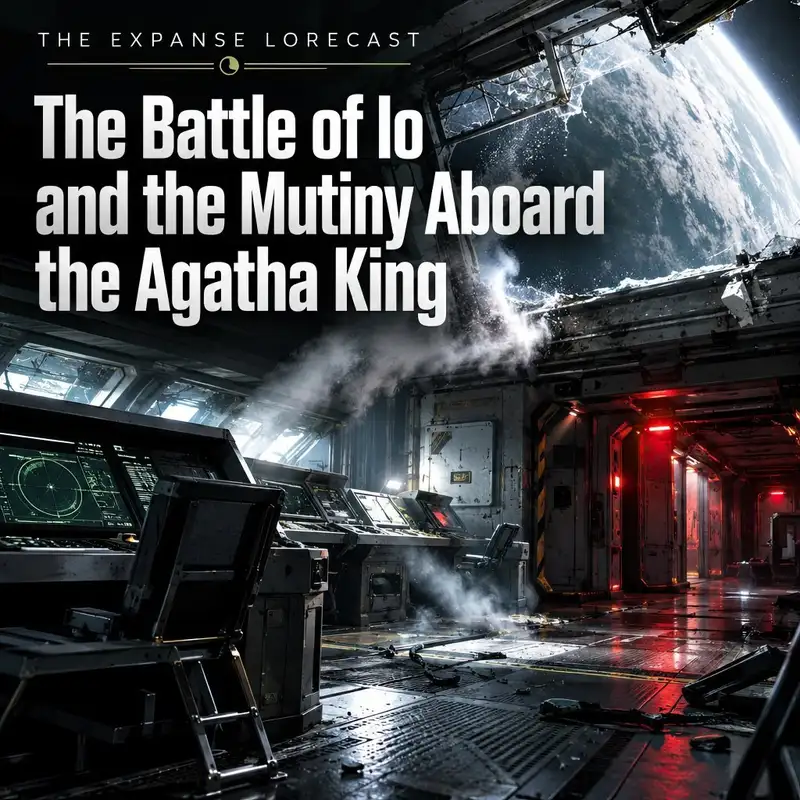
The Battle of Io and the Mutiny Aboard the Agatha King
The order to fire on the Jimenez was the point at which the battle around Io stopped looking like a conventional confrontation between Earth and Mars. A United Nations Navy flagship had Martian ships nearby, missiles armed, and a crisis unfolding around one of Jupiter’s moons. Yet Admiral Augusto Nguyễn’s immediate target was not the Martian cruiser Hammurabi. It was another United Nations vessel that had refused to follow his command. The Agatha King had been built to carry authority across the vast distances of the Solar System. In that moment, it became a weapon pointed inward.
That is what made the mutiny aboard the Agatha King more important than the visible exchange of fire around it. A navy can survive the loss of ships. It can replace hardware, retrain crews, and revise deployment plans. It has much more difficulty surviving the loss of agreement about who has the right to give orders, and what those orders are for. Nguyễn still had rank. He still had loyal officers. He still had access to the ship’s weapons. But the authority behind those tools had fractured. By the time the Agatha King fired on the Jimenez, the United Nations Navy was no longer acting as one instrument of Earth’s policy. It was a collection of armed people trying to decide whether obedience had become complicity.
The Battle of Io was therefore not decided by which side possessed the better ship or the larger formation. It was decided by legitimacy. The Martians understood that they faced a dangerous United Nations force, but they also recognized that the force was coming apart under the pressure of its own secrets. The people aboard the Agatha King understood something even worse. The war they had been told they were fighting was not the same war their commanders had prepared in private. And at Io, that difference became impossible to ignore.
The political setting was already poisoned before the Agatha King changed course. Earth and Mars had moved from cold hostility into open war after a sequence of attacks, provocations, and deceptions that made restraint look like weakness to both governments. Earth struck Martian missile platforms, seeking to reduce Mars’s ability to launch a devastating first blow. The operation achieved part of its military aim. Mars lost much of its immediate first-strike capacity.
But one Martian missile got through. It struck South America, killing roughly two million people in the blast zone. The military exchange was limited compared with the destruction either planet might have inflicted in a full nuclear war. Politically, though, it was catastrophic. The attack transformed an interplanetary crisis into a wound felt across Earth. It gave fear a human scale. It created pressure for retaliation. It made the language of deterrence sound cleaner than the reality of dead civilians, ruined infrastructure, and families who had no role in the decisions that put a missile over their continent.
This was the environment in which Undersecretary Errinwright’s covert strategy operated. His project was not simply the official United Nations policy of defending Earth. It was a private attempt to manage the war through manipulation, selective disclosure, and controlled escalation. The theory behind it was recognizably political. A limited conflict with Mars might unite Earth, isolate enemies within the government, and make the population accept measures that would otherwise be intolerable. It was also dangerously arrogant. Controlled war is a phrase favored by people who have not yet lost control of the weapons.
Errinwright’s scheme depended on secrecy. The wider United Nations government could not openly debate every part of it. The public could not know how much of the crisis had been manufactured or exploited. Professional officers were expected to execute their orders without understanding the political purpose behind them. Corporate and scientific programs could operate beyond ordinary scrutiny. The arrangement worked only as long as every compartment stayed sealed. At Io, the compartments began to fail.
The Agatha King became the place where that failure acquired a physical form. It was a flagship, but not simply because of its weapons or its size. A flagship is a communications center, a command post, and a symbol. It tells subordinate crews where authority sits. It gathers reports, issues orders, coordinates movement, and gives a dispersed force the confidence that someone understands the larger picture. When the flagship is compromised, the danger is not just that one ship may be lost. The danger is that every other ship begins to question the meaning of the signals coming from it.
Admiral Michael Souther had initially held responsibility aboard the Agatha King. He was a career officer, committed to Earth’s defense and to the United Nations Navy as an institution. He was not a Martian sympathizer, and he was not looking for an excuse to abandon the war. His crisis began when the ship recovered Cotyar Ghazi and Theo from a debris field. Cotyar had been Avasarala’s intelligence operative. He carried evidence, knowledge, and the sort of dangerous survival that tends to make conspirators nervous.
Nguyễn arrived and assumed effective command. He accused Chrisjen Avasarala of treason, presented the situation as an emergency, and redirected the Agatha King toward Io. The expected fleet rendezvous had been near Callisto. Io was something else entirely. It was a moon of immense strategic importance, but Nguyễn’s urgency did not fit an ordinary naval operation. He was willing to break from the anticipated plan, pull the flagship toward Io, and risk confrontation with Mars. That did not prove the nature of his mission. It did reveal that the official war plan was no longer his highest priority.
The destination mattered because Io contained Prospero Station and the secret program connected to it. On paper, the war was between sovereign governments. In practice, corporate resources, classified research, political conspirators, and private security structures had created a second conflict inside the first. The Agatha King was moving not merely to meet an enemy fleet, but to protect a hidden project whose consequences extended far beyond a normal campaign objective.
Souther did not begin with all the evidence. No responsible commander does. His problem was that the available facts no longer formed a credible pattern. Avasarala was said to be a traitor, yet Cotyar was alive. Nguyễn’s orders were urgent, yet poorly explained. The ship’s mission had changed, yet the explanation for that change was thin. In military organizations, confusion is not always proof of misconduct. War is confusing by nature. But when confusion consistently protects the same small group of people from scrutiny, it stops looking accidental.
The decisive evidence came from Cotyar. He possessed a recording that implicated Errinwright in the covert manipulation behind the war. He could also confirm that Avasarala was alive. The significance of that information was not merely personal. It changed the legal and political meaning of the conflict. If Avasarala was not a traitor, if the attacks and responses had been shaped by a concealed conspiracy, then orders issued in the name of Earth might be serving a narrower and illegal purpose.
Souther’s position became almost impossible. He had sworn to serve the United Nations. That oath did not mean blind loyalty to any official who could seize a command chair during an emergency. Military obedience depends on a chain of authority, but it also depends on the belief that the chain leads back to lawful civilian government. If an officer concludes that the chain has been hijacked, every order becomes a test. Refusal may look like mutiny. Compliance may make the officer an accomplice to a crime.
This is why Souther’s action should not be described as a defection. He did not offer the Agatha King to Mars. He did not reject Earth’s security interests. He tried to prevent a faction within the United Nations government from using the navy to continue a war it had helped manufacture. His supporters, including officers such as Shaffer and Mancuso, mattered for the same reason. The conflict was not a private rivalry between two admirals with incompatible temperaments. It was a widening judgment among officers who had begun to doubt the mission.
There were three different kinds of authority aboard the Agatha King, and they no longer matched. Nguyễn possessed formal command. His rank and his control of key systems gave him the ability to issue orders. Souther claimed lawful command, rooted in the belief that Nguyễn was executing an illegal operation under false pretenses. Then there was legitimacy, the more fragile form of authority that exists only when crews believe they are serving an institution rather than the private ambitions of those standing above them. Once legitimacy began to erode, neither man could rely on rank alone.
While this crisis unfolded aboard the flagship, Captain Sandrine Kirino approached in the Martian cruiser Hammurabi. Her problem was different, but no less difficult. The Agatha King was a United Nations flagship changing course toward Io during an active war. That was an obvious threat. Yet it was also an uncertain one. Kirino could see hostile capability, but she could not know that every United Nations ship in the formation accepted Nguyễn’s purpose or even understood it.
In a missile engagement, waiting is not passivity. Every minute without firing is a decision. It can preserve options, invite danger, and create the possibility that an opponent will strike first. Kirino had to consider what an immediate Martian attack would accomplish. It might eliminate a threatening flagship. It might also kill officers and crews who were resisting the very escalation Mars feared. It could unify an unstable United Nations force behind Nguyễn by making him appear to be the victim of unprovoked Martian aggression.
The Hammurabi therefore approached without immediately opening fire. That restraint did not make the situation safe. It made it more complicated. Sensors could identify ships, but they could not reliably identify political loyalties. Communications could carry warnings and demands, but they could not instantly repair mistrust. The distance between ships was not the only distance that mattered. There was also the distance between what each commander knew and what each commander feared the other might do.
Kirino’s restraint created time. Inside the Agatha King, time became mutiny.
The struggle for control was not a boarding action. No enemy marines forced their way through pressure doors. No external assault team captured the bridge. This was an institutional collapse taking place inside a warship still armed for fleet combat. The terrain was command authority. The critical spaces were the bridge, the combat information systems, the communications channels, and the weapons controls. The decisive resource was not ammunition. It was trust.
Nguyễn prepared to fire. Souther countermanded him. The exact mechanics of authority became suddenly urgent. A weapons officer had to decide which order to obey. A security officer had to decide whether an admiral was protecting the ship or endangering it. Personnel who had trained for enemy action had to assess the intentions of their own senior officers. In a warship, hesitation can be dangerous. So can unquestioning obedience. The Agatha King had become a pressure vessel full of people making those decisions under the knowledge that any one of them might determine whether missiles launched.
Souther’s faction temporarily gained the initiative. Their goal was not to establish a new political order aboard the ship. It was to halt the escalation, stand down the fleet, and expose the evidence of Errinwright’s conspiracy. In that sense, the mutiny was an attempted restoration of lawful command. Souther believed the navy had been diverted from its constitutional purpose. He tried to pull it back before a secret operation turned into an irreversible war.
But moral conviction and authentic evidence did not automatically produce control. Nguyễn still had loyalists. He still had access to armed security personnel and critical ship systems. He had prepared for secrecy, and secrecy often comes with compartmentalization. That made it easier for some officers to believe they were following a necessary emergency order rather than protecting a conspiracy. Souther’s side had a powerful argument, but arguments move more slowly than a person with a weapon and a clear willingness to use it.
There was also a deeper weakness. A mutiny can interrupt a chain of command, but it cannot instantly replace one. A ship in combat needs people who know who is responsible for navigation, fire control, damage control, internal security, and communication. It needs systems that answer to recognized authority. Souther’s supporters could seize a moment.
Nguyễn’s counterstroke exposed the limit of command by formal rank. He shot Souther and regained the initiative. The act was tactically decisive aboard the flagship. It was also politically ruinous. An admiral killing another admiral during a dispute over unlawful orders does not restore confidence. It proves that the dispute has reached the point where normal authority no longer functions.
Nguyễn then ordered the Agatha King to engage the Jimenez, a United Nations ship that had failed to conform to his formation and command. This was not friendly fire in the accidental sense. It was deliberate coercion directed at a subordinate vessel. The purpose was clear enough. Nguyễn needed the rest of the formation to understand that resistance would have consequences. He was attempting to restore fleet discipline through fear.
Even then, the order did not move smoothly through the ship. Some Agatha King personnel refused to carry it out. That refusal is one of the most revealing moments in the entire battle. The people operating the ship’s weapons no longer accepted that an order was legitimate simply because it came from the command deck.
The Jimenez was destroyed. Tactically, one United Nations warship had eliminated another. That is the smallest possible description of what happened, and the least useful. Operationally, the destruction confirmed that the United Nations formation had split into competing armed commands. Strategically, Earth had lost credibility at the worst possible moment. The force intended to demonstrate resolve against Mars had demonstrated that it could not agree on whom it served.
Politically, the destruction of the Jimenez was a disaster for Errinwright’s project. His strategy depended on keeping the war controllable. But once United Nations ships began firing on one another, escalation ceased to be a tool. It became a condition. The distinction matters. A condition is something that reshapes every decision until no one can return to the previous plan.
The Martians now had an opportunity. A fragmented United Nations formation was vulnerable. Kirino could have treated the confusion as a target solution and ordered her force to destroy the ships around the Agatha King. In a narrow tactical sense, that might have been tempting. A damaged enemy is easier to defeat than a coherent one. But Kirino understood that annihilating confused United Nations crews would solve one immediate military problem while creating a larger political one.
Instead, she offered terms to United Nations ships willing to stand down. This was not softness. It was disciplined use of leverage. The offer gave wavering crews an alternative to Nguyễn without requiring them to identify themselves as Martian allies. Kirino recognized that the quickest way to harden an enemy is to deny its people any honorable route away from disaster.
Her decision also reflected the reality of the war. Mars did not need every United Nations ship destroyed in order to gain an advantage. By withholding indiscriminate fire, Kirino allowed the United Nations Navy’s internal fracture to become visible. Mars gained political and strategic leverage because the Agatha King had already begun destroying the trust beneath Earth’s command structure.
Kirino did not end the war by herself. The larger crisis required political action on Earth, evidence against Errinwright, and the defeat of a threat neither navy fully understood. But her restraint preserved room for those things to happen. At Io, Martian discipline was not merely a matter of following orders.
The conventional fleet confrontation was already breaking apart when the deeper danger emerged from Io itself. Prospero Station was tied to Jules-Pierre Mao’s corporate empire, Dr. Strickland’s research program, and the long effort to turn protomolecule-derived horror into military capability. The human beings at the center of that project were not abstract research subjects. They were children.
This was the hidden strategic purpose behind the urgency around Io. The battle between fleets mattered, but it was never the whole mission. The true objective was the preservation or deployment of a weapons program whose consequences could not be contained within ordinary military categories. The hybrid pods launched from Io were something far more uncertain. They carried transformed beings and protomolecule processes with stealth characteristics that made tracking difficult.
Their suspected destination was Mars. That changed the meaning of the crisis. The danger was no longer limited to ships exchanging fire near Jupiter. It was the possible delivery of biological and protomolecule weapons against a planetary population. Mars had already participated in a war that killed millions on Earth.
The civilian stakes were embedded in every part of the battle. The dead in South America were not simply a political justification used in speeches. They were people killed because leaders believed escalation could be managed. The population of Mars was not a distant strategic asset. It was a society living in fragile habitats, dependent on engineered survival systems and vulnerable to a weapon whose behavior was only partly understood. And the children used at Prospero were not collateral damage from the program. They were the program’s first victims.
Corporate secrecy made this possible, but corporate power alone did not create it. The program depended on state complicity, intelligence failures, political cover, and the willingness of officials to believe that extraordinary technology could be converted into a controlled advantage. That belief was the central delusion. Activating an alien system is not the same as understanding it. Possession is not mastery.
The hybrid launch demonstrated that the program had become an escalation mechanism beyond the people who tried to use it. Mao’s network had imagined that research could be monetized and weaponized. The reality was a set of autonomous, stealthy threats moving toward a planet while fleets around Io struggled to determine who was even in command.
Then the Agatha King was struck by one of the hybrid pods.
The ship’s identity changed again. It had begun as a flagship, the center of United Nations command. It became a disputed command center, where officers fought over the meaning of lawful obedience. It then became a weapon used against its own fleet.
The immediate problem was not simply hull damage. The protomolecule infection spread through the ship, compromising personnel and making normal command conditions impossible. The Agatha King was still a complex machine full of compartments, systems, passageways, and people. But its internal environment could no longer be treated as a secure military space.
This is where the Rocinante crew entered the crisis, but their role should be understood carefully. They did not resolve the political collapse that had destroyed United Nations cohesion. They did not command the fleets. They became essential because the formal institutions were failing around a threat that required people willing to act across political boundaries. Alex Kamal and Naomi Nagata boarded the Agatha King to locate the pod controls.
Cotyar moved through the infected ship under conditions where normal military procedure had little meaning. There was no clean chain of command left to consult. The question was no longer whether the Agatha King could survive. It was whether preserving the ship would allow the infection to spread beyond it.
That distinction is fundamental. A warship is not a prize to be saved at all costs. Its value depends on the mission it can perform and the danger it can contain. Once the Agatha King had become infected, survival of the hull no longer represented success. Cotyar concluded that overloading the reactor was the only dependable containment option available to him.
That decision was not a triumph of improvisation over planning. It was evidence that planning had already failed. The secret program had launched weapons that threatened Mars. By the time reactor overload became necessary, the Agatha King had become a concentrated expression of the entire crisis: military power without legitimate control, advanced technology without understanding, and a state asset transformed into a danger to the people it was meant to defend.
The wider planetary-defense problem required resources outside the formal Earth and Mars command structures. The hybrid pods still had to be stopped. The Rocinante could not solve that problem alone, and neither could the shattered United Nations formation. Fred Johnson and Tycho Station became essential because Tycho possessed nuclear missiles and the infrastructure to support their use.
This was one of the most important strategic lessons of Io. Power in the Solar System was distributed. Governments had navies, laws, and formal sovereignty. Tycho was not merely a construction yard or a Belter political symbol. It was part of the system’s strategic infrastructure. When Mars faced a possible hybrid attack, resources outside Martian control became necessary to its defense.
That did not erase the political differences among Earth, Mars, the Belt, and the various organizations involved. Fred Johnson’s assistance did not make Tycho an arm of Mars. The Rocinante’s actions did not settle the question of who should govern the Belt or control the protomolecule. It demonstrated something more uncomfortable. Interdependence remained real even when trust had collapsed. The major powers could insult, threaten, and fight one another.
The missiles from Tycho were used against the hybrid pods. Their immediate purpose was clear. The pods had to be destroyed before they could reach Mars. The tactical effect was the elimination of the immediate threat. But that success should not be mistaken for a complete resolution. No stable doctrine had been developed for confronting it. The crisis was ended by emergency action, not by mastery.
Meanwhile, Cotyar’s reactor-overload decision destroyed the Agatha King. There would be no recovery, no refit, no postwar inquiry conducted aboard its decks. The flagship that had carried United Nations authority into the Io operation was gone because it had become too dangerous to preserve.
Its destruction had several meanings at once. Operationally, the United Nations formation had fragmented, while Nguyễn’s ability to impose coherent command had collapsed with the vessel at the center of his authority. Strategically, Mars avoided a possible attack of terrifying and uncertain scale. Earth, meanwhile, lost any credible basis for believing that escalation could be managed through secret violence.
Politically, Errinwright’s conspiracy had become vulnerable. Officers questioned orders. Crews refused to fire. A flagship killed one of its own. A covert weapons program escaped the boundaries its sponsors had imagined. The conspiracy did not fall because its authors suddenly developed doubts. It fell because the institutions required to carry it forward could no longer bear the weight of its lies.
The institutional lesson was harsh. Obedience is not produced by rank alone. Rank can compel movement for a time. It can direct weapons. It can punish refusal. But a navy is not a collection of buttons controlled from the top. It is an organization of trained people who must believe that their work serves a lawful purpose, that their commanders are accountable, and that sacrifice is not being demanded for a private scheme hidden behind public symbols.
Nguyễn could still issue orders. He could still fire weapons. He could destroy a subordinate ship. What he could not do was restore the trust that made the United Nations Navy a unified instrument of state policy. By the time the Agatha King was destroyed, the decisive battle had already been lost inside its command structure. Mars had not simply outgunned the flagship in a clean fleet engagement. A secret war strategy had hollowed out its legitimacy, turned its own flagship into a contested weapon, and finally made that ship too dangerous to preserve.