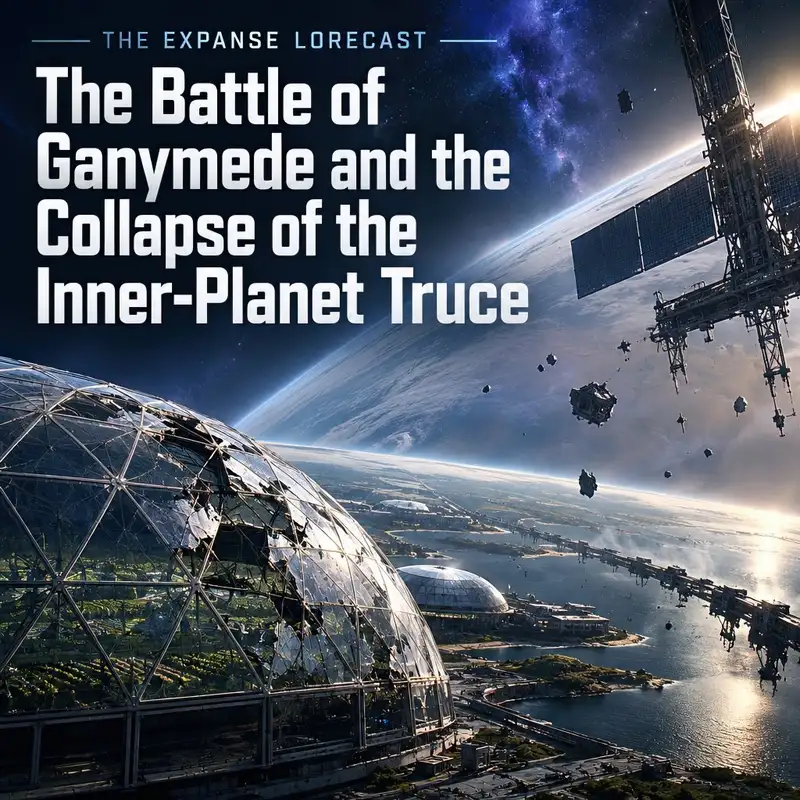
The Battle of Ganymede and the Collapse of the Inner-Planet Truce
Gunnery Sergeant Roberta Draper survived because the thing that killed her squad did not finish the job. On Ganymede’s surface, Martian Marines and United Nations Marines had met in a tense, heavily armed confrontation. Then a new combatant entered the engagement. It moved with a speed and violence that neither side could explain. It attacked Martians. It attacked Earthers. By the time the firing stopped, Draper was left among dead Marines, broken equipment, lost communications, and a record inside her combat suit that no one could immediately make sense of. The evidence existed. It had been carried out of the battle by the one surviving witness. But the governments that most needed to understand it were already acting before they could read it.
That was the central danger at Ganymede. A local attack, committed by an actor neither Earth nor Mars initially understood, entered a political environment built to expect betrayal. Both governments had forces nearby. Both had reasons to fear that the other had acquired some new advantage. Both had officers who believed that hesitation could be fatal. And both were trying to hold together a truce that had stopped open conflict without creating trust. The battle that followed was not simply the result of old enemies deciding to fight again. It was an attribution crisis. A new weapon appeared, the evidence was fragmented or destroyed, and the most dangerous explanation became the easiest one to believe.
The ceasefire after Eros had never been peace in any substantial sense. Earth and Mars had stepped back from a confrontation made worse by the discovery of the protomolecule and the catastrophe at Eros. But the crisis had not removed the strategic rivalry between the two Inner planets. It had intensified it. Each government knew that alien technology existed. Each knew that private corporations, military officers, intelligence services, and political factions might try to exploit it. And each had to consider the possibility that the other side had learned more than it admitted.
Venus made those suspicions harder to dismiss. The transformed mass that had fallen there was active. Neither Earth nor Mars could confidently explain what it was building, whether it was dangerous, or whether it might become useful to a human power willing to take extraordinary risks. The two governments watched Venus, but they also watched each other. In that environment, a report of dead Marines did not arrive as a local security matter. It arrived as possible proof that the balance of power had changed.
Military casualties also carried political meaning. A government that appeared unable to protect its service members could lose credibility with its own public, its legislature, its allies, and its armed forces. A commander who failed to respond to a perceived enemy attack could be accused of weakness. But a commander who struck first on poor evidence could begin a war. That is the familiar trap of a security dilemma. Defensive preparations by one side appear offensive to the other. A precaution becomes a threat. A response becomes confirmation that the threat was real.
Ganymede was especially vulnerable to this kind of failure because it was not merely a military location. It was a shared strategic environment, with Earth and Mars maintaining personnel and interests around a moon whose importance extended far beyond its local population. Its facilities served the wider outer-system economy. Its political condition mattered to both Inner governments. Its civilian systems depended on fragile technical infrastructure. And its position made it a place where military presence, commercial activity, food production, and colonial authority all operated in close proximity.
The moon’s greatest strategic value was agricultural. Ganymede supported controlled ecosystems that produced food for people who could not simply grow it where they lived. The Belt had mines, stations, ships, and scattered communities, but much of it did not possess the space, light, water, soil substitutes, equipment, and stable environmental conditions needed to feed large populations reliably. Agricultural production on Ganymede depended on carefully maintained biological and industrial systems. Mirrors, enclosed growing areas, pumps, transport networks, nutrient supplies, environmental controls, power systems, and skilled workers all had to function together.
That made Ganymede’s farms more than farms. They were strategic infrastructure. A damaged dock could interrupt trade. A damaged reactor could threaten life support. Damage to agricultural systems could create a slower and broader crisis, one measured not only in immediate casualties but in shortages, disrupted contracts, unemployment, migration, and fear. Food moved through the system as cargo, but it was also the physical foundation of political order. A station population that loses confidence in its food supply does not experience that failure as an abstract logistical statistic.
The novel gives a glimpse of this scale through ordinary production rather than a complete census. In one disrupted part of the system, food production was measured at roughly one hundred thousand kilograms a day, while a backlog approached half a million kilograms. Those figures should not be mistaken for the total output of Ganymede. They illustrate something more useful. Even a localized interruption could leave enormous quantities of food waiting for transport while people nearby became increasingly insecure. The system could have food. It could even have food ready to ship. And still fail to feed those most threatened by the crisis.
That contradiction was built into the colonial economy. Much of the food produced on Ganymede belonged to corporate owners. It moved under contracts, schedules, and property claims. A shipment could be vital to a distant population and still be treated first as an asset owed to someone elsewhere. This was not necessarily the work of one villainous executive deciding who deserved dinner. It was the ordinary logic of ownership and obligation operating inside an emergency. Contracts had enforcement mechanisms. Humanitarian need often had requests, appeals, and delayed political decisions.
Praxidike Meng understood Ganymede from inside that civilian world. He was a botanist, trained to work with the fragile living systems that made large-scale agriculture possible in an environment that could not forgive neglect. But the Ganymede crisis reached him first as a father. His daughter, Mei, disappeared amid the confusion. For Prax, the moon’s military emergency was not a debate about deterrence or military posture. It was the collapse of the ordinary systems that might have protected a child, recorded her movement, staffed a clinic, preserved evidence, and helped a parent find her.
Mei was medically vulnerable, and that fact was central to her kidnapping. She was one of several children selected because their conditions made them useful to a clandestine research program. The abductions were not an accidental side effect of the battle. They were part of the hidden operation that the battle helped obscure. But no one on the ground possessed that full picture at the beginning. Prax did not know it. Draper did not know it. Most military commanders did not know it. In the first hours, Ganymede looked like a military crisis because it was one. It also concealed a different kind of violence, carried out through medical records, institutional access, and the theft of children.
The surface encounter that brought Draper into the story was a collision between that hidden operation and the exposed military balance around Ganymede. What she saw was not a conventional Martian assault on a United Nations position, nor a conventional United Nations attack on Martian Marines. The hybrid combatant struck both sides. It was a human-protomolecule-derived weapon, created through deliberate research and experimentation. Calling it simply the protomolecule would hide more than it explains. The protomolecule was the alien system humans had discovered and feared. The attacker on Ganymede was a human attempt to turn fragments of that system into a military capability.
At the moment of contact, however, that distinction was almost impossible to make. Combat did not present Draper or the other Marines with a laboratory report. It presented them with sudden violence, dead personnel, failing communications, and an enemy that did not fit existing doctrine. In that setting, the first task was survival. The second was identification. But identification depended on information that was incomplete, damaged, or inaccessible. Witnesses died. Units lost contact. Sensors did not produce a coherent shared picture. The surviving record had to be interpreted by institutions that already expected deception.
The problem was not that everyone was irrational. Earth and Mars had genuine reasons to worry about each other. Each had advanced military technology. Each had a history of rivalry, covert competition, and political hostility. Each understood that a new weapon could change the local balance of power before diplomats even knew it existed. A Martian commander could look at dead Martian Marines and ask whether Earth had deployed something it could not publicly acknowledge. A United Nations commander could ask the corresponding question about Mars. Neither side needed complete proof before beginning to prepare for the worst.
That is what fog of war means in a conflict like Ganymede. It is not merely confusion in the moment of battle. It is the gap between an event and a usable account of that event. The gap can be widened by jamming, broken equipment, delayed reports, damaged infrastructure, false assumptions, bureaucratic filtering, and the simple fact that people under fire do not observe the same thing from the same place. Into that gap, military organizations insert doctrine. Political leaders insert fear. Intelligence agencies insert competing hypotheses. And ambitious people may insert the explanation that best serves their own purpose.
Once neither Earth nor Mars could confidently attribute the initial attack, the incident moved from a surface confrontation toward a wider military clash. The fighting that followed spread into orbit and around Ganymede’s installations. It lasted roughly two days. The available record supports the broad pattern of escalation more securely than it supports a precise order of battle, and that distinction matters. Ganymede was not clean.
Space combat near Ganymede was not an aircraft dogfight transferred into vacuum. Ships maneuvered through acceleration, relative motion, sensor uncertainty, and the limits of their weapons. A drive plume could reveal a vessel’s activity. Active sensors could improve a firing solution while also announcing attention. Missiles could threaten a target across distance, forcing maneuvers and consuming point-defense ammunition. Railguns and close-range weapons depended on geometry, timing, and the ability to maintain a line of fire. Communications traveled at light speed, not instantly. Even over short astronomical distances, reports could arrive after the decision they might have improved had already been made.
The moon itself imposed constraints. A commander had to think about enemy ships, but also about what a missed shot, debris field, damaged orbital asset, or panicked evacuation might do to the population below. That did not make restraint automatic. Under conditions of fear, commanders may conclude that failing to engage is more dangerous than the collateral risk of engaging.
The battle was driven by more than the immediate desire to destroy enemy forces. Each side had to prevent the other from gaining an apparent advantage. If Mars believed Earth had fielded an unprecedented weapon, allowing United Nations forces freedom of action around Ganymede could look intolerable. If Earth believed Mars had done the same, it faced the same pressure. The tactical objective became entangled with political reputation. No government wanted to appear surprised, penetrated, or unable to defend its people. In that sense, the initial uncertainty did not slow escalation. It helped justify it.
Then Ganymede’s physical vulnerability transformed a military engagement into a broader disaster. An orbital mirror array fell onto the moon. The details of the battle remained confused, but the effect of the falling structure was clear enough. It brought destruction directly into the agricultural and civilian environment below. Mirrors were not decorative equipment. They were part of the larger system that sustained controlled production and habitation. Their loss damaged more than metal and glass.
The mirror fall also deepened the intelligence failure. Sites are burned, crushed, contaminated, evacuated, or sealed off. Equipment disappears. Witnesses scatter. Records are lost with the systems that kept them. On Ganymede, the destruction of infrastructure made forensic reconstruction harder at the exact moment when Earth and Mars needed a reliable account of the original attack. The battlefield did not simply produce casualties. It consumed the evidence that might have prevented further escalation.
A post-battle assessment described nearly three thousand military and civilian dead, along with more than five billion Martian Congressional Republic dollars in infrastructure damage. In a disaster spread across military operations, damaged facilities, displaced populations, and disrupted services, counting is itself difficult. But even as an incomplete assessment, the number establishes the scale. Ganymede had been turned into a battlefield at a cost far beyond the original surface encounter.
For civilians, the distinction between military and infrastructure damage could become meaningless. A worker whose facility no longer operated had lost a livelihood. A family whose transport route had failed faced separation and uncertainty. A patient whose clinic was overwhelmed or cut off had a different kind of casualty count. Ganymede’s residents did not need to know who fired first to understand that the authorities responsible for their safety had failed.
The agricultural consequences were especially severe because biological systems cannot be restored with the speed of a military resupply order. A damaged warship might be patched, towed, or cannibalized for parts. A ruined growing environment required more than replacement hardware. It required conditions stable enough for living systems to recover. It required technicians who understood those systems. It required energy, water, nutrients, transport, and time. Industrial damage could be calculated in currency. The damage to an agricultural ecology included lost continuity.
And yet food still moved. Some shipments continued to launch because contractual obligations and property claims did not disappear simply because the moon was in crisis. This was not evidence that Ganymede’s food system was functioning normally. Cargo could be prepared for departure while local people feared scarcity. A company could be meeting obligations to distant buyers while workers on the moon faced reduced security.
That arrangement had political consequences. A government or corporation can insist that supplies are still moving, and the statement may be technically true. But the people who cannot obtain those supplies will judge the system by their own experience. They will remember which shipments were protected, which workers were left exposed, whose contracts mattered, and whose children disappeared into the chaos. Legitimacy does not collapse only when an institution runs out of resources.
While Ganymede struggled with that immediate reality, Bobbie Draper became the hinge between battlefield evidence and political interpretation. She was not a senior strategist. She did not possess a complete intelligence picture. She was a Marine who had survived an encounter that should have killed her. Her testimony carried the strengths and limitations of a survivor’s account. She had seen the attacker. She had watched it strike people on both sides. She had experienced the confusion of combat at close range.
Her superiors initially had strong incentives to fit her account into a more familiar narrative. Martian forces had taken losses. Earth was the historic rival. A version of events in which the United Nations had launched an attack on Martian personnel was politically and institutionally comprehensible. It justified anger. It justified military readiness. Draper’s account was harder to manage because it suggested that something else had occurred, something that could not be placed neatly inside the existing Earth–Mars rivalry.
The combat suit footage should have settled part of the question, but evidence is only useful when the people examining it know how to recover and interpret it. A decompression or firmware problem, treated incorrectly, could make critical data appear unavailable. That detail carries an important lesson. Intelligence failures are not always failures to collect information.
When the footage was properly recovered, it did not answer every question. It did not identify all the people who had funded or directed the hybrid project. It did not explain every connection between Ganymede, Venus, corporate research, and the abducted children. But it established something of immense importance. The attacker had engaged both Martian and United Nations personnel. That did not create trust between Earth and Mars. It did not erase the casualties or repair Ganymede. It did, however, undermine the most convenient explanation for the incident.
That is often how reality returns during a crisis. Draper’s recovered footage forced military and political leaders to consider a possibility they had not wanted to face. If neither Earth nor Mars had deployed the attacker, then the conflict had been shaped by a third actor. A known rival can be deterred, threatened, negotiated with, or watched through familiar channels. A hidden network with alien-derived weapons, corporate funding, and uncertain political protection is harder to locate and harder to control.
Chrisjen Avasarala understood the immediate requirement from the United Nations side. Prevent a general war. Determine what had happened. Do not allow the military crisis to outrun civilian authority. Her position did not give her perfect knowledge. It placed her at the center of competing reports, partial intelligence, political pressure, and institutional self-protection. She had to consider Mars as a possible source of the threat because that was still a live hypothesis.
Venus mattered because it was proof that the protomolecule crisis had not ended with Eros. The alien system there remained active and poorly understood. That did not mean Venus had directly caused the Ganymede attack. The strategic environment now included technology that neither government had mastered. It included the possibility that human groups had acquired pieces of that technology.
Avasarala’s suspicion developed through connections, timing, and the recognition that powerful institutions were behaving strangely. At this stage, suspicion was not proof. The full conspiracy was still hidden behind compartmentalization. Research teams might know only their laboratory task. Security personnel might know only their assignment. Corporate officers might understand financing without understanding the science. Political patrons might provide protection without seeing the human cost of the experiments they enabled. Such a network did not need to be omniscient.
Mao-Kwikowski Mercantile and associated actors represented that form of power. Their importance was not that one corporation could control every government or predict every outcome. Their importance was that private capital, specialized science, political connections, security personnel, and off-the-books facilities could combine into a capability neither conventional military intelligence nor ordinary regulation was designed to expose quickly. Human beings were reduced to inputs. Their conditions became research criteria. Their families became obstacles to be managed.
The crisis on Ganymede gave that program cover. Military confusion redirected attention toward Earth and Mars. Destroyed infrastructure complicated investigation. Evacuations and casualties created administrative overload. People could disappear into the movement of refugees, patients, prisoners, contractors, and emergency personnel. The battle created dangers for the conspirators as well. But covert operations often thrive not because they control events, but because public institutions are too busy responding to visible catastrophe to identify the hidden operation beneath it.
The Rocinante crew entered this environment in a limited but important role. Working with Fred Johnson and the Outer Planets Alliance, they were not commanding a fleet or deciding the terms of an Earth–Mars war. Their work was closer to relief, transport, and investigation. That distinction matters. Great-power militaries could exchange fire around Ganymede, but the practical work of finding missing people, moving survivors, tracing information, and following the links between apparently separate crimes often fell to smaller actors operating outside formal command structures.
Diplomacy eventually imposed a halt on the immediate military crisis. The arrangement assigned no public blame. It established joint management of the Ganymede problem and imposed controls over traffic and inspections. These measures were not glamorous, but they were strategically necessary. In a crisis of uncertain attribution, a no-blame framework can be less an act of forgiveness than a way to avoid forcing both governments into claims they cannot prove and retaliations they cannot control.
The armistice restored a degree of political control over armed forces that had already begun fighting. But it did not restore trust. Tactical cessation is not strategic reconciliation. Earth and Mars still had damaged personnel, competing intelligence assessments, and publics ready to believe the worst about the other side. They still had military institutions that had learned the other could be confronted near a critical asset.
Within the United Nations system, Admiral Nguyen and Admiral Souther represented different institutional tendencies. Nguyen pressed for a forceful posture and rapid response. His view reflected a real fear that delay could hand an advantage to Mars or leave Earth exposed. Neither man alone explains the crisis, and the United Nations Navy was not a single mind. But their contrast shows how civil-military conflict can emerge within a government even when all participants believe they are defending the same state.
The civilian leadership faced the classic problem of crisis management. Once armed forces exchange fire, diplomacy no longer begins from a position of calm. The armistice succeeded only in the narrow sense that it prevented a larger immediate war. It did not remove the incentives for future escalation. It did not rebuild Ganymede. It did not locate the hidden weapons program.
The deeper campaign continued beneath the armistice. The hybrid attacker had been part of an attempt to weaponize protomolecule-derived processes. This was not the same thing as Eros. Venus represented another large and poorly understood protomolecule event. The Ganymede hybrid was a human-directed project, an effort to produce a controllable military application from something its creators did not fully understand. Possession was mistaken for mastery. Activation was mistaken for control.
That distinction is central to the danger. The people behind the program could build a weapon that altered the military balance, but they could not guarantee that their weapon would behave according to a conventional doctrine. The result was not a stable new capability. The Ganymede incident showed what happens when a research program crosses from laboratory secrecy into a contested political environment before anyone has established who is responsible for its consequences.
The abducted children reveal the cost of treating military research as a compartmentalized technical problem. A weapons program needs subjects. It needs medical knowledge. It needs transportation. It needs secure facilities and people willing to ignore ordinary safeguards. Those requirements create a supply chain of coercion. Mei’s disappearance was therefore not a side story running alongside the battle. It was part of the same history.
The Battle of Ganymede must therefore be judged on several levels. Tactically, Earth and Mars fought, then stopped. Neither gained a clear and durable victory from the exchange. Intellectually, it demonstrated how badly both governments needed reliable attribution before acting, and how easily that attribution could fail. The best evidence was initially unreadable. Other evidence was destroyed by the battle itself.
Strategically, the truce survived in formal terms, but it emerged more brittle than before. Earth and Mars could not confidently accuse each other without risking a larger war. The hidden actors behind the weapons program gained time, cover, and room to operate. They did not need to defeat either great power in battle.
Logistically and industrially, the damage could not be measured only in destroyed structures or currency. Recovery required time. A farmer, botanist, dockworker, maintenance technician, or parent living through the crisis did not experience the armistice as the end of the emergency. The shooting might stop while the shortages, disappearances, and uncertainty continued.
For civilians, the battle exposed a harsher truth. Essential infrastructure is never safely in the rear when rival powers consider it strategically valuable. Ganymede fed distant populations, which made it important. Its importance brought military forces, political suspicion, commercial pressure, and the temptation to use it as leverage. The moon became a hostage to systems that all depended on it but none could reliably protect.
The Earth–Mars truce did not collapse at Ganymede because one side executed a decisive plan for war. It collapsed because ambiguous violence entered a system already organized for worst-case interpretation. Fear supplied motive where evidence was missing. Damaged evidence made restraint look dangerous. Political pressure turned uncertainty into action. And concealed private power used the confusion to advance a program that neither government fully understood. Ganymede showed how easily a civilization can destroy the systems that keep it alive while its leaders are still arguing over who fired first.