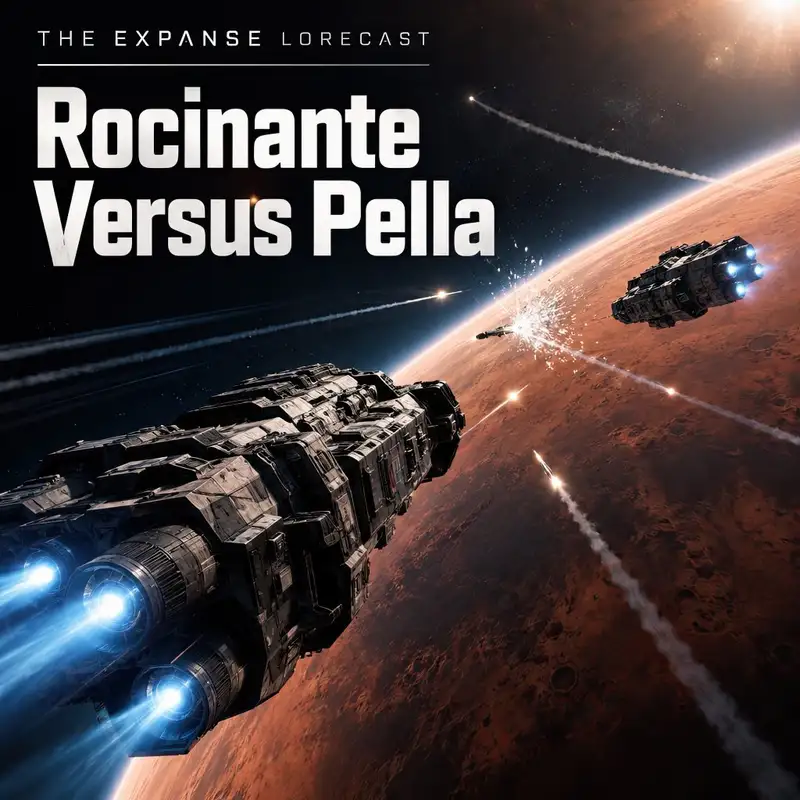
Rocinante Versus Pella
Fred Johnson was traveling aboard the Rocinante because a warship could not do what he was trying to do. The ship could carry him safely, or as safely as anyone could travel through a solar system at war. It could provide guns, armor, trained people, and enough speed to make an attack expensive. But Fred’s real value was not military. He was on his way to Tycho Station to meet Belter factions that had not joined Marco Inaros and his Free Navy. The purpose was to build a political alignment against Marco’s claim to speak for the entire Belt.
That made Fred more valuable than the Rocinante itself. A ship can be repaired, replaced, or captured. A political intermediary is harder to replace, particularly one with Fred’s history. He had relationships with station leaders, OPA factions, labor networks, ship crews, Inner governments, and Tycho’s industrial establishment. Many people distrusted him. Many had reason to. But they also knew he could make deals across lines that had been soaked in blood, suspicion, and old resentment. In the Free Navy War, that was a strategic capability.
Tycho was the destination because Ceres, though recently recovered from Free Navy control, was not a suitable place for a delicate Belter political gathering. It was crowded with United Nations and Martian military forces. A meeting there would have carried the appearance of Belter leaders assembling under Inner protection and Inner supervision. Fred needed a location with its own Belter legitimacy, material capacity, and political independence. Tycho offered that. It was not neutral ground. Nothing in the Belt was neutral in the clean sense. But it was ground where an anti-Marco coalition might speak in its own name.
Marco Inaros did not need to conquer Tycho Station to stop that effort. He did not need to defeat the combined fleets of Earth and Mars in a direct engagement. He only needed to remove the person most capable of turning scattered opposition into an organized alternative. In that sense, the ambush of the Rocinante was not primarily an attempt to sink a troublesome gunship. It was an attack on political succession before succession had even been formally arranged.
The wider war had created the conditions for such an attack. Earth had been devastated by the Free Navy’s campaign of rock strikes. Its population, economy, and government were trying to survive a catastrophe while still fighting a war across the system. Mars had lost ships, personnel, confidence, and part of its future. The opening of the Ring gates had already weakened the old Martian dream of terraforming a single difficult world over generations. Now the Free Navy conflict was exposing fractures inside the Martian military and state.
The Belt, meanwhile, was not one army waiting for one commander. It was a web of stations, ships, labor communities, local authorities, criminal crews, political movements, and OPA factions with different histories and different interests. Marco could draw on genuine grievance. The Belt had been exploited, neglected, and treated as strategically useful but politically disposable by generations of Inner governments and corporations. That history was real. It did not make Marco’s claim to represent all Belters true, and it did not turn the Free Navy into the Belt as a whole.
Earth and Mars could contribute fleets, missiles, yards, supplies, and formal governments. They could not manufacture Belter consent by decree. A coalition against Marco needed Belter leaders who could plausibly say that resistance to the Free Navy was not surrender to Earth, not submission to Mars, and not a return to the old order in which the Belt supplied labor and resources while others made the decisions. Fred Johnson had the unusual ability to argue for that coalition without pretending its contradictions did not exist.
Marco understood the political map well enough to recognize the danger. He had built the Free Navy through charisma, violence, propaganda, access to stolen Martian military technology, and the willingness to turn enormous civilian suffering into strategic leverage. But his authority depended on the idea that no other Belter institution could protect the Belt, speak for it, or negotiate from a position of strength. Fred’s meeting at Tycho threatened that story. If independent factions united, Marco would still have ships. He would still have followers. He would no longer have an uncontested claim to political necessity.
The route from Ceres to Tycho therefore became an intelligence target. Marco’s force had information about Fred’s movement, and it used that information well. The Pella, Marco’s flagship, waited with the Koto and the Shinsakuto. The three Free Navy ships used stealth treatment to reduce their signatures and delay detection. That did not make them invisible. No ship can remain invisible forever while managing heat, maneuvering, communicating, and preparing to fight. But stealth did not need to create permanent invisibility. It only needed to buy time and surprise.
The Free Navy chose the place and the moment. Holden and the Rocinante crew discovered the danger after Marco’s ships had already shaped it. That is the advantage of a successful ambush. It does not simply provide the first shot. It imposes an initial problem on the target, forcing the defender to react before it fully understands the attacker’s position, intent, or timing. In a space engagement, that first problem can be geometry. Where are the threats? Which way can the ship accelerate? Which vectors expose it to railgun fire? Which maneuvers increase missile danger? How much punishment can the crew take before the ship survives but the people inside it do not?
Marco’s objectives were layered. Killing Fred Johnson was the political priority. Destroying the Rocinante would remove a dangerous and experienced combat ship, while also delivering a powerful morale blow to the coalition forming against him. A successful attack would demonstrate that the Free Navy could strike along routes its enemies considered protected by proximity to Ceres and allied forces. And it could intimidate any OPA faction considering attendance at Tycho. A leader who cannot travel safely to a meeting is making a very difficult argument about the future.
For the Rocinante, the immediate objective was much simpler and much harder. Survive. Keep Fred alive. Reach Tycho. Destroying Marco’s flagship would have been useful, certainly, but it was not the first requirement. A smaller ship caught by three armed opponents cannot treat every enemy as a separate duel. The danger comes from coordination. Three attackers can divide missile pressure, cover one another’s blind spots, threaten from different vectors, and force a defender into evasive patterns that consume ammunition, reaction mass, time, and the crew’s physical endurance.
This was not aircraft combat transferred into a black sky. The ships were not circling through a shared horizon, trading turns like fighters over a battlefield. Each vessel could orient its weapons separately from its direction of travel. A ship could coast, rotate, accelerate, flip, and fire along a vector that did not resemble the path it seemed to be taking. There was no universal up, no natural line of retreat, and no simple edge of the battlefield. There was only relative motion, firing geometry, detection, and the brutal fact that changing any of those things required time.
Holden commanded the Rocinante. Alex Kamal flew it. Bobbie Draper operated the guns. Fred Johnson, the mission’s political center of gravity, was aboard as a passenger, though calling him cargo would miss the point so badly that it would become a kind of lie. Naomi Nagata was also present, and the battle would soon make the personal history between her, Marco, and their son Filip impossible to separate from the tactical situation. But at the beginning, the crew’s work was professional and immediate. They had to keep the ship from being trapped.
The Rocinante had formidable weapons for its size, but weapons do not erase disadvantage. Its magazines were finite. Its ammunition was finite. Its hull could take damage, but not indefinitely. It was not operating from a prepared fleet base with a repair dock waiting a few minutes away. If its drive, sensors, railgun, life support, or maneuvering systems suffered serious damage, help might exist in the broader theater without being able to reach the ship in time. The war had plenty of nominal allies. It had fewer allies who could instantly appear at the exact point where a missile was already closing.
Fred made a tightbeam request to Ceres for assistance. Tightbeam communication reduced the chance of casual interception, but it did not defeat light speed. The request had to travel. Ceres had to receive it, understand the situation, decide what could be sent, and launch missiles that still had to cross the distance to the engagement. No allied ship emerged from nowhere to rescue the Rocinante. There was no cavalry charge. There were only missiles adding a new threat to Marco’s force.
That was enough to matter. The Shinsakuto had to break away to defend against the weapons launched from Ceres. It was not destroyed by the station’s intervention, and Ceres did not win the engagement for the Rocinante. But the effect on the battle’s structure was decisive. Marco’s three ships could no longer devote all their attention to containing one target. One attacker now had to account for a threat arriving from outside the original ambush.
The difference between three coordinated ships and two coordinated ships is more than arithmetic. The original plan depended on forming a trap. Every ship diverted to self-defense reduces the angles from which the target can be threatened. It reduces the opportunities to synchronize attacks. It increases the likelihood that one attacker will have to maneuver for its own survival rather than maintaining the formation’s overall pressure. Ceres did not remove Marco from the fight. It made his force less able to fight as a single instrument.
That narrow opening was all the Rocinante needed. Not because the ship had suddenly become stronger than its opponents, but because the fight had become less orderly. Ambushes rely on control. The attacking force begins with better information and a prepared plan. The defender survives by introducing friction into that plan. A surprise missile threat from Ceres was friction. So was the Rocinante’s ability to maneuver under extreme stress. So was the crew’s willingness to keep working through the acceleration, alarms, and rapidly changing tactical picture.
The Koto became the first major target. The Rocinante’s keel-mounted railgun offered enormous destructive potential, but a railgun is not a magical answer to every problem in space. It fires along a fixed line. The gunner needs a firing opportunity, and the pilot has to help create it. Against maneuvering ships, that means managing orientation, relative motion, timing, and the knowledge that a narrow window can vanish in an instant. The railgun did not turn the battle into a contest of reflexes. It turned it into a contest of geometry under pressure.
Alex’s role was central. The ship had to move hard enough, and at the right moments, to place the Rocinante where Bobbie could use its weapons. Every such maneuver imposed a cost on the people strapped into acceleration couches. The Epstein drive could provide efficient propulsion. It could not repeal human physiology. The juice improved tolerance. It did not make a crew immune to high acceleration, pain, vascular injury, exhaustion, or the accumulated strain of a battle fought at the edge of what bodies could endure.
Bobbie’s work at the guns depended on skill, but not on supernatural precision. She was watching enemy movement, timing the moment when the Koto’s position and the Rocinante’s firing geometry aligned, and turning an opportunity into a shot before it disappeared. The railgun struck the Koto hard enough to cripple it. The ship was forced to drop its reactor core. In the immediate tactical sense, that removed it from the fight.
The Koto’s loss was more important than the destruction of one enemy capability. It broke the structure of the ambush. With the Shinsakuto diverted by the missiles from Ceres and the Koto crippled, the Rocinante was no longer facing a functioning three-ship enclosure. It still faced the Pella, and the Pella remained dangerous. Marco’s flagship had not been neutralized. But the defenders had converted a controlled kill zone into a confused engagement with fewer threats able to coordinate against them.
That was the tactical achievement of the Rocinante’s crew. They did not win by overpowering the entire Free Navy group in a clean exchange of fire. They won by preventing the attacking formation from doing what it had been designed to do. Ceres forced one ship to peel away. The railgun took another out of the immediate action. The remaining problem was the Pella, Marco’s command ship, and a commander who still had both a political objective and the will to pursue it.
By then, Bobbie had identified something important about the Pella’s behavior. Marco’s ship had been evading railgun fire in a repeated direction. That was not necessarily foolishness in the ordinary sense. Combat crews make patterns because patterns often emerge from doctrine, ship handling, the geometry of a threat, and the need to choose among bad options quickly. A maneuver that works once can become a habit. A habit that works under ordinary pressure can become a vulnerability when an opponent has enough time and skill to recognize it.
This was intelligence generated during battle. Marco had begun with the intelligence advantage because he knew Fred’s route and had prepared the ambush. The Rocinante did not enter the engagement with a full picture of Pella’s evasive preferences or a prearranged solution for them. Bobbie learned by observing what Marco’s crew did when threatened. That kind of information is often the only information that matters. A commander can conceal plans, communications, and political intent. Repeated physical behavior is harder to hide when a ship is trying not to be hit.
The answer was more than to fire another railgun round and hope the Pella made a mistake. Bobbie used the Rocinante’s point-defense cannon to create danger in the direction where the Pella expected to evade. Point-defense weapons are designed primarily to intercept incoming missiles and other close threats. They are not defensive shields. They do not place an invisible wall around the ship. In the right conditions, though, their fire can make space lethal enough that an opponent’s favored escape route becomes less safe.
The maneuver worked because it constrained choice. The Pella was already reacting to the railgun threat. Bobbie placed point-defense fire where the Pella was likely to move. Marco’s ship could not treat that direction as empty space. The result was damage to the Pella and a forced withdrawal. It was an elegant piece of tactical adaptation, but it was not clean or effortless. The Rocinante’s crew had survived an ambush by making the enemy’s assumptions increasingly expensive.
At the level of immediate combat, the result was clear. The Rocinante remained in action. The Koto had been crippled and driven out of the fight. The Shinsakuto had been diverted. The Pella had been damaged and forced to withdraw rather than finishing the kill. Fred Johnson was alive when the missiles stopped flying. The ship could continue toward Tycho. If the battle had ended there, it would have been remembered as a sharp defensive victory by a smaller ship against a stronger Free Navy force.
But it did not end there, because combat is rarely confined to weapons and hull damage. During the engagement, Holden opened a tightbeam connection with Marco. In that exchange, he saw Filip Inaros at the Pella’s weapons station. Filip was not an abstract name to the Rocinante crew. He was Naomi’s son. He was also, at that moment, an active Free Navy combatant serving on the flagship that had ambushed them and was trying to kill everyone aboard.
That distinction matters because it prevents the moment from becoming sentimental in the wrong way. Filip was not an innocent bystander caught near danger. He was part of Marco’s military apparatus. He had agency, however compromised and distorted by his upbringing, fear, loyalty, and need for his father’s approval. From a strictly military perspective, the Pella was a legitimate enemy combatant. Destroying it would have removed Marco from the battle, damaged the Free Navy, and likely prevented the ship from threatening the Rocinante again.
Holden had an opportunity to launch a final torpedo attack that might have destroyed the Pella. He stopped it. He could not knowingly order the killing blow after seeing Filip aboard. That decision was personal. It was also a command decision with operational consequences. Holden was not choosing between a clean military target and an abstract moral principle. He was choosing while responsible for his crew, his passenger, the coalition mission, Naomi’s son, and the wider war.
The fact of the choice is clear. Holden consciously refused that particular opportunity to kill the Pella. The judgment of that choice remains more complicated. It is possible to understand why he did it without pretending it carried no strategic cost. It is possible to recognize the military value of destroying Marco’s flagship without treating Filip’s death as a trivial administrative outcome. War produces moments where the available choices are all shaped by prior failures, prior violence, and relationships that no tactical map can simplify.
It would be too easy to say that Holden’s restraint alone determined the rest of the war. The Pella’s survival involved more than one decision and more than one moment of uncertainty. The source does not support turning a single withheld torpedo into a complete explanation for every later disaster or every later Free Navy success. But it did preserve the Pella in that moment, and it allowed Marco to leave the battlefield alive. That much mattered.
The Rocinante then continued toward Tycho, carrying what appeared to be a hard-won success. The crew had done what their ship existed to do. They had survived. They had adapted. They had protected the mission long enough to keep moving. But the same maneuvers that saved the ship had imposed a severe cost inside it. Ships do not experience acceleration. People do. The hull can be built for stress. Human bodies remain a far more delicate system.
Fred Johnson suffered a stroke after the battle. The medical response could not save him. There was no specialized Free Navy medical weapon. Marco had not somehow reached inside the Rocinante and engineered a physiological attack. Fred’s death came from the battle’s conditions and the limits of a body under extraordinary strain. That does not make it less connected to the ambush. The Free Navy created the conditions that forced the Rocinante to maneuver as it did. But cause is not the same as a fantastical mechanism.
The death was personal before it was strategic. Fred was a friend, ally, employer, former commander, and political partner to different people around him. He had spent much of his life trying to make himself useful in a system where he had also done terrible things. His record was not clean. His reputation was not universally loved. The Free Navy War did not pause to resolve those contradictions. He died while trying to assemble a coalition that depended, in part, on people accepting that imperfect figures sometimes remain necessary.
The death was also an institutional crisis. Fred had been traveling to Tycho because he could convene people who did not naturally trust one another. He had access to Tycho’s industrial capacity and political networks. He had credibility among parts of the OPA, working relationships with the United Nations and Mars, and practical experience managing disputes that could otherwise become armed confrontations. None of those assets vanished in the instant his heart stopped. Tycho Station remained. Its workers remained. Its ships, facilities, and alliances remained. But the person who connected many of them was gone.
No replacement could simply inherit his authority as if it were an office key passed across a desk. Political legitimacy does not work that way, especially in a fragmented movement. Fred’s influence was accumulated through relationships, bargains, shared history, and the ability to make people believe he could deliver on a promise. A successor might take on part of his role. No one could immediately reproduce the entire network of trust, obligation, resentment, and practical knowledge that he carried.
This changes how the engagement should be judged. Tactically, the Rocinante won. It escaped the trap. It damaged the Pella. It crippled the Koto. It denied Marco the destruction of a valuable enemy ship. At the mission level, however, the result was much worse. Fred did not arrive at Tycho alive to lead the meeting he had planned. The protected passenger was lost, even though the ship survived.
Operationally, the Free Navy had failed to eliminate the Rocinante, but it had disrupted the work of its enemies. Marco’s force had revealed weaknesses as well. Its ambush did not hold together. Its flagship had been damaged. Its commander’s own repeated evasion had become exploitable. Yet Marco had achieved the effect that mattered most in the political contest of that moment. He had removed a rival center of Belter legitimacy before it could become the nucleus of a coordinated opposition.
Strategically, that was a meaningful success for the Free Navy. Marco could present Fred’s death as proof that independent Belter leaders were vulnerable and that the old OPA power structure could not protect itself. He could point to the damaged but surviving Pella and claim that his movement had struck at the heart of the coalition forming against him. Propaganda did not make that account an objective military report. The Pella had withdrawn. The Rocinante had not been destroyed. The Free Navy had not conquered Tycho or ended opposition.
But propaganda works best when it rests on a real political wound. Fred’s death created one. It made the coming negotiations harder. It forced others to carry responsibilities they had not expected to bear. It gave undecided factions another reason to fear that resisting Marco would bring immediate danger without guaranteed protection. In a war where many people had already seen stations abandoned, supplies disrupted, ships destroyed, and governments fail to meet basic obligations, fear could be a more persuasive argument than ideology.
Marco’s victory claim therefore had limits, but it was not empty. He had correctly identified Fred as a strategic asset. He had understood that destroying a ship and killing a political intermediary were not equivalent acts. The Rocinante could fight again. Fred could not negotiate again. The difference lay at the center of the Free Navy’s strategy. Marco did more than seek military superiority. He sought to make every alternative political arrangement appear weak, compromised, or doomed.
The ambush also exposed the limits of Marco’s method. He depended on surprise, concentrated violence, and the ability to convert grievance into obedience. That could produce spectacular results. It could also produce habits. His command group expected the Rocinante to react in ways that preserved the attacker’s advantage. Instead, Ceres introduced a threat that fractured the formation. Alex maneuvered the ship through punishing conditions. Bobbie turned observation into combat intelligence and combat intelligence into damage. Marco’s flagship survived, but it survived after proving it could be hurt.
That mattered because the Free Navy was not invulnerable merely because it had seized the initiative in the war. It had ships, weapons, and a leader capable of identifying political targets. It also had limited resources, competing demands, damaged vessels, and a coalition held together by uneven loyalties. Every failed attempt to destroy a major opponent cost it ammunition, time, repair capacity, and credibility. A commander can claim victory after withdrawing from a battle, but claims do not replace spare parts, trained crews, or control of the system’s supply lines.
For Holden, the aftermath was especially difficult. He had not set out to become the political figure Fred had been. Holden was a captain, an investigator by temperament, and a person often drawn into larger events because he refused to ignore what he believed was wrong. Those qualities were not the same as the ability to manage factional politics across the Belt. Fred had spent years building the institutional connections necessary to make difficult agreements possible. Holden inherited pressure without inheriting the full machinery that made Fred effective.
That burden would fall on more than Holden, of course. Chrisjen Avasarala and the United Nations government had their own stakes in stabilizing the system. Martian leaders and military officers faced a crisis within their own state. Belter factions had to decide whether Marco’s violence represented strength, desperation, liberation, tyranny, or some mixture of all four.
The civilian stakes sat beneath all of this. A coalition against the Free Navy was more than about who held the next meeting or who spoke most convincingly for the Belt. Earth’s recovery depended on food, transport, functioning government, and the restoration of trade. Belt stations depended on air, water, maintenance, shipping, and access to markets. The system’s farms, docks, repair yards, and cargo routes could not be defended by speeches alone. But they also could not be secured by fleets without a political arrangement capable of making people cooperate after the shooting stopped.
That is why Fred Johnson mattered. He represented a chance, not a guarantee, that the war against Marco could become something more than an alliance of temporary convenience between wounded Inner powers and frightened Belter factions. He could not make Earth’s devastation disappear, restore Mars’s confidence, or reconcile every OPA group with Tycho’s leadership. But he could provide a bridge across institutions that needed one another while mistrusting one another profoundly.
The Rocinante versus the Pella was therefore a battle about more than which hull took the most damage. It was a demonstration of how tactical skill can reverse an immediate disadvantage without resolving the political purpose of an attack. The Rocinante broke the Free Navy formation. It exploited the Pella’s patterns. It survived through disciplined crew coordination, outside pressure from Ceres, and a willingness to accept punishing physical strain. In the language of naval combat, it denied the enemy a clean kill.
But the Free Navy still achieved the more consequential immediate effect. Fred Johnson died before he could lead the Tycho effort. Marco lost neither his flagship nor his ability to claim political momentum. Holden’s decision to spare the Pella from a final torpedo attack preserved a human life tied intimately to Naomi, while also leaving Marco’s command ship in the war. The crew had won the exchange of fire and emerged with a more difficult war to fight.
That is the distinction the battle leaves behind. Tactical victory concerns what happens when weapons are fired. Strategic victory concerns what becomes possible afterward. The Rocinante defeated the Pella’s ambush by breaking its formation and exploiting its commander’s habits. Marco Inaros won the more important immediate contest because he understood that Fred Johnson was a strategic asset. In a fractured solar system, killing one political intermediary could matter more than losing a warship.