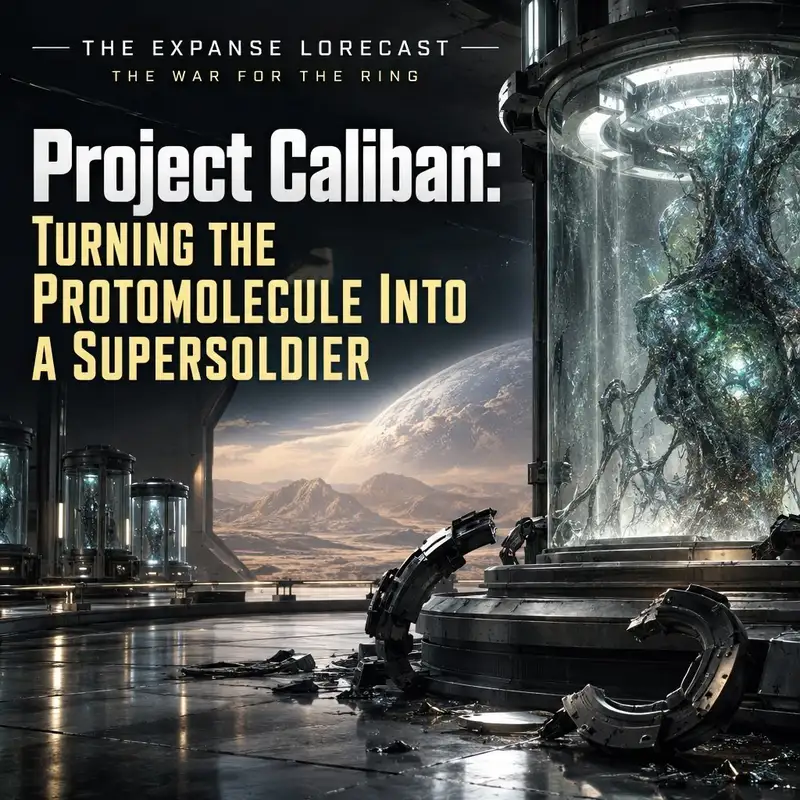
Project Caliban: Turning the Protomolecule Into a Supersoldier
The creature was inside the Rocinante, moving through a ship designed to survive missiles, railgun fire, and hard burns. Small-arms fire had injured it, but not stopped it. Vacuum had not stopped it. The ship’s compartments, bulkheads, and narrow accessways had slowed it only briefly. It was not acting like a trained boarder. It was not clearing rooms, securing hostages, or trying to seize the bridge. It was moving toward power. Toward radiation. Toward the reactor at the heart of the ship.
That was the operational truth buried beneath Project Caliban’s language of research and defense. The project had created something with extraordinary combat potential. It could survive conditions that killed ordinary soldiers. It could move across hulls and through vacuum. It could absorb punishment that would disable a powered-armored marine or tear apart a boarding team. But capability was not command. The creature had not become a soldier merely because human beings had altered it into a weapon-shaped form.
The Rocinante crew survived because they stopped trying to treat the hybrid as a conventional enemy. Prax Meng, a botanist who had spent much of the crisis searching for his abducted daughter, recognized a pattern in the creature’s behavior. It was drawn to radiation. That insight gave the crew an option. They could offer it a stronger signal than the Rocinante’s reactor, lure it away from the ship, and use the drive plume as the actual weapon. The solution was improvised, dangerous, and narrowly successful. It destroyed one hybrid. It did not solve the problem that had put the hybrid aboard the ship.
To understand why that creature existed, it is necessary to return to Ganymede, where Project Caliban first appeared not as a secret laboratory program, but as a military catastrophe with the potential to restart war between Earth and Mars.
The Eros incident had changed the strategic meaning of the protomolecule. Before Eros, it could still be imagined as an exotic research subject, a corporate secret, or an intelligence prize whose full importance remained uncertain. After Eros, that illusion was no longer sustainable. The protomolecule had demonstrated that it could take living tissue, machinery, and vast amounts of matter, then reorganize them according to purposes human observers could not explain. It was not simply a pathogen, a weapon, or a computer. It was an alien system with the ability to transform its environment on a scale that made conventional military research look provincial.
Every major power had reason to fear what another might do with it. Earth feared Martian access. Mars feared that Earth’s larger population and industrial depth would eventually turn alien knowledge into strategic dominance. Corporate interests saw an opportunity large enough to justify extraordinary risk. Intelligence services saw a technology that could not be left in an opponent’s hands. Politicians saw leverage. Scientists saw an unsolved problem. The danger was that each group could draw a sensible conclusion from its own position while producing a collective disaster.
That did not mean the United Nations government, as a whole, authorized Project Caliban. It did not mean Mars, as a whole, approved it either. The program depended on compartmentalized power: officials, military personnel, corporate sponsors, security forces, and researchers who knew enough to cooperate, but not necessarily enough to see the whole operation. Secrecy was not a protective layer around a normal procurement program. It was the structure that allowed the project to exist at all.
The sponsors of Project Caliban were pursuing a grimly familiar strategic dream. If a small number of people could possess a radically superior weapon before their rivals did, they might reshape the balance of power without paying the costs of open war. No mobilization of millions. No years of shipbuilding. No public debate. No treaty negotiation. A handful of exceptional assets, deployed at the right place and time, might force stronger opponents to reconsider everything.
That was the theory. Ganymede showed what happened when the theory met reality.
Ganymede was not simply a moon caught between Earth and Mars. It was a vital agricultural center, a place where food production supported populations far beyond its own settlements. In a Solar System dependent on long supply chains, enclosed habitats, and carefully managed life-support systems, agriculture was strategic infrastructure. Food was not a background commodity. It was survival, employment, political leverage, and social stability.
Ganymede also carried military importance because Earth and Mars both maintained forces there. Their rivalry had not vanished. It had merely been constrained by deterrence, diplomacy, and the knowledge that a direct conflict between the two great powers could devastate the entire system. That made Ganymede a dangerous place for any covert operation. A clash near opposing forces could be mistaken for an attack. A confused sensor picture could become a casus belli. A few minutes of uncertainty could matter more than years of careful diplomacy.
Into that environment came the hybrid.
Bobbie Draper and her fellow Martian Marines encountered something no conventional training had prepared them to fight. The creature moved with frightening speed and apparent indifference to the normal limits of a human body. It did not behave like a Martian marine, an Earth soldier, or a remotely operated machine. It attacked with a violence that made normal questions of unit identification almost irrelevant. Bobbie survived. Most of her team did not.
The immediate tactical effect was devastating. A force equipped and trained for conventional combat had been attacked by something that conventional weapons and doctrine did not readily address. The hybrid’s survivability and speed mattered, but surprise mattered just as much. It appeared in an environment already tense with suspicion. It created casualties before the participants understood what they were seeing. By the time anyone could begin asking whether the attack came from Earth, Mars, or some third actor, the political damage had already begun.
That was the purpose of the field test in its most dangerous form. The hybrid did not need to conquer Ganymede. It only needed to produce confusion powerful enough to make Earth and Mars suspect each other. A single anomalous attack could destabilize the ceasefire because neither side could be certain that the other had not developed a new weapon in secret. The weapon’s physical violence and its political ambiguity reinforced each other.
Ganymede’s civilians paid the cost of that ambiguity. The violence helped push an already vulnerable habitat into crisis. Agricultural systems failed. Order broke down. People were displaced. Families were separated in a place where food production was inseparable from life-support and transport. The conspirators had chosen a location that offered military and political advantage. They had also chosen a population whose survival depended on systems too delicate to absorb chaos.
That is one of the central facts of Project Caliban. It was not merely a hidden laboratory operation. It used a living civilian system as cover, as terrain, and as a source of victims. The project’s field test was effective precisely because Ganymede was too important to ignore and too fragile to endure the shock it received.
Bobbie Draper became the most important military witness to what had happened. Her testimony mattered because she had seen the attack from inside the battle. She knew the behavior of Martian Marines. She knew what a conventional engagement looked like. She understood, at least instinctively, that the thing which had killed her team did not fit the categories available to ordinary military reporting.
But Bobbie’s direct knowledge had limits. She knew that the attacker was not a normal Earth or Martian weapon. She knew that it had capabilities beyond what she had been trained to expect. She knew that someone had concealed the truth afterward. What she did not know, at first, was the full structure of the conspiracy behind it. She did not know every sponsor, every laboratory, every political bargain, or every person who had benefited from the deception.
That distinction mattered. Bobbie’s experience became dangerous to the people protecting Project Caliban because it could not be easily absorbed into the usual language of battlefield confusion. She had not merely survived a chaotic engagement. She had survived evidence.
Her superiors attempted to contain that evidence. Her account was suppressed, manipulated, and redirected. The official machinery of military authority treated her not as a marine whose testimony might reveal an unprecedented threat, but as a political liability. That was a civil-military failure as much as an intelligence failure. The chain of command had a duty to understand what had killed its personnel. Instead, elements within that chain treated truth as a threat to institutional credibility.
This does not mean the entire Martian Congressional Republic Navy knew of Project Caliban. The point is narrower and more troubling. A small number of connected people, operating within institutions that depended on secrecy and hierarchy, could exploit those institutions to protect a covert program. Compartmentalization allowed individuals to claim that they were following orders, protecting national security, or avoiding panic while preventing the larger system from seeing what had actually happened.
Bobbie’s eventual connection with Chrisjen Avasarala widened the crisis. Avasarala understood that the Ganymede attack was not only a military mystery. It was a strategic provocation. If Earth and Mars accepted the obvious interpretation, that the other side had unveiled a horrifying new weapon, both governments could accelerate toward war before either had reliable evidence. Preventing that outcome required more than identifying the creature. It required exposing the network that had turned uncertainty into political leverage.
The network behind Project Caliban combined corporate resources with factional access to state power. Jules-Pierre Mao stood at its center as sponsor, financier, and political entrepreneur. He did not need to command an entire government if he could secure the right contracts, the right scientists, the right security personnel, and the right allies in positions of influence.
Protogen and Mao-Kwikowski Mercantile supplied the machinery of the project. They provided research facilities, personnel, financing, security, transport, and the institutional habits required to hide dangerous work behind layers of contracts and compartmented authority. Their previous involvement with protomolecule research gave them experience, but experience was not understanding. They had learned how to conduct experiments.
The project also depended on covert cooperation from actors connected to both Martian and United Nations power structures. Their motives were not identical. Some sought strategic advantage. Some sought leverage over rivals. Some may have believed that refusing to pursue the protomolecule would leave their side defenseless. Some saw personal advancement in a program so secret that normal oversight could not reach it. What united them was the belief that control of the protomolecule could be converted into political power.
That belief created a fractured command structure. Mao could supply money and political access. Researchers could manipulate subjects and record results. Security teams could protect facilities. Compromised officials could suppress reports or steer investigations. Military contacts could offer a prospective market or operational cover. But no one possessed the kind of stable, accountable command authority required for a weapon of such consequence. Project Caliban had sponsors. It had operators. It had accomplices. It did not have a legitimate chain of command capable of governing what it created.
This was not a normal weapons program with public procurement, established doctrine, trained units, maintenance schedules, legal review, and a political authority willing to take responsibility for deployment. It was a clandestine wager. Its sponsors hoped to gain the benefits of military power while avoiding the obligations that normally accompany military power.
The human material for that wager came from abducted children.
The children taken from Ganymede were not incidental casualties. They were central to the project’s method. Dr. The project treated medical vulnerability as an engineering variable. A child’s illness became a point of entry into an alien process that the researchers believed they could exploit.
The language of research can make such acts sound abstract. It should not. These were children removed from their families and held in a secret facility. They were frightened, sick, and dependent on the people conducting the experiments. Their vulnerability was not a side effect of the program. It was the reason they had been selected.
Prax Meng’s search for his daughter Mei brought that reality into focus. Mei was alive. She was a captive, not the hybrid responsible for the Ganymede attack. Prax refused that language. For him, Mei was not evidence of a research process. She was his daughter.
Katoa, another child taken into the program, became the transformed subject associated with the later hybrid work. The scientists had found a way to trigger extraordinary transformation. They had not found a way to preserve the human being as a predictable military instrument. The body survived, changed, and acquired terrifying capabilities.
Dr. Strickland and his staff were not operating with a complete biological theory. The protomolecule did not offer them a manual. It did not explain its objectives in human language. They observed outcomes, adjusted conditions, and tried to identify subjects who could survive or support the process. That is experimentation in the most literal sense. It is also why the project was so dangerous.
They mistook compatibility for control. A subject capable of undergoing transformation seemed, from their perspective, to be a breakthrough. The human body was only one component in a larger process. Human researchers could initiate conditions. They could not assume they had defined the result.
The military potential was obvious enough to tempt people who should have known better. A hybrid could operate in vacuum without the normal limitations of suit integrity, air supply, or exposure. It could move across the exterior of a ship or station. It could survive damage that would incapacitate or kill a conventional soldier. It could penetrate spaces designed to keep ordinary people out.
In practical terms, such a creature could be used for sabotage, boarding, assassination, terror, or deniable attacks on ships and installations. Its value did not depend on holding territory. The Ganymede field test had already shown that political confusion could be as valuable as destruction.
But those possibilities should not be mistaken for proof of a mature weapons system. Project Caliban did not demonstrate a reliable mass-production line. It did not demonstrate a stable command protocol. There was no evidence of a dependable army. There was evidence of a small number of horrifying experimental assets.
A weapon is not strategically useful merely because it can kill. It must be employable. Commanders need to know what it will do, when it will do it, how it can be recalled, what conditions make it fail, and what consequences follow when it is used. Project Caliban could not answer those questions.
The Rocinante encounter made that uncertainty impossible to ignore. The escaped hybrid was not pursuing a human target list. It was drawn toward energy. The crew faced a threat too durable for ordinary gunfire and too dangerous to confront by simple close-quarters force. Trying to overpower it would have risked the ship, the crew, and the reactor it appeared to want.
Prax’s contribution was not the work of a soldier, but it was decisive in a military sense. He recognized that behavior could be understood without being controlled. The creature’s attraction to radiation offered a means of shaping its movement. Then they used the ship’s drive plume to destroy it.
The maneuver was not a proof that the hybrid had been defeated by superior firepower. It was a proof that the hybrid could be manipulated through an incomplete understanding of its priorities. The crew survived because they adapted faster than the creature’s behavior could adapt to them. They did not defeat a trained enemy in a fair contest.
That difference is essential. Project Caliban had invested enormous resources in transforming children into weapons. A civilian scientist and a small ship crew defeated one of those weapons by recognizing that it was not obeying human logic in the first place. The program’s supposed advantage became its weakness.
At Prospero Station near Io, that deeper problem continued to unfold. The facility was not simply a prison or laboratory. Katoa’s fragmented references to “the work” were among the most disturbing signs that they had failed.
The phrase suggested an ongoing process with a direction of its own. It did not provide a complete explanation. Neither the researchers nor the people observing Katoa understood what the work was, where it led, or how it connected to the larger alien system. But the fact that the transformed child could refer to it at all demonstrated that the protomolecule process was not merely producing stronger bodies. It was engaging with something beyond the human laboratory’s mission plan.
Jules-Pierre Mao’s interest in how the protomolecule communicated with itself showed the limits of his position. He had access to facilities, researchers, subjects, and political protection. He could finance an experiment that governments could not publicly admit existed. Yet he was still trying to discover how the system transmitted information, coordinated behavior, or pursued its unknown objectives. He possessed access, not mastery.
The project’s containment measures revealed the same insecurity. Implants, restraints, isolation, and armed security could reduce immediate risk. They could not establish a durable command relationship. A restraint is not doctrine. A containment chamber is not loyalty. A mechanism that prevents a subject from moving for a few hours does not answer the question of what happens when the subject escapes, changes, or begins following a purpose that the handlers cannot perceive.
Human military systems are built around predictable interfaces. Orders travel through chains of command. Sensors produce information that operators can interpret. Weapons respond to authorized inputs. Even advanced systems require maintenance, authentication, training, and doctrine. Project Caliban assumed that the protomolecule could be inserted into this familiar model.
That assumption was the project’s central technological error. The protomolecule was not a human-designed weapons system waiting to be activated. It was an alien system whose observed behavior exceeded human comprehension. Its ability to remake a body did not imply that it accepted human objectives. Its responsiveness to stimuli did not imply obedience. Its apparent focus on “the work” suggested the opposite: the human project was using the protomolecule for its own purposes while the protomolecule continued pursuing something else.
The crisis at Io forced this contradiction into the open because the laboratory program was no longer safely contained inside a secret facility. Hybrid launch pods were sent toward Mars.
The danger did not depend on a vast number of hybrids. Even a limited deployment could have been catastrophic. Mars might interpret the strike as an Earth operation. Earth might respond to Martian mobilization. The conspirators had built a weapon whose greatest strategic effect could come from making a wider war seem unavoidable.
The operational problem was severe. The pods were already moving. The participants trying to stop them did not enjoy perfect information, unlimited time, or complete control of the battlespace. The Rocinante could not simply appear everywhere at once. A missed pod was not just an escaped piece of equipment. It was a potential political detonation.
The coalition that formed against the project was temporary because its members came with different objectives. Holden wanted to prevent catastrophe and expose the truth. Bobbie understood the military danger in a way few others could. Avasarala needed to stop the conspiracy from dragging Earth and Mars into war. Prax wanted the children back, especially Mei. Allied personnel brought their own loyalties, risks, and calculations. They were not united by a single ideology. They were united by the recognition that Project Caliban had become too dangerous to remain protected by secrecy.
That coalition succeeded not because it was perfectly organized, but because it acted before the project’s sponsors could convert uncertainty into irreversible escalation. The campaign against Io combined tactical action, political exposure, intelligence work, and rescue. None of those elements alone would have been enough. Exposing the conspiracy without stopping the pods would have left Mars under immediate threat.
The assault on the Io facility ended the active Project Caliban operation. The laboratory infrastructure was destroyed. The immediate hybrid threat was defeated. The planned deployment against Mars was disrupted. Children held by the project, including Mei, were recovered. Those were substantial achievements, and they mattered.
Tactically, the project’s creatures and key infrastructure were stopped. Operationally, the attempt to use hybrids against Mars failed. Politically, the factions that had tried to manipulate Earth-Mars fear lost deniability and leverage. The crisis did not vanish, because distrust between worlds cannot be repaired by one successful operation. But the immediate path toward a hybrid-triggered war was blocked.
For the rescued children and their families, the outcome was necessarily incomplete. Recovery did not erase captivity. Reunion did not undo experimentation. Stopping that process was necessary. It could never make the harm disappear.
The destruction of the Io facility also did not end human ambition toward the protomolecule. The knowledge that alien technology existed could not be unlearned. The fear that rivals might seek it could not be erased. Project Caliban’s end was the destruction of a particular active program, a network of facilities and sponsors, and an immediate threat to Mars.
Project Caliban failed before it was physically destroyed because it rested on a series of errors that reinforced one another.
The first was scientific. Its sponsors treated the protomolecule as technology before they understood its operating logic. They had seen that it could transform matter and living tissue. They had observed that certain human subjects could survive forms of exposure and transformation. They had recorded behavioral patterns. But observation is not comprehension. The project moved from “this system can do extraordinary things” to “therefore we can direct those things” without establishing the missing steps.
The second failure was strategic. The sponsors believed that a small number of spectacular weapons could be concealed, controlled, and used to reshape great-power politics. That belief ignored the way fear works between rival states. An ambiguous weapon does not necessarily create leverage for its owner. It can create panic in everyone who sees it. A hybrid attack on Mars might not have made Mars submit.
The third failure was one of command. Transformation created capability, but not obedience. The hybrids could move, survive, regenerate, and kill with terrifying effectiveness. Yet they followed patterns rooted in the protomolecule’s unknown purpose. Their behavior could sometimes be influenced by radiation or containment measures. That was not the same thing as taking orders.
The fourth failure was political and moral. Project Caliban required kidnapped children, hidden laboratories, manipulated military testimony, compromised officials, and a willingness to turn Ganymede’s instability into strategic opportunity. Its secrecy was not incidental. Secrecy was the only environment in which its methods could survive.
That secrecy also made the program weaker. It denied the project normal scrutiny, but it also denied it the correction that scrutiny can provide. Scientists could not openly challenge the political assumptions driving the research. Military professionals could not develop doctrine around a capability they did not know existed. Civilian authorities could not assess the risk to the wider system. Witnesses such as Bobbie had to be silenced rather than heard. The program hid from accountability, and in doing so, hid from the information that might have revealed its failure sooner.
Project Caliban was not defeated because its hybrids lacked power. They had too much power for the people who tried to own them. The program failed because its sponsors confused the ability to alter a human body with the ability to govern the force they had created. It could produce terror, sabotage, and a crisis between worlds. It could not produce a soldier answerable to human command, a weapon safely contained by human institutions, or a political advantage worth the civilian catastrophe required to build it.