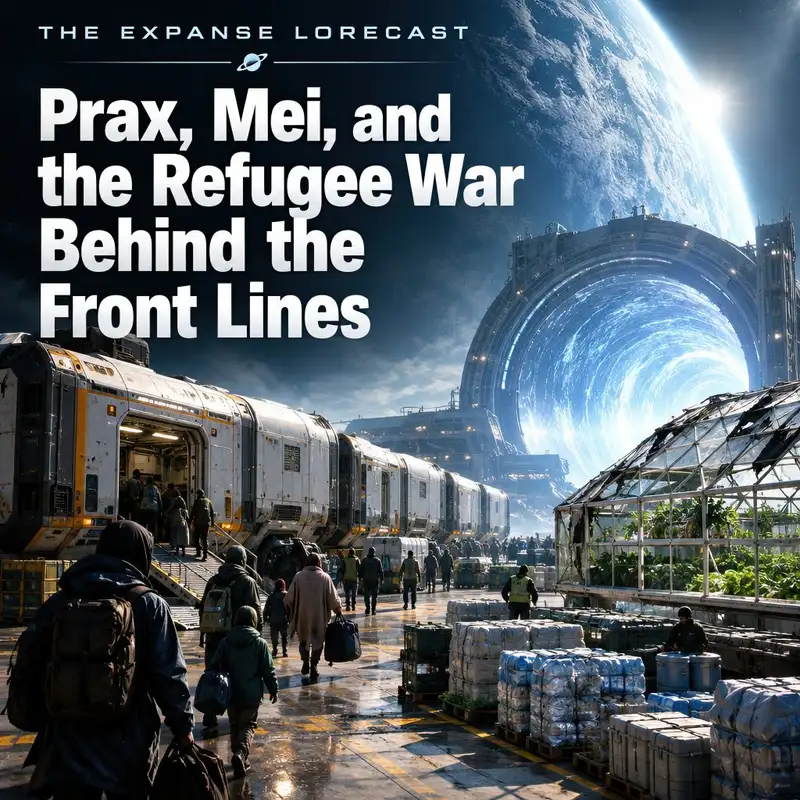
Prax, Mei, and the Refugee War Behind the Front Lines
Praxidike Meng comes home to a world that has stopped keeping its promises. Ganymede is still turning beneath its mirrors and docks. Its corridors still have lights, at least in places. The air has not yet failed. But the routines that make a child safe have begun to unravel all at once. Daycare records are confused. Transit is disrupted. Security personnel are trying to impose order on frightened crowds. People are searching hospitals, shelters, docking queues, and lists of the dead.
Prax is not a soldier, investigator, or political operative. He is an agricultural scientist, one of the specialists whose work helps make Ganymede a food-producing center for the outer system. He is also Mei’s father. Mei has a serious medical condition. Her care depends on medication, regular monitoring, and a stable chain of doctors, records, pharmacies, transport, and refrigeration. In an ordinary society, that chain is almost invisible. A parent knows where the clinic is, who runs the daycare, and what happens when a prescription runs low. Then a battle erupts nearby, and ordinary society becomes an emergency system with too many failures happening at the same time.
When Prax learns that Mei is gone, he does not know whether she was killed in the chaos, separated during an evacuation, taken aboard a departing ship, or deliberately abducted. At first, her disappearance appears to be one more private catastrophe in a public disaster. Ganymede has been struck by military violence, but its deepest wound is not measured by the first exchange of fire. It is measured by what happens afterward, when food production, medical care, transportation, trust, and public records all become uncertain.
That is the war behind the front lines of Ganymede. A battle does not need to target a nursery, clinic, or ration depot directly to place all three at risk. In a dependent space economy, civilian life rests on tightly linked systems. Damage one part of the structure, and the rest begins to bear weight it was never designed to carry.
Before the crisis, Ganymede mattered because it was more than a moon with a large population. It was one of the critical agricultural and logistical nodes of the outer planets. Its controlled environments produced food for people who could not simply plant fields outside. The Belt had mines, stations, transport routes, and industrial labor. It did not have broad soil, open rain, or a naturally forgiving climate. Ganymede’s farms and agricultural infrastructure were part of the system that kept distant habitats supplied.
That role made the moon strategically important long before a military confrontation brought war close to it. Food was not merely a commodity on Ganymede. It was a foundation of political stability. Agricultural output depended on mirrors, power systems, water processing, biological research, maintenance crews, storage, cargo schedules, and ships able to move supplies safely through a crowded and politically tense solar system. A crop does not care whether a government has issued a reassuring statement. Plants still need light. Pumps still need power. Nutrient systems still need technicians. Freight containers still need a dock and someone authorized to release them.
The same was true of medicine. The same was true of air. The same was true of every civilian service that seemed routine before the fighting. A habitat can survive occasional accidents because it is built around redundancy, repair, and trained people. It struggles when many systems fail at once, when workers are injured or fleeing, when traffic is interrupted, when security forces distrust one another, and when no one can say with confidence who has legal authority over the next cargo ship.
Ganymede’s importance made it a prize of logistics. It also made it vulnerable to disruption. A conventional military planner can see a food-production center as infrastructure, a source of supply, a political asset, or a point of leverage. The people living there see it as home. Those perspectives do not cancel each other out. They collide whenever military action damages the systems civilians need to remain alive.
The fighting around Ganymede occurs during a period of growing suspicion between Earth and Mars. The recent Eros crisis has already shown that private actors can possess capabilities with system-wide consequences. Governments are anxious, intelligence services are looking for hidden threats, and political leaders are tempted to interpret incomplete evidence in the most dangerous possible way. The confrontation near Ganymede is part of that wider instability.
But the novel does not present Ganymede as the target of one simple, deliberate campaign to destroy a civilian population. The immediate event is a confused military crisis involving Earth and Martian forces, hidden agendas, and a threat neither government fully understands. The battle damages vital infrastructure, including orbital systems connected to agriculture. It sends shock through a population already dependent on precise coordination. The physical damage matters. So does the fear that another engagement may follow.
For civilians, the distinction between deliberate destruction and destructive consequence can become painfully academic. A damaged mirror does not care whether it was struck intentionally. A food-processing chain does not recover because the official explanation says the outcome was unintended. A parent waiting for medicine cannot feed a child on the assurance that the military objective lay somewhere else.
The military contact around Ganymede produces immediate casualties and panic, but its larger effect is operational. The forces involved can break contact, withdraw, or redeploy. The moon cannot do the same. Its farms, habitats, transport systems, and civilian institutions remain where they are. They must absorb the consequences of the battle with the equipment, personnel, and reserves still available.
That difference matters. A warship can survive a damaged engagement and move toward repair. A civilian food system has to keep feeding people during its repair. A naval commander can redefine a mission after receiving new intelligence. A clinic cannot redefine the need for a child’s medicine. The military crisis may have begun with sensors, weapons, and uncertain contacts. Its civilian phase begins with shortages, rumors, missing people, and the slow realization that normal procedures may not return soon enough.
Food distribution begins to deteriorate. Commercial traffic becomes tangled with relief traffic. Local authorities must decide what to release, what to hold, and what they can still protect. Workers do not know whether their jobs will continue, whether their families can remain safely housed, or whether the systems they maintain will still exist next week. Some people flee because they have already lost homes or relatives. Others leave because they fear hunger, medical collapse, renewed fighting, or the disappearance of any authority capable of organizing recovery.
This is how a battlefield becomes a refugee crisis. Not everyone who leaves is injured by a weapon. Many are displaced by uncertainty. They leave because the future supply of food is no longer reliable. They leave because schools, clinics, work sites, and shelters cannot tell them when normal operations will resume. They leave because the system that once connected a medical file to a pharmacy, a family to a home, and a worker to a paycheck has become fragmented.
Refugees are sometimes described as though they are merely people in transit. In reality, they carry the consequences of institutional failure with them. They carry trauma, grief, professional skills, resentments, debts, children, medical needs, and memories of who helped them and who did not. They also carry political meaning. Every crowded transport leaving Ganymede is evidence that a major center of food production and civilian life can no longer sustain the people who depended on it.
Basia Merton’s family reveals another face of the same disaster. Like Prax, Basia is a parent caught in the confusion surrounding missing children. His son, Katoa, becomes part of the pattern that Prax only gradually begins to see. The point is not that every missing child is connected to one plot. In a collapsing habitat, many explanations are possible. Children can be separated from families, injured, evacuated, misidentified, or lost in overloaded systems. That uncertainty is itself part of the harm.
A crisis destroys information before it destroys every physical record. Witnesses contradict one another. Staff are missing. Cameras are damaged, inaccessible, or ignored by people who have more immediate emergencies. A parent cannot tell whether a blank entry means death, evacuation, incompetence, or concealment. Under those conditions, absence becomes a kind of evidence, but never enough evidence by itself.
Prax begins where a father can begin. He asks questions. He searches lists. He visits places that are no longer functioning as they should. He presses officials who have too many frightened people and too few answers. He remembers Mei’s routines, her doctors, her care requirements, and the people who were supposed to know where she was. His knowledge is intimate rather than strategic. It comes from medication schedules, daycare arrangements, and years of learning the details that keep one vulnerable child alive.
At first, he cannot know that Mei’s disappearance began before the battle. That fact matters because it changes the investigation completely. If she vanished in the fighting, then Prax is searching through the wreckage of a disaster.
The surviving security footage provides the first decisive break. Mei was removed from daycare by Doctor Strickland and a woman who presented herself as Mei’s mother. Mei was not simply lost in the chaos. She was taken.
That discovery is both relief and terror. A missing child who has been deliberately taken may still be alive. But deliberate action implies planning, access, false identities, and somewhere to take her.
Prax also learns that Mei is not the only child connected to Strickland’s medical practice who has disappeared. At this stage, the pattern remains incomplete. The missing children have medical histories. They have families. They have been treated by someone who had access to their records and their trust. But Prax does not yet possess a complete explanation, and neither does anyone else around him. He has fragments. He has a face on security footage. He has the awful recognition that the institutions meant to protect sick children have been used to reach them.
This is an intelligence problem as much as a criminal one. The central difficulty is not a lack of possible explanations. It is an excess of them. A missing child can vanish into a refugee stream, a casualty list, a corporate manifest, a security database, or a deliberately erased record.
The Outer Planets Alliance has its own reason to pay attention. Fred Johnson understands that the Ganymede incident could push Earth and Mars toward open war. The Alliance is not a unified state with a single chain of command, but it has networks, ships, intelligence interests, and leaders who recognize that what happens on Ganymede will affect the balance of power throughout the system.
James Holden and the crew of the Rocinante arrive in that environment under an Outer Planets Alliance contract. Their work has humanitarian and investigative dimensions. They are not a formal rescue agency, and they do not arrive with unlimited authority. Their presence is shaped by the same uncertainty that affects everyone else. Who controls the docks? Which ship has the right to leave? Which cargo can be diverted? Which armed force is protecting civilians, and which is merely protecting its own position?
The relief freighter Weeping Somnambulist becomes a useful symbol of the larger crisis. Ganymede is a food-producing center, yet people on the moon are hungry. Ships carrying food are caught in the confusion of ownership, scheduling, security, and political control. Relief traffic waits to enter while commercial movement struggles to continue. Food may exist on a manifest, in a warehouse, or aboard a vessel. None of that means it is available to the people standing in a ration queue.
This is the political economy of hunger. Starvation is rarely caused by the total absence of food alone. It comes from failure to move food where it is needed, failure to protect the systems that distribute it, failure to decide who has authority to release it, and failure to treat survival as more urgent than ownership. In a space economy, the problem is even more acute. A container that cannot dock might as well be on another planet.
The situation also exposes the weakness of fragmented command. Local administrators, corporate representatives, Earth and Martian interests, OPA-linked personnel, private security teams, and civilian workers do not share the same priorities. Some are trying to stabilize the moon. Some are guarding property. Some are looking for evidence. Some are preparing for the next escalation. Some simply want a ship out before the situation gets worse.
Holden is drawn into Prax’s search because Prax can name a human problem amid a catastrophe that is otherwise becoming statistical. There are shortages, refugees, damaged systems, and rumors of military conspiracy. Those are all real. The details give the investigation a direction.
The Rocinante crew brings different forms of capability. Holden brings a willingness to act even when legal authority is incomplete and the political consequences are uncomfortable. Alex Kamal keeps the ship functioning and mobile in an environment where mobility is never automatic. Amos Burton provides security and the practical capacity to face danger once the investigation enters places where ordinary civilian procedure no longer applies.
Prax brings the knowledge no one else has. He knows Mei’s medical history. He knows the structure of the care system around her. He understands the biological details that may connect the missing children. And he has the stubborn focus of a parent who cannot treat a child as a case file. That focus is not a substitute for military training. It is something different.
The search team is improvised. It does not possess the authority of a national police service, the resources of a navy, or the certainty of a completed intelligence picture. It has a damaged habitat, uncertain allies, incomplete evidence, and a threat that may be connected to the most dangerous technology humanity has yet encountered. Its advantage is that it can move between categories.
The first evidence points downward, into the parts of Ganymede that ordinary public life has stopped seeing clearly. Damaged and abandoned sections of a habitat can become blind spaces quickly. Security coverage weakens. Access records become uncertain. People can hide equipment, bodies, or laboratories behind the general disorder of the crisis.
The clues build slowly. There are missing children with similar medical vulnerabilities. There is Strickland’s access to them. There are traces of biological research that do not belong in a routine pediatric practice. There are facilities that appear too secure, too concealed, or too well resourced for the explanations offered.
His expertise does not make him omniscient. Agricultural science is not the same as counterintelligence or alien biology. But it gives him a disciplined way of looking at living systems. He understands that organisms respond to environments, that biological processes leave traces, and that a pattern of anomalies can reveal an intervention even before the mechanism is fully understood.
The name Carlos Merrian begins to matter. The conclusion that emerges is not based on one confession or one flawless record. It is assembled from personnel history, medical access, missing children, laboratory evidence, and the growing realization that the protomolecule has become the object of a weapons program.
That matters because corporate secrecy is rarely a matter of one locked door. It operates through systems. Researchers move between institutions under changed names. Medical records become lists of potential subjects. Shell organizations conceal funding. Private security limits access. Freight moves equipment. Contracts obscure responsibility. Political patrons ensure that inconvenient questions encounter jurisdictional barriers. A covert program does not need every participant to understand its final purpose.
Ganymede’s civilian collapse helps such a program. In a functioning society, a missing patient may trigger immediate scrutiny. In a society overwhelmed by battle damage, evacuation, food shortages, and political crisis, a missing child can be buried under a mountain of other urgent failures.
The search eventually reaches evidence that makes the human cost impossible to abstract. Basia Merton’s son, Katoa, is found dead. His death confirms that the missing children are not merely being hidden or transported. They have been used in an experiment. The language of research, treatment, and security cannot soften that fact.
The facility also reveals the existence of a protomolecule-derived hybrid. The encounter turns an investigation into a survival problem. Holden, Amos, Prax, and their allies are not hunting a conventional criminal who can be arrested by presenting a warrant.
The hybrid is not important because it is a monster in a corridor. Its real importance is strategic. The protomolecule is not a simple substance that can be poured into a weapon and controlled like fuel. It is an alien system with behaviors humanity barely understands. But the people behind the program are attempting to find ways to shape its effects through human experimentation.
The children’s medical conditions appear to be central to that effort. Prax infers that their biological vulnerabilities made them useful to the researchers in ways healthier children might not have been. That inference is horrifying precisely because it converts dependency into selection criteria.
This is one of the ugliest forms of institutional violence. Vulnerability becomes inventory. A child’s medical record becomes a procurement document. The language of research makes the process sound technical. The reality is coercive experimentation under conditions where the subjects have no meaningful choice and their families have been deceived.
The confrontation with the hybrid provides tactical evidence, but it does not end the program. The team learns more about the scale of the threat, but Ganymede remains damaged, its population remains displaced, and the people responsible for the research have resources beyond one hidden facility.
The trail leads onward to Io. That movement is important because it shows that the operation could not have been sustained by one rogue doctor working alone. A program capable of abducting children, monitoring their conditions, transporting them, maintaining laboratories, acquiring protomolecule material, and protecting its personnel requires infrastructure.
A conspiracy of this kind depends on conventional power even when its objective is alien technology. The protomolecule does not erase bureaucracy. It makes bureaucracy more dangerous when officials, corporations, and military institutions decide that normal ethical limits are obstacles rather than safeguards.
Later revelations establish a convergence of interests among Jules-Pierre Mao, Undersecretary Sadavir Errinwright, Admiral Souther’s rival Admiral Nguyen, and associated networks seeking to exploit the protomolecule for military and political advantage. Prax does not begin his search with a list of conspirators. Holden’s crew does not arrive carrying a complete map of the program.
The logic behind the program is recognizable even if the technology is not. A state fears that a rival may acquire a decisive weapon. A corporation sees access, profit, and influence. Political officials see an opportunity to alter the balance of power. Military leaders see a potential answer to conventional weakness. The scientist says the politician authorized the program. The politician says the military demanded it. The military says the corporation provided the capability. The corporation says it merely fulfilled a contract.
No one in that chain needs to say that children should be sacrificed. The machinery of compartmentalization can produce the outcome without requiring every participant to confront its moral meaning. That is why the investigation matters.
The operation at Io brings the search toward its immediate objective. Mei is found alive, along with other children. The recovery is a real victory. It matters that the children are removed from the program. It matters that their families have the chance to see them again.
But the rescue is not clean. It cannot be. Mei has been taken from her father, subjected to the control of people who used her illness as an experimental opportunity, and held in an environment where care and exploitation were deliberately entangled. The fact that he monitored her condition does not transform abduction into treatment.
Prax’s response to Strickland reveals the burden placed on civilians when institutions fail them. Rage is not difficult to understand. But Prax is not transformed into an executioner simply because the situation offers him one. The moral injury is part of the damage. The people behind the program force victims and families into choices they should never have to make.
Amos Burton’s role in that moment is shaped by his own harsh clarity about what Strickland has done and what he may do again. Amos provides the violence Prax cannot or will not carry out himself. It is not a scene of triumphant justice. Strickland dies, but his death does not restore the children’s lost time, repair Ganymede’s food system, or dismantle every institution that made the program possible.
The rescue produces several different outcomes at once. Tactically, children are recovered from immediate danger. Politically, that evidence becomes part of a larger struggle over war, secrecy, and authority. Strategically, however, the broader conspiracy is not defeated merely because one facility is exposed and one doctor is stopped.
That distinction is essential. Personal victory and systemic victory are not the same thing. Prax gets Mei back. That is enormous. For him, it is the difference between a life shattered beyond repair and the possibility of rebuilding. But the conditions that allowed Mei to be taken were larger than one man.
Mei’s recovery also does not restore Ganymede. The moon remains a damaged agricultural center in a solar system still sliding toward larger conflict. Workers have been displaced. Families have been divided. Food production has been disrupted. Trust in institutions has been weakened.
The refugee crisis outlasts the battle because rebuilding a society takes longer than damaging one. A mirror can be repaired, but not instantly. A transport route can reopen, but not if crews fear attack, insurers refuse the risk, or political authorities cannot agree on rules. A family can be reunited, but not every family is reunited.
The people displaced from Ganymede are not a single undifferentiated mass. They include agricultural workers whose knowledge is valuable elsewhere. They include technicians, medical staff, cargo crews, parents, patients, and people whose former lives depended on a highly specialized habitat. They also include people who have learned, through direct experience, that the great powers can fight near civilian infrastructure and then debate responsibility while civilians wait for food.
Those experiences reshape politics. They deepen anger toward distant governments and corporations. They complicate the claim that any one faction can provide security. A shipment from Earth, Mars, Tycho, or an OPA-linked network is never just a shipment.
The later history of the Barbapiccola makes that point on a smaller scale. Its passengers include Ganymede refugees who eventually become associated with First Landing on Ilus. Their movement is not part of the immediate rescue of Mei, and it does not turn Ganymede’s crisis into a simple prelude to colonization. It shows something more enduring. Refugee flows do not end when the news cycle shifts.
A military historian can count ships damaged, weapons fired, and positions held. Those facts matter. But they are not enough to explain Ganymede. The moon’s real defeat is not simply the damage done during combat. Food security becomes uncertain. Medical continuity breaks down. Families lose track of one another. Records fail. Hidden institutions find cover in the chaos.
Prax’s search matters because it forces the larger conflict into human scale. Mei is not a strategic asset. She is a child whose illness should have brought protection. Prax is not a soldier in a grand campaign. He is a father who refuses to accept that disaster has made his daughter disposable. Yet his search uncovers a truth that fleets and governments have been slow to face. Alien technology becomes dangerous not only because of what it can do, but because human institutions will build laboratories, security systems, supply chains, and political justifications around the hope of controlling it.
Ganymede demonstrates that war enters civilian life long before a weapon strikes a home. It enters through disrupted food, delayed medicine, closed docks, missing records, frightened workers, and exhausted parents. It enters when a society treats the infrastructure of survival as an afterthought and the vulnerable as material to be managed. Prax recovers Mei, but his search reveals the wider cost of that failure: a military crisis that reaches the nursery, the clinic, the ration queue, and finally the refugee ship.