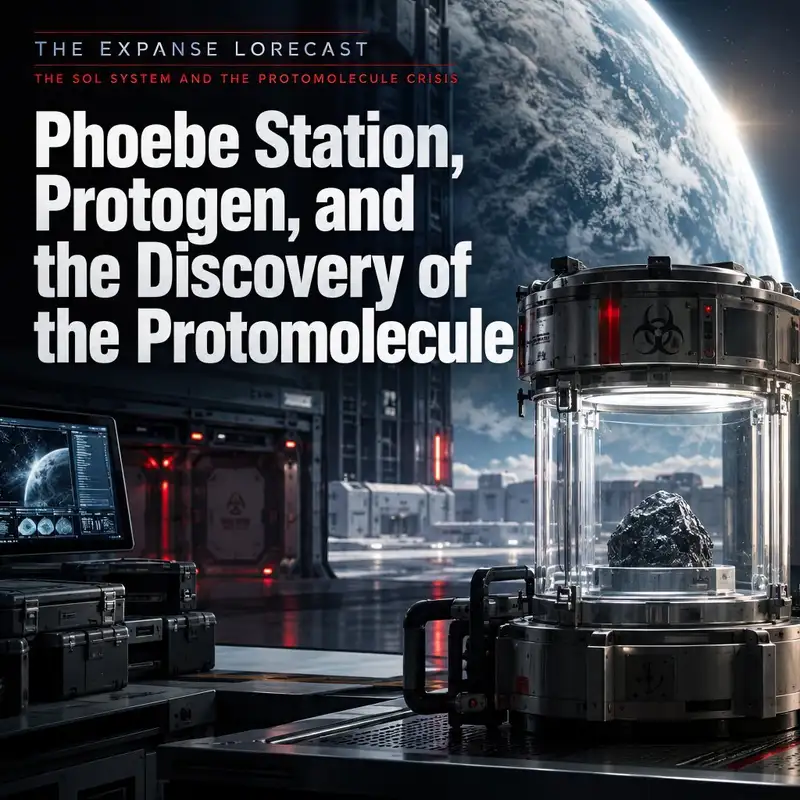
Phoebe Station, Protogen, and the Discovery of the Protomolecule
By the time the crisis around Eros began to break into public view, Mars had reached a grim conclusion about Phoebe. The remote Saturnian moon was no longer a research site, a mineral prospect, or a classified embarrassment. It was a contaminated origin point. Martian forces destroyed it with nuclear weapons, eliminating the station and much of the physical evidence that had accumulated there. The decision was not a declaration of war against an enemy fleet, nor an attempt to seize territory. It was emergency containment. A government that had once allowed a restricted scientific program to operate on Phoebe now judged the moon itself too dangerous to preserve.
That act has often invited a simple conclusion: Mars found the protomolecule, therefore Mars controlled the project that turned it into a weapon. The history is less convenient than that. Mars had authority over the site and Martian personnel took part in its early research. But the covert program that emerged from Phoebe was driven by Protogen, a corporation with money, security assets, scientific staff, and powerful political connections. The destruction of Phoebe shows that Martian authorities understood, eventually, that something catastrophic had happened there. It does not prove that every Martian ministry, naval officer, researcher, or elected official knew what Protogen had been doing.
Phoebe’s importance lies in that gap between access and control. It was where humanity first encountered an alien technological system. It was also where familiar human institutions decided how to handle it. A state saw strategic value. A corporation saw opportunity. Scientists saw an unprecedented problem. Security personnel saw a classified asset. And the people who became inconvenient to the program were treated as evidence to be removed. To understand why a moon at the edge of the inner Solar System had to be destroyed, it is necessary to return to the first survey, when Phoebe still appeared to be a quiet and manageable place.
Phoebe was useful to Mars long before anyone understood what lay inside it. It was remote, cold, and distant from the political centers of Earth, Mars, and the Belt. That remoteness made it difficult to reach, difficult to inspect, and easy to place behind layers of classification. A station there could be supplied by scheduled transports, guarded by restricted docking procedures, and kept out of ordinary commercial traffic. No large civilian population lived nearby. No station government could demand a public inquiry. No labor union could easily organize a strike at the facility’s gates. Distance itself became part of the security system.
But remoteness is not invisibility. A research station still needs technicians, food, water, medicine, replacement electronics, containment equipment, communications links, and ships capable of moving people and cargo across interplanetary distances. It needs budgets, contracts, manifests, clearances, maintenance schedules, and authority to deny access. Someone has to authorize the supply run. Someone has to service the recycler. Someone has to explain why a transport is carrying equipment that does not fit the declared mission. Secret programs do not escape logistics. They merely bury logistics under enough paperwork that no single clerk sees the whole operation.
That was one reason Phoebe was attractive. It did not need to vanish from the Solar System. It only needed to become boring enough, restricted enough, and distant enough that most people would accept the official explanation. At first, the official explanation was plausible. Phoebe was a body of scientific interest, with ice and rock that could justify survey work and perhaps future extraction. Mars had ample reason to examine a potentially useful resource. The first explorers were not necessarily walking into a weapons program. They were walking into a discovery whose implications would only become clear in stages.
The initial survey found more than ice, dust, and ordinary mineral formations. Within Phoebe, investigators encountered structures and material that did not fit conventional expectations. The anomaly was not simply that something unusual had been found on a moon. The anomaly was that the structures appeared organized in ways that natural geology did not adequately explain. For a civilization accustomed to finding valuable things in space, that distinction mattered. Ore could be priced. Ice could be shipped. A strange silicate formation could be sampled and cataloged. But a structure that suggested design forced a different question. Designed by whom, for what purpose, and how long ago?
At the beginning, those questions had no settled answers. The evidence established that Phoebe contained something extraordinary. It did not immediately establish the history of the object, the identity of its makers, or the role it had been meant to play in the Solar System. Later, Protogen would offer a sweeping interpretation. Its researchers argued that Phoebe had been a delivery vehicle, sent toward the early Earth and captured by Saturn’s gravity before it reached its intended destination. That explanation became central to the corporation’s understanding of the protomolecule. It was also an interpretation produced by people who wanted to turn an unexplained discovery into a strategic program.
The difference is important. The material on Phoebe was real. Its behavior was real. The fact that it did not fit human science was real. But the ancient mission assigned to it remained an inference. Protogen’s experts had more information than outsiders did, and some of their conclusions were later supported by events. Even so, the corporation did not possess a complete history of the builders, a reliable manual for the system, or a proven understanding of its ultimate function. It had fragments, observations, and a powerful incentive to sound more certain than it was.
That uncertainty should have made Phoebe a place of extreme caution. Instead, it made Phoebe valuable. In military and corporate institutions, an unexplained capability can be more tempting than an understood one. A known weapon has limits, costs, countermeasures, and doctrine. An unknown system invites imagination. If it can alter living matter, perhaps it can be controlled. If it can build structures, perhaps it can create new weapons. If it can adapt, perhaps it can defeat an enemy’s defenses. The first danger at Phoebe was not merely the alien material. It was the human urge to convert mystery into advantage before anyone had earned the right to claim understanding.
Mars had the authority to establish and protect the Phoebe facility, but it did not necessarily possess every institution needed to exploit the discovery in secrecy. The Martian Congressional Republic was a state built around a vast collective project. Its military, industrial base, scientific institutions, and terraforming effort were all tied to a culture of discipline and long-term planning. Yet even a capable state faces political limits. Public research must answer to budgets. Military programs create chains of command. Scientists leave records. Officers report upward. Legislators ask questions, even when the answers are classified.
Protogen offered another model. It was an Earth-based corporation with access to research talent, capital, private security, transport networks, and political influence. It could move people through contracts rather than military postings. It could compartmentalize work through corporate departments rather than openly declared government programs. It could shelter behind confidentiality agreements, subcontractors, shell arrangements, and the ordinary fog of interplanetary commerce. A corporation did not need to be sovereign to exercise coercive power. It only needed enough money, enough protection, and enough partners willing to avoid asking questions.
The Phoebe arrangement joined these capabilities. Mars provided access, jurisdiction, and personnel. Protogen supplied scientific management, security, and the insulation that allowed the project’s real direction to become obscure. This did not make Mars and Protogen identical institutions. Their interests overlapped at the beginning, but their responsibilities were not the same. A Martian researcher could believe that he or she was contributing to a controlled scientific study. A Martian official could know that a restricted project existed without knowing that human exposure experiments had begun. Protogen could exploit those distinctions precisely because no public authority appeared to hold complete responsibility.
Blurred responsibility was not an accidental side effect. It was one of the project’s protections. When decisions are divided among agencies, contractors, laboratories, security teams, and political patrons, each participant can claim a limited role. The scientist worked on the sample. The security officer protected the facility. The transport captain moved sealed cargo. The administrator approved a budget line. The government sponsor authorized research under classification. No one, in theory, had to admit responsibility for the whole chain. In practice, that structure allowed the people at the top to use everyone beneath them while preserving deniability.
Jules-Pierre Mao represented the kind of power that made such a system possible. His significance was not simply that he was wealthy or connected, and not simply that he was Julie Mao’s father. He stood at the intersection of corporate capital, political access, and private infrastructure. A project like Phoebe required more than one ambitious scientist. It required money that could survive years of secrecy, ships that could travel without inviting inspection, security personnel who could be trusted with compartmented orders, and influence capable of softening inconvenient scrutiny. Mao’s network provided the conditions under which Protogen could treat alien discovery as a proprietary asset.
The decisive shift came when Protogen stopped treating the anomaly as a dangerous object to be studied and began treating it as a system to be used. The corporation named it the protomolecule. The name made the unknown sound almost manageable, as though a new term could turn an alien process into a research category. But the protomolecule was not an ordinary organism. It was not a virus in the familiar medical sense, and it was not a conventional biological weapon designed by a human military. It behaved more like an engineered process, using living material to carry out a larger set of instructions.
That shift made ordinary assumptions unreliable. Disease can be studied through infection patterns, immune response, containment, and treatment. A weapon can be evaluated through yield, delivery method, target effects, and countermeasures. The protomolecule did not fit neatly into either category. It could alter biological matter, but its apparent purpose reached beyond illness or death. It seemed to use life as raw material. The people exposed to it were not merely victims of poisoning. They were part of a process that Protogen only partly observed and did not control.
Antony Dresden, Protogen’s leading scientist, later provided one of the clearest explanations available to outsiders. Through recovered material, he described the protomolecule as a kind of tool sent across interstellar space, a system intended to arrive, take hold, and build something larger from the resources it found. His account helped James Holden, Josephus Miller, Naomi Nagata, Amos Burton, and Alex Kamal understand the connection among Phoebe, the Anubis, Julie Mao, and Eros. It also served another purpose. Dresden’s explanation was a defense of the research program. He presented atrocity as the price of knowledge.
That makes his testimony useful but not neutral. Dresden had direct knowledge of Protogen’s work. He also had every reason to portray the corporation as visionary rather than criminal. In his account, the scale of the discovery justified the scale of the experiment. Humanity had found evidence of an ancient civilization and a technology beyond any human achievement. According to that logic, the dead on Phoebe and Eros were tragic but necessary costs in a race for survival and power. It was the language of strategic necessity, stripped of the people who would pay for it.
A responsible scientific program would have treated the protomolecule’s unpredictability as a reason to slow down. It would have separated observation from exposure, containment from deployment, and theory from operational use. Protogen did the opposite. The less it understood, the more urgent the opportunity seemed. The corporation feared that Earth, Mars, or a rival interest might seize the discovery first. In that environment, caution could be recast as weakness. Ethical restraint could be described as delay. And a warning that the system might be uncontrollable could become an argument for testing it before someone else did.
The transition from research to human experimentation was therefore not one sudden act of madness. It was an institutional escalation. First came the anomaly. Then the classification. Then the claim that only a restricted group could understand it. Then the argument that more data was required. Then the decision to use living subjects. At each stage, the moral boundary moved a little farther away from the people making the choice. By the time Protogen exposed human beings to the protomolecule, the program had already trained itself to think of secrecy and scientific progress as higher obligations than the lives under its control.
The Martian personnel at Phoebe are central to this history because they demonstrate how completely the project’s internal rules had changed. They were not distant civilians on a station selected for sacrifice. They were researchers and workers inside the very operation that had been authorized to study the anomaly. Available evidence makes clear that exposure or infection occurred at the facility, that the station became compromised, and that Protogen moved to eliminate evidence and abandon liabilities. The exact sequence of every death is less certain than the larger fact. People who had helped make the discovery became disposable once they knew too much and had been exposed to something the corporation could not safely explain.
This was not merely a security failure. It was a collapse of legitimate authority. Protogen may have protected its secrets in the narrow sense. It prevented immediate public scrutiny, restricted surviving evidence, and preserved its ability to continue the project elsewhere. But secrecy gained through the abandonment or removal of compromised personnel destroyed any claim that the program remained a lawful scientific enterprise. The corporation had crossed from classified research into an operation that treated human beings as experimental material and witnesses as threats.
That logic also explains why Mars later acted against Phoebe itself. By the time the moon was destroyed, the site had become both a physical hazard and a political liability. It contained evidence that could implicate Martian authorities in a project they may not have fully controlled. It also contained alien material whose behavior had already exceeded conventional containment. Destruction was a brutal form of crisis management, but it was not irrational. A remote facility is valuable only while it can be secured. Once it becomes a source of contamination, investigation, and strategic panic, the same remoteness that once protected it can make annihilation appear administratively possible.
Protogen did not stop when Phoebe became unsafe. The project moved because its managers had already decided that the discovery was too valuable to abandon. Research, security, transport, and compartmentalized corporate authority created a mobile architecture in which dangerous material could leave the original site while responsibility remained divided among people who did not all see the whole operation.
The Anubis became part of that architecture. It could move personnel and material, operate with secrecy, and support the covert work Protogen needed to continue beyond Phoebe. But transport created vulnerability as well. A hidden project that must move samples, researchers, equipment, and prisoners through ordinary space leaves routes that can be intercepted and people who can survive long enough to carry evidence away.
Julie Mao and the Scopuli entered the story through that weakness. The surviving record does not justify inventing every detail of the Scopuli’s mission, but it establishes that Julie was working with the OPA, that the Scopuli encountered the Anubis, and that the covert operation did not remain sealed inside Protogen’s compartments. Julie’s capture and later escape turned a controlled research program into a trail other people could follow.
Protogen responded by manipulating the political environment around that trail. The Scopuli became bait, the Canterbury was drawn into a false rescue, and its destruction was framed in a way likely to inflame suspicion between Mars, Earth, and the Belt. The purpose was not simply destruction. It was to create enough confusion that the people looking for the truth would be forced to search through a system already preparing to blame itself.
That diversion bought time, but it did not restore control. The Anubis was compromised, Julie reached Eros, and evidence began moving outward through survivors, investigators, and people Protogen had never intended to brief. A program built on compartmentalization discovered the weakness of compartmentalization: once the fragments escaped their boxes, outsiders could begin assembling a picture no single insider had been authorized to see.
That decision reveals the true nature of Protogen’s weapons program. The corporation was not simply trying to destroy Eros. Destruction would have been simpler, cheaper, and far more predictable. It wanted to observe what the protomolecule would do when given a substantial human population and a built environment. It wanted to see whether the alien system could be understood, guided, perhaps eventually controlled. The possibility of strategic application was inseparable from the experiment, but Protogen did not know enough to define the weapon it hoped to obtain.
This made the operation more reckless, not less. A known weapon can be evaluated against an objective. A system whose function is unknown cannot be responsibly deployed at population scale on the assumption that observation will produce mastery. Protogen had enough capability to initiate exposure. It had guards, sealed facilities, transport, researchers, and plans for deception. But it did not have reliable control over the protomolecule’s response. It had mistaken access for understanding.
The people of Eros were therefore not collateral casualties of a battle that went wrong. They were the intended material of the experiment. Their station, their bodies, their labor, and their enclosed environment were turned into inputs for a process designed by beings who had no moral claim to use them. This was colonial disregard in its most extreme form. Eros was a Belter station, part of a system where Inner institutions had long benefited from Outer Planet labor and resources while denying equivalent political power. Protogen extended that logic until the residents of an entire station could be treated as consumable research stock.
The result escaped the boundaries of a corporate project. Protogen had hoped to generate knowledge and perhaps a strategic advantage. Instead, it created a crisis that no private security force could contain. The protomolecule did not remain a specimen in a controlled facility. It did not behave like a weapon with a predictable target and effect. The scale of Eros made the consequences visible to every major power in the Solar System. A secret asset became a system-level threat.
Only then did the fragments begin to align. Holden, Miller, Naomi, Amos, and Alex did not witness the first survey of Phoebe. They did not stand in the research station when the Martian personnel were exposed. They reconstructed the history indirectly, under pressure, through the abandoned Anubis, Julie Mao’s trail, Protogen records, and the unfolding catastrophe on Eros. Their knowledge arrived in pieces. One clue explained a previous mystery while creating a larger one. The name Phoebe shifted from a remote location on a map to the origin point of an operation that had reached across the Solar System.
The recovered evidence gave outside investigators the first coherent account of what Protogen had been attempting. It linked the corporation’s alien research to the Scopuli, the Anubis, Julie, and Eros. It also revealed how much the corporation had depended on secrecy and misdirection. Yet even at that moment, the full meaning of the protomolecule remained beyond human understanding. The people trying to stop the crisis knew enough to recognize a threat. They did not know enough to predict every consequence. That was the condition Protogen had created for everyone else: a civilization forced to react to a technology that had been tested on human beings before its nature was understood.
Mars’s destruction of Phoebe must be judged in that context. It was an attempt to remove a contaminated facility, deny access to a site of immense danger, and contain evidence that could no longer be managed through classification alone. It may also have reflected fear of what rival powers could recover if the moon remained intact. Emergency decisions rarely arrive with clean motives. Containment, institutional self-protection, military caution, and political panic can all operate at once.
But destroying Phoebe could not undo what had already been distributed. The station could be erased. Its equipment could be vaporized. Its surviving records could be denied, classified, or lost. The original site could be made inaccessible. None of that could eliminate material that had already moved elsewhere, knowledge that had already passed through Protogen’s network, or the consequences of Eros. The attempt to solve the problem by destroying the place where it began was understandable. It was also far too late.
Phoebe’s historical significance is not simply that it proved humanity was no longer alone. The more important lesson is darker. Humanity’s first response to alien technology was shaped by institutions it already knew well: state secrecy, corporate insulation, military competition, unequal colonial power, and the belief that other people could be spent in pursuit of strategic advantage. Protogen did not fail because it lacked ambition, money, or technical skill. It failed because it mistook possession for understanding, secrecy for control, and expendable lives for an acceptable cost. The catastrophe began on Phoebe, but it was made human by the choices that followed.