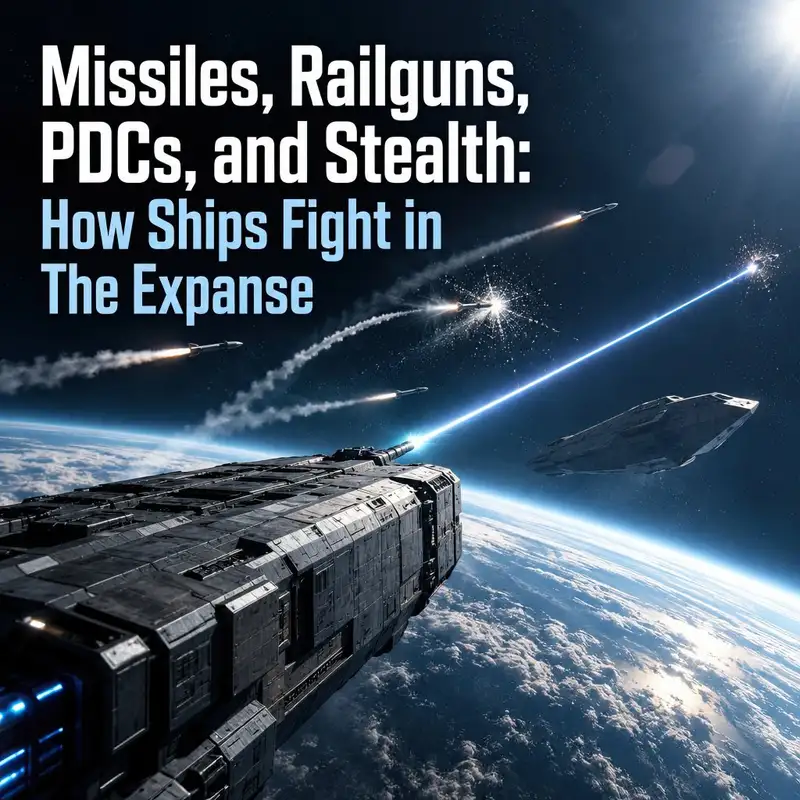
Missiles, Railguns, PDCs, and Stealth: How Ships Fight in The Expanse
The Donnager was built to make lesser powers reconsider their plans. It was a Martian battleship, heavily armed, professionally crewed, and backed by the military culture of a state that had spent generations preparing for the war it hoped never to fight. When it encountered an apparently limited threat, its commanders had every reason to believe they held the advantage. Then the contact picture changed. What had seemed manageable became an ambush involving more attackers, better concealment, and a geometry chosen by someone else. The Donnager was not defeated because Martian weapons were inadequate. It was defeated because a powerful ship had entered a fight without understanding the fight it was in.
Ship combat in The Expanse begins long before the first missile launch or railgun shot. It begins with detection, identification, and interpretation. A commander must decide whether a distant object is a freighter, a patrol ship, debris, a sensor artifact, or an enemy. That decision must often be made with incomplete information and across distances where messages arrive too late for a superior headquarters to help. Missiles, railguns, point-defense cannons, and stealth are not separate answers to that problem. They are parts of one contest over time, motion, and information.
The ship that wins is not always the one with the largest gun or the deepest magazine. It is often the ship whose commander understands what the other side sees, what it fears, how long it has to react, and which evasive move will create the next vulnerability. A missile can force a turn. That turn can create a railgun opportunity. Point-defense fire can prevent destruction, but it also consumes ammunition and reveals where a ship can defend itself. Stealth can delay detection, but it cannot survive every act of movement, communication, or attack. Every advantage comes with a cost, and every cost can become an opening.
The battlefield is not a flat map with two ships facing one another. It is a volume of moving objects, each carrying momentum, heat, people, fuel, ammunition, and a finite ability to endure acceleration. A ship in The Expanse does not fly like an aircraft. It does not bank into a turn, pull behind an opponent, and settle into a familiar chase. It may point one direction while traveling another. It may rotate to aim weapons or sensors while continuing along a previous vector. It may cut thrust and coast without stopping. It may flip around and fire its drive in the opposite direction to slow down, alter a trajectory, or create a new apparent down for the crew.
That last detail matters. On most ships, gravity comes from acceleration. When the drive is pushing the vessel forward, the deck beneath the crew becomes down. When the ship is coasting, the crew is on the float unless the vessel has some other source of apparent gravity. A maneuver is therefore not just a line on a tactical display. It changes where people stand, how fluids move, how injured crew members are treated, and how hard the ship is asking human bodies to work.
The Epstein drive gives ships in this setting extraordinary endurance compared with conventional rocketry. It permits long periods of sustained acceleration and makes an interplanetary civilization possible. But it does not abolish mass, inertia, heat, maintenance, or biology. A ship can only push its crew so hard for so long. Medication and acceleration couches help people survive high-g maneuvers. They do not make organs immune to force. A hard burn can leave a crew exhausted, injured, or dead. Even when the people survive, machinery may not welcome being treated as though maintenance schedules were a personal insult.
Acceleration also consumes options. A ship that commits to a major burn has selected a trajectory, exposed a drive plume, and accepted a certain future position unless it spends more time and reaction mass changing course again. A captain cannot simply decide to be somewhere else. The ship must get there through a sequence of burns, coasts, and braking maneuvers. The enemy is making the same calculations. Combat becomes a struggle to predict where everyone will be when weapons arrive, not merely where they are at the moment of launch.
The words speed and maneuver can therefore be misleading. A fast ship is not necessarily agile. A ship under heavy thrust may be able to change its future position rapidly, but it may also be revealing itself across vast distances. A ship that coasts quietly may preserve concealment, but it sacrifices the ability to make sudden major changes. A vessel with a damaged drive may still have weapons and sensors, yet be unable to control range, evade a threat, or leave the engagement. In space, losing thrust can turn a warship into a very expensive piece of debris with opinions.
Before any weapon can be used effectively, someone has to know what is out there. Sensors are therefore as important as guns, though they receive less attention from people who enjoy explosions. Ships search for drive plumes, heat signatures, reflected emissions, traffic patterns, transponder signals, tightbeam communications, and objects whose behavior does not fit the expected pattern. A vessel that burns hard announces that it is doing work. A vessel that communicates carelessly may reveal its location even if its hull is difficult to detect. A vessel that uses active sensors may gain information while also telling others that it is looking.
Detection is not the same as identification. A sensor return might establish that something is moving on an unusual trajectory. It may not establish who owns it, what weapons it carries, whether it intends hostility, or whether it is even crewed. In an interplanetary political crisis, that ambiguity can be as dangerous as a confirmed target. Firing first may start a war. Waiting may permit an attack. A transponder can be forged, absent, damaged, or simply ignored. A contact may be operating under false registration. A government may deny responsibility for a vessel it secretly supports. A corporation may possess military-grade capability while insisting it is conducting private security.
The reader can often see the conspiracy before the people inside the story can. That does not make every commander who hesitates foolish. The commander acts on reports, sensor data, doctrine, political instruction, and the knowledge that a wrong decision may kill civilians or widen a conflict across the system. In The Expanse, intelligence failure rarely means that no one had information. More often, it means the information was incomplete, delayed, misread, hidden in a bureaucracy, or dismissed because it did not fit what powerful people expected to be true.
Once a ship has enough information to act, missiles and torpedoes offer the greatest reach. They are the principal long-range offensive weapons because they can maneuver after launch. A railgun round follows the path given to it. A missile can continue to adjust, pursue, and force the target to respond. That does not make a missile magical. It needs a target solution, guidance, propulsion, and time. It may lose the target, be deceived, be destroyed, or arrive after the target has changed the conditions of the fight. But a missile does not need to strike in order to matter.
A missile launch creates a problem that cannot be ignored. The target may have to alter course. It may have to deploy countermeasures. It may have to activate point-defense cannons, turn protected arcs toward the threat, or abandon a preferred approach. It may have to reveal sensors, communications, or defensive doctrine. If several missiles arrive from different angles, the target may face saturation. No defensive system can place unlimited guns, ammunition, and attention in every direction at once.
That is why missile combat is often about forcing decisions. A ship under missile attack must choose which threat is most dangerous, which maneuver preserves the greatest number of future options, and which systems can be risked. It may protect its drive at the cost of exposing a sensor mast. It may preserve its main armament while allowing a less critical compartment to take damage. It may burn hard enough to disrupt a firing solution and punish its crew with acceleration. In an extreme case, it may accept damage because the alternative is surrender, destruction, or a trajectory that leads directly into a more dangerous threat.
The missile commander is trying to shape those choices. A launch can drive the target into a predictable line. It can break a formation. It can compel a ship to slow down, accelerate, or expose the side with weaker defensive coverage. It can make a convoy scatter. It can consume scarce point-defense ammunition before the real attack arrives. It can also serve a political purpose. A missile fired near a disputed station may signal resolve, trigger panic, interrupt commerce, or convince neutral parties that a route is no longer safe.
This does not mean every missile is a nuclear weapon, or that every missile hit destroys a ship. The weapons available in The Expanse vary in purpose and effect. What matters is that a guided weapon arriving at high velocity can threaten pressure hulls, propulsion, sensors, communications, and crew. Even a nonfatal strike may produce a mission kill. A ship that cannot see, maneuver, communicate, or maintain pressure may still exist as a physical object, but it no longer controls the battle.
Missiles also impose logistical limits. A warship cannot fire forever. It carries a magazine, and the magazine must be replenished. Replacement weapons require industrial capacity, secure ports, transport, trained ordnance crews, and political control over supply lines. A fleet that expends too much ammunition may retain impressive hulls while losing its ability to compel an enemy. This is one reason why a battle cannot be evaluated merely by counting destroyed ships. The question is also what each side has left when the next threat appears.
Against missiles, the most visible immediate defense is the point-defense cannon. These are rapid-fire kinetic weapons intended above all to destroy incoming missiles and dangerous debris before impact. Their operation depends heavily on automated fire control. The system must detect a fast-moving threat, identify it, calculate an intercept, assign a weapon with the right arc of coverage, and fire enough rounds quickly enough to break the threat apart or deflect it. The crew may authorize the engagement, but no human being is manually tracking each incoming object in the time available.
Point defense is not a shield. It does not create an invisible wall around the ship. It is a collection of guns with fields of fire, limited ammunition, mechanical limits, and imperfect information. A missile may arrive from an awkward angle. Several missiles may arrive together. Debris from one destroyed weapon can remain dangerous. A gun may be damaged, its sensors blinded, or its ammunition depleted. Defensive fire may be effective at one moment and overwhelmed the next.
The phrase point defense can also conceal how violent the process is. The ship is firing dense streams of metal at objects approaching at extreme speed. In close combat, those same guns can be used against another vessel. A point-defense cannon is designed to strike small targets quickly. At short range, an enemy ship is a large target with external systems, sensors, radiators, weapons mounts, and a pressure hull that would prefer not to be struck repeatedly by high-velocity tungsten. The distinction between defensive and offensive use can become very thin when two ships close.
The limitation is time. Point defense works best when the ship has enough warning, enough tracking quality, and enough ammunition. Every second of detection delay reduces the chance of interception. Every evasive maneuver may change the defensive arcs available. Every missile that must be engaged consumes rounds that cannot be recovered later. A competent commander does not think of point-defense ammunition as an abstract number. It is survival measured in remaining chances.
If a missile gets through, the result need not resemble a single dramatic explosion. A strike can rupture a compartment, shred a sensor package, ignite a fire, sever power and data lines, contaminate life-support systems, or injure people with debris and pressure loss. A ship can be damaged in ways that are initially invisible from outside. Its hull may remain broadly intact while the crew struggles with smoke, radiation, flooding systems, damaged maneuvering thrusters, or a reactor problem that has turned the engine room into the last place anyone wishes to visit.
Damage control is therefore combat power. A crew that can isolate a breach, reroute power, treat casualties, repair sensors, and preserve propulsion may keep a ship in the fight. A crew that cannot may lose the vessel after a hit that looked survivable on a tactical screen. Training, redundancy, spare parts, and discipline all matter here. So does luck. A fragment that strikes an empty compartment is not the same as one that hits a command deck, a drive system, or a crew member who happens to be holding the only tool that can fix the next problem.
Railguns impose a different geometry of danger. They are direct-fire kinetic weapons. Once the round leaves the weapon, it does not chase the target. It has no guidance package and no opportunity to reconsider its employment after launch. Its power comes from speed, mass, and the destructive consequences of impact. Its weakness is that the target has time to move if the range is long enough and the future position is uncertain enough.
A railgun shot is therefore a prediction. The gunner is not shooting at where the target is. The gunner is shooting at where the target will be when the round arrives. If the target can alter course after the shot is fired, the predicted point becomes wrong. At long distances, even a modest change in acceleration can move a ship away from the line of fire. At shorter distances, or in situations where the target’s movement is constrained, reaction time contracts. The railgun becomes far more dangerous.
Railguns are therefore not simply close-range guns, though they are especially lethal in close engagements. Their usefulness depends on geometry. A target might be unable to maneuver sharply because it is protecting a station, escorting a transport, preserving a formation, or avoiding a missile. It might be committed to a braking burn. It might have damage that limits its thrust. It might be caught in a narrow tactical moment where any evasive action creates a worse problem. Under those conditions, an unguided round can become the decisive weapon.
A railgun penetration can be catastrophic without destroying a ship in one clean blow. A round may tear through a pressure vessel, send fragments through equipment and people, disable sensors, destroy power systems, or remove the ability to maneuver. It can turn a tactical problem into a cascade of engineering emergencies. It can also miss. Space is very large, targets can change course, and a weapon that depends on prediction is only as good as the prediction.
Railgun combat rewards anticipation. A commander who can make the enemy’s next move obvious gains an advantage. That is why missiles and railguns work so well together. The missile says, move now. The railgun says, I know where you have to move. The point-defense cannon says, survive the missile first. The entire engagement becomes a sequence in which one weapon creates the condition for another.
Consider a ship facing incoming torpedoes. It may turn to bring its point-defense cannons to bear. That turn changes its vector. It may burn to evade, revealing a drive plume and committing to a new trajectory. It may concentrate defensive fire on one threat, leaving another approach less protected. It may use countermeasures that confuse the missile but also clutter its own sensor picture. The attacker watches these responses. If the target’s behavior becomes predictable, the attacker may gain a railgun solution. If the target has spent too much point-defense ammunition, another missile salvo becomes more dangerous. If the target has been forced to accelerate hard, its crew may be less able to tolerate another maneuver.
Initiative is not merely firing first. It is forcing the enemy to solve multiple problems at once. A ship may have excellent weapons and trained personnel, but it cannot make every correct decision if threats arrive faster than its command system can interpret them. Saturation works because attention, ammunition, sensors, and maneuvering options are finite. The attacker does not need every weapon to hit. It may only need the defender to make one mistake, expose one vulnerable arc, lose one essential system, or retreat from one strategically important position.
The same principle applies to formations and fleets. A squadron can use missiles to disperse an enemy screen. A larger warship can use its defensive guns to protect weaker vessels, but in doing so it may become the focal point of enemy targeting. Escorts may spend their ammunition protecting transports that cannot return fire. A fleet commander may hold missiles in reserve because the first engagement is not the only one that matters. Every tactical exchange carries operational consequences. A damaged vessel requires repair. A depleted magazine requires resupply. A frightened merchant captain may refuse a route. A station that loses confidence in its defenders may seek terms with another power.
Stealth shapes when this layered contest begins. In The Expanse, stealth is not invisibility. It is an effort to reduce the signatures by which an enemy can find, identify, and target a ship. That can include materials that reduce sensor returns, careful management of heat, passive observation, minimal communications, cold coasting, and approach geometry designed to exploit what the other side is not watching.
The crucial word is reduce. A stealth ship does not disappear from the universe. It remains an object with mass, temperature, and a need to operate. It may be difficult to distinguish from background noise, debris, or an expected civilian contact. It may avoid detection long enough to close range or select a favorable approach. But sustained drive thrust produces a plume. Heat must eventually go somewhere. Active sensors emit. Communications can be intercepted or analyzed. Weapons launches announce hostile intent with considerable enthusiasm.
Stealth is therefore most useful before the fight. It buys time. It creates uncertainty. It allows an attacker to choose when to reveal itself, and perhaps to reveal itself only after the target has entered a disadvantageous position. A stealth vessel that opens fire has traded concealment for violence. That may be a worthwhile trade if the ambush has already placed the defender under pressure.
The destruction of the Canterbury demonstrates the strategic value of that trade. The Canterbury was an ice hauler, not a warship prepared for an encounter with a concealed military threat. Its destruction by an unidentified stealth vessel was more than an attack on one ship and its crew. It was an act of political manipulation. The attacker used deniable capability to create a crisis of attribution. Who had fired? Earth? Mars? Some hidden faction? In a system already shaped by rivalry, exploitation, and distrust, uncertainty itself became a weapon.
The covert network behind that attack understood that states do not react only to evidence. They react to fear, public pressure, institutional assumptions, and the political cost of appearing weak. A stealth platform made it possible to strike without immediate clear responsibility. That ambiguity was operationally valuable because it encouraged Earth and Mars to suspect one another. The point was not simply to destroy a civilian vessel. It was to alter the political environment in which fleets, governments, corporations, and Belter communities would make their next decisions.
The Donnager engagement showed the same principle at the military level. The Martian battleship possessed formidable weapons and a crew trained for disciplined naval combat. But the attackers had prepared the situation. Their stealth capability distorted the Donnager’s understanding of the threat. The Martian vessel encountered more danger than it expected, from opponents better positioned to exploit surprise and close geometry.
The battle became a layered fight. Missiles created pressure. Point-defense cannons attempted to prevent the worst consequences of that pressure. Railgun fire became increasingly dangerous as the engagement narrowed and the attackers gained opportunities to strike. Damage accumulated. Systems failed. The Donnager’s ability to control its own movement and continue fighting degraded. The crew still had training, weapons, armor, and determination. None of those qualities changed the fact that a battleship with damaged propulsion, compromised systems, and attackers close enough to exploit its vulnerabilities was no longer operating on Martian terms.
The tactical outcome was the destruction of the Donnager. But that was not the whole result. Operationally, the loss weakened Martian control in that immediate crisis and demonstrated that a supposedly hidden force possessed dangerous warships. Intellectually, it challenged assumptions about who could build or acquire stealth-capable combat vessels. Politically, it deepened the Earth-Mars confrontation at the moment when restraint was already difficult. The battle did not prove that Martian naval power was worthless. It proved that superiority in a platform cannot compensate for surprise, incomplete intelligence, and an enemy that has shaped the engagement in advance.
The Donnager’s defeat also clarifies why ship combat cannot be understood as a simple comparison of specifications. The better ship may lose because it has the worse information. The more numerous force may lose because it cannot coordinate under pressure. The side with superior missiles may fail because it cannot locate the enemy. The side with railguns may never gain a firing solution. The side with point defense may survive the first salvo and have nothing left for the second. An engagement is an argument between machines, but it is conducted through people who must interpret uncertainty while the consequences of error travel toward them at high velocity.
Combat near stations introduces another set of limits. At Thoth Station, the problem was not merely how to destroy an enemy ship. The station was a source of evidence, personnel, research, life-support infrastructure, and political liability. A station is fixed in place. It cannot evade. It may have defenses, but its defenders must consider the danger to its own compartments, systems, and inhabitants. Attackers face the same constraint if they need the facility intact.
In this environment, range compresses. Point-defense cannons become especially dangerous because ships cannot always maneuver freely without risking collision, striking the station, or damaging the very objective they came to seize. Missiles remain a threat, but their use carries the risk of destroying something irreplaceable. Railguns can be valuable because a direct kinetic strike can disable a hostile vessel or system, yet they too can cause catastrophic damage if the line of fire is wrong.
The fight around a station is therefore as much an exercise in restraint as destruction. Commanders must ask whether a target is worth killing if the result ruptures life support, destroys evidence, or kills people whose knowledge is the reason for the mission. Boarding and seizure may become preferable to annihilation, even though boarding a damaged station means entering an environment of uncertain pressure, blocked passages, armed defenders, frightened civilians, and systems that may fail at the worst possible moment.
The Rocinante demonstrates how a small warship can be unusually effective in such conditions. Its crew combines piloting, engineering, tactical awareness, and a willingness to accept risk that larger institutions do not always permit. But it should not be mistaken for a standard model of fleet capability. The Rocinante succeeds because of its crew, its circumstances, and its repeated ability to operate outside normal command structures. Few ships combine all of those advantages. Most captains do not receive repeated opportunities to solve civilization-scale crises with an improvised plan and a barely functional repair schedule.
Stealth becomes even more dangerous when applied to objects that do not look like warships. The Free Navy’s use of redirected asteroids against Earth exploited the same logic as the Canterbury ambush on a vastly larger scale: reduce the defender’s warning time, disguise the true nature of the threat, and force a government to make decisions after the attack is already in motion. Earth could watch enormous volumes of space, but it could not inspect every object continuously and with perfect certainty.
The bombardment also shows why asymmetric warfare cannot be understood only as a technical trick. Its purpose was political. Striking Earth’s civilian infrastructure, agriculture, government continuity, and sense of safety created effects no conventional fleet engagement could reproduce. The weapons mattered because of the social system they were designed to disrupt.
By the wider Free Navy war, ship combat had therefore become inseparable from coalition warfare and logistics. Formal navies brought yards, trained personnel, doctrine, and industrial depth. Belter allies brought local knowledge, access, relationships, and an understanding of routes and communities no Inner fleet could simply manufacture. Weapons could decide an engagement, but the campaign depended on sustaining the force and understanding the political terrain around it.
The Ring gates later enlarge that terrain again. They create new chokepoints and new distances, but they do not change the basic rule: every missile, railgun, point-defense burst, stealth system, and maneuver is useful only inside a larger contest over information, position, endurance, and mission.
The weapons of The Expanse are compelling because none of them solves the central problem alone. Missiles have reach, but they require information and create logistical demands. Railguns are devastating, but they depend on timing and prediction. Point-defense cannons buy survival, but they cannot promise it. Stealth creates an ambush window, but it collapses when a ship must burn, communicate, radiate heat, or attack. The decisive advantage belongs to the commander who can shape what the enemy sees, when the enemy must maneuver, which defenses the enemy expends, and whether the force can remain supplied, repaired, crewed, and politically supported after the shooting stops.