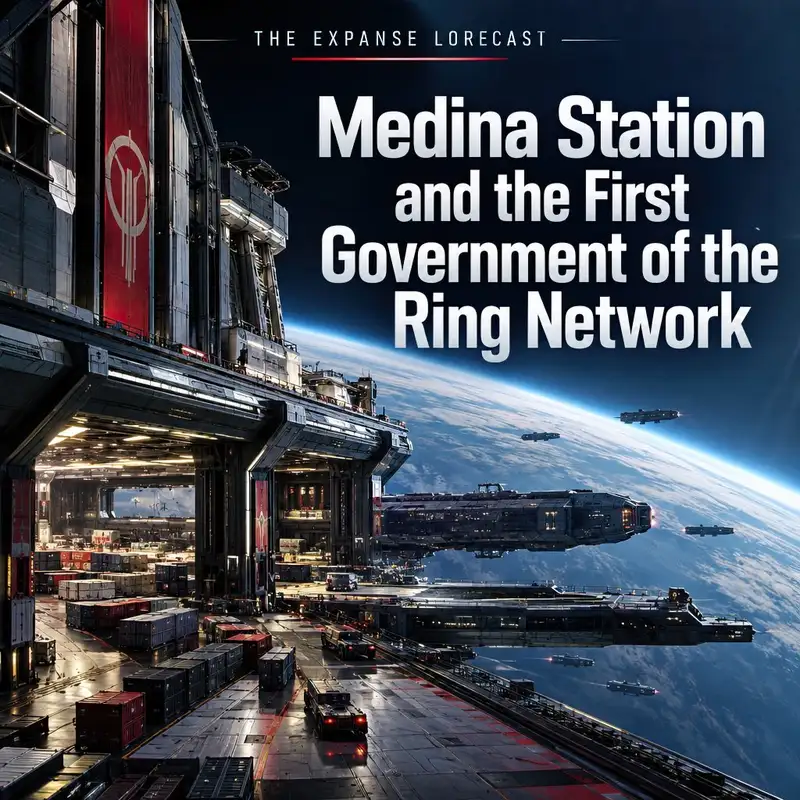
Medina Station and the First Government of the Ring Network
The Free Navy had been beaten, but the most important prize in the war was not a planet, a fleet yard, or a government palace. It was an old ship that no longer went anywhere. Medina Station floated in the Slow Zone beside the immense alien station at the center of the Ring Network, surrounded by gates leading to more than a thousand human possibilities. Whoever governed Medina did not own those distant worlds. They controlled the passage to them. That distinction became the foundation of the first durable political order built around the gates.
Medina’s importance came from geography, but not geography in the old terrestrial sense. It had no continent, no agricultural hinterland, no population large enough to dominate by numbers. Its strength came from location. Every ship moving from one human system to another had to pass through the Slow Zone. The gates ended and began there. A colony vessel, a freighter carrying medical supplies, a survey ship, a naval task group, or a family leaving for a new settlement all entered the same central transit space before continuing toward a destination. The Ring Network expanded humanity’s map, but it compressed interstellar movement through a single shared crossroads.
That crossroads had already lived several political lives. Medina began as the Nauvoo, a massive generation ship built for a religious journey beyond the Solar System. Its designers had imagined it carrying people through the dark between stars for generations. Events made that mission impossible, then irrelevant. The ship was seized, converted, and refitted as the Behemoth, an improvised and often uncomfortable warship during the first human crisis inside the Slow Zone. Later, once humanity understood that the gates would remain open, the old vessel became Medina Station. A ship built to flee the Solar System became a station from which humanity would try to govern its expansion.
That history mattered because Medina was never a purpose-built capital. It was an adaptation. Its structure, crews, machinery, and habits came from older needs. It had once been designed to sustain a self-contained population over enormous distance. Then it became a military conversion. Then it became a port, a repair facility, a traffic-control point, a workplace, a habitat, and finally a political headquarters. Its authority would never rest on elegant constitutional architecture alone. It rested on the practical work of keeping ships moving, keeping people alive, and preventing the central transit space from becoming a battlefield again.
The Ring gates did not abolish distance. A ship that passed through a gate still had to travel across the destination system. A colony on a distant planet might be weeks or months from its gate, depending on its orbit, propulsion, cargo, and the condition of its crew. Messages still traveled at light speed. Supplies still required hulls, fuel, reaction mass, trained personnel, and safe ports. But the gates changed the scale of the problem. Before them, the Solar System contained a familiar hierarchy of Earth, Mars, the Belt, and the outer planets. After them, humanity had access to a growing number of systems, each with its own risks, resources, isolation, and political ambitions.
Medina therefore had more than military value. It was the point where migration became administration. A ship leaving Earth for a colony did not merely cross a line on a map. It needed docking space, traffic clearance, repairs, information, supplies, legal recognition, and some assurance that another armed faction would not decide the route belonged to them. The people passing through Medina were not abstractions. They were workers, settlers, technicians, scientists, refugees, investors, families, soldiers, and crews trying to make payroll before the filters failed. Control of transit meant influence over all of them.
For the Belt, that fact carried both promise and danger. Belter society had been shaped by transport, extraction, repair work, station maintenance, and the unequal risks of keeping the outer system alive. Earth and Mars depended on Belt labor and Belt resources, even when their governments and corporations preferred not to say so too loudly. The Ring Network seemed, at first, to offer Belters a future beyond that dependency. New worlds could provide room to settle, land to cultivate, and alternatives to the crowded stations and work contracts of the old system.
But the gates also threatened to make the Belt less important. If Earth and Mars could send colonists, machinery, capital, and military forces directly into hundreds of new systems, then the old transport routes and extractive economies of the Belt could lose their central place. The Inner planets might no longer need Belter labor in the same way. Corporations could shift investment outward. Ambitious people could leave. Stations that had once mattered because they sat along difficult routes could become sidelined by a new geography. The opening of the gates was not simply liberation. It was a market disruption on a civilizational scale, and the Belt had fewer reserves to absorb the shock.
That did not mean Belters formed one political bloc. The Belt was made up of stations, ship crews, unions, criminal networks, local authorities, families, contractors, activists, and factions that used the name of the Outer Planets Alliance in very different ways. Some wanted recognition and negotiated autonomy. Some wanted a larger share of trade. Some wanted security from Inner military power. Some wanted survival, and had little interest in grand political language. Others believed the old order could be destroyed only by force. The Ring Network gave all of them reasons to care about Medina, but not one common answer to what Medina should become.
Marco Inaros and the Free Navy understood the station’s strategic value. Their control of Medina was not merely a matter of planting a flag at the center of the gates. It was a denial strategy. If Earth, Mars, and hostile Belter factions could be kept away from the Slow Zone, then the Free Navy could deny them access to the colonies and reshape the political map of humanity. The point was not to govern every world beyond the gates directly. No force could do that easily. The point was to control the narrow passage that every other force needed to use.
Medina’s defenses made that control more than symbolic. The Free Navy and its allies established a fortified position in the Slow Zone, including powerful rail-gun defenses mounted around the alien Ring Station. Ships entering the transit space faced the prospect of being engaged from fixed positions that were difficult to challenge directly. A conventional fleet assault would have placed attackers in a killing zone. The defenders did not need to destroy every enemy ship. They only needed to make entry dangerous enough that the coalition could not use the gates freely.
This was the strategic logic of a chokepoint. A fleet can be larger, more modern, or more numerous, yet still be constrained if it must pass through a narrow and well-defended place. Medina did not need to equal the combined industrial power of Earth and Mars. It only needed to exploit the fact that the coalition’s forces had to enter the Slow Zone, while the defenders already occupied it. The rail guns were not a substitute for a full navy, but they changed the immediate tactical problem. They turned access into a risk calculation.
The Free Navy’s use of Medina also revealed a limit in Marco’s broader strategy. He drew on real Belter grievances. The Belt had been exploited, marginalized, and treated as expendable by powerful institutions from Earth and Mars. Those grievances were not invented by Free Navy propaganda. But a movement can begin with genuine injustice and still build its power through coercion, intimidation, and attacks that place entire civilian populations at risk. The Free Navy was not the Belt. It was not the Outer Planets Alliance as a whole. And its attempt to monopolize the gates would have replaced one unequal order with another.
For the coalition opposing Marco, destroying Free Navy ships was not enough. Earth needed access to the new worlds because a damaged and vulnerable planet could not accept permanent exclusion from the routes of migration and trade. Mars needed access because the opening of the gates had already destabilized its national project, economy, and military institutions. Anti-Free Navy Belter factions needed access because the Belt could not survive as a permanent battlefield or as an excluded labor reserve. These interests overlapped, but they did not naturally align. Every partner had reason to fear that another would use victory to create a new hierarchy.
The coalition itself was therefore a wartime arrangement, not a finished government. Fred Johnson’s death had removed one of the people best positioned to connect Belter politics, Tycho infrastructure, and Inner diplomacy. Chrisjen Avasarala could speak for the United Nations government, but not for every Earther or every institution on Earth. Martian authorities retained advanced military capacity, but Mars was increasingly divided by defections, economic anxiety, and uncertainty about its future. Holden and the Rocinante had unusual credibility across factional lines, but a ship and its crew could not substitute for constitutional authority.
The coalition also worked with incomplete information. It did not possess a neat map of Free Navy dispositions, a full account of Medina’s defenses, or a reliable understanding of every Martian faction involved in the crisis. Winston Duarte’s breakaway group had already moved through the Laconia gate, beginning a project whose scale and purpose were not yet clear to the people fighting the Free Navy War. The later importance of Laconia can make this period look more obvious in retrospect than it was. At the time, Duarte’s movement was a dangerous and poorly understood development, not a fully visible future empire.
The coalition’s problem was not simply how to enter the Slow Zone. It was how to take Medina without destroying the very infrastructure that made the station valuable. A warship can be replaced, eventually, if a government has shipyards, skilled workers, raw material, and time. A functioning transit hub at the center of a newly opened network is harder to replace. Medina contained docks, systems, crews, knowledge, and a population accustomed to operating in an environment where a mechanical failure could become a mass casualty event. A bombardment that reduced the station to wreckage might remove the Free Navy, but it would leave the coalition with an expensive ruin and no government.
That made the Medina operation a seizure mission rather than a battle of annihilation. The Rocinante escorted the ice hauler Giambattista toward the Ring. Elsewhere, coalition actions created diversions and forced the Free Navy to confront multiple threats at once. In military terms, the operation sought to concentrate effect without concentrating every ship in one obvious target.
Small unmanned craft and decoys became important because fixed defenses are dangerous when they can focus on a few large, identifiable targets. They become less effective when confronted with uncertainty, clutter, and too many objects demanding attention at once. The coalition did not need every decoy to survive. It needed the defensive system to spend time, ammunition, attention, and firing opportunities on targets that did not carry the decisive force. This was not magic, and it was not a guarantee. It was a way of forcing the defenders to make choices under pressure.
The assault itself depended on people willing to close with a fortified position. Bobbie Draper and the assault force were not conducting an ordinary infantry attack on stable ground. They were operating in and around a station where pressure, compartments, access routes, local knowledge, mechanical systems, and the possibility of civilian presence all shaped the fight. Fixed defenses can be formidable, but they also depend on crews, power, communications, ammunition, maintenance, and people who can be reached. Once an attacker gets close enough to disrupt those systems, the defender’s advantage begins to change.
The operation was dangerous precisely because the coalition could not solve its problem by firing more weapons from farther away. A missile barrage might have damaged the defenses, but it could also have damaged the systems needed to keep Medina operating afterward. The coalition was fighting for infrastructure, not just against it. That is a difficult kind of war, because restraint can look like weakness until the moment it preserves the prize everyone else has ruined.
Medina was also a workplace. Its residents and crews were not merely military assets standing behind a target marker. They were technicians maintaining equipment, workers handling cargo, people responsible for life support, families living in a place whose political rulers could change without warning. Any force that hoped to govern the station afterward had to consider them as future citizens, employees, and partners in administration. Capturing Medina intact was not only a tactical preference. It was an economic and political necessity.
The decisive opportunity came from a behavior in the Slow Zone that Naomi Nagata was able to recognize and analyze. Human beings did not fully understand the alien systems around them. They understood effects, patterns, and dangers. Ships that exceeded certain limits within the transit space had faced consequences that no human authority could explain or control. The coalition did not suddenly discover the complete physics of the Ring Station. It identified an observed operational vulnerability and used it. That was enough.
The significance of Naomi’s analysis was not that it turned the alien station into a friendly weapon. The Ring Station had no human political allegiance, no interest in Belter liberation, Inner security, or the future of the Transport Union. It was an alien mechanism with rules humanity had only partly observed. But fixed defenses, however powerful, are still positioned within an environment. If that environment imposes constraints on movement and mass, then a defender’s apparent control may contain its own vulnerability. The coalition succeeded by understanding just enough of the system to shape the battle around it.
That is often how strategic surprises work. One side does not need complete knowledge. It needs a better working model than its opponent at the moment of decision. The Free Navy had built its Medina strategy around the assumption that the central transit space could be controlled through fortified firepower. The coalition found a way to make that firepower less decisive. The turning point was not the destruction of one symbolic target. It was the collapse of confidence that Medina’s defenses could deny access indefinitely.
The seizure of Medina changed the military situation quickly. Tactically, the coalition neutralized the defensive system and took control of the station. Operationally, it reopened access to the Ring Network. The Free Navy could no longer use the central transit space as an uncontested barrier between the Inner planets and the colony systems. But strategically, victory created a larger problem. Now that the coalition held Medina, who had the right to decide how the gates would be used?
That question could not be answered by saying that the winners owned the station. Earth and Mars had military power, industrial depth, and reasons to demand secure access. But direct Inner control of Medina would have confirmed the worst fears of much of the Belt. It would have looked like a familiar pattern: Belter labor and Belter sacrifice securing infrastructure that the Inner planets then claimed as their own. A Belter monopoly, on the other hand, would have frightened Earth and Mars, and might have encouraged the same kind of exclusionary politics that had made the Free Navy so dangerous.
The coalition needed a political solution that could turn possession into legitimacy. A station can be seized by force. Traffic rules cannot be sustained by force alone, especially when the people affected by those rules include governments, corporations, colonists, ship crews, and distant settlements with their own interests. Medina would need administrators, maintenance workers, security personnel, docking procedures, dispute mechanisms, commercial rules, inspection authority, emergency response, and a way to make decisions that others considered binding enough to obey. The war had created the possibility of a new order. It had not written one.
About six months after the Free Navy’s defeat, the surviving powers met to establish that order. The proposal associated with Avasarala was not a simple act of generosity toward the Belt. It was a security arrangement. Earth could not credibly own the gates without creating a permanent source of resentment and resistance. Mars could not claim them without provoking the same fears, while its own political future was already uncertain. Leaving Medina in the hands of whatever armed faction happened to occupy it would invite the next conflict. An independent Transport Union offered a way to make shared access more credible.
The Transport Union was not described in the novels as a fully detailed nation-state with a clearly mapped constitution, universal bureaucracy, and settled system of representation. Its early structure is better understood as an independent governing and transportation authority. It would regulate traffic through the gates, provide security, coordinate access, and manage the economic exchange that flowed through Medina.
That distinction was essential. The Union did not own the colony worlds merely because ships passed through Medina. It did not automatically command their local governments, feed their populations, build their roads, or settle every conflict at the far end of a distant system. It could not make light-speed delay disappear. It could not dispatch a force instantly to every emergency. Its authority would always be strongest at the point of transit and weaker as distance increased.
Holden was initially an attractive candidate to lead the new institution because he was known to all the major factions. He had worked with Earthers, Martians, Belters, station authorities, and people who trusted no government at all. His reputation was not universally admired, but it was broadly understood. In a negotiation among institutions that distrusted one another, a familiar and difficult-to-classify figure had obvious appeal.
But that personal credibility had limits. An Earther leading the authority created to prevent Inner domination of the gates would have weakened the Union’s purpose from the first day. The problem was not his intentions. The problem was what the institution would mean. A government built around the gates had to show that Belters were not merely labor, advisers, or useful allies in an Inner-designed settlement. They had to exercise real authority.
Holden’s support for Michio Pa therefore mattered beyond the choice of one leader. In the novel continuity, Pa became the founding Belter figure of the Transport Union. Her selection placed Belter agency at the center of the new order. The point was not that Pa spoke for every Belter. No one could. The point was that the new authority could not claim legitimacy while treating the people most shaped by transport, station life, and outer-system labor as spectators to the governance of the network.
This was also a demanding victory. The Transport Union gave the Belt leverage that no previous political arrangement had provided. But leverage creates obligations. Belter leadership at Medina meant responsibility for fair traffic rules, safe passage, security, repairs, commercial access, and the disputes that emerge whenever people believe someone else is receiving better treatment. It meant dealing with Earth’s needs without becoming Earth’s client. It meant dealing with Mars’s fears without becoming Mars’s instrument.
The Union’s legitimacy depended on resisting the temptation to turn access into tribute. A chokepoint can enrich whoever controls it, and history offers many examples of governments, corporations, and armed groups treating strategic access as private property. Medina could have become a toll booth backed by guns. It could have become an Inner military base with Belter staff. It could have become the capital of another exclusionary faction. The Union’s promise was different.
That did not eliminate inequality. Earth still had enormous population, institutions, and needs. Mars still possessed technical expertise, military traditions, and a troubled but consequential industrial base. New colonies did not begin as equal partners simply because they existed beyond a gate. Some were poor, isolated, dependent on outside supplies, or divided by competing claims.
Nor could Medina govern by command alone. Every new system introduced local interests that were difficult to control from the Slow Zone. A corporation might seek ways around oversight. A government might demand privileged transit for military or economic reasons. The Union’s central position gave it leverage, but it also made it the place where every unresolved argument about access would arrive.
Roughly three decades later, the endurance of the Transport Union was clear. By the time of Persepolis Rising, Medina remained the principal authority regulating traffic through the Ring Network. Camina Drummer served as president of the Union in that later era. Her presidency demonstrates that the institution developed beyond its provisional foundation under Michio Pa, and beyond the immediate bargains that ended the Free Navy War.
The details of that institutional evolution are not fully laid out. The novels do not provide a complete record of every election, reform, security contract, tariff, administrative dispute, or internal crisis during those decades. It would be easy to invent a neat constitutional story because the Union’s later importance makes one feel necessary. But the more useful historical point is simpler. The organization survived because the need it addressed survived. Humanity had expanded into many systems, but the gates still concentrated transit through Medina. Interdependence remained the basic fact of the new age.
Medina Station became the first effective government of the Ring Network because it converted a military chokepoint into a negotiated obligation. The station could not own humanity’s future, and the Transport Union could not solve every inequality created by expansion. But it could establish a principle that the Free Navy had rejected and the Inner planets could not impose alone: access to the gates had to be managed as a shared necessity, not held as the private weapon of whichever power reached Medina first.