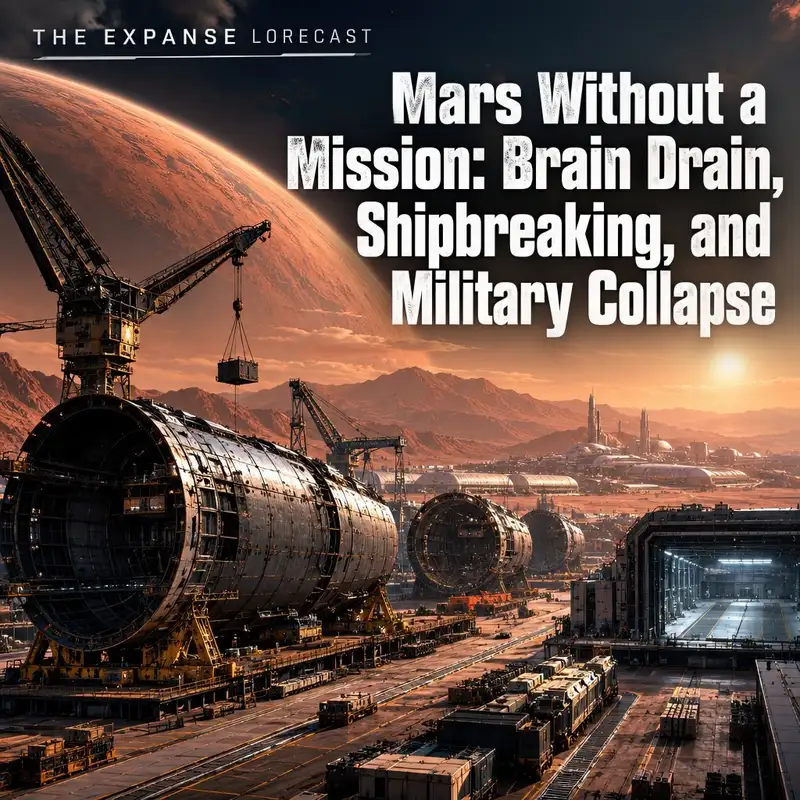
Mars Without a Mission: Brain Drain, Shipbreaking, and Military Collapse
At Callisto, the warning arrived in the form of a raid on a Martian shipyard. The immediate target was valuable military technology, including stealth materials that would later help make the Free Navy’s attack on Earth possible. But the deeper significance was not the theft itself. States lose secrets. Shipyards suffer sabotage. Security systems fail. The more serious question was how a society as disciplined, technically capable, and security-conscious as Mars had become vulnerable to this kind of extraction from within its own military-industrial system.
A shipyard is not only a collection of docks, hulls, cranes, and machine shops. It is a chain of trust. It depends on inventory records that match physical reality, personnel vetting that means something, officers who believe their careers remain tied to the state, technicians who can recognize irregular orders, and political leaders who understand what their armed forces are actually doing. The Callisto raid exposed a weakness in all of those systems. It was an early sign that Mars still possessed military power, but was losing the common purpose that had made that power coherent.
Mars did not collapse because an enemy fleet smashed its navy in a single decisive battle. It did not become strategically irrelevant because its people suddenly forgot how to build ships or operate reactors. Its decline was slower, more intimate, and in some ways more dangerous. Mars lost confidence in the future it had spent generations constructing. Once that happened, its warships, research programs, trained personnel, and industrial capacity ceased to look like permanent national assets. They became portable capital. They could be sold, redirected, dismantled, stolen, or carried through a Ring gate to build somebody else’s future.
Before the Ring gates opened, Mars had one of the clearest strategic identities in the Solar System. Earth had population, established institutions, ecological damage, and the political weight of an old world. The Belt had labor, resource extraction, local cultures, and a long record of being governed by people far away. Mars had a project. Its people lived under domes and in sealed habitats because they believed their descendants would not have to. Terraforming was more than an environmental program. It was a national promise.
That promise shaped education, military service, engineering, public sacrifice, and Martian political culture. A child raised on Mars could be taught that every difficult decision belonged to a larger arc. The work was slow. It was expensive. It required restraint in the present for a reward that might not fully arrive for centuries. But it gave Mars a reason to organize itself as a disciplined, technically sophisticated society. The Martian Congressional Republic was more than a garrison state waiting for a war with Earth. It was a civilization trying to manufacture the conditions of its own independence.
The Martian navy protected that project. Its ships defended the republic against Earth, certainly, but they also represented Mars’s claim to adulthood. A world that could build advanced warships, train crews, maintain supply chains, and deter the United Nations could not be treated as a temporary outpost. Military prestige was connected to national dignity. The fleet told Martians that their sacrifices had produced something durable, something that could not be ignored or casually governed from Earth.
That did not mean every Martian loved the military, trusted every officer, or accepted every demand of the state. Mars had political factions, private interests, black markets, dissatisfied veterans, and people who saw the costs of the national project more clearly than its official speeches admitted. But the larger mission still held the society together. Terraforming gave military discipline a civilian purpose. Technical skill had a destination. Service to Mars meant service to a future Mars that was supposed to be greener, freer, and more secure than the enclosed world of the present.
Then the Ring gates opened, and the market for futures changed.
The gates did not create paradise. They opened routes to more than a thousand systems, but not every system contained a habitable world, useful resources, or an easy settlement site. A planet on the other side of a gate could still be hostile, distant from its ring, biologically dangerous, politically disputed, or simply too expensive to reach. Colonists still needed ships, machinery, food, medicine, shelter, trained labor, and some way to survive the first failure of a pump, crop, or power system. The Ring Network did not abolish logistics. It made logistics larger.
But it did something more immediate than terraforming could ever offer. It made other futures visible.
For generations, Mars had asked its people to invest in a world that their grandchildren might inherit. The gates offered worlds that seemed to offer opportunity now. Some had breathable air. Some had land. Some had strange alien environments that might be dangerous, but could also be claimed. Others held resources, scientific mysteries, or simply distance from the old political order. The promise was not that every colony would prosper. The promise was that a person could leave Mars and help build a society whose central question was not how long it would take to make one planet livable.
That was a direct challenge to the Martian national story. Terraforming had required patience because Mars had no alternative. Once alternatives appeared, patience became harder to organize politically. A young engineer could look at a vast but slow planetary transformation and then look through the gates at a new world needing power systems, habitat designers, survey teams, agricultural specialists, mechanics, pilots, and builders. The choice was no longer between sacrifice and idleness. It was between sacrifice for an old promise and risk for a new one.
The Ring Network also changed strategic geography. It created chokepoints at the gates and at Medina Station. It made control of transit a source of power. But it did not make the Solar System irrelevant overnight. Ships still needed to travel from a gate to a destination within a system. Supplies still took time to move. Messages still traveled at light speed. A colony could be politically independent in theory and still be dangerously dependent on imported parts, medical supplies, or technical expertise in practice. The gates opened space. They did not make civilization easy.
For Mars, however, the important effect was psychological as much as physical. The old republic had been built around delayed gratification. The gates rewarded people willing to make immediate, risky, individual choices. Mars’s most ambitious citizens no longer had to believe that the best use of their skills was to remain inside the old social contract. They could take those skills somewhere else. The problem was not that every Martian wanted to leave. It was that enough capable Martians could now imagine a life beyond the mission that had once defined Mars.
This was brain drain, but not in the shallow sense of a population statistic. The novels do not provide a neat ledger showing exactly how many engineers, scientists, soldiers, technicians, entrepreneurs, or students departed. They do not establish a single moment when Mars crossed a demographic line and became doomed. What they show is a structural change in incentives. The people best able to leave often had the strongest reasons to consider it. They had portable expertise, valuable certifications, savings, contacts, or the confidence that comes from being needed somewhere.
Military power depends heavily on such people. A navy is not a row of ships on a strategic map. It is trained crews who know how to operate under acceleration, technicians who can maintain drives and life-support systems, weapons specialists who understand missile guidance and point-defense coverage, software engineers, yard workers, medical staff, instructors, logisticians, and officers who have spent years learning how to make decisions with incomplete information. A military can lose a hull and replace it. Replacing the human systems around that hull is harder.
Institutional memory is especially difficult to rebuild. A dockyard can fabricate metal. It cannot quickly recreate a senior engineer who has spent fifteen years learning which component fails first under a specific stress load, or a chief who understands the difference between a documented maintenance schedule and what actually keeps a ship alive during an emergency burn. Mars’s strength had always included the density of its technical culture. Once opportunity pulled portions of that culture outward, the loss was not always visible in official budgets or fleet reviews.
The civilian consequences were equally important. For some Martians, the gates offered liberation. Leaving did not necessarily mean betrayal. A family might see a colony as a chance to own land, escape a rigid hierarchy, begin a business, or build a life that did not revolve around a state timetable. For others, migration meant watching friends, children, colleagues, and skilled neighbors depart. The remaining society inherited expensive infrastructure built for a larger and more confident future. It also inherited the question of whether the sacrifices already made still had a purpose.
A nation can survive a decline in population. It can survive a smaller defense budget. It can even survive the retirement of old ships. What is much harder to survive is a loss of confidence in why public institutions should be maintained. Mars had built its fleet for a particular strategic world: one in which it faced Earth, defended a singular planetary project, and needed credible military power to protect that project. The gates did not immediately remove Earth as a rival. They made the old rivalry less central to the ambitions of many Martians.
That changed the meaning of the fleet. A warship designed to deter Earth has value when Earth is the defining strategic problem. It has less obvious value when colonies need transports, construction equipment, survey vessels, and reliable freight capacity. This did not mean the Martian Congressional Republic Navy was simply melted down or thrown away. The evidence does not support a clean national shipbreaking program in which every old hull was dismantled on schedule. The process was messier than that.
Some ships could be decommissioned. Some could be reassigned. Some could be stripped for parts. Some might receive less maintenance because other priorities were more urgent. Some military facilities could be redirected toward civilian traffic, colonial support, or private contracts. Some equipment could disappear through theft, corruption, or covert transfer. And some ships, even if they remained technically in service, could become less useful because the crews, spare parts, ammunition, dock capacity, and political mission necessary to sustain them were no longer secure.
This is what shipbreaking meant in the larger historical sense. It was not only the cutting apart of hulls. It was the breaking apart of a military system’s assumptions. Defense procurement is never glamorous once a colony ship can promise investors, workers, and politicians a future they can see from the passenger list. A reserve warship may still be formidable. But it becomes difficult to defend its cost when the public no longer agrees on the war it is meant to fight.
That problem became dangerous because Mars did more than reduce or redirect military assets in an orderly way. Parts of its system were being covertly extracted. The missing-ship investigation involving Alex Kamal and Bobbie Draper revealed the difference between a respected military reputation and the actual condition of military administration. Alex had been a Martian naval officer. Bobbie had been a Marine. Neither represented all of Mars, and neither could repair the republic by force of loyalty. But together, their experience exposed the depth of the institutional failure.
The missing ships and matériel did not initially reveal a complete political project. Investigators working inside a compromised system rarely begin with the full picture. They see inconsistencies. Records do not match. A ship that should be in one place is absent. Equipment changes hands without a convincing explanation. Officials provide information that is technically plausible but operationally incomplete. The problem is more than that intelligence officers lack data. It is that they cannot trust the data they possess.
A navy can respond to an external threat if it knows where the threat is and who controls it. It has far more difficulty responding when its own inventory system has been manipulated by people with legitimate access. A stolen warship is a security crisis. A stolen warship hidden inside a functioning bureaucracy is a counterintelligence crisis. The institution begins investigating itself, and every investigation risks revealing how many people had reasons not to notice.
Bobbie Draper’s role in this period matters because she represents a form of Martian loyalty that had not yet died. Her loyalty was not blind obedience to every official statement. It was loyalty to competence, service, and the belief that Mars should be capable of living up to its own standards. That made institutional decay feel personal. A military culture built around professional pride suffers a particular kind of injury when corruption and covert disloyalty reveal that the chain of command has been used against the state it was meant to protect.
Alex Kamal provided another perspective. As a pilot and former naval officer, he understood that ships are not abstract units. They have crews, maintenance histories, flight plans, ownership records, and people who should notice when they vanish. His investigation made the collapse visible at human scale. Missing ships were not only strategic assets. They were evidence that somebody had found ways to move weapons, personnel, and resources through a system that still publicly claimed to be in control.
Later events made clear that these disappearances were not random criminal leakage. They were connected to a faction led by Winston Duarte. Duarte’s movement was more than a band of officers stealing ships because Mars was in decline. It was a planned secession. Its members had concluded that the Martian republic, as it existed, no longer had a viable future. Rather than accept that decline or attempt to reform the existing state, they intended to use Martian capability to construct a replacement beyond the Ring Network.
This was a civil-military fracture of unusual scale. Duarte’s faction had access to trained personnel, military logistics, classified knowledge, ships, and strategic planning. It also possessed the protomolecule sample that had become one of the most dangerous political objects in human history. The group did not take all of Mars’s armed forces. The novels describe the scale with enough ambiguity that firm percentages should be treated cautiously. What matters is that a substantial portion of Martian capability was removed from the republic and placed at the service of a new political project.
The assets were more than stolen. They were repurposed. Duarte understood that Mars still possessed strengths even if Mars itself had lost confidence in its mission. It had disciplined officers, engineers accustomed to difficult environments, soldiers trained to operate under extreme conditions, industrial knowledge, and a culture that believed technical mastery could justify sacrifice. Those qualities could be transplanted. In Laconia, detached from Martian civilian institutions and republican legitimacy, they could become the foundation of a more centralized and authoritarian state.
The early settlement of Laconia reflected that logic. Scientists and researchers arrived alongside the people needed to secure and develop the new colony. The alien infrastructure there was not understood in any complete sense, but it offered possibilities that no ordinary colony could match. Duarte’s project therefore combined conventional military preparation with an extraordinary technological gamble. The Martian defectors were more than escaping a declining planet. They were seeking the means to return later with a form of power the old Solar System could not easily answer.
For that plan to work, the existing order had to be distracted and weakened. The Free Navy provided that disruption.
Marco Inaros mobilized genuine Belter anger. The Belt had long endured exploitation, dangerous labor, dependence on Inner-controlled supplies, and political marginalization. Those grievances were real. They were not invented by Marco, and they did not disappear because he exploited them. But the Free Navy was not identical with the Belt, the Outer Planets Alliance, or Belter civilians. Many Belters opposed Marco. Others were coerced, trapped by circumstances, or forced to navigate a war they did not control.
The Free Navy’s military capability also cannot be explained as a spontaneous uprising by under-equipped civilians. Its ships, weapons, and strategic reach were strengthened by illicit Martian transfers. Stealth technology connected to the Callisto raid helped enable the attack on Earth. Black-market Martian military assets gave Marco’s forces capabilities that ordinary Belter political movements had not possessed. The result was a catastrophe in which real colonial grievance became entangled with Martian state-security failure and a revolutionary leader’s willingness to destroy civilian life on a massive scale.
The attacks on Earth were not made less criminal because Earth had exploited the Belt. They were attacks on a civilian population at planetary scale. Their strategic purpose was to break the old balance of power, terrorize Earth, and establish the Free Navy as the dominant armed force in the outer system. Their consequences were measured not only in immediate deaths, but in damaged infrastructure, ecological disruption, hunger, political shock, and the enormous effort required to keep survivors alive.
Mars as a whole did not become the Free Navy. Martian civilians did not collectively authorize Marco’s war. Martian service members who remained loyal to their republic were not responsible for every covert transfer made by Duarte’s network. But the Free Navy demonstrated the consequences of Martian fragmentation. A portion of Mars’s military capacity had been diverted into a conflict that devastated Earth, destabilized the Belt, and made it harder for every surviving government to understand what threat it faced next.
The war also imposed costs on Belter populations. Marco’s rule depended on coercion as well as enthusiasm. Stations and ships faced food shortages, disrupted trade, political intimidation, and the danger of retaliation from forces seeking to defeat the Free Navy. The Belt’s longstanding demand for dignity did not become more achievable when Marco turned essential transport and life-support dependencies into instruments of war. His movement drew strength from real injustice, but it created new forms of suffering for the people in whose name it claimed to act.
By the end of the Free Navy conflict, the old Solar System order was exhausted. Earth had survived, but survival was not recovery. Its food systems and infrastructure required immense attention. The Belt faced shortages, fractured authority, and a dangerous transition from war to a new political arrangement. Mars had lost material assets, personnel, confidence, and strategic clarity. The immediate question was not whether somebody should punish Laconia. It was whether anybody possessed the information, logistics, and political stability to do so.
From a distance, the failure to launch an immediate expedition against Duarte can appear like passivity. It was not. Laconia lay beyond a gate, and the gate was not a door opening onto a nearby battlefield. An expeditionary force would need to assemble ships, crews, supplies, ammunition, repair capacity, medical support, and a realistic intelligence picture. It would need to enter a chokepoint where the defender’s strength, defenses, industrial capacity, and alien capabilities were uncertain. Then it would need to sustain operations inside an unfamiliar system.
That was a difficult prospect even for a stable great power. The postwar Solar System had no such power available. Earth was engaged in reconstruction and food security. Mars was dealing with the consequences of its own internal fracture. The Belt required political stabilization and reliable transport. New colonies created additional demands for governance, trade, and humanitarian support. Every available ship had competing missions. Every political leader had domestic crises. Every military planner had reason to question whether a punitive raid would become a prolonged war against an enemy using technology no one fully understood.
There was also an intelligence problem. The surviving powers knew that Duarte had escaped with significant resources. They did not know enough about what he had built, what he had learned, or what alien systems he might have activated. Sending a fleet through the Laconia gate without that knowledge could have produced a defeat that left the rest of humanity even more exposed. Restraint was not proof of courage, and it was not proof of cowardice. It was a constrained decision made by governments whose capacity had been damaged by a war they had not chosen on favorable terms.
The political answer to the postwar crisis was not a restoration of the old Earth-Mars competition. It was the creation of a new order around Medina Station and the Transport Union. This changed the hierarchy of power. Under the Ring Network, authority over transit could matter as much as authority over a planet. Whoever regulated passage through Medina and the gates possessed leverage over trade, migration, colonization, and communication between human systems.
For Mars, this was another strategic demotion. It remained important. It still possessed population, expertise, industry, and military capability. But it was no longer one half of the central military rivalry that had organized the old Solar System. The dominant question was no longer whether Earth or Mars would prevail in a contest for local supremacy. It was who could manage a civilization spread across hundreds of new destinations without turning the gates into instruments of monopoly, coercion, or imperial control.
The Transport Union did not solve inequality for every Belter, and Medina’s authority did not instantly make every colony secure. It did, however, recognize the new geography. Movement was now a political resource. Mars’s older strengths still mattered, but they no longer determined the shape of the human future by themselves. The republic had built its identity around making one world habitable. The post-Ring order was built around moving people, goods, information, and power among many worlds.
Roughly three decades later, in the period of Persepolis Rising, Mars still existed as a meaningful power. It was not empty. It was not helpless. It had ships, trained people, technical expertise, and a role in the alliance linking Earth, Mars, and the Transport Union. Martians still served, fought, governed, built, and resisted. Any account that describes Mars as simply dead after the gates opened misses the persistence of its institutions and its people.
But the old Mars was gone. What had disappeared was not every factory or every military officer. It was the certainty that Mars’s armed forces expressed a unified planetary destiny. The republic’s prestige had once rested on the idea that its discipline served a collective future. After the gates, that future fractured into competing possibilities. Some Martians chose colonies. Some remained committed to the republic. Some adapted to the new political economy. Some moved through black markets. Some followed Duarte into Laconia. The national project had become plural, and that plurality weakened the cohesion that military power required.
When Laconia returned, it revealed what Duarte had done with the capabilities Mars could no longer hold together. Laconia’s victory over the combined Earth-Mars-Union force was not the result of one simple technological trick. Alien-derived infrastructure mattered enormously. So did Laconia’s advanced ships and weapons. But military outcomes are rarely produced by hardware alone. Laconia had prepared in secrecy for decades. It had centralized command. It had built institutions around a single strategic objective. It had studied an enemy coalition that had spent years managing commerce, migration, reconstruction, and political compromise rather than preparing for a concentrated imperial assault.
The combined fleet was not incompetent. Its members faced an opponent with advantages in surprise, preparation, doctrine, and technology. They also faced the political limitations of a coalition. Earth, Mars, and the Transport Union had interests in common, but they were not a single state. They had different constituencies, different institutional cultures, and different reasons to fear escalation. Laconia, by contrast, had concentrated authority under a system designed to make strategic decisions quickly and enforce them ruthlessly.
The irony was severe. Laconia’s strength was partly Martian strength transformed. Its officers, engineers, military discipline, technical education, and capacity for long-term planning all carried the inheritance of Mars. But they had been severed from the Martian republic and placed at the service of empire. The skills that Mars had developed to protect a difficult, collective, civilian project were redirected toward conquest and control.
That did not make Laconia invincible, and it did not make conquest legitimate. Rapid military success gave Duarte’s empire operational control over key systems and institutions. It did not create voluntary consent among the populations it ruled. Occupation, coercion, surveillance, and superior ships can impose obedience for a time. They cannot resolve every information problem, eliminate resistance, or produce the political trust that a stable interstellar order requires. Laconia proved that Mars’s capability had survived. It also proved that capability without legitimacy can become a threat to the society that created it.
Mars’s military collapse, then, was not the disappearance of ships from a ledger. It was the breakdown of the social bargain that had made those ships part of a coherent national purpose. The Ring Network offered individuals and factions a future faster than terraforming could deliver, and Mars’s disciplined institutions proved unable to prevent its expertise, weapons, and ambitions from being carried elsewhere. Laconia’s later conquest showed that Martian capability had not vanished. It had been separated from Martian legitimacy, redirected into empire, and turned against the society that created it.