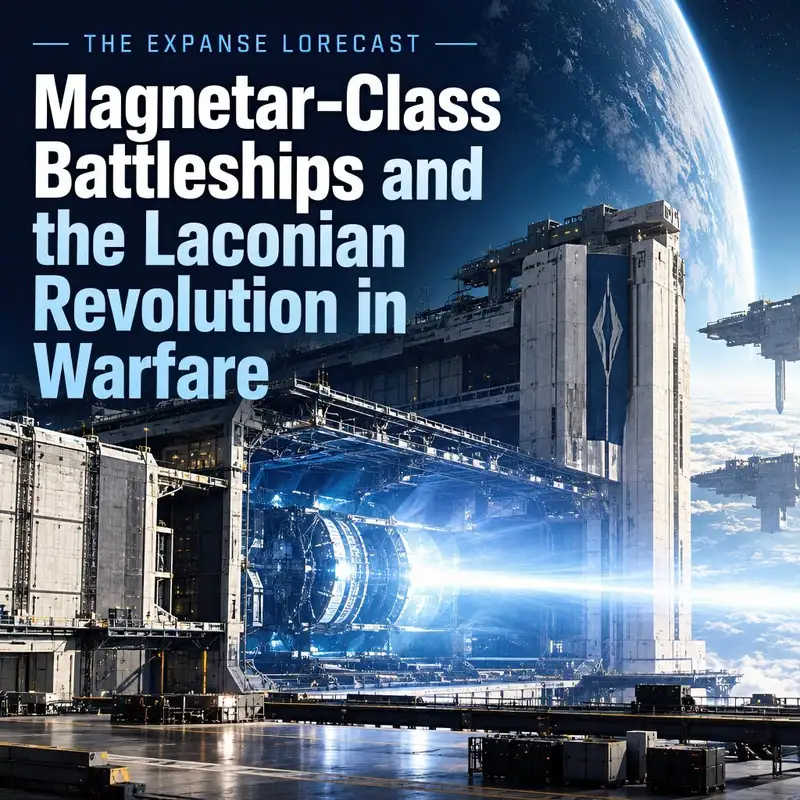
Magnetar-Class Battleships and the Laconian Revolution in Warfare
Pallas Station was a target because it could make damaged fleets useful again. Docks, machine tools, skilled labor, repair knowledge, storage, fabrication, and supply networks gave the station value that could not be measured by the number of ships tied up alongside it. When the Heart of the Tempest attacked Pallas, Laconia was not simply destroying hardware. It was demonstrating that it could erase an enemy’s capacity to recover, while using a weapon whose deeper consequences even Laconia did not fully understand.
The weapon did not behave like a missile, a railgun round, or a nuclear torpedo. It did not offer defenders a familiar sequence of detection, interception, impact, damage control, and repair. The result was catastrophic destruction on a scale that made ordinary defenses irrelevant. Then, almost immediately, another consequence followed. Across the Sol system, people suffered a simultaneous lapse of consciousness lasting nearly three minutes. A strange sphere appeared aboard the Tempest. The Laconian victory display had also produced evidence that the weapon was interacting with systems its operators did not understand.
That was the central contradiction of the Magnetar-class battleships. They gave Laconia a military advantage so great that conventional resistance became temporarily futile. But the advantage rested on a narrow and dangerous foundation. The ships were few. Their construction depended on specialized alien-derived industry. Their most decisive weapon carried consequences beyond Laconian control. And the empire that used them mistook obedience under threat for stable political authority.
Before Laconia returned, the military balance of the human worlds was brutal, but recognizable. Earth, Mars, the Transport Union, and the many armed groups that operated beyond the old national systems understood the basic grammar of space combat. Ships detected one another through emissions, active sensors, traffic data, intelligence, and the plain fact that a hard-burning drive was difficult to hide. They traded torpedoes across great distances, used point-defense cannons to break incoming missiles, and relied on railguns when geometry brought opponents into a more direct line of fire.
No fleet expected protection to be perfect. Armor could be penetrated. Internal systems could fail. A ship that remained structurally intact might still lose sensors, drive capacity, weapons, pressure, power distribution, or enough crew to become combat ineffective. Damage control mattered because warships were not merely weapons platforms. They were pressure vessels, computer networks, life-support systems, machine shops, medical spaces, and workplaces full of people trying to keep complex machinery alive while someone fired at them.
This produced a familiar relationship between force and risk. A stronger fleet might have better ships, more ammunition, better-trained crews, or more reliable intelligence. But even a weaker opponent could impose costs. Enough torpedoes might saturate point defense. A railgun strike might cripple a drive cone or tear through critical systems. A damaged ship might withdraw. A fleet that suffered too many losses could lose the capacity to protect a route, support a station, or influence a political negotiation. Attrition was not elegant, but it was intelligible.
The Magnetar broke that relationship. Its hull incorporated alien-derived materials with extraordinary self-repairing properties. It carried formidable conventional weapons as well, including railguns, torpedoes, and point-defense systems. But its defining capability was the field projector, a weapon based on technology humanity could operate in limited ways without fully comprehending. The weapon’s effects were devastating. Its mechanism remained obscure. It should not be understood as a particularly large conventional magnet, nor as a piece of human engineering with a few exotic components added for decoration.
The practical military consequence was clear even when the science was not. Conventional fleets could find a Magnetar. They could maneuver against it. They could fire torpedoes and railguns at it. They could even score hits. What they could not do, at least at first, was convert those hits into meaningful damage. The normal expectation that repeated attacks would degrade a ship’s fighting power no longer held. A Magnetar did not merely have better armor. It appeared to exist outside the expected exchange rate of naval warfare.
That was a revolution in tactics, but it did not emerge from a shipyard in isolation. It came from Laconia’s larger transformation. Roughly three decades after the Free Navy conflict, the Martian breakaway force that had entered the Laconia system had become something far more consequential than a group of defectors with stolen ships. Under Winston Duarte, it had built a closed political and military order around the alien infrastructure it found there.
Laconia’s strength came from secrecy, time, discipline, and concentration. The regime had decades to develop its institutions beyond the attention of Earth, Mars, and the Transport Union. It had access to construction platforms and other Ring-builder systems in orbit around its world. It cultivated scientists, engineers, naval personnel, administrators, and security forces under a command structure designed for unity of purpose. Its armed forces did not emerge from the same fractured political environment that constrained the older powers.
Duarte’s stated vision was larger than conquest for its own sake. He believed that human civilization, scattered across more than a thousand systems, needed centralized authority to survive dangers beyond the Ring Network. In his view, the old human governments were too divided, too parochial, and too vulnerable to act at the necessary scale. Laconia would impose unity first, then prepare humanity for threats that no individual system could face alone.
There was a strategic logic in that argument. The Ring gates had opened an enormous human frontier, but they had not created stable institutions to govern it. They had weakened Mars’s long-term terraforming project, encouraged migration, spread military technology, and produced new conflicts over transport, colonial claims, resources, and political authority. The old powers remained capable, but they were not unified. Duarte saw fragmentation as an existential weakness.
What he possessed, however, was not proof that he understood the alien systems he had inherited. Laconia could activate technologies it did not create. It could build ships with materials it did not fully comprehend. It could use weapons whose consequences it could not reliably predict. Its military superiority was real. Its claim to mastery was much less secure.
The most important Laconian arsenal was not any one battleship. It was the industrial system that produced and sustained those ships. The construction platforms around Laconia were the foundation of the Magnetar program. They made possible advanced hulls, specialized components, alien-derived materials, and capabilities that could not simply be reproduced by a conventional shipyard on Earth, Mars, or in the Belt. The battleships were visible symbols of power. The platforms were the means by which that power could be renewed.
When Laconia ended its isolation, it did not return with a giant conventional invasion armada. It did not need one. The initial force that entered the Slow Zone included the Heart of the Tempest, a Magnetar-class battleship, and the Pulsar-class destroyer Gathering Storm. Numerically, this was a small expedition. Strategically, it was enough to transform the balance of power because it arrived at the center of the Ring Network.
Medina Station was not merely a station sitting in unusual space. It was the main transit hub for the gates. It organized traffic, served as a center of communications and logistics, and represented the political architecture that had emerged after the Free Navy war. Whoever controlled Medina could not automatically govern every distant colony. Ships still had to travel conventionally within each system, and local governments still possessed their own interests and armed forces. But control of Medina gave an actor extraordinary leverage over movement between worlds.
The Ring Network had expanded human geography, yet it had also created a chokepoint. More than a thousand systems might lie beyond the gates, but passage between them ran through the same central space. Laconia understood that it did not need to conquer every colony one by one. It needed to seize the place where commerce, migration, messages, military movement, and political legitimacy converged.
The defending ship Tori Byron was destroyed by the Tempest’s primary weapon. This was not a symmetrical fleet battle in which two sides tested comparable forces. It was a demonstration. Laconia showed that the existing defense system could not protect itself, and that the normal assumptions of deterrence had failed. A station that had become the hub of human expansion was suddenly under the shadow of a force it could not meaningfully resist.
The Gathering Storm remained in the Slow Zone as an enforcement vessel while the Tempest moved onward toward Sol. That division of labor reveals something important about Laconian doctrine. The Magnetar was not designed to sit forever at every occupied station. It was a strategic instrument, able to destroy resistance, intimidate governments, and shift the political map with a limited number of appearances. Smaller Laconian ships and occupation authorities would then maintain the order created by the threat of its return.
Santiago Singh became governor of Medina. His assignment demonstrated the problem waiting behind Laconia’s military success. A station can be captured by force. It cannot be governed by weapons alone. Medina was a populated, economically vital habitat with its own labor networks, informal relationships, political memories, rival loyalties, and practical knowledge of how life-supporting infrastructure actually functioned. A military occupation could take control of official channels. It could not instantly replace the social systems through which people survived.
At Jupiter, the Earth-Mars Coalition and the Transport Union confronted the Heart of the Tempest directly. Their commanders understood that Laconia possessed advanced technology. They did not yet know the practical limits of the Magnetar’s defenses. That distinction matters. The coalition did not act irrationally because it lacked the information later available to historians. It fought with the weapons, doctrine, and expectations that had governed warfare across the human system for generations.
The coalition used torpedoes, railguns, maneuver, and coordinated attacks. It attempted to impose the kind of damage that any conventional warship, however advanced, would eventually have to respect. In an ordinary engagement, the attackers might not expect an easy victory. But they could expect that successful hits would matter. They might force a withdrawal, degrade weapons, kill sensors, breach compartments, or at least compel the enemy to spend ammunition and expose vulnerabilities.
The Tempest showed them otherwise. The coalition’s attacks failed to produce meaningful damage. Its weapons struck a ship that seemed able to absorb or repair what should have been decisive injury. Meanwhile, Laconian firepower began to destroy and cripple the forces confronting it. The engagement did not simply demonstrate that Laconia had a superior battleship. It demonstrated that the coalition’s entire method of contesting naval power had ceased to function against this particular opponent.
The destruction of the void city Independence made the political purpose of the battle unmistakable. It was not only a military loss. It was coercion directed at the societies the coalition was supposed to defend. A station or void city is never just a military map symbol. It is a habitat sustained by air, water, power, food, maintenance crews, families, and workers. Its destruction made clear that Sol’s defenders could not guarantee the safety of critical civilian infrastructure.
Tactically, the coalition could not mission-kill the Magnetar. Operationally, it could not protect the assets on which military resistance depended. Strategically, political leaders had to confront a grim reality. Continuing the battle might satisfy military pride, but it would not preserve their governments, their industries, or the people under their protection. The Tempest had made conventional deterrence irrational because it removed the credible expectation of reciprocal cost.
This is why the later destruction of Pallas mattered so much. The Tempest was not simply punishing a defeated enemy. It was attacking future capacity. A navy can recover from a lost battle if it retains shipyards, trained labor, repair facilities, supply networks, and the confidence that new hulls can replace old ones. Destroying Pallas threatened all of those things at once. It was a blow against the possibility that the defeated powers might rebuild on a meaningful timescale.
Tycho Station withdrew rather than wait to become the next demonstration target. That decision was not necessarily cowardice. A mobile industrial facility cannot manufacture replacement ships if it has been annihilated for symbolic defiance. Laconia’s method was to make survival itself conditional on submission. A government, union, or station authority that resisted risked not merely losing a battle, but losing the infrastructure needed to feed people, employ them, repair their ships, and retain any future independence.
Camina Drummer, president of the Transport Union in the novel continuity, faced this problem directly. Her surrender was not an admission that Laconia’s rule was legitimate. It was a recognition that the remaining forces could not protect the populations and institutions they claimed to serve. There is a difference between refusing to surrender and preserving the capacity for a society to endure occupation, recover, and resist under more favorable conditions.
Laconia won quickly because it combined military surprise, a decisive technological advantage, centralized command, and carefully chosen targets. It did not need to station a division on every moon or occupy every habitat with a conventional garrison. It only needed to demonstrate that resistance could not defend its fleets, transit routes, industrial base, or civilian centers. In a network civilization, selective vulnerability can be more coercive than total physical control.
But military control is not political knowledge. Singh’s administration at Medina exposed that weakness almost immediately. He understood hierarchy. He understood orders, punishment, security measures, and the importance of demonstrating resolve. What he did not understand was the social terrain of the station. Medina’s people were not passive components in an imperial machine. They had families, work crews, debts, loyalties, grudges, hidden communications, and long experience of living under authorities that treated their labor as necessary but their consent as optional.
Occupation forces often confuse compliance with acceptance. A station population may obey curfews because airlocks and armed guards are persuasive. It may also preserve networks of mutual aid, information sharing, sabotage, evasion, and quiet refusal. Formal control of docking schedules and security checkpoints does not guarantee control of maintenance crews. It does not guarantee that local officials believe the occupier will last. And it does not make collective punishment a substitute for legitimacy.
Resistance at Medina emerged from a mixture of station personnel, Outer Planets Alliance-linked networks, the Rocinante’s allies, and people whose reasons for opposing Laconia were not identical. They did not all share one ideology or one command structure. What united them was the recognition that Laconian occupation threatened local autonomy and made ordinary life subject to a distant military hierarchy.
The result was not immediate liberation. Laconia retained enormous strength. But the resistance succeeded in capturing or disabling the Gathering Storm, and roughly twenty ships escaped through the gates. That was militarily significant, but its greatest value was informational. The resistance now had access to Laconian systems, Laconian equipment, Laconian procedures, and evidence about how the supposedly invulnerable force actually operated.
This is often the first real crack in a military monopoly. Not the first defeat, necessarily, but the first reliable knowledge. A weapon can be vastly stronger than its opponents and still depend on sensors, maintenance, crew routines, logistics, assumptions about enemy behavior, and the security of its supply chain. The Magnetar’s strength had made direct attack foolish. It had not made careful observation useless.
The campaign against the Heart of the Tempest became an intelligence operation before it became a strike mission. Resistance forces studied what they could learn from captured hardware and from the record of earlier combat. They identified a sensor vulnerability associated with the Tempest’s behavior during the Jovian battle. It was not a universal weakness that any fleet could exploit at any time. It was a localized opening, useful only to operators who understood the conditions and could approach with extraordinary precision.
Bobbie Draper and Alex Kamal operated aboard the captured Gathering Storm. Their role was not to prove that courage could overcome technological superiority in a fair fight. It could not. The mission depended on access to a captured Laconian destroyer, intelligence gathered over time, deception, timing, and a willingness to undertake a risk that could not become ordinary doctrine for a fleet.
Antimatter became part of the plan. The novels establish that antimatter was being transported for Laconian use in connection with the Magnetar’s field-projector system. Its complete technical role remains uncertain, and it would be a mistake to reduce the weapon to an antimatter bomb with unusual scenery around it. The relevant point is that antimatter was a critical enabling component within a system Laconia itself only partly understood.
Bobbie and Alex intercepted that material and turned it against the Tempest. Their attack exploited the narrow sensor opening and used captured resources against the empire that had created them. The Heart of the Tempest was destroyed. The event proved that a Magnetar was not invincible. It also proved something more sobering. Destroying one required intelligence, specialized matériel, surprise, and people prepared to accept a mission with little margin for error.
That distinction prevented the victory from becoming a simple answer to Laconia’s power. An ordinary coalition fleet had failed against the Tempest. The successful attack did not establish a new standard battle plan. It revealed that exceptional systems require exceptional countermeasures. It also showed that Laconia’s confidence had created a vulnerability. Its commanders had become accustomed to opponents behaving rationally by retreating. Once an enemy accepted the risk of a seemingly impossible attack, the patterns built on Laconian superiority could be turned against it.
Even as the resistance learned how to hurt Laconia, the regime’s use of alien power was drawing it into a more dangerous conflict. The field-projector firing at Pallas had already produced the system-wide lapse of consciousness and the anomalous sphere aboard the Tempest. These events suggested that human use of Ring-builder technology was not occurring in an empty universe. Something responded. What that something was, what it wanted, and how it perceived human actions remained unresolved.
Laconia’s experiments escalated the danger. In the Tecoma system, actions involving Ring-builder structures and a neutron star produced a catastrophe that moved through the Ring Network. The neutron star collapsed. A gamma-ray burst followed. The event had consequences far beyond a single system or a single military target. It was not a controlled technological success in the ordinary military sense. It was an intervention into a system whose deeper rules remained beyond human understanding.
The resulting disaster destroyed Medina Station, the Eye of the Typhoon, civilian vessels, and crucial infrastructure within the Slow Zone. The empire that had seized the central transit hub now lost it in a catastrophe of its own making. Ships and people that depended on Medina’s infrastructure were caught in events they had little ability to influence. The consequences were military, economic, political, and deeply civilian. A transit network is not an abstraction when it is full of crews, passengers, freight, supplies, and communities relying on its continued operation.
The catastrophe also incapacitated Winston Duarte. That had immediate implications for Laconian command. Duarte had concentrated political authority, strategic vision, and the legitimacy of the regime in his own person. Such centralization can create impressive unity while the leader remains capable. It can also produce brittleness when the leader becomes unavailable and the institutions around him have been trained more to execute a vision than to question, adapt, or share authority.
Admiral Anton Trejo and other Laconian leaders remained formidable. The Laconian Navy did not disappear. Its surviving ships still possessed extraordinary capabilities, its personnel retained discipline, and its government still had the machinery of coercion. But the destruction of Medina and the loss of Duarte changed the character of the war. Laconia no longer had the secure transit hub through which it had projected power. It no longer possessed an unquestioned military monopoly. And it could no longer conceal the fact that its alien technology came with risks it could not govern.
The Underground had to adapt to this new situation. Its strength did not begin with a single fleet or a single famous commander. It began with scattered communities, local resistance networks, covert communications, hidden ships, sympathetic officials, skilled crews, and people who retained enough trust in one another to keep working under occupation. That kind of resistance is slow to build because it depends on relationships rather than declarations.
Naomi Nagata’s contribution was organizational and strategic. She helped turn dispersed opposition into a coordinated campaign. This required more than sending orders. Across the Ring Network, communications were constrained by distance, transit, danger, and the fact that every system had its own politics. Some communities had suffered directly under Laconian rule. Others were cautious, divided, frightened, or primarily concerned with surviving. A resistance movement could not demand loyalty merely because Laconia was an empire.
The force that eventually assembled included more than four hundred ships from numerous systems. That number should not be mistaken for proof that conventional naval mass had finally solved the Magnetar problem. A large collection of ships does not automatically become a coherent fleet. It requires fuel, maintenance, crews, ammunition, navigation, command arrangements, shared intelligence, and an answer to the question of why people should accept risk for a cause larger than their own colony or station.
The Underground’s achievement was to make coordination possible without pretending that all participants had identical motives. It linked local knowledge with a wider strategy. It made use of deception. It understood that Laconian commanders had become conditioned by their own superiority. When every enemy retreat seems prudent, a determined approach can appear implausible. When every apparent threat has previously been a feint, a real attack can be mistaken for another distraction.
This was campaign-level deception, not a contest of individual ship handling. The objective was not to sail a conventional fleet directly at a Magnetar and hope numbers would prevail. The objective was to shift Laconian attention, isolate the decisive industrial system, and strike the foundations of the military advantage rather than its most intimidating symbol.
The surviving Magnetar, Voice of the Whirlwind, was lured away from Laconia. That created the opening the Underground required. The assault focused on the orbital construction platforms and planetary defense infrastructure. This was the strategic heart of the campaign. If the platforms remained intact, Laconia could potentially replace lost ships, rebuild specialized capabilities, and restore its monopoly over time. If they were destroyed, every surviving advanced vessel would become a diminishing asset rather than the foundation of a renewable empire.
The platforms were defended. Laconia still possessed formidable forces, experienced personnel, and the advantage of fighting near its own industrial center. The Underground did not win because the defenders suddenly became incompetent. It won because the campaign had changed the terms of the problem. Laconia could not place its exceptional ships everywhere. It could not guarantee that opponents would remain predictable. And it could not defend concentrated production forever once the wider human network had learned to coordinate against it.
The destruction of the platforms and associated defense infrastructure had several different meanings. Tactically, it destroyed critical targets. Operationally, it deprived Laconia of secure production and reduced the strategic depth of its home system. Strategically, it ended the renewable character of the Magnetar monopoly. The surviving ships remained dangerous, but each loss now mattered in a different way. A state can endure the loss of equipment it can replace. It becomes much more vulnerable when its most advanced capabilities are irreplaceable.
Politically, the assault broke the image of imperial inevitability. Laconia had ruled in part through the belief that resistance was hopeless. Its weapons had made that belief understandable. The Tempest had defeated conventional fleets. Pallas had demonstrated that industry itself was vulnerable. Medina had shown that the empire could seize the network’s central hub. But the destruction of the construction platforms revealed that Laconia’s power had limits, dependencies, and a home system that could be reached.
That did not make the aftermath simple. The end of a military monopoly does not erase the damage done by occupation, war, and technological catastrophe. It does not restore destroyed stations, lost workers, shattered families, or vanished infrastructure. Nor does it mean that every resistance decision had been wise, or that every participant emerged with the same vision of what should replace Laconian rule. The war became more contested, not magically resolved.
The Magnetar-class battleships were revolutionary because they destroyed the practical basis of conventional deterrence. A handful of ships allowed a small, secretive state to confront a network civilization and make ordinary military calculations useless. The old powers could still field fleets. They could still fire missiles. They could still possess larger populations, older institutions, and broader industrial capacity. But none of that helped when they could not damage the decisive enemy ship or protect the infrastructure it chose to destroy.
Laconia’s revolution in warfare was therefore tactical, operational, and political at once. Tactically, the Magnetar defeated the normal relationship between firepower, armor, and attrition. Operationally, it allowed a small force to seize Medina and threaten the routes that connected human systems. Politically, it made surrender appear less like a choice between courage and weakness than a choice between submission and the destruction of populations that could not be defended.
But the revolution had limits from the beginning. The Magnetars depended on a concentrated industrial ecosystem, specialized knowledge, scarce ships, disciplined crews, secure logistics, and control of transit infrastructure. They depended on secrecy. They depended on commanders remaining cohesive. They depended on enemies responding in ways that Laconia could predict. And they depended on alien systems that Laconia could activate, but not truly command.
Pallas showed both sides of Laconian power in a single attack. The empire could erase an opponent’s ability to repair and rebuild, yet its most terrifying weapon remained connected to phenomena beyond human control. Laconia wanted the strike to prove that resistance was futile. Instead, it also revealed the bargain beneath the empire’s superiority: human command was resting on machinery whose consequences no human command could fully contain.