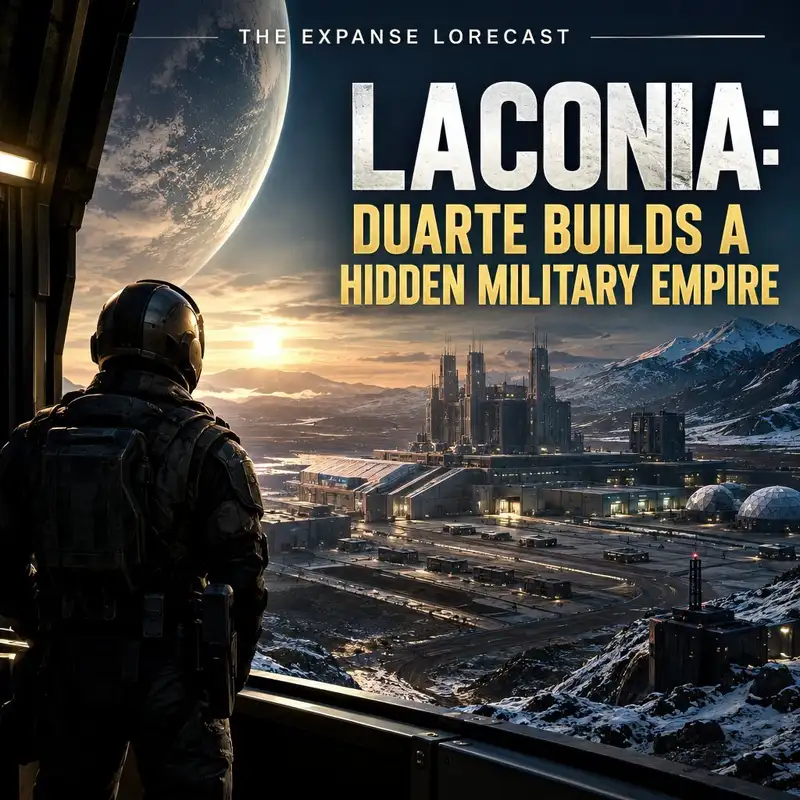
Laconia: Duarte Builds a Hidden Military Empire
Laconia did not announce itself while it was becoming dangerous. For three decades, human civilization rebuilt, traded, colonized, and argued across the Ring Network while a breakaway Martian project developed beyond meaningful observation. When Laconian warships finally emerged, Earth, Mars, and the Transport Union confronted more than a new fleet. They confronted the accumulated result of thirty years of secrecy, institutional discipline, alien-derived industry, and strategic patience.
The ships were the visible part of the surprise. They were not the surprise itself. By the time Laconia moved openly against Medina Station and the wider network, its real advantages had already been accumulated in secret: trained personnel taken from Mars, scientific expertise, protected industrial capacity, alien infrastructure, a disciplined political hierarchy, and thirty years in which rivals could not inspect, regulate, infiltrate, or meaningfully deter the project. The invasion was not the beginning of Laconian power. It was the unveiling of it.
That raises the central question. How did Winston Duarte transform a Martian breakaway force into a military empire capable of imposing authority across the Ring network? The simple answer is alien technology. It is also incomplete. Alien technology mattered enormously, but it could not recruit crews, secure supply chains, educate officers, build institutions, suppress dissent, maintain ships, or decide when to strike. Duarte’s achievement was to combine an extraordinary technological opportunity with a very human political project. He built a sanctuary, then used it to build a state. He built a state, then used it to build an empire.
The crisis that made that project imaginable began on Mars. For generations, the Martian Congressional Republic had organized its society around a long horizon. Mars was harsh, enclosed, expensive, and dependent on continuous labor. Its people accepted sacrifice partly because they had been promised a future. Terraforming would take centuries, but it gave the republic a national purpose. Children could be taught that their work, discipline, military service, and technical education belonged to a civilization-building project larger than any one life.
The Ring gates disrupted that logic. They did not make Mars uninhabitable, and they did not instantly destroy Martian industry or military power. What they did was offer an alternative future. Thousands of worlds, or at least the possibility of thousands of worlds, now stood beyond the gates. Some were dangerous. Some were barren. Some contained alien hazards no settler understood. But even a difficult new world could appear more attractive than spending generations under domes, waiting for Mars to become a place that children could visit without a pressure suit.
The novels do not give us a complete private manifesto from Duarte explaining every stage of his plan. They do show what he did, and later events make the broad inference difficult to avoid. Duarte appears to have recognized that the opening of the gates was not merely an exploration crisis. It was a strategic revolution. Mars could remain armed, technically capable, and proud, yet still lose its future. Its military power had been built to defend a planet and deter Earth. The new contest would concern settlement, transit, alien technology, and control of an expanding human civilization.
For an officer trained inside the Martian system, this was an alarming conclusion. Mars possessed some of humanity’s best warships, its most disciplined military culture, and a deep reserve of technical skill. But those strengths depended on social cohesion and long-term confidence. If the population scattered toward the gates, the institutions that sustained military power would hollow out. Duarte did not respond by trying to rescue the old Martian project through reform. He chose extraction. He would take the parts of Mars that still worked, remove them from the republic, and establish a new center of power where they could not be diluted by political uncertainty.
That required more than ambition. Duarte held senior authority within the Martian military system, and authority matters most when institutions are under strain. A rank grants access to reports, personnel channels, procurement systems, classified information, and the habits of obedience that make large organizations function. It also provides camouflage. A fleet movement can look like a redeployment. A research assignment can look like a survey mission. A security compartment can hide the fact that people assigned to protect the state are quietly preparing to leave it.
The essential intelligence success was not simply discovering Laconia. Surveyors found worlds beyond the gates constantly after the Ring network opened. The strategic achievement was recognizing that Laconia was unusually valuable, then preventing the wider Martian government and the rest of humanity from understanding what had been found before Duarte’s faction was ready. Laconia had a Ring gate, a remote location, a colonial population, and access to alien-built infrastructure that could become the foundation of exceptional military power. A discovery like that could have been managed as a public colonial venture, a scientific expedition, or a contested Martian asset. Duarte treated it as a state secret and a future arsenal.
The exact mechanics of the conspiracy remain incomplete. The novels do not provide a clean organizational chart with every conspirator, every false report, every diverted shipment, and every officer who knew the whole plan. That uncertainty is appropriate. Successful conspiracies survive by limiting knowledge. Different participants can believe they are carrying out different missions. Some may know they are defecting. Others may think they are being reassigned to a classified project. Some may be motivated by ideology, others by career, fear, loyalty, or the conviction that Mars had already failed them.
What is clear is that Duarte did not depart alone. He drew with him officers, crews, marines, technicians, scientists, and support personnel. A warship without a trained crew is not a weapon. A research program without engineers, security, medical staff, and specialized labor is not a strategic capability. A colony without people who can repair water systems, teach children, move cargo, maintain reactors, grow food, and operate docks is not a state. Duarte’s real theft from Mars was institutional continuity. He removed people who carried habits of command, maintenance, technical competence, and military discipline.
Formal authority and actual control began to diverge inside the Martian Congressional Republic. Mars still possessed a government, a navy, a chain of command, and an identity built around service. But a portion of the assets inside that system had become loyal to a different future. This is one of the enduring dangers of civil-military decline. A state can retain impressive hardware after its political purpose has begun to dissolve. The ships remain in their berths. The officers still salute. The reports still circulate. Yet the people responsible for those assets may already be calculating which institution will survive the coming change.
Secrecy, however, was not enough. A breakaway movement cannot quietly relocate major military resources while every government in the system is calm, observant, and capable of asking questions. Duarte needed confusion on a scale large enough to consume the attention of Earth, Mars, the Belt, and the emerging institutions around the gates. He found it in the Free Navy crisis.
Marco Inaros had his own political project. He drew on real Belter grievance, on the history of exploitation and neglect, and on the anger of communities that had been asked to labor for the Inner planets while accepting inferior political status and constant vulnerability. He also sought personal power. Marco’s movement was not simply an extension of Laconia, and the Free Navy was never identical with the Belt as a whole. Many Belters opposed Marco, suffered under his policies, or fought against him. Many others were caught between fear, need, coercion, and the hope that someone might finally make the Inner planets treat the Belt as more than a source of labor and minerals.
Duarte’s faction supplied Marco with Martian ships, weapons, equipment, and technical assistance. That support made the Free Navy far more dangerous than it otherwise could have been. It also served Duarte’s own purposes. The conflict forced Earth and Mars into a struggle for survival. It fractured already weak trust among the major powers. It diverted intelligence services toward immediate threats. It made the movement of military personnel and equipment easier to hide within a wider pattern of chaos, defections, smuggling, emergency deployments, and collapsing command relationships.
The relationship was useful to both men, but it was not equal in strategic horizon. Marco fought for dominance within the existing human system. He wanted the Belt to become a power that could compel recognition, and he wanted to stand at the center of that power. Duarte was planning beyond the immediate war. He wanted time. He wanted the old balance among Earth, Mars, and the Belt broken beyond easy repair. He wanted his own departure concealed while everyone else concentrated on the catastrophe in front of them.
It would be too simple to say that Duarte controlled every Free Navy decision or directly intended every atrocity Marco committed. The available record does not support that kind of clean command relationship. Marco was not merely taking instructions from a distant Martian officer. He had his own ambitions, followers, enemies, and political instincts. But Duarte did arm him. He did exploit the war Marco helped create. And he accepted a strategy in which system-wide destruction and political distraction created room for a separate imperial project. The exact scale of devastation Duarte expected, or believed acceptable, remains less certain than the fact that he benefited from the collapse.
While Earth endured catastrophe, while Mars struggled with disillusionment and internal betrayal, and while Belt factions fought over survival and authority, Duarte moved. A substantial Martian force passed through the Laconia gate. It is often described as roughly a third of the Martian fleet, which conveys the scale of the loss without pretending that the record provides a precise inventory. The important point is not a ship count. It is that Mars lost enough trained force, technical expertise, and organized capability to alter the balance of power permanently.
This was not a conventional redeployment. A fleet transfer normally moves combat power from one theater to another while remaining subordinate to the same state. Duarte’s movement through the gate removed a military-industrial core from Martian authority and placed it beyond practical recall. The ships carried more than weapons. They carried crews, command staffs, maintenance knowledge, scientific personnel, equipment, stores, communications systems, and the routines of a professional military. They carried the beginnings of a new state bureaucracy, even if no one had yet written the final name on the door.
The logistical achievement deserves attention because it explains why Laconia endured. A military force can raid from a distant base for a time. An empire requires continuity. Ships require maintenance. Crews require food, water, medicine, training, rest, and replacements. Scientists require secure laboratories, power, data, materials, and protection. Colonies require homes, schools, transport, agriculture, waste management, medical care, and ordinary people willing to keep living there after the excitement of departure has faded. Duarte did not merely smuggle a strike force into another system. He relocated the tools needed to reproduce organized power.
Laconia’s geography made this possible. It was remote from the old centers of power and accessible through a single Ring gate. The gate was not an impenetrable wall. Nothing about the Ring network made a system permanently unreachable. But distance, secrecy, and political distraction created a sanctuary. An expedition sent to investigate Laconia would have required political agreement, ships, supplies, intelligence, and a reason to risk a new confrontation while humanity was still recovering from civil war. For years, the larger system lacked all of those things at once.
A hidden fleet, however, does not automatically become an empire. It can become a stranded garrison, a warlord enclave, or a decaying military camp. Laconia survived because it was not empty. Before it became the seat of Duarte’s empire, it was a colony inhabited by civilians. Families had come there. Children grew up there. Technicians, settlers, workers, and local communities built lives under an alien sky. That civilian presence matters because the history of Laconia is not just the story of defecting soldiers finding a secret base. It is the story of military power arriving in a society and transforming that society into the foundation of a new regime.
The events seen through Cara and her family make this transformation especially clear. Laconia is not presented as a blank map square waiting for admirals to fill it with ships. It is a place where children explore, parents worry, neighbors work, and people try to understand a landscape full of things their species did not build. The arrival and consolidation of military authority changes the texture of daily life. The colony acquires new rules, new hierarchies, new armed personnel, and a new sense that private life now exists inside a state project much larger than any household.
For some colonists, military consolidation could plausibly offer security. A remote settlement needs predictable supply, medical support, infrastructure, and protection against dangers it may not understand. A disciplined government can provide order where a weak colony might otherwise face isolation and scarcity. But order is never politically neutral when it comes with armed control over movement, information, and dissent. Laconia offered stability in exchange for autonomy. It gave settlers a place in an ambitious collective future, but it also made them subjects of a system that treated political disagreement as a threat to survival.
That exchange shaped the empire’s social base. Colonists provided more than passive territory. They supplied labor, family networks, technical skills, future recruits, and continuity across generations. Their children could be educated inside Laconian institutions rather than Martian ones. Their sense of normality could be formed around the idea that military hierarchy, secrecy, and centralized authority were not temporary emergency measures but the natural structure of civilization. A state becomes durable when its institutions outlast the original conspirators. Laconia’s civilian population made that possible.
Civilian life on Laconia also unfolded beside alien systems that humans had not mastered. The strange repair organisms encountered there demonstrated a dangerous truth about the world: Ring-builder technology could act with extraordinary capability, but it did not operate according to human priorities. It could repair, transform, preserve, or alter life in ways that were useful only if one ignored the human cost and the absence of informed consent. The lesson should have been humility. Duarte’s regime drew a different lesson. It saw a strategic resource.
Above and around Laconia lay the deeper source of its exceptional power: alien-built infrastructure. The system contained facilities and materials that gave human researchers access to capabilities beyond the established fleets of Earth, Mars, and the Transport Union. This was not a matter of finding a complete instruction manual written in a language humans could translate. The Ring builders were gone. Their systems had purposes, mechanisms, and assumptions that humanity could only partly reconstruct. Laconia’s scientists could observe effects, activate some processes, and adapt certain results. They could not claim comprehensive understanding.
That distinction is essential. Discovery is not mastery. Activation is not comprehension. A working artifact is not a reproducible industrial process. Reverse engineering is not ownership of the underlying science. Duarte’s empire became dangerous because it crossed some of those thresholds, not all of them. It learned enough to use alien-derived materials, construction systems, weapons, and ship designs in ways its rivals could not immediately counter. It did not become equal to the civilization that built the gates, and it certainly did not become safe from the forces that had destroyed that civilization.
Paolo Cortázar represented the most unsettling part of this research apparatus. He carried forward the legacy of Protogen-era protomolecule work, combining technical brilliance with a willingness to treat human beings as material for experimentation. Under Laconian protection, his work connected scientific inquiry directly to state power. He was valuable to Duarte precisely because he would push past moral limits that other institutions might enforce. But Cortázar’s presence should not be mistaken for proof that Laconia understood the protomolecule. A ruthless scientist can gather data. He cannot make an alien system become predictable simply by being willing to hurt people.
The military value of Laconia’s alien infrastructure came from the relationship between technology and institutions. A superior hull or weapon is useful only if a state can build, crew, maintain, repair, secure, and deploy it. It requires specialized labor, reliable power, protected facilities, scientific knowledge, disciplined command, and time to learn from failure. Laconia had those conditions because Duarte had removed his project from public scrutiny and given it decades to mature. Its advantage was not a single miracle device. It was a protected ecosystem of military production.
The decades after the secession were Laconia’s true campaign. No dramatic battle defined them. There was no single moment when Duarte declared the empire complete. Instead there was continuous preparation. Officers trained subordinates. Crews learned new systems. Technicians maintained equipment that could not simply be replaced at a familiar Martian dockyard. Scientists investigated alien tools and materials. Administrators turned a settlement into a governed society. Children grew into adults under a different flag, with a different history and a different set of assumptions about authority.
Martian institutional memory became Laconian state culture. The defectors brought habits developed under the Martian Congressional Republic: professionalism, hierarchy, technical competence, sacrifice for a collective project, and respect for long preparation. Those habits had once supported a republic organized around terraforming and national survival. Under Duarte, they were redirected toward imperial expansion. The transformation was not automatic. A military culture can provide discipline, but it cannot by itself create legitimacy or solve every problem of governing civilians. Still, it gave Laconia a far stronger starting point than a frontier colony would normally possess.
The next generation mattered as much as the original defectors. The first arrivals could remember Mars, the Free Navy crisis, and the decision to leave. Their children and younger recruits inherited a more settled system. For them, Laconia was not a betrayal of Mars. It was home. Its hierarchy, military service, controlled information, and grand claims about humanity’s future could appear normal because they had never known another political order closely enough to compare. That is how a clandestine force becomes a durable regime. It replaces emergency loyalty with institutional loyalty.
Industrial development was equally important. A fleet cannot remain modern through slogans. Ships require yards, repair facilities, fabrication capacity, electronics, tools, spare parts, trained machinists, software specialists, dock crews, medical personnel, and a supply system capable of keeping all of them alive. Alien infrastructure expanded Laconia’s possibilities, but it did not remove the need for human work. Every advanced system still depended on people who understood enough to operate it, people who could recognize a failure, and people willing to spend years maintaining machines whose deepest principles remained obscure.
A remote state faces distinctive logistical pressures. It must feed and house its population while building military strength. It must train replacements without draining essential civilian labor. It must protect researchers while preventing scientific secrecy from becoming a bottleneck. It must preserve a chain of command without allowing every capable subordinate to become an independent power center. It must manage the flow of materials through a system that cannot assume help from Earth, Mars, or the Transport Union. These are difficult problems even for an open society trading freely with its neighbors. Laconia solved them through concentration, planning, and coercive control.
That control gave Duarte advantages his rivals often lacked. Earth, Mars, and the postwar colonies had competing constituencies, divided authority, public argument, commercial interests, and local demands. Those features could slow decision-making, but they also allowed correction. Laconia could focus resources on a long-term strategic goal without debating the allocation in public. It could keep failures classified. It could direct talent into priority programs. It could decide that one remote system mattered more than the preferences of the people living there. Militarily, this produced unity of effort.
It also produced dangerous blindness. In an authoritarian system, obedience can be confused with competence. Subordinates may hide problems because reporting failure risks punishment. Administrators may repeat policy language rather than explain local reality. Officers may assume that a command is wise because it comes from above, even when the commander lacks the information required to make it wise. Scientific personnel may exaggerate control over systems they fear to admit they do not understand. Centralized authority can accelerate action. It can also prevent leaders from hearing the warnings that would make action less catastrophic.
Duarte’s ideology made this trade seem necessary. He believed humanity faced dangers larger than its own wars. In the novel continuity, the threat associated with the ancient builders and the unknown forces that opposed or destroyed them is real. Humanity had opened a network it did not create and did not fully comprehend. It had already seen evidence that alien systems could alter biology, physics, consciousness, and the conditions under which human technology operated. Duarte’s fear was not invented. The universe had given humanity reasons to be afraid.
That claim fused military doctrine with administration. Laconia was designed not only to defeat fleets but to govern populations. Its forces could compel surrender, but surrender had to be followed by registration, transport regulation, surveillance, labor coordination, communications control, and the management of local elites. A navy can seize Medina Station. It cannot personally operate every dock, grow every crop, repair every recycler, or persuade every colony that imperial orders deserve loyalty. Duarte’s system recognized the need for administration, but it treated administration as an extension of command rather than a relationship requiring consent.
By the time Laconia returned, the political environment favored that approach more than it should have. The post-Free Navy order had avoided immediate collapse, but it remained fragmented. Earth was rebuilding from disaster on a scale that strained every institution. Its population, agriculture, infrastructure, and political confidence had all been damaged. Mars remained technically capable but diminished, its old project weakened by migration and disillusionment. The Belt had won greater political recognition, yet it was not a unified nation with one command structure or one interest. The colonies beyond the gates had their own needs, ambitions, and resentments.
Gate geography made coordination harder. Medina stood at the central junction, but the gates did not erase distance inside individual systems. A colony might be days, weeks, or longer from its gate depending on local conditions and available ships. Messages still traveled at light speed. Orders still arrived late. A crisis in one system could become known elsewhere before meaningful help could physically reach it. A power that controlled the hub possessed immense leverage, but it did not automatically possess detailed knowledge of every world or the capacity to govern them all.
Laconia understood this better than its opponents because it had spent decades preparing for a moment of decisive action. Its rivals possessed greater aggregate resources in many categories. Together, Earth, Mars, the Belt, and the colonies contained more people, more ships, more industrial sites, and more political experience than one hidden system. But aggregate power is not the same as usable power. Forces must be ready, informed, connected, and willing to act toward the same objective. Laconia faced adversaries with resources but no common strategic picture.
The intelligence failure was therefore structural. Decades of silence left the established powers with incomplete knowledge of Laconian industry, science, fleet capability, command culture, and political intention. They knew enough to suspect danger when the empire returned. They did not know enough to design a reliable response before Laconia demonstrated its advantages. Surprise was not merely a matter of appearing from behind a gate. It was the result of controlling what others could learn over an entire generation.
When Laconia moved against Medina, it struck a political system as much as a station. Its naval superiority mattered. Alien-derived ships and weapons gave it a qualitative advantage that existing forces could not casually match. Its preparations allowed it to make threats credible. But the larger effect came from demonstrating that resistance might bring overwhelming punishment while coordinated relief was uncertain. A defender does not need to be physically destroyed to be defeated. Sometimes it is enough to make every possible choice look worse than submission.
Control of Medina gave Laconia the central chokepoint of the Ring network. It could regulate movement, inspect traffic, shape trade, control access, and turn transit into an instrument of imperial administration. That was strategically decisive in the short term. It allowed a single hidden state to place itself between the old powers and the colonies they had helped create. The empire could present itself as the new guarantor of order while using control of movement to make opposition costly.
The Laconian model offered order through surveillance, threats, control of information, and exemplary punishment. It could be efficient in the narrow sense that people obeyed because the consequences of defiance were clear. But stations and colonies are not empty terrain. They contain workers whose expertise cannot be replaced overnight, families whose lives are disrupted by new rules, local leaders with private influence, and populations capable of slowing, evading, or quietly resisting a government that has no understanding of their needs. Compliance is not consent. Silence is not loyalty.
This did not make Laconia weak in the immediate military sense. Its forces remained formidable, and its enemies faced severe limits. But it exposed the contradiction built into Duarte’s project. He had solved the problem of preparation through secrecy and centralized command. He had solved the problem of military asymmetry through alien-enabled industry. He had solved the problem of political fragmentation by conquering the institutions that linked the network together. What he had not solved was the problem of governing human beings who had not chosen his unity.
Later events make that limit unmistakable. Resistance persisted. The empire’s scientific ambitions encountered dangers it could not simply discipline away. The ancient systems that had helped make Laconia powerful also carried risks beyond Duarte’s control. His belief that humanity required centralized authority was strengthened by genuine threats, but his system remained vulnerable to the very authoritarian failures it was designed to prevent: concealed information, overconfidence, coercive legitimacy, and dependence on leaders who believed their strategic vision justified every cost.
Duarte’s success came from combining a collapsing Martian project with a protected sanctuary, alien infrastructure, concentrated institutions, and enough time to prepare beyond outside scrutiny. Laconia’s conquest therefore began long before its ships crossed back through the gate. Its eventual weakness was present just as early. A state that can manufacture obedience faster than legitimacy can look permanent right up to the moment people discover that its power can be survived, stolen from, and resisted.