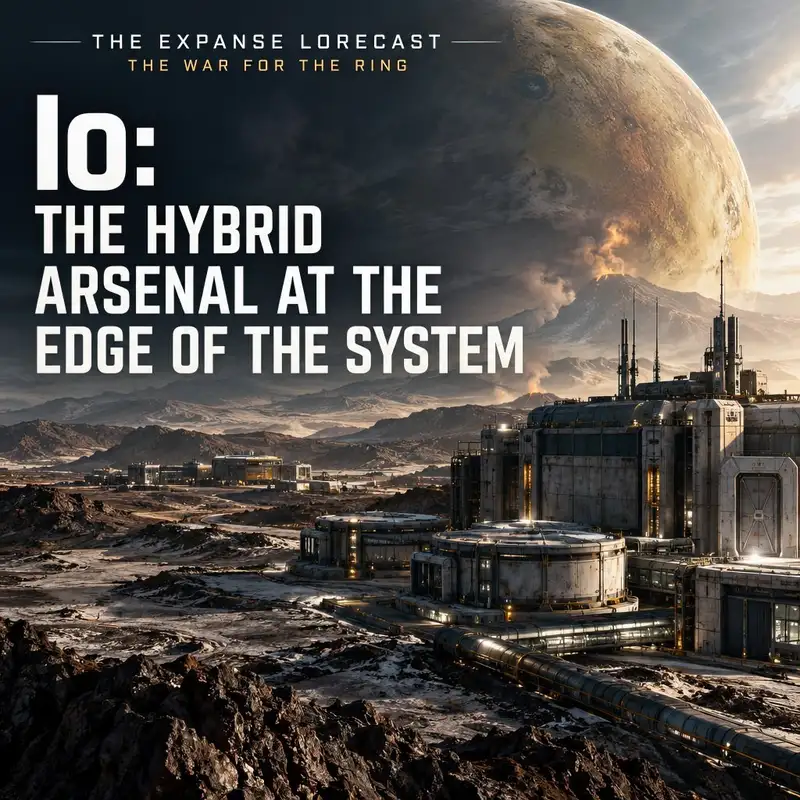
Io: The Hybrid Arsenal at the Edge of the System
Missiles leaving the fighting around Io carried a contradiction at the heart of the entire operation. They were meant to preserve leverage for the men who had built a secret weapons program out of alien science and abducted children. But once launched, the weapons were no longer simply ammunition. They were mobile containment failures, carrying altered human beings toward Mars at a moment when Earth and Mars were already close to war. Stopping them required more than destroying a laboratory. It required identifying the launches, tracing their trajectories, deciding which signals could be trusted, and coordinating forces that had every recent reason to suspect one another. The people directing the crisis had wanted a strategic advantage. What they had produced was a weapon that could not be safely stored, reliably commanded, or politically defended. The battle around Io was therefore not just a fleet engagement. It was an emergency effort to prevent a covert research program from becoming a system-wide biological catastrophe.
Io was not literally at the edge of the Solar System. It is one of Jupiter’s moons, deep inside the territory that human shipping and military forces could reach. But it was distant from the immediate oversight of Earth and Mars, far enough from the Inner planets that secrecy, delay, and compartmentalized authority could do useful work. In that practical sense, it sat at the edge of the crisis’s command reach. By the time forces converged there, a missing-child investigation had become a counterproliferation campaign, an Earth-Mars confrontation had become a struggle over legitimacy inside the United Nations system, and the protomolecule had again shown that human beings were willing to mistake activation for understanding. The missiles were the final expression of that mistake. To understand why they were launched, and why the arsenal behind them failed, it is necessary to begin not on Io, but on Ganymede.
Ganymede was more than a moon caught between rival navies. It was an agricultural center, a habitat complex, and a critical part of the food system that sustained populations beyond Earth. Its farms, infrastructure, workers, and transport routes mattered because stations and ships did not survive on military discipline alone. They survived on water, air, calories, replacement parts, and the people who kept those systems functioning. Damage to Ganymede therefore had consequences far beyond the immediate battle. It threatened civilian life across the outer system and intensified the fear already shaping Earth-Mars relations.
During the violence around Ganymede, Martian marines encountered something neither side could place inside an existing military doctrine. Gunnery Sergeant Bobbie Draper and her unit faced a human being transformed by protomolecule experimentation. The creature moved and survived in ways that ordinary soldiers were not prepared to confront. It overwhelmed trained marines, and Bobbie became the principal surviving witness to an event that was difficult to explain and easy to misinterpret. She knew what she had seen. She did not know who had made it, where it came from, or what larger purpose it served.
That distinction mattered. Mars had evidence of an attack. Earth had its own fears, military pressures, and political factions. The public had fragments, reports, rumors, and the familiar assumption that the other side must be preparing a new weapon. An unknown threat was quickly absorbed into an old security dilemma. Each government had reasons to fear surprise. Each military institution had reasons to prepare for the worst. The result was fighting around Ganymede and a widening crisis between Earth and Mars. But the hybrid had not been built by Mars, and it was not a conventional Earth weapon either. It was evidence of a hidden program operating inside the gaps between public authority, corporate secrecy, and military ambition.
Amid that wider disorder, Praxidike Meng was searching for his daughter. Prax was a botanist on Ganymede, a civilian whose expertise was tied to food production and plant life rather than war. His daughter, Mei, had disappeared during the chaos. At first, his search had the shape of a familiar disaster story: a parent trying to find a child after institutions have failed, records have become unreliable, and the people responsible are more concerned with security than with explanation. But Mei was not the only child missing. A pattern emerged. Children with serious medical vulnerabilities had been taken from care systems and moved through channels that concealed their destination.
The selection of those children was central to the hybrid program. The exact biological mechanism was not fully available to the people trying to stop it, and the larger protomolecule process remained poorly understood. What was clear was that the children’s illnesses or immunological conditions made them useful to the experimenters. Medical vulnerability had been converted into military input. The program did not begin with volunteers in a barracks or with recruits promised advancement. It began with children who required care, whose families trusted institutions, and whose disappearance could be buried beneath the confusion of a wider crisis.
Lawrence Strickland, the physician associated with the experiments, represented one of the most disturbing features of the operation. Medical authority is supposed to reduce suffering, preserve life, and help people who cannot protect themselves. In the hybrid program, those skills and that access were redirected toward weapons research. The children were treated as material for a strategic project. Their personhood became an inconvenience. Their medical histories became data. Their families became obstacles to be managed. That was not an accidental moral failure at the edge of an otherwise rational program. It was part of the program’s operating model. A military system willing to make children into experimental assets had already accepted that the weapon’s intended use would outrun any normal boundary of law, consent, or accountability.
Prax’s search mattered because he refused to accept the disappearance as a bureaucratic loss. But private determination was not enough. He needed transportation, records, contacts, and people capable of moving through a system where official channels had been compromised. That is how his rescue effort intersected with James Holden and the crew of the Rocinante. Holden’s ship was not an intelligence service, a police department, or a naval task force. It had no secure chain of command reaching back to a government that everyone trusted. Yet the Rocinante became an investigative platform because formal institutions were either distracted, deceived, or implicated.
The investigation developed through fragments. Missing-person information pointed toward a pattern. Surveillance and transport records suggested that the children had not simply vanished into the disorder on Ganymede. Corporate connections linked the search to the commercial networks surrounding Jules-Pierre Mao. The earlier hybrid attack indicated that the kidnappings were not a separate crime but part of a weapons effort. Each clue changed the mission. Recovering Mei remained Prax’s central purpose, but the stakes expanded. The crew now needed to find the laboratory, identify the sponsors, expose the network protecting it, and prevent more hybrid deployments.
That was a difficult transformation for everyone involved. A rescue mission has a human center and a clear moral purpose. Counterproliferation requires decisions about targets, secrecy, risk, and force. It asks whether a facility must be captured, destroyed, or merely exposed. It asks whether the people inside are victims, perpetrators, intelligence sources, or all three at once. The Rocinante’s crew had to operate in that uncertain space while knowing that every delay might mean another child was altered, another hybrid was deployed, or another political faction gained time to turn the crisis into war.
The immediate danger became unmistakable when a hybrid reached the Rocinante itself. The creature demonstrated capabilities that made it terrifying as a tactical threat. It could survive vacuum exposure and extreme physical damage better than an ordinary human being. It could kill at close range with devastating speed and force. It could move through a ship as both a biological danger and an enemy combatant. But the encounter also revealed the limits of the weapon. The hybrid was not a disciplined marine. It did not answer orders in any meaningful human sense. It was not something a commander could brief, deploy, recover, or demobilize with confidence.
Its behavior appeared linked to energy or radiation. Prax’s scientific perspective helped the crew recognize that pattern. The Rocinante did not defeat the creature by overpowering it in a straightforward contest. The crew identified a behavioral vulnerability, created a stronger lure, and used the ship’s exhaust to destroy it. That solution was brutal, improvised, and highly specific to the situation. It was not a general doctrine for fighting hybrids. It did, however, establish a crucial point. The creatures were not invulnerable. Their power did not make them controllable, and their resilience did not remove the need for their operators to understand what attracted them, what constrained them, and how close their own personnel could safely get.
This is where the hybrid program failed as military design, even before its political sponsors began to lose control. A useful weapon must do more than harm the enemy. It must be transportable, identifiable, commandable, supportable, and survivable for the force that employs it. A missile can be dangerous without being strategically useful if no one can be certain where it will land or what it will destroy. A biological weapon can terrorize a population while creating risks that its owners cannot contain. The hybrids were proof that the protomolecule could transform human bodies into something militarily formidable. They were not proof that human beings had developed a stable super-soldier program. The difference was the difference between a laboratory horror and a sustainable capability.
The creature aboard the Rocinante also helped point the investigation toward Io. By then, the political dimensions of the case had become increasingly visible. The hybrid program connected Jules-Pierre Mao’s corporate network, secret research, senior figures inside the United Nations government, and military officers prepared to use the Earth-Mars crisis for their own purposes. These actors were connected, but they were not interchangeable. Mao-Kwikowski Mercantile supplied money, access, logistics, and corporate cover. Jules-Pierre Mao had the wealth and influence to sustain work that ordinary oversight would have stopped. Sadavir Errinwright had political standing and access to the machinery of emergency government. Admiral Nguyen controlled armed assets that could protect the operation when secrecy failed.
The convergence of those interests was the real arsenal at Io. The laboratory and the hybrids were its visible edge. Behind them stood classified financing, private transport, medical facilities, security personnel, research staff, political protection, and warships. The program required people willing to move abducted children without creating records that could be followed. It required technicians able to handle dangerous biological material. It required a remote installation with power, containment, launch capacity, and reliable support. It required someone in government to ensure that warnings were ignored, investigations were redirected, or inconvenient witnesses were discredited.
Chrisjen Avasarala understood the shape of the conspiracy gradually. She did not possess a clean intelligence file marked with every participant and objective. Her understanding came from surveillance, political contacts, intercepted information, corporate relationships, and the behavior of people whose actions made sense only if they believed a new weapon was worth risking war. That process is important because it explains why the conspiracy lasted as long as it did. It was not hidden by one perfect secret. It survived because different institutions each saw only part of the operation, and because the crisis around Ganymede gave everyone a reason to focus on the visible conflict rather than the machinery behind it.
Nguyen’s role was especially dangerous because he had ships, crews, and the appearance of formal authority. His forces belonged to the United Nations military structure, but they did not represent the entire United Nations Navy, much less every civilian institution on Earth. They had become the armed shield of a factional project. That distinction was not academic. In a crisis between Earth and Mars, a United Nations warship could be interpreted as a national instrument even when its commander was acting to protect a conspiracy. Nguyen’s command could exploit that ambiguity. It could issue orders, pursue targets, and claim legitimacy long enough to make resistance appear treasonous or provocational.
Avasarala and Bobbie Draper became central to breaking that ambiguity when they escaped aboard the Razorback, Julie Mao’s racing pinnace. The escape was not merely a chase through space. It was a race to move information and political credibility before Nguyen’s faction could define the situation for everyone else. Bobbie carried direct knowledge of the first hybrid attack. Avasarala carried the political experience to recognize that the threat was not simply Martian aggression or Belter sabotage. The Rocinante offered an independent platform with a crew already committed to finding the children and exposing the program.
Their convergence created an improvised coalition built from people who would not normally share a command structure. Avasarala had influence within the United Nations political world, but her position had been undermined by the very faction she was investigating. Holden commanded a privately operated warship with a reputation for attracting danger and an uneven relationship with almost every government in the system. Naomi Nagata, Alex Kamal, Amos Burton, and Prax each brought different skills, histories, and motives. None of that created unity by itself. It created the possibility of cooperation because the alternative was allowing Nguyen’s faction to set the terms of the crisis.
The problem was identification. Earth and Mars were already close to open war. A warning sent by tightbeam might be ignored, intercepted, or treated as deception. A vessel approaching another under combat conditions could be a rescuer, a decoy, or the opening move in an attack. Orders could arrive after a tactical situation had changed. Officers had to make decisions with incomplete information, knowing that one mistaken shot might confirm the very war that the conspiracy wanted.
This was why the approach to Io became a command-legitimacy crisis as much as a military operation. The question was no longer only whether a secret facility existed. The question was whether any force could reach it, stop the hybrid program, and do so without triggering a larger Earth-Mars exchange. The emerging coalition had evidence, urgency, and an unstable collection of relationships. It could not assume that all United Nations officers would support it. It could not assume that all Martian commanders would trust it.
Io was a useful location for such a program because remoteness provided cover. The Jovian system had enough traffic, infrastructure, and industrial activity to make some movement less conspicuous than it would be in a more isolated location. At the same time, the facility was not independent of the system around it. It needed shipments, personnel, power, equipment, secure communications, security, and transport. It needed the children to arrive alive. It needed researchers to work in a dangerous environment.
That logistical footprint was the program’s weakness. A secret laboratory can be hidden. Every shipment creates a record, even if the record is falsified. Every employee creates a possible witness. Every security measure reveals that something worth protecting is inside. The hybrid arsenal was never merely a room full of creatures. It was a supply chain built on secrecy and coercion.
The facility’s position also shaped the military problem. Destroying it would deny the conspirators a place to conduct further experiments, maintain subjects, and prepare launches. But a facility could not be treated like an ordinary target. Children were inside. Research records might reveal the extent of the program. Personnel might be needed for testimony or intelligence. Damaging containment systems could create new dangers. The requirement to save survivors turned the assault into a more difficult mission. It imposed restraint precisely when the enemy’s methods had shown none.
Nor would destroying Io resolve the larger protomolecule crisis. The hybrid program had used a fragment of alien technology in a particular human project. Still, the Io facility mattered because it was a place where human beings were actively trying to convert an incompletely understood alien system into a deployable weapon.
The fleet confrontation around Io was therefore fought with several objectives at once. The coalition needed to isolate Nguyen’s forces, prevent launches, protect Mars from hybrid attack, preserve the possibility of recovering the children, and demonstrate that the rogue command did not speak for Earth as a whole. It was not a clean contest between two national fleets. United Nations and Martian forces were operating amid a political environment in which both sides feared betrayal and escalation.
The details that matter most are not a precise count of missiles or hulls. They are the strategic choices behind the exchange. Nguyen’s faction had used secrecy as long as secrecy worked. Once the facility was exposed and its military shield came under pressure, it faced a choice between surrender, flight, negotiated survival, or escalation. It chose escalation. That choice exposed the weakness of its entire political project. A program supposedly built to strengthen human security was prepared to make planetary catastrophe a tool of survival.
The coalition formed not because Earth and Mars had suddenly overcome their historical rivalry, but because Nguyen’s faction threatened both of them. For loyal United Nations personnel, the deployment threatened to turn a covert conspiracy into an act that could provoke catastrophic war and destroy what remained of Earth’s political credibility. For Holden and the Rocinante, the launch threatened the children, the wider system, and any chance of containing the technology before it spread further. Shared danger created temporary alignment.
As Nguyen’s position became militarily untenable and politically indefensible, the crisis split into two linked containment problems. The other was inside the Io installation, where Mei and the surviving children still waited amid the machinery that had turned them into experimental subjects. The first problem demanded tracking, interception, and control of information.
The hybrid weapon turned on its custodians with grim efficiency. One of the altered subjects reached Nguyen’s flagship and began transforming the crew. The force that had expected to use the hybrids against Mars now confronted the fact that proximity offered no safety. Possession was not command. The people who had funded, transported, and deployed the weapon had not made themselves immune to it.
Holden’s boarding action on the damaged vessel mattered because destruction alone would not solve the launch problem. The coalition needed information about the remaining projectiles. Boarding a compromised warship was not a romantic act of individual courage. It was a calculated risk driven by an intelligence requirement. The ship might contain armed survivors, damaged systems, pressure hazards, infected personnel, and incomplete records.
A missile defense system can only engage what it can detect and identify. A fleet can only coordinate if its commanders know which contacts are hostile, which are friendly, and which may be carrying a weapon whose effects cannot be measured by ordinary battle damage. The immediate tactical threat could then be interrupted.
Inside the Io facility, the original purpose of the mission remained painfully clear. Amos Burton and Prax entered to find Mei and the other surviving children. Prax was not transformed into a conventional combatant by grief. He remained a father trying to reach his daughter and a scientist trying to understand enough of the environment around him to keep people alive. His presence mattered because the children needed more than extraction.
The ground operation had to contend with the physical realities of an installation built for secrecy and dangerous research. Compartments, doors, life-support systems, security arrangements, medical spaces, and uncertain personnel all shaped the fight. Capturing a facility intact was impossible in the full sense. It had already been morally destroyed by what occurred inside it.
Bobbie Draper’s second encounter with a hybrid showed what adaptation under pressure looked like. Her powered armor, training, and combat experience gave her tools. They did not make her equal to the creature in strength or resilience. She survived by observing how it moved, exploiting limitations in its response, using the terrain and her equipment, and employing incendiary weapons where direct force alone would not be enough. This was not proof that one marine in armor could routinely defeat an alien-derived weapon.
Strickland was killed during the final struggle. His death ended neither the moral injury nor the scientific danger represented by his work. The operation recovered lives. It did not restore the lost safety of their childhoods, repair their families’ trust, or undo the wider damage caused on Ganymede. The children had been at the center of the program’s logic. Their survival was therefore more than a personal victory.
The victory at Io had several layers, and they should not be confused. Tactically, the immediate hybrid threat was stopped. The rogue commander’s military position collapsed. The attempt to launch hybrids toward Mars was interrupted before it could become the planetary catastrophe its sponsors had been willing to risk.
Operationally, the campaign dismantled a deployable arsenal. The program’s support chain was broken. That mattered as much as the destruction of individual hybrids. An arsenal is not merely the weapon at its far end. It is the personnel, facilities, records, funding, transport, and command relationships that make repeated use possible. Io lost that capacity.
Intelligence also mattered. The conspiracy became far more visible. Not every uncertainty vanished, and not every participant became immediately accountable. But the operation exposed enough of the network to destroy its claim to legitimacy. It showed that emergency authority had been used to conceal private and factional interests, not to protect the populations supposedly placed under its care.
Politically, the defeat of Nguyen’s faction helped prevent the Earth-Mars crisis from expanding into a wider war. It did not repair the underlying distrust. Ganymede had still suffered. Earth’s institutions had still been shown vulnerable to internal capture by powerful officials and wealthy private networks. The United Nations government could not simply declare the problem solved because a rogue fleet had been defeated.
The civilian consequences also remained. Families had been separated. Mei and the other survivors were rescued, but their recovery was only the beginning of a longer human reckoning. The program had demonstrated what happens when medical dependence becomes an avenue for coercion. It had turned illness into a selection criterion and care into a trap.
Strategically, Io did not resolve the protomolecule threat. The alien structure on Venus continued its transformation beyond the reach of human understanding. The hybrid program had been contained, not comprehended. Humanity had stopped one attempt to weaponize the protomolecule, but it had not mastered the technology, explained its origin, or secured the future against others trying again. The lesson of Io was not that alien power could never be used. It was that activation, possession, and even temporary deployment were not the same as control.
Io was not merely the destruction of a secret laboratory. It was the exposure of a system in which corporate money, emergency politics, military force, and alien experimentation had combined to make children into strategic assets. Nguyen’s faction could launch weapons and seize initiative for a few dangerous hours, but it could not make the hybrids obedient, make the conspiracy legitimate, or make alien technology safely human. The coalition succeeded because it treated Io as a containment crisis rather than a prize, and because it understood that no weapon can create durable order when its owners cannot govern the consequences of using it.