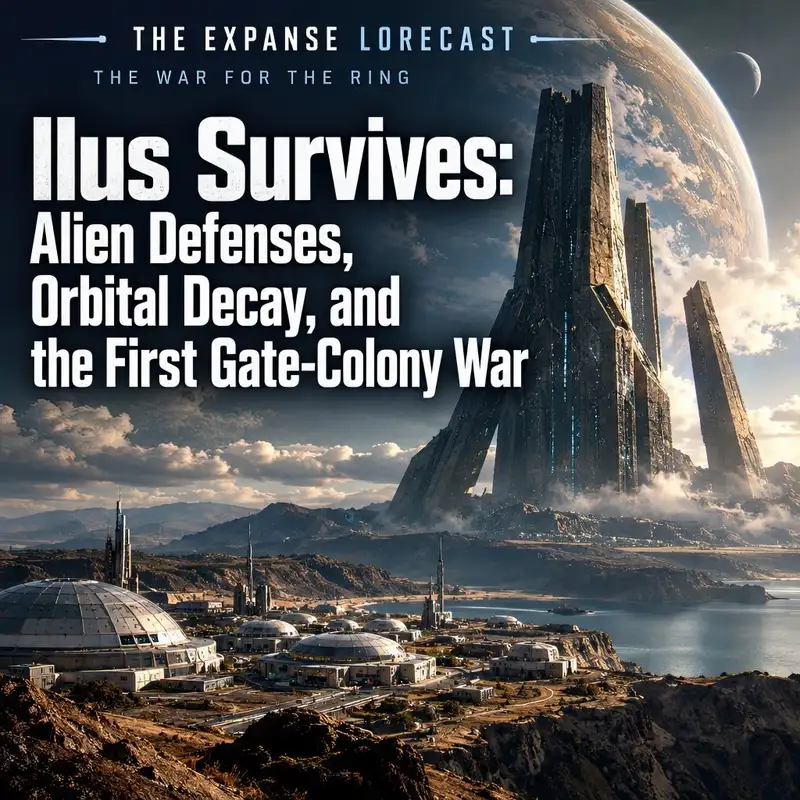
Ilus Survives: Alien Defenses, Orbital Decay, and the First Gate-Colony War
The Barbapiccola was falling, though at first there was nothing dramatic about it. No flames trailed behind her. No alarms could change the arithmetic. Her fusion reactor had been shut down by an alien system on the planet below, and without normal propulsion, the ship had lost the ability to correct its course. Orbit is not a place where a vessel simply remains after arriving. It is a continuing balance of motion, altitude, and energy. A ship that cannot maneuver is living on borrowed geometry. The Barbapiccola had been the settlers’ transport, shelter, and connection to the human worlds behind them. Now it was becoming a temporary refuge with a deadline. The Rocinante and Royal Charter Energy’s Edward Israel were trapped in the same broad emergency. Their reactors were dead. Their batteries had become their reserves of power, heat, communications, life support, and judgment. Below them, on Ilus, a settlement had been smashed by a planetary catastrophe. The people who survived faced poisoned weather, damaged supplies, unfamiliar biology, and a sickness that was taking their sight. Behind all of it stood a political conflict that had already turned violent. The settlers believed they had earned a claim to the world through labor, danger, and survival. Royal Charter Energy believed it possessed a lawful charter to exploit the planet’s resources. Neither side understood that the old argument over ownership had been overtaken by a larger problem. Ilus was not an empty frontier waiting for human law to arrive.
It was an active remnant of an alien civilization, and its machinery had begun to respond. The crisis that followed was not a conventional war. There was no recognized front, no stable chain of command, and no government capable of enforcing a settlement. But it had the essential features of a colonial war. It concerned territory, labor, resources, legitimacy, armed coercion, and the question of who would bear the costs of someone else’s claim. Ilus survived because the catastrophe made monopoly impossible. Neither the settlers’ physical presence nor Royal Charter Energy’s legal authority could sustain a colony alone. Survival required technical skill, improvised cooperation, and a restraint that arrived only after much of the damage had already been done.
The Ring Network had opened more than a thousand systems faster than human law could follow. Ilus became a test case because settlers arrived before any durable frontier order did. Many had been displaced from Ganymede, and they built First Landing around labor, risk, and the hope that lithium could give the colony an economic future.
Royal Charter Energy arrived with a United Nations charter, scientific personnel, equipment, security, and a competing claim to lawful development. The charter gave the company a legal foundation, but it did not make RCE a sovereign government or erase the people already living on the planet. The settlers, in turn, had a real practical claim without an uncontested legal mechanism to settle it.
Sabotage by Basia Merton and other settlers turned the dispute into a security crisis when explosives killed and injured members of the arriving RCE expedition. Adolphus Murtry used that violence to justify an increasingly coercive response. James Holden arrived with enough political visibility to mediate, but without a court, police force, or accepted government behind him. Then the planet itself intervened, and the argument over ownership became secondary to survival.
The first warning came from alien infrastructure on the far side of the planet. Something failed, activated, or catastrophically transformed there. The human beings on Ilus did not understand the mechanism well enough to describe it with confidence. What mattered was the effect. A massive shock wave crossed the world and destroyed First Landing. Buildings, equipment, stores, communications, and the carefully assembled routines of colony life were shattered. The settlement that had been the center of the political dispute ceased to be a defensible or even reliably habitable base. Survivors fled into ancient alien structures because those structures offered the only available shelter. It was an extraordinary reversal. People who had come to Ilus to establish ownership over a new world survived only by taking refuge inside the remains of a civilization they could neither interpret nor control.
The alien system did not behave like a human military force. There was no declaration, no demand, no recognizable campaign plan. The best evidence suggested automated infrastructure responding to conditions that humans had accidentally entered without understanding. Whether it had once been a defense system, an industrial safeguard, a planetary control mechanism, or several overlapping systems was uncertain. The people on Ilus could observe effects. They could not reliably infer original purpose. That distinction was not academic. A human adversary can be deterred, negotiated with, deceived, or defeated according to some recognizable logic. An automated alien response may not know or care that humans are present at all.
It may operate according to rules so old and so poorly understood that the distinction between attack, maintenance, and malfunction becomes impossible to draw. After the catastrophe, powered craft attempting to descend came under attack. The ships in orbit lost their fusion reactors. The Rocinante, the Edward Israel, and the Barbapiccola were suddenly reduced to battery power. The defense network’s full architecture remained unknown, but it had demonstrated a terrifying capability. It could interfere with human technology at the level of the fusion systems that made interplanetary life possible. This was not a planetary shield in any fully understood sense.
It was not a weapon humans could study, duplicate, or command. It was a dead civilization’s machinery still capable of imposing consequences on the living. The political dispute over Ilus had been about access to lithium, land, and authority. The alien response revealed a more immediate truth. Nobody on the planet possessed enough knowledge to claim mastery. The settlers had lost their town. Royal Charter Energy had lost the reliable use of its expeditionary advantage. And the ships that connected both sides to the rest of humanity were beginning to die above them.
On the surface, the conflict became a civilian survival operation. First Landing’s destruction was not simply a tactical setback for one faction. It meant the loss of shelter, food stores, medical access, communications equipment, mining infrastructure, and the practical organization of labor. A frontier settlement exists through systems that are easy to overlook when they work. Someone maintains filters. Someone inventories medicine. Someone repairs pumps, seals, power connections, and transport equipment. Someone keeps track of food, water, and the people who know how to operate the machinery. When the settlement was smashed, every one of those systems became uncertain at once. The alien environment added its own dangers. Toxic organisms, contaminated rain, and biological processes that humans had no evolutionary preparation for turned ordinary exposure into a medical threat.
The progressive blindness spreading among the survivors was especially cruel because it did not merely threaten individual health. It threatened the colony’s capacity to function. A settlement with fewer people able to see, move safely, repair equipment, administer medicine, or care for children was losing skilled labor at the moment it most needed it. Elvi Okoye and Fayez Sarkis had arrived as scientists. Under emergency conditions, scientific work stopped being a matter of professional curiosity and became a form of crisis management. They had to identify patterns, test possible explanations, and find treatments while the people around them were frightened, sick, and politically divided. Holden’s anti-cancer medication became unexpectedly important because it offered a path toward treating the alien biological process affecting the survivors.
But it was not a limitless miracle, and it did not remove the wider medical problem. Supplies were finite. Diagnosis remained uncertain. Treatment had to be organized amid damaged infrastructure and mistrust. The settlers and Royal Charter Energy personnel were now exposed to the same rain, the same medical danger, and the same shortages. Their previous dispute did not disappear, but survival made cooperation a practical necessity. That necessity did not produce harmony. Murtry saw emergency conditions as an opportunity to impose control while the settlers were weakened. Other RCE personnel saw the danger differently. They understood that the colony could not be secured by force if the people who operated its remaining systems were dying, fleeing, or refusing to cooperate. Ilus made a harsh argument through material conditions. A claim to authority was worthless if it could not keep people alive.
In orbit, the problem was even less forgiving. The ships still had hulls, crews, and batteries, but the loss of fusion power had stripped away the systems that made them spacecraft rather than sealed metal habitats drifting on old momentum. Batteries could sustain limited life support. They could preserve some communications, some heat management, some sensor capability, and enough power for essential decisions. But every demand drew down the reserve. A captain could not simply issue an order to hold position. The ships could not maintain normal propulsion or maneuver freely. They could not count on their usual weapons, sensors, or drive systems. The Barbapiccola’s orbit was decaying, and that meant the crew faced a time problem with no reliable reserve margin.
As the ship descended into thicker atmosphere, heat and drag would increase. The vessel had not been designed to solve the problem it now faced. Its people needed evacuation. The ship itself was unlikely to survive. Naomi Nagata approached the crisis as an engineering problem stripped of all elegance. The Rocinante still possessed a railgun. Under normal conditions, the weapon’s recoil was a hazard the ship’s systems were designed to manage. In this emergency, recoil could become a source of motion. By tethering the Rocinante to the Barbapiccola and using carefully controlled railgun fire, Naomi saw a way to transfer enough momentum to alter the situation. Alex Kamal had to turn that concept into ship handling under severe constraints.
The maneuver depended on timing, tethering, limited power, changing mass, and the danger of making an already fragile situation worse. It was not a standard propulsion technique. It was an improvised use of a weapon as an emergency engine because the normal engine had been taken away. The plan could not restore the Barbapiccola to a safe and enduring orbit. It could not replace a fusion reactor or erase the damage done by the alien network. What it could do was create time and position. In disaster operations, that difference can be decisive. A mission often changes when the original objective becomes impossible. The question ceases to be whether an asset can be saved and becomes whether the people inside it can be brought home. Naomi and Alex were not trying to achieve a clean victory over orbital mechanics. They were trying to make the failure of one ship less final.
The Barbapiccola was lost, but her people were not. Crews from the Rocinante and the Edward Israel worked to evacuate those aboard before the ship entered the atmosphere. The rescue mattered because it separated the value of a vessel from the value of the human beings who depended on it. In the narrowest tactical sense, the outcome was defeat. A ship that had carried settlers through the Ring and supported the first years of their colony could not be preserved. In operational terms, the rescue was a success. The people aboard survived. In logistical terms, the loss was devastating. The Barbapiccola had been more than transport. It represented cargo capacity, living space, repair capability, institutional memory, and a link to the colony’s original migration.
Frontier communities can be built around a remarkably small number of hulls and skilled crews. Lose one, and the consequences travel outward through every system that depended on it. Fewer berths mean fewer people can move. Less cargo space means less food, medicine, equipment, and spare parts can be carried. Fewer experienced hands mean fewer people know how to make emergency repairs when the next failure arrives. The destruction of the Barbapiccola therefore did not end when it was lost to atmospheric entry. It remained part of the colony’s future burden. Yet the evacuation also demonstrated something important about Ilus’s emerging political reality. The rescue depended on people from nominally opposed groups acting together. The Rocinante crew brought capability and initiative.
Edward Israel personnel brought resources and access. The settlers brought the human stake that made the mission necessary. The alien crisis had made the boundaries between factions less useful than the boundary between those who could contribute to survival and those who were willing to sacrifice others for control. That division now ran through Royal Charter Energy itself. Dimitri Havelock had arrived as part of the company’s security apparatus. He was not a settler partisan, and he did not abandon every obligation he had accepted when he joined the expedition. But the unfolding emergency made Murtry’s command style impossible to ignore. Havelock saw that security policy had ceased to be principally about protecting people. It was becoming a method for imposing one man’s political answer to the colony’s dispute.
Havelock’s break with Murtry was a failure of command legitimacy. Formal authority matters in a crisis. People need to know who can issue orders, who controls weapons, who has responsibility for prisoners, civilians, supplies, and the use of force. But formal authority is not self-sustaining. It depends on a shared belief that orders serve the mission and remain within some recognizable boundary of necessity. Murtry had begun with a defensible responsibility. RCE personnel had been attacked. The expedition needed protection. As the crisis deepened, however, he treated every constraint as proof that he needed more coercive authority. Settler resistance became justification for armed pressure. Alien disaster became an opportunity to force compliance. The presence of civilians and dependent personnel became less a duty of care than a source of leverage.
That approach corroded the loyalty of people who had not joined the expedition to become instruments of collective punishment. Havelock’s actions showed that a security force is not a machine that automatically produces obedience. Its members carry professional standards, personal loyalties, memories, fears, and their own understanding of what the mission has become. When Murtry proved willing to endanger personnel and civilians for the sake of control, he made it easier for subordinates to conclude that obedience itself had become dangerous. Havelock helped free Naomi and aided the orbital rescue because the immediate survival of the trapped crews had become more important than Murtry’s effort to maintain exclusive control over information and force.
This was not a simple ideological conversion. Havelock did not suddenly become the representative of the settlers’ political cause. The settlers’ grievances did not erase the bombing, and RCE’s charter did not erase the company’s responsibilities. His decision was narrower and more consequential. He rejected a command policy that had become visibly detached from proportionality and survival. That rejection weakened Murtry at the moment when the security chief most needed disciplined obedience. But it did not resolve the larger emergency. The alien defense system remained active. Ships still needed their power restored. The people on the surface still faced medical danger and political uncertainty. The fight over Ilus could not be settled through a change in personnel alone. The machinery beneath the planet still held the decisive advantage.
The final movement toward survival took Holden, Amos Burton, Elvi Okoye, Fayez Sarkis, Murtry, and the Miller construct into the alien installation. It was not a conventional assault on a known command center. The human beings involved had incomplete maps, limited understanding, and no reliable doctrine for confronting infrastructure built by a civilization that had vanished long before humanity reached the stars. Murtry nevertheless treated the moment as an opportunity to settle his own struggle for control. He attacked the group. Amos was wounded. Chandra Wei was killed. The violence was personal and immediate, but it also revealed the strategic bankruptcy of Murtry’s approach. He was still trying to win a colonial dispute through coercion while the colony’s actual survival depended on understanding and disabling a system no human force could fight directly.
Holden stopped Murtry, but he did not execute him. Detaining Murtry for trial was not sentimental restraint. It was an assertion that frontier violence did not have to become a permanent license for private judgment. Holden’s authority was limited, but in that moment he could preserve a distinction between stopping a threat and becoming another source of unaccountable force. The Miller construct was essential to the larger resolution, but it must be understood carefully. It was not Josephus Miller restored to biological life. It was a protomolecule-derived human-facing interface, shaped in part by Miller’s pattern and used by alien systems for purposes that were only partly visible.
Its knowledge was incomplete, its motives were not simply human, and its relationship to the original detective remained unsettling rather than comforting. Through the construct, Elvi and the others reached what they understood as a blind spot, a poorly understood phenomenon associated with the destruction of the Ring builders. The source of that destruction was not a confirmed species, weapon, or comprehensible enemy. It was an observed absence, a danger at the edge of human understanding. Miller used the alien-controlled machinery and that blind spot to shut down the planetary defense network. Humans did not seize control of the system. They did not learn how to reproduce it, safely operate it, or guarantee that it would remain silent forever. They survived because an alien interface carried out an action through systems that remained fundamentally beyond them.
When power returned, the immediate emergency ended, but Ilus did not become settled in the deeper political sense. The ships regained the ability to operate. The Rocinante could depart. Murtry could be taken away under detention to face legal judgment rather than remain the armed authority of a private company on an isolated world. The defense network was no longer actively trapping vessels in orbit or imposing the same immediate threat on the surface. The blindness crisis could be treated. People had survived the destruction of First Landing, the loss of the Barbapiccola, the medical emergency, and the collapse of the assumptions that had brought them to the planet. But survival was not the same as resolution. Basia remained on Ilus. Elvi remained as well.
Settlers and surviving Royal Charter Energy personnel faced the work of rebuilding a colony whose original institutions had been destroyed or discredited. The settlers’ labor claim was still real. They had made the world livable at great personal risk, and no corporate charter could erase that fact. Royal Charter Energy’s legal claim was still consequential. It represented capital, state recognition, technical capacity, and a broader effort to regulate the rush through the Ring gates. Neither side emerged with an uncontested monopoly. The settlers could not claim that unilateral violence had secured their future. The sabotage had brought death, widened fear, and strengthened the conditions for repression. Royal Charter Energy could not claim that a charter and armed security had given it unquestioned authority.
Its effort to impose control had exposed the limits of corporate power when the people on the ground no longer accepted its legitimacy. Tactically, the alien defenses had been neutralized and the immediate fighting contained. Operationally, the trapped ships had regained power and the Barbapiccola’s people had been saved, even though their ship was gone. Politically, no one had achieved a clean victory. Institutionally, mediation and ad hoc cooperation had prevented catastrophe, but they had not created a mature frontier government. Strategically, Ilus demonstrated what the Ring Network had changed. Humanity could reach new worlds faster than it could build laws capable of governing them. The gates had widened the frontier, but they had also multiplied the places where labor, property, sovereignty, and violence would collide. Ilus endured because catastrophe destroyed the illusion that possession, charter law, firepower, or alien machinery could provide simple control over a new world. Its people survived only when they accepted that the frontier belonged, for the moment, to everyone who still had to keep one another alive.