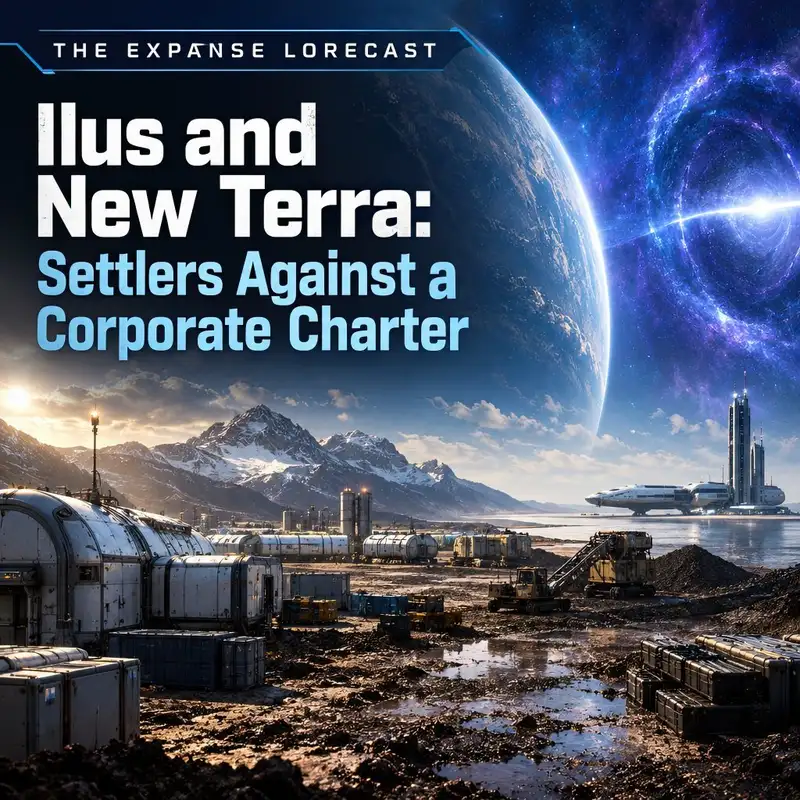
Ilus and New Terra: Settlers Against a Corporate Charter
The first attempt to land Royal Charter Energy personnel on Ilus ended in an explosion. The company had crossed an interstellar gate with scientists, engineers, administrators, security officers, equipment, and a United Nations charter. It expected a difficult expedition. It did not expect the ground beneath its landing area to be wired with explosives.
The bomb had been prepared by settlers who believed that the arrival of Royal Charter Energy meant the end of the home they had already built. Its detonation came at the wrong moment, or perhaps the worst possible moment. An unexpected shuttle was caught in the blast, and people who had not yet established offices, laboratories, or security posts died before the expedition had properly begun.
That attack did not prove that every resident of Ilus was a killer. Most were refugees, workers, families, and technicians trying to survive on a difficult new world. But it did transform the political situation. A dispute over settlement, extraction rights, and legal jurisdiction became a security crisis. It gave Royal Charter Energy’s security chief, Adolphus Murtry, the evidence he needed to argue that the settlers were not neighbors with competing claims. They were an armed threat.
And once one side defines an entire population as a security problem, restraint becomes difficult to recover.
The conflict began with a world that had two names. To the people who arrived first, it was Ilus. The name belonged to a settlement built by people who had crossed into the unknown because the old Solar System had failed them. To the United Nations and Royal Charter Energy, it was New Terra. That name appeared in charters, prospecting plans, corporate reports, and official claims to orderly development.
Neither name was merely decorative. Ilus meant labor, danger, shelter, and prior presence. New Terra meant legal recognition, investment, administrative authority, and the promise that the old powers of humanity could regulate the new frontier. The disagreement over language was an argument about who had the right to describe the planet, and therefore who had the right to decide its future.
The Ring Network had created this problem at extraordinary speed. The gates opened access to roughly a thousand systems, each one offering the possibility of land, minerals, water, biological discovery, and escape from the pressures of the old worlds. But the gates did not come with a constitution. There was no accepted interstellar legislature, no mature colonial court system, no common police authority, and no agreement on whether Earth, Mars, the Outer Planets Alliance, private corporations, or settlers themselves could claim authority beyond the gates.
The old institutions tried to extend their reach anyway. That was understandable. A thousand new systems could not simply be left to chance, piracy, private armies, and whoever happened to arrive first. But issuing a charter from the Solar System was easier than making that charter legitimate on a world where people were already living.
The settlers of Ilus had not arrived as a corporate advance party or a national colonization program. They came from displacement. Many had been refugees from Ganymede, where previous conflict and ecological disruption had destroyed the security of ordinary life. They traveled aboard the Barbapiccola, a ship that was more than transportation.
Crossing the gate did not turn them into prosperous pioneers. It placed them on a dangerous planet with unfamiliar ecology, uncertain weather, difficult logistics, and no guarantee that rescue would ever arrive. They established First Landing because they needed a place where children could sleep, injured people could be treated, equipment could be repaired, and food could be grown or preserved.
Then they found lithium.
The deposit gave the colony something more than hope. It gave it economic value. A resource that might support industry, trade, and eventual independence also made the planet visible to people with money, lawyers, ships, and political connections. The settlers had found a way to make Ilus viable. In doing so, they made it valuable enough to be contested.
This is one of the recurring traps of frontier settlement. A population may be ignored while it is merely surviving. The people who built the first shelters are reclassified as unauthorized occupants. Their settlement becomes a problem of paperwork. Their need to remain becomes an obstacle to development.
That did not give the settlers automatic sovereignty. First arrival is not a complete constitutional theory, particularly in a human civilization expanding into worlds with no settled legal order. But physical presence mattered. The settlers had established homes, dependencies, local knowledge, and a community whose survival was tied to the planet. They had taken risks no charter had protected them from.
Royal Charter Energy arrived with a different kind of claim. Its expedition traveled aboard the Edward Israel, a vessel carrying the tools of formal expansion. It had scientific teams, technical specialists, equipment, administrators, security personnel, and corporate backing. The company possessed a United Nations charter for exploration and resource activity. It had official recognition that the settlers lacked.
The charter was not meaningless. It represented an attempt to prevent the Ring worlds from becoming a free-for-all in which armed crews, criminal networks, or wealthy private interests seized territory without oversight. The United Nations had an interest in establishing some form of regulation before uncontrolled migration produced a hundred new conflicts. Royal Charter Energy also had legitimate scientific reasons to study a planet built around alien ruins and unfamiliar biology.
Scientists such as Elvi Okoye were not simply prospectors in lab coats. They were trying to understand an environment that could not safely be reduced to a mineral claim. Engineers had real problems to solve. Ordinary company employees had accepted a dangerous assignment, and many arrived expecting to perform technical work rather than participate in a colonial confrontation.
But formal authorization had limits. Royal Charter Energy did not arrive on an empty world. It did not have the consent of the people already living there. Its charter did not create a functioning local government, a trusted court, or a police force accepted by both sides. It could give the company a basis for a claim. It could not, by itself, make the settlers disappear or persuade them that their removal would be lawful, humane, or temporary.
The company also had material advantages. It possessed capital, better equipment, trained specialists, orbital infrastructure, and access to powerful institutions back in the Solar System. The settlers had fewer resources and more immediate vulnerabilities. They needed air, power, medicine, replacement parts, transport, and a reliable connection to the Barbapiccola in orbit. A prolonged confrontation favored the organization with deeper reserves.
Yet Royal Charter Energy had vulnerabilities of its own. Its personnel were far from reinforcement. Its expedition was not a military occupation force. It lacked uncontested authority, dependable local intelligence, and a civilian political structure capable of absorbing conflict. The more it treated settlement as a security operation, the more it risked making resistance appear necessary to people who already feared dispossession.
The bombing made that danger immediate. In one tactical sense, the sabotage succeeded. It damaged Royal Charter Energy, imposed casualties, and demonstrated that the settlers could strike before the corporation secured its position.
Strategically, it was disastrous for the settlers’ cause. The attack made negotiation harder. It validated the fears of corporate personnel who had not previously seen themselves as combatants. It strengthened the authority of the expedition’s armed security element.
Murtry was Royal Charter Energy’s security chief. He was not elected by the settlers. He was not appointed as governor of an accepted planetary government. He did not possess a constitutional mandate to decide who belonged on Ilus, who could be punished, or how much violence was necessary to impose order. But crises often create their own chains of command.
That is what happened on Ilus. The Edward Israel remained a corporate expedition with scientists, engineers, administrators, pilots, and technical crews. Its personnel did not all share Murtry’s instincts or ambitions. But the security emergency gave him practical leverage.
The distinction was not academic. Security personnel are supposed to protect people and facilities from danger. In a stable system, those functions are separated by law, procedure, and accountable institutions. On Ilus, those boundaries blurred almost immediately.
Murtry’s basic concern was real. More violence remained possible. The company had an obligation to protect its people. A responsible security chief would have investigated the bombing, identified the people directly involved, protected vulnerable personnel, and maintained enough discipline to prevent panic from becoming policy.
Murtry did something else. He began to treat the existence of a hostile faction as evidence that the entire settlement could be governed through intimidation. He assumed that the company’s charter entitled it to define the political future of the planet.
His conduct mattered not simply because he was personally ruthless. It mattered because the expedition’s corporate structure gave him room to make ruthlessness operational. In a frontier environment, private security can become a substitute for civil authority with alarming speed. The company’s need for protection became an argument for coercion.
Earth and the Outer Planets Alliance understood that the conflict could not be allowed to develop without intervention. Chrisjen Avasarala and Fred Johnson did not send a conventional occupation force. That would have raised its own questions. An Outer Planets Alliance intervention might have looked like a declaration that the Belt could seize any new world by arriving first.
Instead, they sent James Holden and the Rocinante.
The Rocinante was a small warship, but on Ilus it served as a diplomatic instrument. It had enough firepower and reputation to discourage reckless escalation. It could operate in the planet’s atmosphere. Its crew had working relationships across Earth, Mars, and the Belt.
His task was not to decide who owned the planet. No one had given him that power, and no one on Ilus would have accepted it if they had. If the first major colonial conflict ended with corporate security expelling refugees by force, the gates would become a new extension of Inner hierarchy. If settlers established that bombs and armed resistance could defeat any outside claim, every charter and treaty would become an invitation to private war.
Holden arrived with a mandate, but not neutrality in the pure judicial sense. He had been sent by powerful figures with their own political concerns. He carried his own moral instincts, his history with the Outer Planets Alliance, and his deep suspicion of people who treated lives as expendable.
His initial position was simple enough to sound obvious and difficult enough to be nearly impossible. Royal Charter Energy had an official charter. The settlers were already there. Both facts had to be recognized. Any arrangement that ignored the company’s legal backing would be unstable.
Carol Chiwewe, one of the settlers’ civilian leaders, represented the possibility of a negotiated future. She understood that the colony could not defeat the Inner planets by force. She also understood that accepting the wrong agreement could turn First Landing into a temporary labor camp on land the settlers had opened and made habitable. Her problem was not only what Royal Charter Energy offered.
On the corporate side, the bombing had poisoned every conversation. Royal Charter Energy personnel had reason to fear another attack. They had watched colleagues die before the expedition could establish itself. Every unexplained movement, every missing tool, every angry public gathering, and every local contact might appear to be part of another plot.
This was an intelligence spiral. Each side possessed partial evidence of danger. Each side interpreted uncertainty through its own fear. Royal Charter Energy saw secrecy, resentment, and real conspiratorial activity as proof that the colony could not be trusted. Neither side was entirely wrong about the threat. Both were capable of turning fear into confirmation.
Murtry exploited that condition. The killing was not a simple battlefield engagement. It was an assertion that armed corporate authority could decide, in public and without a legitimate court, which settlers had forfeited the right to live.
The effect was predictable. It widened the gap between people who might have supported a compromise and people who concluded that compromise was merely surrender by another name. It made Murtry’s own security forces more central to the company’s identity. And it taught the settlers that Royal Charter Energy’s charter might be enforced by the same people who held the weapons.
At the same time, a genuine plot against Royal Charter Energy personnel existed among elements of the settler population. That fact mattered. A responsible mediator could not dismiss it as corporate invention.
But valid intelligence does not erase the difference between defense and punishment. Murtry used surveillance and threat information to justify preemptive violence beyond narrow protection of his personnel. He acted as investigator, prosecutor, judge, and executioner. The existence of a conspiracy became a license to treat broad categories of settlers as enemies.
The settlers were not innocent simply because they had been displaced from Ganymede. Displacement can explain desperation. It does not make a bomb under a landing field harmless. People who had endured exploitation and abandonment could still choose to endanger civilians, scientists, medical staff, and workers who had no personal responsibility for the wider injustices of the Solar System.
But Royal Charter Energy was not made legitimate merely because it had suffered an attack. Its employees deserved protection. Its security staff had a duty to respond. Its charter had political significance.
Then the planet itself changed the terms of the dispute.
Ilus was not an ordinary frontier world. Its ancient ruins and strange geology were not abandoned scenery around a human resource contest. They were part of an immense Ring-builder system, a planetary-scale remnant of alien industry whose purposes were only partly visible and very poorly understood. Royal Charter Energy had arrived to study and exploit it. Neither side knew what they were living inside.
When dormant infrastructure activated, the consequences were catastrophic. The settlement suffered devastation. Systems failed. The planet became more dangerous. The effects reached into orbit, disrupting the fusion-driven ships that had brought the competing populations to Ilus in the first place.
The Rocinante, the Edward Israel, and the Barbapiccola were suddenly not simply vehicles or symbols of jurisdiction. A ship without drive power does not hover patiently above a planet. It continues on its existing path. Depending on that path, gravity can pull it toward destruction.
The Barbapiccola was in the most immediate danger. That danger carried political meaning because the ship was so much more than a hull. It had brought the settlers through the gate. It represented their prior occupation of Ilus. If it was lost with people aboard, the colony would lose lives.
The alien activation also made the surface crisis worse. Contaminated conditions and unfamiliar biological hazards turned ordinary injuries into serious risks. People suffered neurological symptoms, including blindness. The practical work of survival became harder at exactly the moment when trust between the groups was at its lowest.
For families in First Landing, the charter dispute had become immediate in a different way. It was no longer only about future rights to lithium deposits or political control. For Royal Charter Energy personnel, the expedition had ceased to be a controlled scientific mission. They were trapped alongside people who had recently attacked them, on a world whose machinery could disable ships in orbit.
The alien system did not morally judge either side. It did not punish settlers for violence or corporations for ambition. It was not a cosmic court. It was a dangerous and incompletely understood mechanism left behind by a civilization that humanity barely comprehended. Its activation simply revealed the arrogance behind both human claims.
Elvi Okoye and Fayez Sarkis became essential because they understood that the crisis could not be solved through force alone. Their work showed that Ilus was not merely a mineral deposit with some interesting ruins.
Scientific knowledge did not give Elvi command authority. It did not settle the political dispute. But it changed what competent leadership required. The planet had made clear that human legal categories meant little if the infrastructure beneath the ground could turn off power, trap ships, and endanger every person on the surface.
The disaster forced cooperation because neither side had enough capacity alone. Royal Charter Energy had equipment, scientific expertise, trained engineers, medical personnel, and access to technical systems the settlers did not possess. The settlers had local experience, labor networks, practical knowledge of First Landing, and people accustomed to maintaining a fragile community under difficult conditions.
Air had to be managed. Water had to be protected. Generators and pumps had to work. Medical care had to be improvised. Food had to be rationed and moved. Injured people had to be sheltered. Equipment had to be repaired with whatever parts remained available.
A charter could not filter water. A security patrol could not replace a burned-out pump. A lithium claim could not stabilize a damaged shelter. The people who could keep systems operating became more important than the people who could make the strongest argument about ownership.
This was the political truth that the crisis exposed. The settlers and Royal Charter Energy personnel were interdependent whether they liked it or not. The settlers needed equipment, expertise, medical support, and access to the technical capacity the company had brought with it.
Murtry saw the same emergency and drew a different conclusion. To him, shared survival was not a reason to create a durable political arrangement. It was an opportunity to establish control while everyone else was weak, frightened, and dependent. In that sense, the alien crisis did not end the human conflict. It created a more dangerous arena for it.
The people who paid most directly were neither corporate executives on Earth nor political leaders in distant stations. They were the families in First Landing, the injured workers, the technicians keeping life-support systems functioning, the scientists trying to prevent another catastrophe, and the crews trapped aboard ships with limited options.
The Barbapiccola’s failing orbit made that reality impossible to ignore. Naomi Nagata, the Rocinante crew, and personnel from the Edward Israel confronted a problem that could not be intimidated or negotiated away. Without functioning drives, it could not simply turn and accelerate to a new trajectory. Its orbital path had become a deadline.
The rescue required improvisation under conditions no normal mission plan would welcome. The use of railgun recoil as part of the effort was not standard naval procedure or a clever trick that could be applied whenever a ship needed maneuvering. It was a desperate response to a specific emergency, using whatever controlled force remained available.
That distinction matters. Spacecraft are not abstract game pieces. They carry momentum, mass, damaged systems, frightened crews, and limited time. A rescue operation must account for all of them. The people trying to save the Barbapiccola had to think about relative position, available capacity, how to transfer survivors, and whether each action improved the odds or merely delayed failure.
The ship itself could not be saved. But many of the people aboard it could be evacuated.
That outcome was both a loss and a political lesson. The settlers lost a vital piece of their material foundation. The Barbapiccola had been their transport, their industrial anchor, and a tangible symbol that they had reached Ilus under their own power.
Yet the evacuation also demonstrated something the earlier conflict had denied. The settlers survived because people from different factions used technical skill, shared capacity, and accepted mutual dependence. Their lives were preserved not by a charter, not by an armed claim to sovereignty, and not by the superiority of one side’s political story.
That did not make Murtry less dangerous. As Holden pursued answers inside the alien structures, Murtry continued to see the crisis as an opportunity to remove obstacles. His objective was no longer limited to protecting Royal Charter Energy personnel.
His pursuit of Holden made the underlying logic explicit. A mediator was intolerable to a man whose authority depended on presenting the conflict as a choice between security and chaos. Murtry needed that possibility to disappear.
The final confrontation cost more lives. Amos Burton was wounded. Chandra Wei, one of Murtry’s own people, died in the violence. The episode showed again how private security structures can deform responsibility. People recruited to protect an expedition can become trapped in the ambitions of a commander who sees every legal limit as weakness and every subordinate as an asset to be spent.
Holden defeated Murtry, but he did not execute him. The man had ordered or committed violence, sabotaged the possibility of coexistence, and pursued control at the expense of people struggling to survive. A frontier crisis offers many excuses for vengeance.
Holden rejected that logic. He disabled Murtry and returned him to face trial.
The choice did not create a complete legal order on Ilus. It did not erase the deaths caused by the bombing, the killings committed by Murtry, or the fear that had driven people toward violence. But it established an essential boundary.
Justice in a frontier setting is often incomplete and slow. Even so, the alternative is worse. If every security chief becomes judge and executioner during an emergency, then a charter becomes little more than a document used to rationalize whoever has the most guns.
The alien defense system was eventually shut down through a combination of Holden’s dangerous journey, Elvi’s scientific insight, and the continued intervention of the Investigator, the protomolecule-created representation that used Josephus Miller’s pattern as an interface. The process revealed more about the scale of the Ring builders’ lost civilization, but it did not provide humanity with a full explanation.
A destructive anomaly within the alien network played a critical role in ending the immediate threat. Its exact relationship to the forces or entities associated with the Ring builders’ destruction remained uncertain. Humanity had observed an effect and found a way to exploit it under desperate conditions.
When power returned, the survivors faced a less dramatic but more difficult task. They had to rebuild. The settlers and Royal Charter Energy personnel remained on Ilus because neither group could simply undo what had happened. The refugees had nowhere easy to return to. The corporation had invested heavily in a world of immense scientific and economic value.
Their cooperation was not a final constitutional settlement. No unquestioned sovereign emerged. The United Nations charter still mattered. The settlers’ prior presence still mattered. The company retained resources and institutional backing. The survivors of First Landing retained their claim to the place they had built through risk and labor. The political future remained unresolved because the underlying problem remained unresolved.
But the emergency had changed the terms of the argument. Royal Charter Energy could not plausibly treat the settlers as disposable squatters after depending on them for survival. The settlers could not plausibly build a stable future through sabotage and armed exclusion after the disaster had demonstrated their dependence on technical cooperation and outside support.
Ilus also changed the wider politics of humanity. People could cross the gates, establish communities, and begin building lives on other worlds. That possibility accelerated migration throughout the network. It also weakened Mars’s long-term political consensus, because a difficult terraforming project no longer appeared to be humanity’s only path to a new home.
That consequence would echo far beyond Ilus. New territory did not solve the old Solar System’s inequalities. The gates expanded human geography much faster than human law, trust, or political maturity.
The corporate charter on New Terra was therefore neither a complete fraud nor a sufficient answer. It gave Royal Charter Energy a formal claim, a basis for operating, and a connection to the institutions of the United Nations. But paper authority could not create legitimate rule over people who had already arrived, built homes, buried their dead, and made their survival dependent on the land.
The settlers possessed a real moral and practical claim, but they weakened it when fear became violence against people who were not simply agents of dispossession. Murtry possessed a real security problem, but he turned it into a justification for collective suspicion, extrajudicial killing, and private rule by force.
Ilus endured only when both sides were forced to confront what their rival claims had denied. No corporation, government, or settlement can build a durable future on the Ring worlds by treating the people already there as obstacles to be removed.