Holden Closes the Gates: Isolation, Survival, and Humanity a Thousand Years Later
The last exodus through Ring Space was not a victory parade. It was a mass decision made under a deadline no civilization had prepared for. Ships chose Sol, familiar colonies, family connections, supply bases, or simply the destination that offered the best chance of surviving after the gates were gone. Every transit carried the same finality. A route used routinely for decades might close forever as soon as the ship crossed it.
At the center of that emergency stood Ring Station. It was not merely an alien artifact, or a strange monument at the hub of a vast transit network. At that moment, it was the decisive terrain in the human war for survival. Whoever controlled it could influence the gates, the strange physics of Ring Space, and the minds of people caught within its reach. James Holden’s final decision would not be a conventional attack against an enemy fleet. He would not capture territory, compel a surrender, or impose a treaty. He would decide whether humanity could survive the loss of the infrastructure that had made interstellar civilization possible.
That was the contradiction of the final crisis. The gates were humanity’s greatest achievement, though humans had not built them and scarcely understood them. They connected roughly thirteen hundred systems. They transformed colonies from impossible dreams into reachable destinations. They opened routes for migration, trade, research, extraction, faith, escape, and conquest. They relieved pressure on the old Solar System while creating new pressures everywhere else. They did not make travel effortless. A ship still had to cross the distance from a gate to a planet, station, moon, or settlement by ordinary means. It still needed reaction mass, maintenance crews, food, water, medical care, and time. But the gates made the difference between a difficult voyage within a system and a civilization spread across the stars.
That infrastructure also created dependence long before it created equality. A colony might have land, air, and water, yet still depend on other systems for machine tools, medicines, technical specialists, replacement electronics, agricultural stock, and political recognition. A settlement might call itself independent while relying on gate traffic to prevent a failed harvest from becoming a famine. A shipyard might possess skilled workers and raw materials but still require components made somewhere else. The Ring Network was not only a map of opportunities. It was a web of obligations, vulnerabilities, and leverage.
Humanity had spent decades learning how much could be gained from that web. It had not learned quickly enough what using it might cost. The ancient builders of the gates were gone, annihilated or defeated by forces that humanity could not identify with confidence. The network itself was evidence of that catastrophe. It was an inheritance from a civilization powerful enough to reshape systems and construct pathways between stars, but not powerful enough to survive whatever opposed it. Humans saw the roads first. They understood the graveyard much later.
The danger did not arrive as a fleet with a flag, a demand, and a target list. The unknown entities associated with the destruction of the gate builders did not offer terms, explain their intentions, or present a military problem in a form that human doctrine could recognize. Their effects could be observed. Human minds could be altered, interrupted, or overwhelmed. Ships and systems could be subjected to phenomena beyond ordinary engineering. At least one entire colony system was effectively erased from the human world. But motive remained uncertain. Human labels for these forces were only labels. They did not establish a species, a government, or a coherent enemy strategy in the familiar sense.
That uncertainty mattered. A state can be deterred if it values something that can be threatened. A fleet can be defeated if it can be found, tracked, and engaged. An occupation force can be exhausted if its supply lines and political legitimacy fail. Humanity had no such framework here. There was no known target set. No reliable way to communicate. No assurance that a show of force would even be perceived. The combined military power of human civilization was formidable by human standards, but it was irrelevant if the threat existed outside the range of human weapons, human sensors, and human concepts of retaliation.
Elvi Okoye’s scientific work did not solve that mystery. It did something more operationally important. It changed the threat assessment. The available evidence suggested that the Ring Network was not a harmless relic waiting to be inherited. It was an intrusion into a larger reality, and continued human use of the gates appeared to provoke a response from whatever existed there. Humanity had not simply discovered a transportation system. It had moved into an ancient battlefield without knowing which weapons had been left armed.
That made the gates strategically intolerable, even before the final decision was made. Their value was precisely what made them dangerous. Every ship passing through them, every colony founded beyond them, every government built around their traffic, increased humanity’s exposure to a threat it could not defeat or even properly describe. Closing the gates would be catastrophic. Leaving them open might be worse. It was the sort of choice that appears impossible until every alternative has become less possible.
Winston Duarte offered one answer. It was not an answer based on dispersal, local survival, or human political compromise. It was based on unity imposed at the level of consciousness itself. Duarte had built Laconia into an empire through preparation, secrecy, military discipline, alien-derived technology, and a ruthless understanding of the fractured systems beyond his borders. His project had always promised order. In the final crisis, order became something much more absolute. Through Ring Station, Duarte sought to bring human beings into a single coordinated mind.
The immediate tactical appeal was obvious. A hive mind would not suffer from delayed orders. It would not need negotiation between Earth, Mars, Belters, colonies, corporations, resistance networks, and local governments. It would not lose battles because commanders misunderstood one another, because intelligence arrived late, or because political disagreement slowed a response. A unified consciousness could coordinate ships, weapons, and decisions with a speed that no conventional command system could match.
It could also eliminate the people being coordinated.
Duarte’s solution treated separateness as a weakness. Individual judgment, dissent, privacy, memory, and choice became inefficiencies to be overcome. In an existential emergency, that argument can sound almost responsible. A civilization facing annihilation is vulnerable to any leader who promises survival in exchange for obedience. But Duarte’s project demanded more than obedience. It demanded the end of meaningful consent. A human being absorbed into a unified system might continue to think, feel, and act in some limited way, but no longer as an independent political or moral agent.
That is the deeper authoritarian promise. It presents disagreement as disorder, and disorder as a luxury humanity can no longer afford. It calls plural politics wasteful when it is inconvenient. It describes freedom as a vulnerability when people refuse to accept the ruler’s solution. Duarte did not merely intend to defend humanity. He intended to define what humanity would be allowed to remain.
Teresa Duarte mattered because she stood inside that structure. She was not simply an outside rebel rejecting an imperial enemy. She was the daughter and intended heir of the man attempting to remake human civilization. Her refusal to accept his future exposed the political emptiness at the center of his project. An empire can build fleets, command scientists, and impose obedience on occupied worlds. It cannot guarantee that its own succession will believe in the purpose for which all that power was accumulated.
The confrontation in Ring Space therefore became more than the final battle of the Laconian war. It was a struggle over what command itself meant. The human forces resisting Duarte did not have a clean path to decisive victory. Their purpose was to preserve enough independent people, ships, and choices to escape. The objective was time. Time for evacuation. Time for ships to clear the hub. Time for someone to find a solution before Duarte’s control became permanent and the unknown entities inflicted a catastrophe no one could contain.
In a conventional battle, centralized command can be a powerful advantage. Shared targeting data, coordinated maneuver, and common doctrine can turn separate ships into a coherent force. But the hive mind transformed coordination into captivity. It made human consciousness part of the weapons system. The danger was not only that Duarte could issue better orders. It was that people could no longer refuse them, question them, or recognize that they had become instruments of someone else’s will.
The resistance had to distinguish between tactical survival and strategic survival. A ship that escaped a barrage or held position against a Laconian threat had achieved a tactical result. A force that bought time for more vessels to evacuate had achieved an operational result. But neither would matter if the survivors remained exposed to the entities through the gates, or if they survived only by surrendering their independence to Duarte. The final objective was not to hold Ring Space. It was to get humanity out of it.
Aliana Tanaka’s killing of Duarte broke the immediate human mechanism of the hive mind. It was decisive, but it was not restorative. Duarte’s death did not make Ring Station safe. It did not explain the unknown entities. It did not reopen a path to ordinary government. It removed the person attempting to rule humanity through the station, and in doing so created a new crisis. The systems he had manipulated did not become harmless merely because their operator was gone.
Tanaka’s action also revealed the limits of Laconian power. Laconia had conquered because it had prepared for a fractured enemy. It had superior ships, disciplined institutions, privileged access to alien technology, and the advantage of surprise. Those strengths were real. They were not illusions. But conquest had not solved the problems that followed conquest. It had not created consent. It had not eliminated resistance. It had not made alien technology understandable. And it had concentrated so much authority in Duarte that the empire’s final crisis became inseparable from the condition of one man.
That was the central weakness of Duarte’s system. It had reduced information flowing upward by making disagreement dangerous. It had trained obedience where it needed honest warning. It had built its legitimacy around competence and order, then discovered that competence cannot be permanently commanded from above when the underlying reality is unknown. Duarte could force human institutions into alignment. He could not force the universe to become legible.
With Duarte dead, Ring Station still required a human interface. Holden became that interface. He did not take control because he had discovered a master key to alien technology or because he had finally become the commander of a united humanity. The opposite was true. He acted because the institutions that might have shared or constrained such a decision had failed under the pressure of the crisis. The available choices had narrowed until one person, in one impossible position, had to hold the line.
The station’s workings remained beyond human understanding. What mattered was the observed result. Holden could resist or delay the immediate danger long enough for ships to evacuate Ring Space. He could use the station’s connection to the network to create a brief interval in which escape remained possible. But he could not defeat the unknown entities in their own domain. He could not establish a stable balance of deterrence. He could not preserve the gate system without preserving the route through which humanity had become vulnerable.
His remaining option was strategic denial.
Strategic denial is an old military logic. When an enemy cannot be defeated directly, a commander may destroy the bridge, fuel depot, port, rail line, or communications network that gives the enemy access to the battlefield. Such decisions are never painless. Infrastructure serves civilians as well as soldiers. It carries food, medicine, families, knowledge, trade, and hope. The bridge that an army might use is also the bridge a refugee needs to cross. The difference in Ring Space was scale. Holden was considering the destruction of every bridge between the human systems.
The evacuation gave that decision its human dimension. Alex Kamal took the Rocinante toward Nieuwestad, where his son and grandson offered a future more immediate than any abstract argument about the fate of civilization. Naomi Nagata, Amos Burton, Teresa Duarte, and others traveled toward Sol aboard the Falcon. The old Rocinante crew had survived conspiracies, wars, invasions, political betrayals, and alien disasters because they had remained, in some form, a mobile institution. They carried experience across borders that governments could not cross easily. They had repeatedly found ways to stay together.
Now they separated because staying together was no longer the operationally responsible choice.
That separation was not a sentimental ending to a long voyage. It was a logistical fact. Every ship needed to choose a reachable destination. Every destination represented a wager on local resources, existing relationships, industrial capacity, and the ability of a community to govern itself after interstellar support disappeared. No one could promise that Sol would be safe, that Nieuwestad would prosper, or that any particular world would endure unchanged. The gates had allowed people to imagine that distance could be managed. Their closure made distance sovereign again.
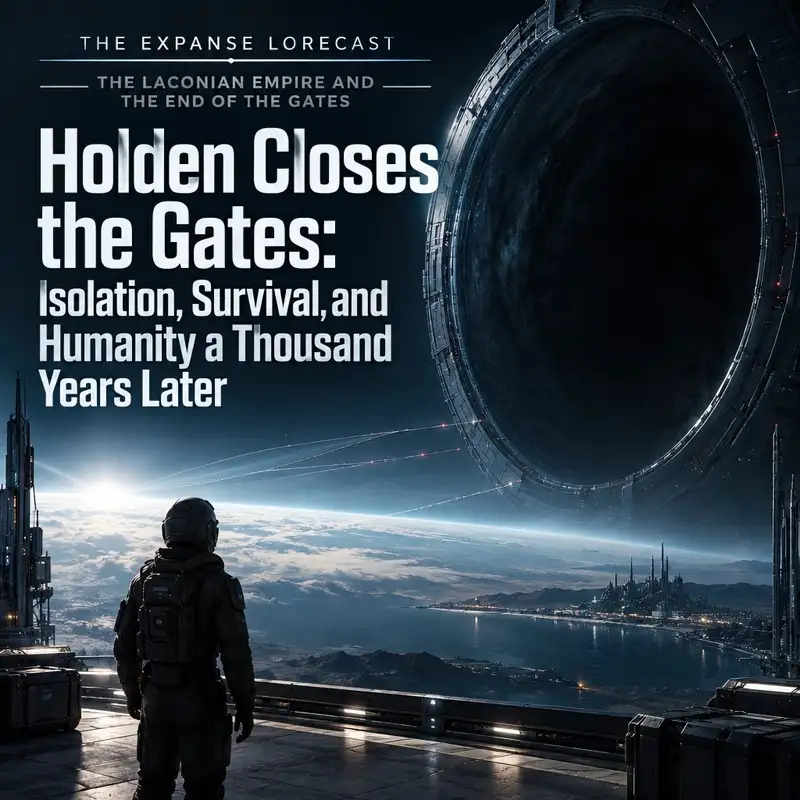
Once the evacuation had gone as far as it could, Holden acted. Ring Station collapsed or was destroyed through the same extraordinary systems that had made it the center of human transit. The gates ceased to function. Across the scattered human worlds, the artifacts that had opened routes between stars fell toward their local suns. The visible image was simple enough to understand. Civilization’s roads were dropping out of the sky.
Strategically, the result was equally clear. Holden did not destroy the unknown entities. He did not invade their reality, punish them, or prove that humanity had won some final war against the force that destroyed the gate builders. He severed their direct access to the human universe through the Ring infrastructure. He removed the point of contact. He made the battlefield unavailable.
That may have saved humanity. It also imposed an extraordinary cost on humanity without universal consultation. There was no system-wide vote. No time for every colony, station, family, government, and ship crew to weigh the risks. Holden made a civilization-scale decision because delay could have left no civilization capable of making any decision afterward. That emergency does not make the act uncomplicatedly legitimate. It does explain why ordinary legitimacy could not function in the time available.
The gates had been a common inheritance, even if access to them had never been equally shared. Destroying them meant deciding that no one could use them. It meant denying the network to Duarte, to the unknown entities, and to every human community that depended upon it. Holden chose survival through separation over survival through absorption or exposure. Whether every stranded population would have agreed is unknowable. The fiction does not offer the comfort of unanimous consent after the fact.
The first years after closure were therefore not a clean return to local independence. They were an age of emergency adaptation. The loss of gate traffic did not merely mean fewer travelers and slower commerce. It meant that every isolated system had to discover which parts of its civilization were genuinely local and which had been borrowed from a network that no longer existed.
A colony with a breathable atmosphere might still lack the agricultural capacity to feed its population. A settlement with fertile land might lack medicine, skilled surgeons, replacement parts, or the machine tools needed to manufacture replacements for failing systems. A world with power generation and local industry might survive shortages that destroyed another community with more pleasant weather but less technical depth. A station might possess experienced workers but no access to the volatiles, food, or spare components that had once arrived through regular trade. Habitability was not self-sufficiency.
The conditions shown in the aftermath on one isolated colony make that clear. Supplies were depleted. Defenses were weak. Authority was uncertain. Alien ecology created dangers no human frontier society had fully mastered. Internal disputes became more serious because no distant authority could be expected to intervene, resupply, or impose a settlement. People were not simply pioneers enjoying a new freedom. They were inheritors of infrastructure they might not be able to maintain, and of social conflicts they could no longer export to another system.
That is what isolation means in material terms. Food has to be grown, processed, stored, and distributed. Water systems need pumps, seals, filters, power, and people who understand how to repair them. Medicine requires knowledge, laboratories, manufacturing capacity, and supply chains that may no longer exist. Technical education cannot be replaced by a warehouse full of manuals if the people trained to use the machines are aging, dying, or leaving. Security becomes local because no fleet can arrive from another star. Governance becomes local because no interstellar institution can reliably enforce its decisions.
Families were separated by the closure. Communities that had imagined themselves as part of a wider human future found themselves cut off from that future overnight. Trade relationships vanished. Old political arguments changed meaning. A colony that had resented distant oversight might discover that the loss of external support came with its own forms of vulnerability. Another world might find that distance protected it from old rivalries and allowed a more durable society to emerge. The gates’ closure did not produce one post-Ring history. It produced many.
The record refuses to provide a complete ledger of those histories. It does not tell us that every one of the roughly thirteen hundred systems survived. It does not tell us that all colonies collapsed into hardship, tyranny, or technological decline. It does not offer a comforting catalog of restored worlds. That restraint is important. The fate of a society depends on more than whether it has a planet and a population. It depends on soil, water, energy, workshops, institutions, memory, trained labor, local leadership, and the ability to settle conflicts without expecting rescue from elsewhere.
Some systems may have retained enough agriculture, fabrication, and technical skill to build durable local economies. Others may have lost critical capabilities slowly, one failed component or untrained replacement at a time. Some may have become more cohesive under pressure. Others may have fractured. The collapse of the Ring Network ended the old common framework of interstellar transport and political connection, but it did not erase local differences. Humanity did not become one isolated civilization. It became a scattered collection of civilizations, each carrying fragments of a shared past.
That fragmentation was the price of Holden’s choice. It was also part of its purpose. The old network had made empire possible because it made concentration possible. Duarte could imagine ruling humanity because the gates had tied humanity together through one central hub. The same infrastructure that connected families and trade routes also offered an authoritarian ruler a path to universal command. The same system that allowed human expansion also exposed humanity to forces beyond human control.
A thousand years later, the epilogue reveals that isolation was not permanent. Humanity had developed another means of traveling faster than light. A polity known as the Thirty Worlds had reestablished long-distance contact and sent a linguist to Earth. The visitor’s arrival matters because it is not presented as the restoration of the old order. The Thirty Worlds are not established as the government of all surviving humanity. Their technology is not simply the Ring Network rebuilt with human branding. The details remain sparse, and that sparseness is part of the point.
Humanity had found another way forward, but it had done so by its own effort, across a millennium of separation. The future that reappears is not the old gate civilization returned intact. It is a new civilization approaching Earth with new language, new institutions, and a history shaped by distances that the old network once seemed to abolish. Reconnection comes, but it comes after difference has had time to become real.
Amos Burton is there to receive that future. His survival is extraordinary, not ordinary evidence that humans had conquered mortality. He has been transformed by protomolecule processes into something that remains recognizably connected to the person he once was, while no longer being simply a conventional human being. He is a survivor from the old age standing at the edge of a new one. His presence gives the epilogue an intimate scale. A thousand years of political collapse, local endurance, innovation, and renewal are represented by one visitor arriving at Earth and one ancient witness still able to answer the door.
That encounter does not erase the cost of what came before. It does not restore the lost families, colonies, ships, or institutions of the Ring era. It does not prove that every isolated world endured. It does not make Holden’s choice painless in retrospect. The people stranded after the closure still had to live with shortages, uncertainty, danger, and the knowledge that no gate would open to bring help. For generations, survival depended on what communities could grow, repair, learn, defend, and govern for themselves.
But the epilogue does establish something essential. Humanity’s future did not depend on keeping the gate builders’ machine alive. It did not require Duarte’s imposed unity. It did not require a permanent connection to a system that had become both an alien killing ground and a mechanism for human domination. Humanity survived because enough people remained capable of adapting after the old structure failed.
Holden’s last decision saves no interstellar empire. It destroys the mechanism that made one possible. The gates close, colonies are isolated, supply chains break, and countless people inherit futures they did not choose. Yet the same act denies Duarte a human hive mind and denies the unknown entities continued access through the Ring system. A thousand years later, humanity has survived not as one perfectly coordinated civilization, but as descendants of many separated ones. The network ends. Human possibility does not.