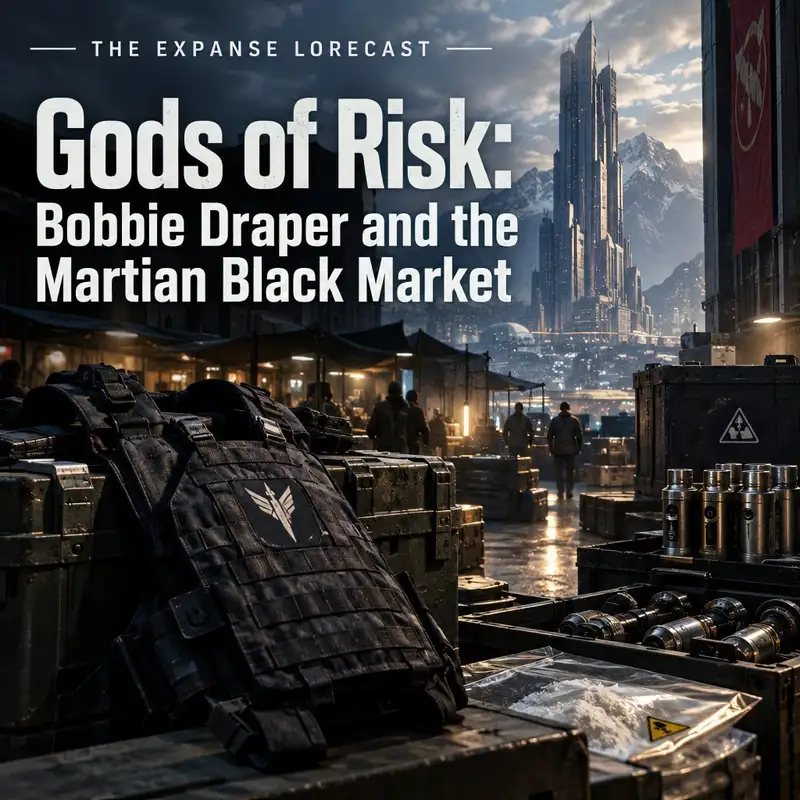
Gods of Risk: Bobbie Draper and the Martian Black Market
Bobbie Draper comes home to Mars carrying the kind of experience that civilian language handles badly. On Ganymede, she had been a Martian Marine in powered armor, part of a force built around training, discipline, and confidence in its equipment. She had seen something that did not fit the models her government used to explain war. Then she had survived the political confusion that followed. By the time she is living with her brother’s family in Londres Nova, she is no longer operating inside a unit with a mission, a chain of command, and a clear definition of danger. She is on psychological furlough, or at least outside active service in every way that matters to daily life. Her family gives her a room, meals, concern, and the ordinary tolerance offered to someone who has returned changed. What it cannot give her is a purpose.
That gap is the quiet center of Gods of Risk. The novella is not primarily an account of a criminal syndicate, a police investigation, or a military operation. It is a story about a family crisis in a Martian city. A teenage boy manufactures illicit drugs. A young woman becomes trapped in the orbit of a predatory dealer. An injured veteran recognizes danger before the people around her do, then acts with the competence she still possesses. But the small scale is deceptive. James S. A. Corey uses the Draper family to examine Mars at a moment when its public discipline no longer guarantees private confidence. The immediate risks belong to David Draper. The deeper risk belongs to the society that produced him.
Mars had always asked a great deal of its people. Its national project was more than survival beneath domes and tunnels. It was transformation. Generations of Martians accepted sacrifice, regulation, technical labor, military service, and a harsh environment because these were investments in a future world. Terraforming gave the sacrifices a direction. Mars was more than a colony with a navy. It was a society organized around the promise that effort accumulated. Each difficult year was supposed to make the next generation less constrained by the planet that had once been barren.
That promise shaped institutions as well as emotions. Mars educated engineers, scientists, technicians, administrators, soldiers, and skilled workers because the entire project required them. It built a military capable of defending the planet against Earth, but military power was tied to a civilian ideal. The Martian Congressional Republic did not train people only to fight. It trained them to build, maintain, calculate, supervise, and endure. Its reputation for competence came from a society that had little room for waste. A leaking seal, a failed recycler, or a poorly designed transit line was not an inconvenience. It was a reminder that survival depended on systems functioning as intended.
Londres Nova is part of that civilian Mars. It contains families, schools, public transit, laboratories, technical workplaces, neighborhoods of different means, and young people trying to determine whether their lives will amount to more than the paths already assigned to them. It is not a parade ground. Its residents are not all soldiers, engineers, or believers in the national project. Mars has inequality, ambition, private disappointment, family conflict, and crime. The point is not that these things have suddenly appeared. Every advanced society produces them. The point is that the old Martian bargain has begun to feel less certain at precisely the moment when people are being asked to continue living by it.
The political atmosphere makes ordinary life more brittle. Tensions between Earth and Mars remain serious after the Ganymede crisis. Reports of terrorism and sabotage circulate through the city. A disruption in a transit tube becomes more than a transportation problem because Martian infrastructure is intimate. Enclosed routes connect sealed neighborhoods. Their reliability supports work schedules, schooling, supply, medical access, and family life. When a tube is damaged or closed, the immediate physical danger may be limited, but the psychological effect can be broad. People begin to imagine what else might fail, and who might be responsible.
That does not mean Londres Nova has become a battlefield. The novella does not establish a citywide insurgency, a comprehensive terrorist campaign, or a hidden military front. Its security environment is more subtle. Public anxiety creates a setting in which people are prepared to see threat everywhere. Government tension with Earth, stories of violence elsewhere, and the memory of Ganymede all make disruptions feel connected, even when the connection is uncertain. A habitat society can be unusually vulnerable to that kind of fear. When life depends on engineered systems, people understand that a small act of sabotage can have consequences far beyond its material scale.
Bobbie understands institutional failure in a different way. Her experience on Ganymede has taught her that a system can appear strong until it encounters something it did not anticipate. She is more than traumatized by combat in the abstract. She has been forced to confront a threat that challenged Martian assumptions about surveillance, weapons, command, and technological superiority. The Martian military had been built to face Earth in a rivalry that both sides understood. Ganymede exposed the possibility that the strategic environment contained actors, technologies, and motives outside that familiar competition.
The full meaning of Ganymede is not immediately available to everyone on Mars. Bobbie has seen events from ground level, under conditions of confusion, exhaustion, and fear. The Martian government has intelligence reports, political obligations, military secrets, and reasons to control public interpretation. Earth has its own account. The wider public receives fragments, official statements, rumors, and the visible evidence of a system under strain. Nobody possesses an uncomplicated picture. But uncertainty itself is destabilizing when national identity rests on competence. Mars can accept danger. It has been built around danger. What it has more difficulty accepting is the discovery that careful preparation may not be enough.
For Bobbie, the result is dislocation. In uniform, competence had a place. It was measured, rewarded, and directed toward a mission. The Marine Corps had given her comrades, procedures, equipment, and an institutional language for risk. Civilian life offers no equivalent structure. Her family sees a beloved relative who has come home wounded in ways they cannot fully see. Bobbie sees rooms that are too quiet, routines that do not require her, and concerns that seem both precious and strangely distant. This is not a failure of affection. It is a failure of translation. A family can welcome a veteran home without knowing how to absorb the realities that made homecoming necessary.
Her nephew David inhabits another form of pressure. He is young, talented, and studying chemistry at the lower university. His education is supposed to be a route upward. Placement in the higher university would bring status, opportunity, and a stronger claim on Mars’s technical future. The path matters to his parents, and it matters to him. Academic advancement is more than a matter of adolescent pride. In a society built around expertise, credentials carry practical weight. They affect the work a person may do, the future they can imagine, and the degree to which they are considered to have fulfilled their share of the collective bargain.
David is capable enough to meet many of those demands. That is part of the problem. Technical ability can create a dangerous illusion of maturity. A person who understands a laboratory process may assume that he understands the people who want him to perform it. A teenager who can solve chemical problems may believe he can improvise his way through social ones. David wants autonomy, money, excitement, and recognition. He also wants to be useful to people who seem more worldly than his family. None of this makes him unusual in the broad human sense. It makes him vulnerable in a specific environment where specialized knowledge is valuable and access to institutional resources can be quietly exploited.
The illicit economy that finds him is small enough to hide in ordinary life. Hutch’s drug operation does not require the apparatus of a major cartel. It needs something more common and more difficult to police completely: access. It needs chemical knowledge, laboratory facilities, inputs that can be diverted or concealed, people willing to distribute the product, and young workers who believe they are participating in a private opportunity rather than entering a coercive relationship. A university environment offers several of those things at once. It concentrates skill, ambition, equipment, and students who may not yet understand the difference between being recruited and being used.
This is how criminal capacity often develops inside advanced societies. It does not always arrive from outside carrying obvious signs of disorder. It can emerge through the misuse of normal systems. Laboratories exist for education and research. Transit exists to move people safely through a sealed city. Professional networks exist to connect talent with work. Family expectations are meant to encourage success. None of these institutions are criminal by nature. Yet each can become part of an illicit arrangement when someone finds a way to redirect its value. Hutch’s operation is not proof that Mars is collapsing. It is evidence that no society is so disciplined that skill, infrastructure, and aspiration cannot be diverted.
The black market in Gods of Risk must be understood precisely. It is a drug-production and distribution network centered on local criminal relationships. It is not an Outer Planets Alliance operation. It is not a terrorist cell. It is not a secret military procurement system. It is not the same black market that later appears in Martian military equipment, armor, ammunition, medical supplies, and ships. To merge these different economies would make the story seem larger and cleaner than it is. The novella’s power comes from its narrowness. David does not stumble into a planetary conspiracy. He stumbles into a local system of exploitation with immediate consequences for people he knows.
Leelee stands at the human center of that system. David is attached to her, and that attachment is real, but it is also confused. He sees her through the intensity of adolescent desire and through his own need to become someone decisive. She is associated with Hutch’s operation and vulnerable to the control that comes with it. When she disappears, David does not receive a neatly verified intelligence report. He has fear, partial knowledge, suspicion, and a sense that he has failed someone. Those emotions push him toward action. The action is brave in one sense. It is also driven by assumptions he has not examined.
David’s mistake is more than that he cares about Leelee. Care matters. His mistake is believing that care gives him authority over her life, or that rescue will produce the romantic resolution he wants. Coercive environments distort relationships. People become difficult to reach. Their choices may be constrained by fear, debt, dependency, or manipulation. A young person trying to help can easily confuse another person’s danger with an opportunity to become indispensable. David is not cruel, and the novella does not ask the listener to dismiss him. It asks us to see that courage and entitlement can coexist in the same person, especially when that person has little experience of consequences.
Hutch understands consequences very well. He is not a grand criminal mastermind, nor does he need to be. His advantage comes from familiarity with coercion. He knows how to use fear, secrecy, dependency, and the threat of violence to protect a business that rests on other people’s risk. David has laboratory skill and emotional urgency. Hutch has practical authority within the criminal relationship. He knows which people can be pressured, which promises are empty, and when a threat is enough. That asymmetry matters more than David’s intelligence. In any confrontation, technical competence is only one form of power.
The surrounding city reinforces the atmosphere of uncertainty. Londres Nova is connected by systems that are designed to create order. Transit routes organize movement. Educational institutions sort students into pathways. Residential districts define private space. Security measures create a sense that danger can be contained. But the same compartmentalization can isolate people. A disrupted tube can cut a neighborhood off from the rhythms that make it feel secure. A student can pass between home, university, and illicit work without any one institution seeing the complete pattern. A veteran can live in a family household while carrying knowledge no civilian conversation can easily accommodate.
In such a setting, public fear and private secrecy feed one another. Anxiety about Earth, terrorism, or sabotage does not cause David’s choices. It does make the background harder to read. When people expect political violence, they may overlook the quieter violence already present in ordinary relationships. A local dealer with a firearm may not be discussed in the same terms as a geopolitical crisis, but he has immediate power over those within his reach. A young woman’s disappearance may not produce a government response. For David, it becomes the only crisis that matters. For Bobbie, it becomes recognizable as a threat because she has spent her life learning what coercion looks like when the stakes become physical.
David decides to confront Hutch and recover Leelee. The impulse has a certain logic. He has knowledge of the drug operation. He has access to its production. He believes that this knowledge gives him leverage. He may be able to offer drugs, information, or some other bargaining position in exchange for Leelee’s safety. But this is not a plan in the military sense. He does not have reliable intelligence about where she is, what Hutch intends, or who else may be involved. He has no backup, no secure escape route, no effective communications plan, and no credible answer to the possibility that Hutch will simply choose violence.
That failure is not a condemnation of David as cowardly. He is not cowardly. He goes into danger because someone may need help. The problem is that courage does not erase asymmetry. A person can be brave and still be unprepared. In military terms, David has entered a hostile situation without understanding the terrain, the adversary, or the likely escalation points. He has confused possession of information with control over events. This is a common human error, and it is particularly dangerous in criminal settings. Knowledge of wrongdoing does not by itself protect the person who knows it. Often it makes that person more vulnerable.
Hutch’s firearm clarifies the real balance of power. Until then, David can imagine himself negotiating among peers, or at least confronting someone who will respond to reason and risk calculation. A weapon changes the relationship. It reveals that Hutch’s authority is not based merely on persuasion, money, or social confidence. It rests on a willingness to impose bodily harm. David may have believed that Hutch has reasons not to hurt him. Hutch’s threat demonstrates that the criminal economy is protected by a form of force David has not seriously accounted for. The laboratory has prepared him to make compounds. It has not prepared him to manage violence.
Bobbie’s arrival changes the encounter because she does understand violence. She does not enter as a police officer conducting an investigation, and she has no formal authority to dismantle Hutch’s operation. She arrives as a veteran whose training remains intact even while her institutional role has become uncertain. In the critical moment, she assesses the immediate threat, acts decisively, and disarms Hutch. The action is controlled rather than theatrical. Her objective is not to win a war or make a statement. It is to protect David and Leelee from a man who has shown that he is prepared to use a gun.
Her success comes from habits developed in military service. Bobbie is physically confident, but physical confidence alone is not enough. She is able to identify the urgent problem, act without freezing, and apply force in a limited way. She understands that a confrontation can shift in seconds. She does not need to persuade Hutch into behaving better. She needs to remove his ability to impose immediate harm. Those are different tasks. The scene demonstrates why military training retains value after a soldier leaves the battlefield. It also shows how unsettling that value can be in civilian life. A family emergency should not require the skills of a combat veteran. When it does, the veteran may be the only person in the room prepared to act.
The tactical result is real but narrow. David and Leelee are protected. Hutch is disarmed. An immediate threat ends. Yet nothing in the novella suggests that Bobbie has destroyed a large criminal market, exposed a vast network, or repaired the failures that allowed it to exist. She has won a short encounter. She has not restored the conditions that make young people less susceptible to coercion, nor has she solved the uncertainty in her nephew’s life. A tactical success is not the same as a strategic cure. Mars still has its anxieties, its private pressures, and its institutions struggling to explain a future that feels less solid than it once did.
The aftermath also refuses the comforting idea that violence creates clarity. David has done something meaningful. He has tried to help Leelee, and his willingness to act has mattered. But the outcome does not validate every belief he brought into the confrontation. Leelee is not a reward for his bravery. Her life and choices do not become his property because he took a risk. Bobbie can recognize his courage without endorsing his romantic expectations. That is one of the novella’s quieter acts of moral discipline. It treats David seriously enough to deny him the fantasy that danger automatically makes a person wise.
Bobbie’s response to David is unsentimental because she has learned what risk actually costs. Combat has not turned her into a detached machine. It has made her wary of stories people tell about themselves after surviving danger. The young often imagine risk as a test that will reveal their true importance. Soldiers are not immune to that fantasy, and neither are societies. Mars has spent generations treating hardship as proof of national character. There is dignity in that tradition, but it can become dangerous when sacrifice is treated as meaningful by definition. Sacrifice needs a credible purpose. Without one, hardship becomes resentment, escape, or private self-destruction.
This returns us to Bobbie’s place in the Draper household. The confrontation gives her a temporary mission. For a short time, her experience has an obvious use. She can protect people she loves. She can bring order to a moment of chaos. But it does not provide a durable answer to the question of what happens next. Her family cannot just convert her military identity into a civilian profession. The state that trained her for extraordinary danger has not given her a clear route toward recovery, belonging, or a new sense of usefulness. She is still Bobbie Draper, and her abilities have not diminished. The social structure around her has changed.
This is a civil-military problem as much as a personal one. States often imagine that military service can be contained within institutions. People are trained, deployed, injured, returned, and reassigned through a sequence of procedures. But no administrative process can guarantee that a person will return with the same relationship to ordinary life. Bobbie has seen too much, and she has learned too clearly that official confidence can fail. Her alienation is more than psychological damage in the narrow clinical sense. It is also political and institutional. She has served a society that promised purpose through competence, then placed her in a world where that competence has no obvious destination.
Mars’s difficulty is not that it lacks discipline. The novella makes clear that discipline remains deeply embedded in Martian culture. Families value education. Institutions produce technical talent. The military still creates formidable soldiers. Infrastructure still functions well enough that its failures are startling. The difficulty is that the old collective story is losing some of its organizing force. Terraforming remains a real project. Mars has not abandoned it, and the planet has not dissolved into chaos. But the arrival of new possibilities beyond the Ring, combined with the strategic shock of recent events, makes the old promise harder to sustain as the sole answer to the question of why people should sacrifice.
For a teenager like David, this does not necessarily appear as an ideological crisis. He does not sit down and reject Martian civilization in a formal political argument. The change appears as restlessness, impatience, and the search for a private route to status or excitement. The approved path through education and professional advancement may still be available, but it no longer feels like the only imaginable future. Illicit work offers money, secrecy, and the intoxicating feeling of operating outside parental and institutional control. It is a bad bargain. That does not make it incomprehensible.
For Bobbie, the weakening of purpose appears differently. She has already dedicated herself to the collective project. Her life has been shaped by duty, service, and loyalty to Mars. The crisis is not that she suddenly becomes disloyal. It is that the institutions around her no longer provide an adequate explanation for what she has endured. Ganymede has made the military future uncertain. Civilian life has made her personal future uncertain. Her family gives her something worth protecting, but protection is not the same as direction. The skills that once connected her to Mars now mark her as someone apart.
The title, Gods of Risk, therefore works as an interpretive frame rather than a description of formal belief. Mars has long given risk a kind of civic meaning. Its citizens take chances with their bodies, their time, and their ambitions because the society tells them those risks contribute to a shared future. David’s risk is more private and immature. He gambles with his education, his safety, and another person’s trust. Hutch’s risk is predatory. He transfers danger downward, making young people bear the consequences while he claims the profit. Bobbie’s risk has been institutionalized. She has taken danger on behalf of a state that now struggles to return the meaning of that service.
The later history of Mars gives this small story additional weight, but it must be used carefully. In Nemesis Games, Bobbie becomes involved with a far more dangerous illicit traffic in Martian military equipment and related resources. Weapons, armor, medical supplies, ammunition, and even ships move out of the control of the institutions that created them. That later black market is not Hutch’s enterprise enlarged. There is no basis for claiming that David, Leelee, Hutch, or their local drug operation directly lead into the conspiracy around stolen military assets. They are separate criminal worlds, operating at different scales and with different strategic consequences.
The connection is thematic, not organizational. Both stories show forms of institutional leakage. In Gods of Risk, a university’s knowledge and facilities can be redirected into a small drug economy. In the later military crisis, the technical and industrial capacity of Mars itself becomes vulnerable to diversion. In both cases, the important question is not whether Mars suddenly lacks talent. It has talent in abundance. The question is whether Mars can still direct that talent toward a future people believe in. A society may retain advanced laboratories, disciplined soldiers, shipyards, and technical schools while losing confidence in the project that once held those assets together.
That is why the eventual Martian crisis cannot be explained only by foreign manipulation, greed, or military conspiracy. Those factors matter, but they work most effectively where faith in the existing order has already weakened. A black market needs more than goods. It needs participants willing to believe that official structures no longer deserve their loyalty, cannot protect them, or simply offer too little in return. Hutch exploits individual vulnerability. Later actors exploit institutional vulnerability. The scale changes. The underlying danger is the same: valuable capability becomes available to people whose purposes are private, coercive, or destructive.
Gods of Risk does not portray Mars as doomed. That would be too simple, and it would misunderstand the society presented in the novella. Londres Nova remains a place of families, learning, work, public systems, and ordinary decency. David’s parents care about him. Bobbie cares about David and Leelee. The university represents genuine opportunity as well as vulnerability. The existence of a criminal economy does not invalidate the entire Martian project. Nor does one traumatized Marine stand for every veteran. The story is more patient than that. It captures a moment when confidence begins to weaken before visible collapse makes the weakness impossible to deny.
The danger is not conventional military defeat. Mars has not lost a planetary war in Londres Nova. No fleet arrives to conquer the city. No invading army occupies the Draper household. The threat is the gradual loss of a shared answer to the question of what sacrifice is for. When that answer becomes less convincing, people begin to seek private exits. A student uses his knowledge for illicit work. A dealer turns opportunity into coercion. A veteran finds that the skills praised in war have no settled place in peace. Public anxiety grows around infrastructure that once symbolized control.
Bobbie can resolve the immediate confrontation because Martian military culture still produces disciplined competence. She can see the threat, act under pressure, and protect the people in front of her. But she cannot restore the larger purpose that once made such competence feel part of an advancing civilization. That is Mars’s real risk in Gods of Risk. Before fleets defect, before institutions fracture, and before the machinery of a great national project visibly fails, people begin looking for lives outside a future they no longer fully believe is worth building.