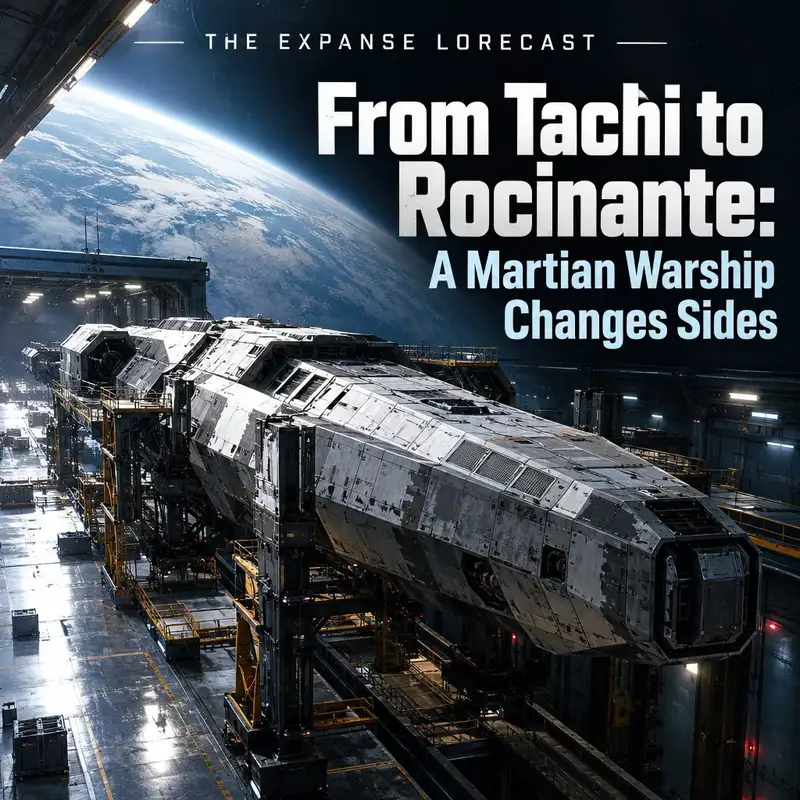
From Tachi to Rocinante: A Martian Warship Changes Sides
The Tachi left the Donnager while the battleship was dying around it. It was still, in every formal sense that mattered to Mars, a Martian Congressional Republic Navy vessel. Its systems belonged to Mars. Its weapons belonged to Mars. Its registry, command chain, and purpose belonged to Mars. But the people taking control of it were not Martian sailors. They were survivors from the ice hauler Canterbury, civilians and working spacers who had become witnesses to a disaster somebody wanted blamed on Mars. Lieutenant Kelly helped put them aboard, then died as the evacuation collapsed into battle. Shed Garvey had already been killed. Behind them, the Donnager fought an enemy it had not expected and could not quickly understand. Ahead of them was a functioning warship, a system-wide crisis, and no document saying that James Holden or anyone else had the right to possess either.
That contradiction is the beginning of the Rocinante. It was not a clean defection. The Tachi did not receive orders to change allegiance. Mars did not hand it over as a diplomatic concession, a humanitarian gift, or a reward for civilian courage. The ship escaped because its original chain of command had been broken by combat, because its last available Martian protectors were trying to save the people who might reveal a larger conspiracy, and because the Donnager could no longer guarantee the survival of anyone aboard her. The vessel was militarily intact enough to flee. Politically, it was orphaned.
The story of the Rocinante is therefore not just the story of a famous ship receiving a famous name. It is the history of how control of a hull became something more durable than possession. First, the ship was a means of survival. Then it became a deniable instrument in a political crisis. Later it became a contractor, a mediator, a coalition asset, a symbol, an aging veteran of several wars, and eventually a resistance vessel in an empire that claimed the right to reorder human civilization. Its identity did not come from the paint on its hull. It came from the people who kept it flying, the workers who repaired it, the institutions that protected it, and the missions that gave it a purpose.
The Canterbury crisis had made that transformation possible, though not by design. Holden, Naomi Nagata, Amos Burton, Alex Kamal, and Shed Garvey had answered the Scopuli’s distress signal from the Canterbury’s shuttle, the Knight. What they found was not a routine rescue problem. The Scopuli had been abandoned, and its distress call had been used to draw the Canterbury into a trap. Before the shuttle could return, the Canterbury was destroyed. The attackers made the assault look Martian. The intended political effect was as important as the military one. If Earth believed Mars had murdered a civilian ice hauler, public anger and military suspicion could do the rest.
That was why the Donnager recovered the survivors. Captain Yao and the Martian command did not merely rescue people in need. They acquired witnesses whose testimony might show that Mars had been framed. The Martians had every reason to question them, protect them, and control the information they carried. In an ordinary crisis, the Donnager’s intervention might have settled the matter. A powerful Martian battleship had taken custody of the only surviving witnesses. It could investigate, report, and return them through established channels.
But the attackers followed. The force that struck the Donnager used capabilities that made the situation more dangerous precisely because they did not fit neatly into the familiar Earth-Mars rivalry. The battleship’s destruction demonstrated that military prestige was not the same thing as invulnerability. The Donnager had size, armament, trained personnel, and the authority of a great power. It was still surprised by an enemy prepared to accept extraordinary risk and equipped to challenge a ship that most opponents would have avoided.
The Tachi’s escape was not a victory in the usual military sense. It was an evacuation from a collapsing position. The crew of the Donnager had to decide what could still be preserved. They could not save the battleship. They could not maintain control over every docked vessel and every civilian. They could, at least briefly, send the Canterbury survivors away in a smaller ship that had a chance of surviving the battle. That decision gave Holden’s group their first possession of the Tachi. It did not give them uncontested title.
A ship is not merely a vehicle. In the world of The Expanse, it is a workplace, a pressure vessel, a computer network, a drive system, a weapons platform, a supply problem, and a legal identity moving through jurisdictions that may be months or light-minutes apart. The Tachi carried the advantages of Martian military construction. It had the propulsion, sensors, defensive systems, weapons, communications, life support, and damage-control capacity of a purpose-built naval vessel. It was small enough to move quickly and operate independently, but substantial enough to survive missions that would destroy a civilian shuttle or leave a lightly defended freighter helpless.
Those capabilities mattered together. It would be a mistake to explain the ship’s later importance with one railgun, one missile system, or one piece of armor. The Tachi was valuable because its systems formed an integrated military tool. It could detect, maneuver, communicate, defend itself, transport people into danger, and continue functioning after damage that might end another vessel’s voyage. A warship’s real strength is often less glamorous than its armament. It is redundancy. It is maintenance access. It is damage control. It is the ability to keep the air breathable and the engines responsive after somebody has tried very hard to stop both.
Still, the Canterbury survivors had a hull, not a navy. Alex Kamal had the piloting skill to make a Martian military vessel usable under pressure. Naomi Nagata understood the engineering systems well enough to help turn captured hardware into a working home. Amos Burton brought the practical competence of a mechanic and damage-control specialist, the person who understands that a ship survives through pumps, seals, wiring, fittings, spare parts, and relentless attention to what is about to fail. Holden became captain less through appointment than because someone had to accept responsibility for decisions that could kill everyone aboard.
None of that solved the central problem. They had no Martian transfer order. They had no recognized naval crew. They had no friendly government waiting to receive them. They had no secure port, reliable supply chain, or established legal defense against the obvious accusation that they had stolen a Martian warship. Possession is a fact. Ownership is an argument. Legitimacy is what remains after other people decide whether they will honor that argument, challenge it, or find the issue inconvenient enough to postpone.
Their route to Tycho Station brought them into the orbit of Fred Johnson, and that phrase matters. Fred did not simply rescue the crew from legal trouble out of generosity. He offered sanctuary because the ship and its passengers had political value. Johnson had his own history with Earth, Mars, and the Outer Planets Alliance. He understood that the Canterbury disaster, the Donnager’s destruction, and the emerging evidence around Protogen could destabilize the entire system. He also understood what a small Martian warship could do for a network that lacked the industrial depth and formal legitimacy of the Inner governments.
Tycho Station turned escape into permanence. Without a place like Tycho, the Tachi would have been a temporary prize. It would need repairs. It would need fuel and reaction mass, food, water, air, ammunition, replacement components, technicians, docking access, and somewhere to conduct work without attracting immediate official attention. A ship can leave a battle with its hull intact and still be close to useless. It may have damage nobody sees from outside. It may have worn parts, exhausted supplies, compromised systems, or a crew that has no idea how long it can safely remain underway.
Tycho possessed what the crew lacked. It had docks, industrial workers, political connections, and the practical discretion of a station that knew how to make complicated things happen without waiting for every government office to approve them. The conversion from Tachi to Rocinante was not just an act of personal identity. It was labor. Someone altered systems. Someone fabricated or installed the equipment needed for a changed public identity. Someone stocked stores, checked machinery, performed repairs, and made it possible for the ship to depart as something other than an immediately recognizable Martian naval asset.
The crew’s salvage claim was useful, but it was never a final legal settlement accepted across the Solar System. In the aftermath of the Donnager’s destruction, Mars was in no position to simply retrieve the vessel without creating further political complications. The wider crisis made the claim plausible enough to defend, especially with Johnson’s protection. But its real force came from circumstance. The ship remained in the crew’s hands because they could operate it, because Tycho could support it, because powerful people found it useful, and because no larger power could easily seize it without asking uncomfortable questions about why it had been abandoned in the first place.
Johnson gained an asset. Holden and the others gained sanctuary, supply, and an opportunity to act. They also gained entanglement. Independence in The Expanse is rarely absolute. A ship may not fly under a government flag and still depend on somebody’s dock, somebody’s food shipments, somebody’s access codes, somebody’s political protection, and somebody’s willingness to look the other way. The Rocinante’s early autonomy rested on overlapping interests. That made it flexible. It also made it vulnerable whenever those interests diverged.
The new name mattered because names frame responsibility. Rocinante was Don Quixote’s horse, an old and worn animal recast in the imagination of its rider as a noble steed fit for improbable quests. Holden’s choice was not a magical transfer of ownership. It did not erase Martian records or make the ship less capable of being recognized. It was a declaration that this vessel would no longer be defined only by its original military assignment. A Martian frigate had been built to serve a state. The Rocinante would serve a crew trying to decide, mission by mission, what responsibility required.
The name also carried a warning. Don Quixote’s visions were noble and often absurd. Holden’s instinct to intervene, expose hidden crimes, and refuse convenient silence would make the Rocinante valuable. It would also repeatedly place the crew in danger. A ship can become a symbol of principle, but symbols do not refill ammunition stores or repair damaged radiators. The Rocinante survived not because its captain had ideals, but because those ideals were paired, sometimes uneasily, with Naomi’s engineering judgment, Alex’s flight skill, Amos’s practical discipline, and the support of people who understood that righteous intentions still require functioning machinery.
Changing the transponder and registry data was part of that transformation. In a crowded and politically tense Solar System, identification is not administrative decoration. It affects traffic control, docking rights, insurance, customs, surveillance, threat assessment, and the decision of another captain whether an approaching contact is a freighter, a warship, a pirate, or an enemy. A Martian military vessel moving without explanation could provoke a response before its crew had time to explain itself. A gas freighter had a different set of expectations attached to it.
The disguise gave the Rocinante room to maneuver in the political sense. It allowed the crew to travel without constantly announcing that a Martian military asset was operating under civilian control. But altered records did not make the ship invisible. A drive plume still produced information. Heat still had to go somewhere. Sensors, behavior, weapon use, and the judgment of experienced spacers could reveal a great deal. The deception changed the first question observers asked. It did not erase the physical realities of a warship.
The ship’s independence also depended on the crew learning to function as more than survivors occupying someone else’s hardware. Alex brought Martian naval experience and the ability to fly the vessel as it was designed to be flown. Naomi understood engineering, systems, and the practical compromises required to keep a ship working outside a normal military support chain. Amos supplied mechanical skill and physical reliability under pressure. Holden carried command, judgment, and the burden of deciding when their freedom to act should become intervention. The Rocinante became durable because those roles developed into a working institution rather than remaining a temporary emergency arrangement.
That distinction became important almost immediately. Under the Rocinante name, the ship entered the conflict around Protogen, Thoth Station, and Eros. The crew was no longer simply fleeing the aftermath of the Canterbury attack. They were investigating a conspiracy that joined private corporate power, secret research, political manipulation, and the protomolecule. Their ship gave them mobility and survivability, but it also made them visible enough to matter. People began to see the Rocinante not as abandoned Martian property, but as a mobile actor whose decisions could affect the balance among governments, corporations, and Belt factions.
At Thoth Station, the Rocinante showed what a small, well-run warship could do when attached to a larger operation. It could approach under deception, fight in a confined tactical problem, carry a specialized crew, and support a boarding force without pretending to be a fleet. The ship mattered because its capabilities matched the mission, not because it had somehow become invulnerable.
Eros gave that usefulness a larger purpose. The crew could move between jurisdictions, carry evidence, pursue leads, and act while Earth, Mars, and Belter factions were still arguing over authority. The same independence that made the Rocinante valuable also made every choice politically exposed. Without a normal chain of command, Holden and his crew had to justify their actions through results, relationships, and the trust they could maintain with people who did not formally control them.
After Eros, work connected to Fred Johnson and Tycho helped turn the ship from an escaped Martian asset into an enduring independent crew. Security missions, investigations, and operations around crises such as Ganymede tested whether that independence could be useful without becoming reckless. The Rocinante could cross political boundaries more easily than a state warship, but it could not impose peace on powers much larger than itself.
The Ring crisis changed the ship again. Exploration and mediation became as important as combat because the crew repeatedly encountered problems where shooting first would have made the political situation worse. On Ilus, the Rocinante carried visible coercive power into a dispute between settlers and corporate authority, yet its most important function was helping prevent that dispute from becoming a complete catastrophe.
The Free Navy war returned the Rocinante to coalition conflict. It operated among Earth, Mars, anti-Free Navy Belters, Tycho interests, Medina, and independent actors whose objectives overlapped without becoming identical. The ship’s value came from experience moving among those worlds, not from the fantasy that one crew could decide the war alone.
After the war, the Rocinante remained independent enough to carry memory across changing institutions. Time altered the crew, the political order, and the ship’s place within it, but decades of experience gave its people something no new hull could be issued from a yard: knowledge of how earlier crises had begun, which compromises had failed, and what happened when governments confused force with legitimacy.
Then came time. Roughly three decades passed between the end of the Free Navy conflict and the events of Persepolis Rising. The Rocinante endured, but it did not remain unchanged. Neither did its crew, the Transport Union, Medina, Mars, Earth, or the colonies beyond the gates. The ship’s age was not decorative nostalgia. A vessel that survives for decades accumulates maintenance burdens, replacement problems, refits, compromises, and scars. Systems must be repaired with what can still be obtained. Knowledge of old machinery becomes valuable because the people who understood its original configuration may be gone, retired, or scattered across the network.
What the Rocinante retained was institutional memory. Its crew knew how the ship behaved under stress. They knew its habits, limitations, sounds, weak points, and strengths. They knew how to improvise because they had spent decades improvising. They also possessed relationships that could not be manufactured quickly: trust between crewmates, credibility with allies, and a reputation formed across missions where others had seen them take risks for people outside their immediate circle. An aging ship is not automatically a weak ship. But its value increasingly lies in the experience organized around it, not in the novelty of its hardware.
Laconia’s emergence tested that value against an enemy with extraordinary technological and military advantages. The Laconian Empire did not succeed merely because it possessed alien-derived systems. Its rise depended on preparation, secrecy, disciplined command, industrial capacity, Martian military expertise, and the political weakness of the scattered human systems it attacked. The empire understood that control of transit, communications, and decisive force could create rapid obedience. It was less prepared to understand that obedience gained under shock is not the same as legitimacy.
Against Laconian power, the Rocinante could not pretend to be a peer competitor in a conventional fleet contest. Its value shifted again. It became a resistance asset. It could move people, carry information, connect dispersed networks, assist operations too small or too sensitive for open confrontation, and survive through flexibility. In this period, concealment measures and false identities, including the use of the name Vincent Soo, demonstrated the same principle that had shaped the original Tachi-to-Rocinante transformation. Identification was strategic. A ship’s public name, emissions profile, behavior, and apparent purpose could determine whether it received access, suspicion, pursuit, or a chance to slip through a narrowing gap.
But concealment was never invisibility. The Rocinante could alter how it appeared. It could not repeal the laws of heat, drive emissions, sensor detection, or human memory. The ship survived because concealment was paired with intelligence, discipline, maintenance, trusted contacts, and a crew that understood when to avoid a fight. Resistance is not simply courage under fire. It is the ability to preserve people, information, tools, and options long enough for an occupying power’s apparent certainty to begin breaking apart.
The Rocinante’s contribution against Laconia was tactical in some moments, operational in others, and political throughout. Tactically, it survived and completed discrete missions. Operationally, it helped keep resistance elements connected across distances that imperial command could not fully seal. Strategically, it contributed to the erosion of Laconian control, not by proving that one old ship could defeat an empire in direct combat, but by helping sustain the networks that made imperial control costly, incomplete, and vulnerable to failure. Politically, it preserved a model of cooperation that did not depend on conquest or obedience.
That was the final meaning of the ship. The Tachi had been built as a Martian military asset, designed to serve a state with a clear command structure and a national purpose. The Rocinante became something else because the state that owned it lost practical control, and because other people took on the work of making the vessel live under a new identity. Holden provided direction, often imperfectly. Naomi made independence technically possible. Alex made the ship fly. Amos kept it alive when survival depended on unglamorous competence. Tycho workers, Fred Johnson’s network, allies, contractors, and later resistance contacts supplied the wider structure no single crew could create alone.
The Rocinante did not change sides once. It changed meaning repeatedly. It was captured capability, contested salvage, disguised commerce, deniable intervention, independent contract work, coalition service, frontier mediation, postwar stewardship, and resistance. At each stage, the crucial question was not simply who possessed the hull. It was who could maintain it, supply it, identify it, direct it, protect it, and trust it with consequences that reached far beyond its crew.
Its durability did not come from being the most powerful ship in the system. More powerful ships existed. Larger fleets existed. Governments with far greater industrial resources existed. The Rocinante endured because it became a vessel whose mission could adapt without losing sight of the people forced to live with the consequences of war, occupation, neglect, and political ambition. A Martian warship changed sides only in the narrowest sense. In the larger one, it became proof that military machines acquire their true identity from the human institutions, labor, and responsibilities that keep them in service.