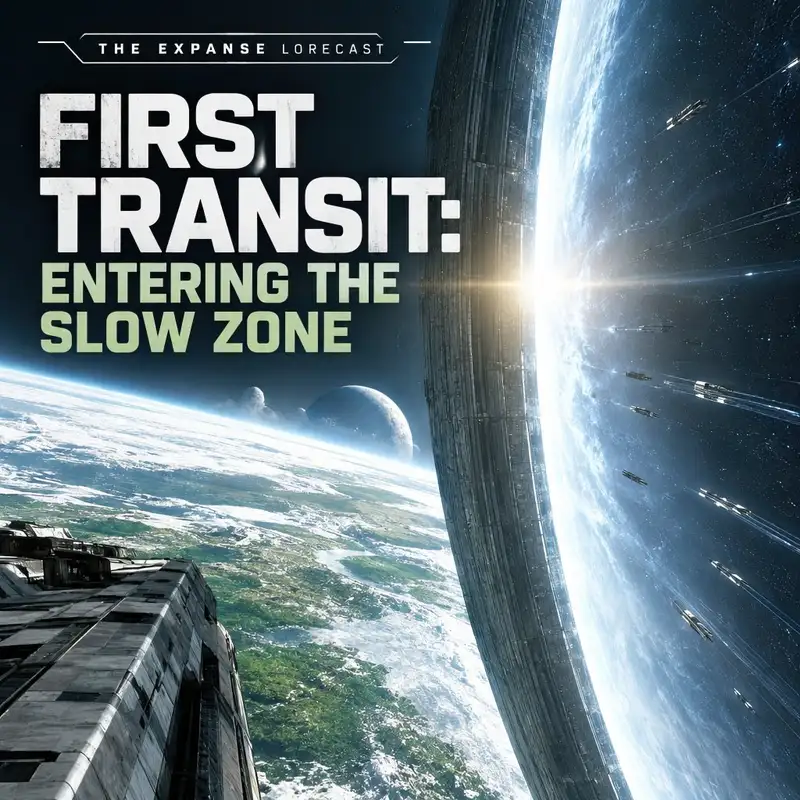
First Transit: Entering the Slow Zone
Manéo Jung-Espinoza went through the Ring faster than any sensible commander would have chosen, which was exactly the point. He was a Belter slingshotter, part of a culture that understood danger not as an abstraction but as the price of doing something nobody else had done. His ship, the Y Que, was not leading a surveyed expedition or following a doctrine approved by any navy. It was making a run for history. Beyond Uranus, an alien structure large enough to alter the political map of humanity had appeared, and Manéo intended to be the first human being through it.
He did succeed in one narrow sense. The Y Que crossed the threshold. But it entered a place that did not obey the assumptions built into every human flight plan. Its velocity was violently reduced. The ship remained intact enough to become evidence, but Manéo did not survive the transition.
That distinction matters. The Y Que was the first human ship through the Ring. It was not the first successful crewed transit. Manéo had not discovered a route. He had triggered an experiment, and the experiment had killed him.
The first lesson of the Ring was therefore not wonder. It was restraint. Human beings had encountered an artifact that could alter the motion of a spacecraft without asking permission from its crew, its owner, or the governments that believed they had a stake in the expedition. The Ring was not simply a hole in space.
The trouble was that nobody knew what the rules were. The Ring had formed beyond Uranus after the events surrounding Eros and the protomolecule crisis. By the time the great powers and smaller interests began assembling near it, the object had already become far more than a scientific anomaly. It was a strategic prize before anyone knew where it led. Earth could not accept an uncontrolled alien gateway at the edge of the Solar System. Mars could not allow Earth to dominate the investigation. The Outer Planets Alliance could not accept a future in which the Belt supplied labor, fuel, and risk while the Inner planets claimed authority over the result.
Scientists saw a question that could redefine human knowledge. Corporations saw contracts, patents, transport routes, and opportunities that had not existed the week before. Journalists saw the largest story in human history. Military planners saw an unknown route through an unknown strategic environment, and did what military planners usually do when confronted with uncertainty.
No recognized legal system governed the Ring. In that vacuum, presence became an argument. A ship at the Ring was not just a ship. It was a flag, a sensor platform, a research laboratory, a security force, and potentially the opening move in a contest for control of the future.
The expedition was described as exploratory because that was true. It was also armed because that was true. Those facts did not contradict each other. They were the ordinary condition of human expansion in The Expanse. Exploration occurred through institutions that distrusted one another, carried old grievances into new territory, and understood that the first group able to establish a durable presence might shape every later rule.
The death of Manéo Jung-Espinoza should have imposed caution. It did impose some caution. But it did not produce understanding. The flotilla approaching the Ring knew that rapid transit was dangerous. It did not know whether the danger came from the Ring itself, from the far side, from some interaction with a ship’s drive, or from an active defense system. It did not know if slower transit would be safe. It did not know whether a ship could return.
It would begin with sabotage. The Rocinante had arrived near the Ring carrying James Holden, his crew, and a documentary team. That arrangement was not as odd as it sounds. Holden had become publicly associated with the protomolecule crises that had already shaken the Solar System, and public attention followed him with the persistence of debris in a bad orbit. The documentary crew expected access to a historic mission.
The Rocinante was already a ship with a complicated identity. It had begun life as the Martian gunship Tachi, then passed into Holden’s possession and became a legally awkward, heavily armed independent vessel. Its crew had spent enough time between governments, corporations, and OPA factions to understand that a ship’s registry did not settle the question of who trusted it. Near the Ring, that ambiguity became dangerous.
Clarissa Mao, operating under a false identity, used the expedition’s confusion to frame Holden. Her sabotage did more than damage machinery or remove a political obstacle. It poisoned the information environment. A broadcast was fabricated to make it appear that Holden had claimed responsibility for the destruction of the United Nations ship Seung Un. The attack itself mattered. The attribution mattered more.
In military and political history, false attribution can move forces with remarkable speed. A confirmed enemy is useful. A plausible enemy is often enough. The evidence against Holden appeared convincing enough to make the Rocinante an immediate problem for every force near the Ring.
That did not mean everyone possessed the same information, trusted the same source, or pursued the same objective. Earth, Mars, and the OPA had not suddenly become one fleet because they had a common suspect. Their command structures remained separate. Their political leaders remained suspicious of one another. Their intelligence services retained their own assumptions.
Holden’s position changed almost at once. He had come to investigate an alien structure. Now he had to survive a growing pursuit by people who believed, with varying degrees of confidence, that he had committed an act of war or terrorism. The Ring, which had been an object of scientific concern and political competition, became an immediate tactical option. It was dangerous, barely understood, and possibly lethal.
The Rocinante had not chosen the Ring as a route because it was safe. It chose it because the alternative was worse.
The largest OPA presence near the Ring was the Behemoth, a vast converted vessel whose existence carried its own political message. It had been built for another purpose and remade under pressure into something that could serve as a major OPA platform. That conversion gave it size, capacity, and symbolic weight. It also gave it the compromises of a converted hull. A ship designed for one strategic purpose does not become ideal for another merely because people bolt weapons onto it and declare it important.
The Behemoth was not the Belt made manifest, and it did not represent every OPA faction. No one ship could have done that. But its presence meant that the Belt had arrived at the Ring with more than a petition. It had arrived with a large vessel, armed personnel, competing political authorities aboard, and a claim to participate in decisions that Earth and Mars might otherwise make alone.
Carlos “Bull” de Baca served as security chief aboard the Behemoth. His responsibilities were practical and immediate. In ordinary times, divided authority creates delays and frustration. In a crisis involving sabotage, a suspected mass attack, and an alien gate, it can turn every decision into a contest over who has the right to make it.
From the Behemoth’s perspective, the Rocinante appeared dangerous. The decision to pursue it was shaped by that available evidence. Later knowledge would reveal the deception, but later knowledge cannot be sent backward through time to improve a commander’s original decision.
The Behemoth launched a torpedo at the Rocinante. The target would maneuver, employ point defense, alter its trajectory, seek cover where cover existed, or try to make the pursuing missile expend its fuel. The fight might still be chaotic, but it would occur inside a tactical language all parties understood.
The Ring changed that language before anyone could finish speaking it. Holden had one source of information unavailable to most of the pursuing ships. The Investigator appeared to him through the protomolecule’s reconstruction of patterns associated with Josephus Miller. The biological Miller was dead. What confronted Holden was a human-facing construct, assembled through alien processes and using enough of Miller’s pattern to communicate in ways Holden could recognize.
That did not make the Investigator trustworthy in the ordinary sense. It had access to fragments of a system humanity did not understand, but it was neither a friendly guide nor an omniscient intelligence officer handing over a complete operational briefing. Its messages were partial. Its methods were alien. Its explanations were shaped by a purpose that remained unclear. It could offer direction without providing comprehension.
What Holden received was not an answer to the Ring. It was a warning. The Rocinante had to slow down before it entered.
That warning gave Holden a decision, not certainty. He could dismiss it and risk the fate of the Y Que. Or he could treat the warning as the best available intelligence and attempt a maneuver that would place his ship below whatever threshold had killed Manéo Jung-Espinoza.
This was not faith in a solved mystery. It was command judgment under pressure. The Investigator’s guidance was not enough to make the maneuver safe. It was enough to make inaction look less safe.
The task of turning that warning into survival fell most directly to Alex Kamal. Alex was the Rocinante’s pilot, but that title can sound smaller than the work required in this moment. Piloting in The Expanse is not simply pointing a ship toward a destination and trusting an engine to do the rest. Near the Ring, those ordinary demands were intensified by the fact that the destination itself had already killed one crew through a mechanism nobody could explain.
The Rocinante needed to shed velocity. That required a flip-and-burn maneuver. The ship had to turn so that its drive could thrust against its direction of travel, reducing its speed relative to the Ring before crossing the threshold. This was deceleration, not stopping. A vessel continues moving until another force changes that motion. The Rocinante had to spend time and reaction mass changing its trajectory because the Ring appeared to care about velocity at entry.
The maneuver also illustrates a point that is often misunderstood. The crew’s apparent gravity came from acceleration, not from speed. A ship moving rapidly while under no thrust could leave everyone on the float. Velocity and gravity are related only through the maneuver being performed. They are not the same thing.
Alex had to manage the ship through a high-pressure deceleration while the Rocinante’s crew struggled to keep the vessel functional. Amos Burton contributed to the hard physical work of repair and survival. A ship in crisis is a system of engines, sensors, data lines, compartments, tools, exhausted people, and whatever still works after sabotage.
There was no graceful margin for error. The Ring was ahead. The torpedo was behind. A ship does not become safe merely because it has completed a burn. The crew still has to deal with the consequences of stress, damaged equipment, uncertain sensors, and a destination that may punish a mistake nobody has yet defined.
The Rocinante crossed the Ring below the lethal threshold. It became the first crewed human ship to make a controlled entry.
That achievement was real. It was also only the first minute of a much larger problem.
On the far side of the Ring, there were no stars. The Rocinante emerged into a dark, enclosed region unlike an ordinary star system. The space later became known as the Slow Zone. Initial observation suggested a vast volume, roughly one million kilometers across, surrounded by 1,373 evenly spaced gates.
Those measurements provided orientation, not explanation. Human instruments could describe size, spacing, and position. They could not explain who had constructed the place, why it had been built, what the central station controlled, or what rules governed the gates. The visual order of the environment was striking. So was the absence of any familiar celestial frame of reference.
In an ordinary system, a navigator can orient a ship through known stars, planets, moons, orbital bodies, charts, and predictable relationships among gravity wells. The Slow Zone offered none of that comfort. It was a constructed geography. The gates were arranged with a precision that suggested purpose, but purpose remained an inference.
For the Rocinante crew, the psychological effect was as significant as the visual one. They had entered a space where humanity’s maps did not apply, where the horizon consisted of artificial structures, and where the rules of safe movement had already proven lethal. Their ship had survived the threshold, but they had no established doctrine for what came next.
The Slow Zone was not a new country waiting to be explored. It was an operational environment designed by an unknown civilization. Human beings had arrived inside its perimeter with no understanding of its security procedures, no recognized authority, and no agreement among themselves about what counted as a threat.
Then the Behemoth’s torpedo came through. The weapon had been launched in normal space, where its purpose was simple enough. It was supposed to pursue the Rocinante. Once it passed through the Ring, however, it became evidence. Its motion exceeded the local limit. The Slow Zone arrested it and redirected it toward the central station.
That observation connected the fate of the torpedo to the earlier death of Manéo Jung-Espinoza. The Y Que had not merely suffered an inexplicable accident. It had entered too fast. Other fast-moving probes and objects were likewise caught. The available evidence suggested an initial maximum velocity of roughly six hundred meters per second.
The effect was not a universal alteration of physics. The universe outside the Ring had not changed. Human ships still operated according to familiar mechanics before and after transit. The Slow Zone appeared to impose a local control regime, likely associated with the Ring Station and the network around it.
But its tactical consequences were immediate. A missile no longer behaved as a commander expected once it crossed into the zone. Rapid pursuit became hazardous. High-speed maneuver could turn a ship into its own casualty. Weapons designed to exploit distance and acceleration could be captured, neutralized, or transformed into objects directed toward the central station.
The Ring had stripped conventional fleets of one of their most basic assumptions. Inside the Slow Zone, an alien system had imposed a limit. Human ships still possessed engines, torpedoes, railguns, point-defense cannons, sensors, and trained crews. But the value of those assets had changed because the battlespace had changed.
The first successful transit was therefore not the moment when humanity gained control of an interstellar route. It was the moment when humanity learned that the route possessed control of it.
More ships entered behind the Rocinante. They came from Earth, Mars, and the OPA, still influenced by the false conclusion that Holden was responsible for the Seung Un attack. Their arrival did not produce a unified expeditionary command. It produced multiple armed contingents inside the same confined environment, each with its own political obligations, its own communications channels, and its own suspicion of the others.
The Earth and Martian forces had reasons to cooperate temporarily. Neither government wanted an uncontrolled crisis near an alien structure. Both had an interest in containing a potentially dangerous suspect. Both had an interest in preventing the other from claiming a decisive advantage. But common concern is not the same as common command. Their officers answered to different institutions. Their governments had different strategic anxieties.
The OPA presence complicated matters further. The Belt’s representatives were not merely observers. They had ships, personnel, political claims, and a history of being excluded from decisions made by Earth and Mars. Belters had every reason to fear that the Inner planets would declare the discovery a shared human inheritance and then distribute the actual benefits through familiar hierarchies.
Yet the OPA itself was not a single government with a single policy. It was an umbrella of factions, crews, stations, organizers, militants, pragmatists, and leaders whose interests overlapped only imperfectly. The Behemoth could provide a focal point. It could not dissolve those differences.
The flotilla also contained people whose roles were neither naval nor political in the narrow sense. Scientists had come to study the Ring. Journalists had come to record the event. Civilian personnel provided technical skills that armed ships still required. Anna Volovodov and Father Cortez represented a religious presence within the expedition, a reminder that humanity had brought moral and spiritual questions into the alien structure along with its weapons and sensors.
Their presence mattered because the Slow Zone was never a clean military laboratory. It became a crowded settlement of ships. Every vessel carried people who required air, water, food, medical care, functional sanitation, power, heat management, repair equipment, and a chain of command capable of making decisions under pressure. The expedition had brought supplies for investigation and transit.
Logistics became strategic almost immediately. A warship with damaged engines is a problem. Repair parts cannot be manufactured by confidence. Casualties cannot be wished back into readiness. Reaction mass, food, and medical capacity become more important when a fleet’s mobility is restricted by rules it does not understand.
The first transit had created not a fleet victory, but a trapped community. Ships retained some ability to maneuver within the limits imposed on them. They were not frozen in place. But operational mobility was no longer strategic freedom. They could not simply flee at maximum acceleration. They could not fight as though missile range and rapid changes in velocity remained normal tools.
And none of them yet knew how sensitive that system was to violence. The most devastating proof came later, when the crisis moved toward the Ring Station itself. By that point, the uncertainty surrounding Holden had not disappeared. From the perspective of those trying to apprehend him, he remained tied to events they did not understand. He had previous contact with protomolecule phenomena. He had crossed the Ring under circumstances nobody could fully explain.
Martian personnel attempted to take Holden into custody at the Ring Station. In hindsight, it is easy to condemn every decision made during that encounter as foolish. That would be too simple. The participants were operating amid false intelligence, fractured authority, fear of another protomolecule disaster, and uncertainty over whether Holden represented a threat, an asset, or both.
Then a weapon was fired.
The Ring Station appeared to interpret that discharge as a greater threat than anything it had yet encountered. Its response was not a warning humans could negotiate with. The permitted velocity inside the Slow Zone dropped drastically, from roughly six hundred meters per second to something closer to the speed of a fast thrown ball.
The result was catastrophic.
Ships and people already moving faster than the new limit were violently arrested. The danger was not simply that vessels could no longer maneuver. Bodies that had survived ordinary flight conditions suffered injuries no medical team could easily prepare for. Crews died. Others were maimed. Ships became scenes of emergency medicine, damaged systems, and command breakdown.
This was the moment when the fleet understood, at terrible cost, that the Slow Zone did not merely limit movement. It possessed an escalation logic. Human beings had performed an action that the system interpreted as threatening, and the system had responded by changing the environment around every ship inside it.
The exact purpose of that response remained unknown. It may have been a defensive measure. It may have been an automated containment procedure. It may have reflected a protocol built for dangers humanity could not yet imagine. What mattered to the people trapped inside was simpler.
The tactical effect was immediate. Conventional maneuver collapsed. Ships could not build speed. Weapons designed around rapid motion became useless or dangerous. Boarding, rescue, docking, and station operations had to be reconsidered under radically altered physical limits.
The medical effect was worse. Fleet strength is not only measured in intact hulls. The speed-limit reduction did not merely damage ships. It tore at the human infrastructure required to operate them.
The institutional effect was equally serious. Earth, Mars, and the OPA had entered the Slow Zone carrying claims of authority. The Ring Station demonstrated that none of those claims mattered to the system governing the space. Commanders could issue orders. Political leaders could argue over jurisdiction.
This was a species-level warning, not because every human civilization was immediately doomed, but because humanity had encountered infrastructure powerful enough to make all its familiar distinctions feel provisional. A Martian naval weapon, an Earth security operation, an OPA warship, and an independent gunship could all be reduced to the same condition. They were objects inside someone else’s system.
Eventually, the Ring Station made the broader network available. More than a thousand gates opened access to other systems. Until that moment, civilization had been contained within one Solar System. Distance remained vast, but it was a known distance. Earth, Mars, the Belt, and the outer planets existed inside a single political and economic framework of routes, dependencies, and limits.
The gates did not erase distance. A planet might be far from its gate. A colony might have no port, no agriculture, no medicine, and no stable government. The network did not produce instant settlement, instant prosperity, or instant safety. It created access.
Access, however, is never neutral. The Ring network transformed a central transit point into a chokepoint. Whoever managed passage through the Slow Zone and the gates could influence migration, trade, military movement, scientific access, and the political future of worlds not yet settled. That prospect alarmed Earth and Mars, both of which understood that the Belt’s location, experience in space, and presence aboard the Behemoth could give it unusual leverage over the new routes.
The Behemoth’s later role as Medina Station showed why this mattered. The converted vessel became more than a ship. It became a hub, a place where transit could be observed, regulated, taxed, contested, defended, and politicized. But a hub is not the same as sovereignty. Holding a station does not automatically command the consent of everyone who uses it. It does not make distant colonies obedient.
The Ring network created administration problems before it created stable governance. It offered more routes than any existing political order could easily manage. It widened the horizon while concentrating power at a central bottleneck. It gave the Belt opportunities for influence, but also exposed Belters to the burden of maintaining access for populations and governments that had long treated them as peripheral.
For Earth and Mars, the gates threatened to disrupt old national projects. A thousand new systems could make that project look less inevitable. Earth possessed population, industry, and institutional weight, but it now faced a future in which its old centrality could be challenged by new settlements beyond any familiar frontier.
For everyone, the gates introduced a dangerous temptation. The Ring showed humanity paths to other worlds. It did not provide the knowledge, patience, labor, trust, or political maturity required to use them well.
The history of first transit begins with a man trying to make history in the Y Que. It continues with the Rocinante escaping a false accusation through a maneuver based on partial alien guidance. It includes a torpedo that became a diagnostic tool, a flotilla that entered under corrupted intelligence, and a weapons discharge that taught every armed force inside the Slow Zone that the local environment could punish escalation more effectively than any fleet.
These were not separate incidents. They were one chain of evidence.
Manéo’s death showed that passage through the Ring was conditional. The captured torpedo showed that the limit applied to weapons as well as ships. The later speed-limit catastrophe showed that the system could change its rules in response to human behavior.
Each event narrowed the gap between what humanity hoped the Ring might be and what it actually encountered. At first, the Ring looked like a door. Then it looked like a dangerous door.
Humanity had brought substantial power to the threshold. The OPA possessed experience, local knowledge, networks, and a determination not to be excluded from another transformation of the human economy. None of those assets were meaningless. But inside the Slow Zone, none of them guaranteed control.
Military power depends on assumptions about the environment in which it operates. A fleet needs to know how quickly it can move, how weapons behave, how communications travel, what counts as a safe retreat, and what consequences follow an attack. In the Slow Zone, those assumptions failed together. The first transit revealed that superiority in familiar systems could become vulnerability inside an unfamiliar one.
The Ring opened routes to more than a thousand systems. It changed humanity’s map before it changed humanity’s wisdom. Old rivalries, unequal power, commercial ambition, political grievance, and military distrust all entered the new network alongside the first ships. The Slow Zone did not abolish human conflict. It exposed how little conventional authority meant when nobody understood the rules of the space they had entered.