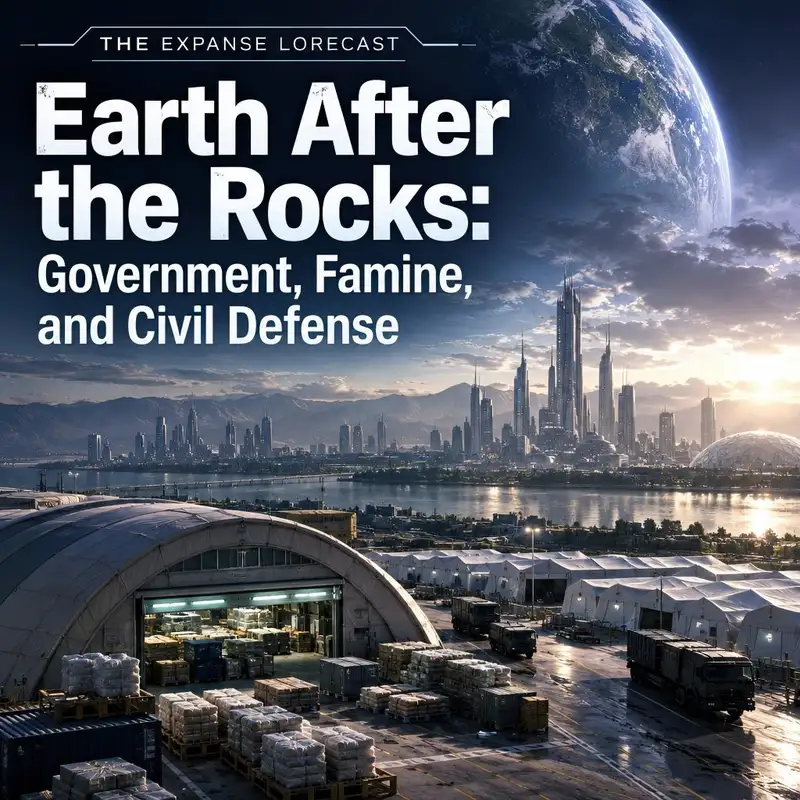
Earth After the Rocks: Government, Famine, and Civil Defense
Three months after the first rocks struck Earth, the emergency in Greater Abuja no longer looked like the aftermath of a single disaster. Ash and grit still hung in the air. Power arrived unpredictably, then vanished again. Medical facilities were crowded beyond any normal capacity. Food came through emergency vehicles and local distribution networks, not through the routines that had once made a city of millions feel permanent. Communications worked in fragments. A message might arrive late, or not at all. Somewhere beyond the damaged roads, a fusion reactor was being moved from Kinshasa toward Abuja because restoring priority power to one part of one surviving city had become an operation worthy of national attention.
That is the scale at which Earth’s catastrophe has to be understood. The asteroid strikes were not over when the impacts ended. They continued through the broken power line, the delayed food shipment, the failed pump, the clinic without medicine, and the family waiting for an alert that might tell them whether another rock was coming. In Abuja, Namono, Anna Volovodov, and the child Nami experience the crisis through its daily demands. They need food. They need information. They need a functioning clinic, a working vehicle, and enough electricity to preserve what little remains. Civil defense is not a speech from a capital. It is work performed by exhausted people inside damaged institutions.
Greater Abuja was not unique. It was a scale model of a planetary emergency. Earth had survived the first phase of Marco Inaros’s attack in the narrowest sense. It still had cities, governments, military forces, farms, hospitals, and millions of people capable of helping one another. But survival was no longer a completed event. It was a continuing logistical contest against hunger, disease, cold, displacement, fear, and the physical limits of a damaged planet. The question facing the United Nations government was more than how to punish the people who had attacked Earth. It was how to keep a civilization of roughly thirty billion people functioning after the systems that supported them began failing together.
Marco’s first strikes were aimed at Earth with stealth-coated asteroids. The coating delayed or defeated the warning systems that might otherwise have identified a deadly object in time for a planetary defense response. The initial impacts included the strike at Laghouat in North Africa, another in the Atlantic, and a third in North America. Their effects were not confined to craters. They produced seismic destruction, flooding, atmospheric debris, ruined transportation routes, shattered power infrastructure, and immediate mass death on a scale too large for any early wartime estimate to capture cleanly.
The military failure before impact was therefore also an intelligence failure. Planetary defense depends on detecting a threat, classifying it correctly, calculating its trajectory, deciding who has authority to respond, and then having an interceptor in the right place with enough time to act. Marco’s asteroids attacked every part of that sequence. They were not warships broadcasting transponder codes. They were disguised masses moving through a system where many objects already travel on complex paths. By the time their purpose was understood, the decisive moment had passed.
But the rocks did not have to destroy every city to cripple the planet. Earth’s population was vast, its industrial base immense, and its surviving resources still formidable. Those facts were also part of its vulnerability. A world supporting tens of billions of people cannot rely on local improvisation for long. It depends on continuous flows of food, water, energy, medicine, data, machinery, spare parts, trained labor, and transportation. A disruption in one system becomes a burden on the next. A city without reliable power cannot run hospitals normally. A hospital without power cannot preserve medicine or operate equipment. A water system without maintenance becomes a public health emergency. A food system without transport is merely food somewhere else.
The most lasting weapon in Marco’s campaign was that cascade. Famine did not begin because one harvest failed, or because a single impact destroyed one agricultural district. It emerged from accumulated breakdown. Atmospheric dust and debris reduced sunlight and degraded solar generation. Wind and solar systems already strained by physical damage and neglected maintenance became less reliable. Damaged electrical grids had to choose among hospitals, water treatment, communications, transport, emergency shelters, and food production. Every priority created another shortage somewhere else.
Hydroponic agriculture required power, water, nutrients, pumps, technicians, transport, and a predictable supply chain. Conventional agriculture needed functioning weather systems, equipment, seed, labor, fertilizer, and routes to market. Refrigeration depended on electricity. Food distribution depended on vehicles, fuel, roads, landing fields, rail systems, ports, warehouses, and people able to coordinate them. A crisis that removes skilled workers through death, injury, displacement, or exhaustion damages recovery as surely as it damages production. You can rebuild a wall more quickly than you can replace an experienced engineer, nurse, grower, dispatcher, or water-system technician.
Medical collapse made the food crisis worse, and the food crisis made medical collapse worse. People weakened by hunger and exposure become more vulnerable to disease. Hospitals operating on limited power and limited supplies cannot provide normal care. Trauma patients, people dependent on medication, the elderly, children, and anyone living in damaged or overcrowded shelter face risks that are not visible in the initial blast footage. The physical impact is dramatic. The later deaths are often quieter. They happen in a dark apartment, a stalled transport line, a failed clinic, or a ration queue that does not have enough food at the end of it.
That distinction matters because the largest casualty figures circulating during the war are estimates produced under catastrophic conditions. Some assessments suggest losses so vast that they may encompass an enormous share of Earth’s population, including people already dead and people judged beyond rescue. They are not a final census. They cannot be. The dead of the initial strikes, the drowned, the injured, the displaced, the hungry, and the sick do not all appear in one ledger at one moment. The numbers are evidence of the scale of failure, not a clean answer to the question of how many survived.
Secretary-General Nancy Gao died during the attacks. Her death was not only a personal loss or a constitutional problem. It removed the head of government at the moment when the government needed to prove that lawful authority still existed. Chrisjen Avasarala became acting Secretary-General, and the center of practical United Nations administration shifted toward Luna. That did not mean Earth had been abandoned. It meant that a damaged planet could no longer serve as the only reliable location for strategic command, secure communications, diplomatic coordination, and military planning.
Luna became a wartime administrative center because some functions had to remain intact somewhere. Orders had to be authenticated. Emergency supplies had to be allocated. Military movements had to be coordinated with Martian and Belter partners. Intelligence reports had to be assessed. Public statements had to be issued by an authority people still recognized. In a crisis of this scale, continuity of government is not ceremonial. It determines whether a transport receives fuel, whether a shipment receives escort, whether a city receives a reactor part, and whether local officials know which emergency order is genuine.
Yet authority from Luna had limits. Avasarala could issue instructions, but she could not personally restore a failed grid in Abuja or clear a damaged road in North America. Communications were intermittent. Local administrators had incomplete information. Some supplies could not move because the route was gone. Some could not move because no one knew whether the destination could receive them. Others could not move because military ships and transports were needed somewhere else. A planetary government remained in being, but implementation became uneven, improvised, and painfully local.
Evacuation could not solve the problem. Luna and off-world facilities could receive selected evacuees, officials, specialists, and people whose removal served a specific emergency purpose. They could not absorb a meaningful fraction of Earth’s population. Even with efficient fusion drives, transport capacity remained finite. Every passenger required air, water, food, medical support, space, and a destination prepared to receive them. The arithmetic was merciless. Earth could not be evacuated. It had to be kept alive where it was.
That made civil defense the central work of government. Civil defense began with detection and warning. After the first impacts, Earth’s defenses became more alert, and later incoming rocks had a greater chance of being detected and intercepted. But vigilance did not eliminate danger. It created a permanent burden. Every alert disrupted already fragile communities. Every suspected trajectory demanded analysis. Every defensive asset assigned to one approach could not cover another. People on the ground did not experience this as an elegant orbital problem. They experienced it as the possibility that the sky might kill them again.
Civil defense also meant medical triage. It meant deciding which clinics received power, which routes were cleared first, where emergency vehicles went, and how scarce supplies were distributed. It meant rubble clearance, water treatment, shelter management, transport repair, communications restoration, and public information. A government that cannot tell its people where food will arrive, whether water is safe, or what an alarm means loses trust quickly. Rumor becomes a second emergency service, except one designed to make the first emergency worse.
The movement of the fusion reactor from Kinshasa to Abuja captures the nature of the problem. A reactor was more than a machine. It represented electricity for priority systems, which meant possible power for hospitals, water infrastructure, communications, food preservation, and repair work. But getting it where it was needed required transport, security, usable routes, technical crews, coordination across damaged jurisdictions, and confidence that the destination could support its operation. In peacetime, such a project might have been described through procurement schedules and engineering requirements. In the aftermath of the rocks, it was a matter of survival.
Emergency government vehicles mattered. Municipal workers mattered. Medical staff mattered. So did local volunteers carrying food, caring for children, checking on neighbors, translating information, clearing debris, and maintaining what equipment they could. Civilian endurance is often described as resilience, which can become a flattering word for people being asked to survive conditions they never chose. The more honest description is labor. Someone has to run the clinic with too few supplies. Someone has to repair the pump. Someone has to organize the food queue. Someone has to decide who gets the last available bed.
That labor was not distributed equally, and neither was the famine. Scarcity always arrives through social structures already in place. Communities with functioning political connections, secure storage, surviving transport links, technical personnel, and access to protected supply networks could often hold on longer. Wealthy districts might preserve reserves. Better-connected institutions might receive earlier assistance. Areas considered strategically important could receive priority power or security. None of that made them safe. It did mean that other populations were exposed sooner.
The urban poor, the displaced, people dependent on regular medical treatment, isolated rural communities, and neighborhoods cut off by damaged transportation faced a different calendar of disaster. For them, a delayed shipment could be the difference between hardship and death. A broken communication link could leave them outside the emergency system entirely. A government ration plan may be fair on paper while becoming unequal in practice because some people cannot reach the distribution point, cannot prove their identity, cannot travel safely, or arrive after the food is gone.
This is where political legitimacy becomes tangible. It is not measured by the elegance of a speech or the legal correctness of an emergency decree. It is measured in air, water, medicine, food, shelter, and trustworthy information. People do not need to believe that their government can fix everything immediately. They do need reason to believe that someone is trying to keep them alive according to rules that are comprehensible and not entirely reserved for the powerful. In a famine, the distribution system becomes the government most people actually encounter.
Avasarala’s administration faced another danger in public anger. Earth had been attacked by forces identified with Marco Inaros and the Free Navy. Many on Earth wanted retaliation against Belters in general. The emotion was understandable. It was also strategically dangerous. The Free Navy drew strength from real histories of exploitation, exclusion, and resentment across the Belt. Indiscriminate punishment of Belter populations would not have brought food back to Earth. It would have validated Marco’s claim that Earth saw all Belters as disposable enemies and would have driven potential allies into his political orbit.
The distinction was essential. The Free Navy was not the Belt. Marco Inaros did not represent every station, every ship crew, every worker, or every faction within the Outer Planets Alliance. Belters were among the people resisting him, fighting him, and suffering from the systems he disrupted. The war could not be won by pretending otherwise. Earth needed Belter allies, Belter intelligence, Belter routes, Belter crews, and political partners capable of separating a violent faction from the populations it claimed to represent.
The United Nations Navy faced its own version of the same dilemma. It had to protect Earth from further rocks while also helping destroy the Free Navy’s ability to launch, direct, and sustain attacks. Every ship assigned to planetary defense was a ship unavailable for offensive operations. Every ship sent outward to hunt Free Navy assets created more risk at home. A purely defensive posture might intercept some threats, but it left the attacker’s network intact. An aggressive offensive posture might disrupt that network, but it required accepting danger over Earth.
No navy can guard every trajectory forever. The Solar System is too large, communications are too slow, and threats can be concealed or misidentified. The problem was worsened by incomplete intelligence. Coalition commanders did not possess a clean map of every Free Navy ship, supply cache, communication route, and political supporter. They had reports, intercepted traffic, defections, observation, and deduction. They also had deception, delay, and uncertainty. A contact could be hostile, civilian, irrelevant, or bait. In war, the universe rarely labels its dangers for administrative convenience.
The naval mission therefore had to move beyond intercepting individual rocks. Interception was necessary, but it was only tactical defense. It protected people from one immediate impact. It did not restore food production, repair a water network, or reassure a city that another attack would not come tomorrow. Strategic survival required identifying the mechanism that made the bombardment possible. The rocks were not random debris. They were elements in an operational system of observation, communication, targeting, and guidance.
The Azure Dragon was important because it helped reveal that system. It was more than another Free Navy vessel in a crowded war. It functioned as part of the architecture coordinating additional asteroid attacks against Earth. Once the coalition understood that, the problem changed. A threat spread across planetary distances could be narrowed into a military objective. Destroying or neutralizing one coordination ship would not undo the craters, but it could reduce the enemy’s ability to turn more rocks into weapons.
The Rocinante and Bobbie Draper became part of that effort. Their role matters here not because one small ship could save Earth by itself, but because their mission linked combat directly to civil defense. The objective was not glory, territorial conquest, or an abstract tally of enemy losses. It was disruption. If the coordination mechanism could be captured, destroyed, or rendered ineffective, Earth might gain time. Time for interception systems. Time for relief convoys. Time for damaged cities to restore power and food distribution. Time was the one resource no relief office could manufacture.
The operation also demonstrates a familiar principle of military history. An enemy’s visible weapon is not always the most important target. The asteroid is the object that strikes. The coordinator, communication node, supply ship, or targeting system may be the more valuable military objective because it connects separate acts of violence into a campaign. The Free Navy’s power did not rest only in its ships or its missiles. It rested in its ability to decide where pressure would fall and to keep opponents reacting.
Neutralizing the Azure Dragon could reduce the immediate danger of renewed bombardment. It gave the coalition room to shift from helpless emergency defense toward a broader campaign against the Free Navy. But the strategic limitation remained brutally clear. No raid could repair Earth’s ecology. No boarding action could restore lost harvests. No destroyed enemy hull could bring back trained medical staff, reopen flooded ports, or remove ash from the atmosphere. Military success mattered because it stopped the next blow. It did not end the consequences of the previous one.
Marco Inaros understood the political value of that asymmetry. His objective was more than to kill. The attacks sought to break Earth’s old political dominance, force recognition of Belter power, and seize the future opened by the Ring gates. Earth had long stood at the center of the human system through population, legacy institutions, economic weight, and control over vital resources. Marco aimed to prove that this center could be made helpless. A devastated Earth would have less ability to dictate terms to the Belt, Mars, or the new worlds beyond the gates.
There was a strategic logic in that ambition. The Ring Network had already destabilized old assumptions. New colony systems offered land, resources, and escape from established political structures. Mars was weakened by defections and by the sudden erosion of its terraforming project’s long-term promise. The Belt could imagine a future in which Inner governments no longer controlled every route or every economic opportunity. Marco tried to convert that historical opening into a revolutionary settlement enforced by violence.
But his strategy carried a contradiction that he could not solve. Earth, Mars, and the Belt were unequal, but they remained interdependent. The Belt relied on trade, industrial inputs, shipping networks, food systems, expertise, and markets that had developed across the entire Solar System. Mars could not just detach itself from economic disruption. Earth’s suffering did not create an independent Belter economy overnight. It damaged the networks upon which Belter communities also depended. A campaign intended to end dependence risked destroying the conditions that made survival possible.
That contradiction was moral as well as strategic. Belter grievances were real. The Belt had been exploited, politically marginalized, and expected to bear danger for the prosperity of others. None of that makes deliberate mass starvation of civilians wise, necessary, or defensible. Marco’s war transformed legitimate anger into a program that treated billions of people as instruments of political theater. It also placed Belter populations at risk by making them dependent on a leader whose victories deepened the systemic collapse around them.
The coalition against the Free Navy had to operate within that political landscape. Avasarala needed Mars, despite Mars’s own internal weakening. The Martian Congressional Republic still possessed military capability, trained personnel, and naval assets, but it was not an undamaged equal partner. Defections, covert conspiracies, economic uncertainty, and the disruption caused by the Ring gates had eroded the confidence of a society built around a long national project. Mars entered the coalition carrying its own fractures.
Earth also needed legitimate Outer Planets Alliance figures, including Fred Johnson and other Belter partners. Their participation had military value, but it also had political value. It established that the war was not Earth and Mars against the Belt. It was a coalition against a Free Navy faction that had seized on Belt grievances while endangering Belt survival. That distinction could not erase anger or mistrust. It could, however, create the possibility of a settlement that did not require permanent occupation or collective punishment.
Coalition warfare is always harder when every participant suspects that its partner may exploit the crisis afterward. Earth feared abandonment and further attack. Mars feared collapse and manipulation. Belter factions feared that victory would restore the old Inner hierarchy under another name. The coalition had to fight while negotiating the political meaning of its own success. A military alliance is not held together by shared maps alone. It requires some agreement about what the world should look like after the shooting stops.
For Earth, that meant accepting an uncomfortable truth. The prewar order could not just be restored. The old system had produced real dependency and real resentment, then proved incapable of protecting Earth from a determined campaign of asymmetric violence. Even if the Free Navy were defeated, Earth could not govern the postwar system by relying only on size, tradition, and naval force. It would need cooperation from the people and institutions it had once expected to obey.
The coalition eventually defeated the Free Navy. That removed a major armed threat and ended Marco’s attempt to rule the future through bombardment, blockade, and fear. It did not end Earth’s emergency. Military victory is often confused with restoration because the enemy fleet is visible and the damaged food system is not. A destroyed warship produces a clear result. A repaired agricultural network requires years of labor, transport, investment, trained personnel, reliable power, and political coordination.
The political settlement that followed created the Transport Union, changing the governance of Ring transit and confirming that the old Earth-centered order had not survived intact. This was not a humanitarian repair plan for Earth. It was a new framework for managing intersystem traffic, trade, and power. Its existence reflected the political fact that the Belt had to be part of any durable order around the gates. Earth still mattered enormously. It simply could not claim that its suffering entitled it to resume unquestioned control.
Earth remained dependent on cooperation. Food, industrial inputs, shipping capacity, technical knowledge, and access to the wider human network all required negotiated relationships. That dependence was not a humiliation imposed by the war. It had always existed, though Earth’s scale and wealth had often obscured it. The rocks made it impossible to ignore. A planet of billions is not self-sufficient merely because it is large. Size increases resilience in some areas, but it also increases the volume of systems that must continue working every day.
The recovery that followed was measured in decades. Roughly twenty-eight years later, the world of Persepolis Rising makes clear that Earth did recover. The planet was not permanently dead, and its people were not reduced to scattered survivors in ruins. Cities endured. Institutions endured. Communities adapted. Farms, technical systems, governments, and families persisted through conditions that would have destroyed a less capable society. But the period between attack and recovery was remembered as the starving years, a name that captures duration as much as severity.
That memory matters because it prevents a false choice between total collapse and quick repair. Earth did not cease to exist as a civilization. Nor did it return to normal after a few emergency operations and a military victory. Recovery involved rebuilding physical infrastructure, restoring agricultural capacity, replacing equipment, training new workers, reconnecting transport networks, treating long-term health damage, and rebuilding the trust that allows people to believe that public systems will function when they need them.
Some losses could be replaced with enough time and material. Others could not. A broken bridge can be rebuilt. A lost family cannot. A destroyed reactor can be replaced. A generation that grew up under hunger, displacement, and emergency rule carries the experience into every later political decision. Famine changes more than body weight and crop yields. It changes expectations of government, perceptions of outsiders, tolerance for risk, and the meaning of security. A society that has watched food become uncertain does not forget easily.
The same is true of institutions. The United Nations survived, but it survived differently. Its authority had been tested not by a debate over constitutional theory, but by the practical question of whether its systems could still deliver necessities to people in danger. Luna-based leadership mattered. So did the people in damaged cities who translated orders into action. So did naval crews intercepting threats, technicians repairing systems, volunteers moving food, and coalition partners preventing Marco from turning the crisis into a permanent political order.
Earth after the rocks was therefore not a story of one government saving one planet through command from above. It was a story of distributed survival. Formal authority provided coordination, legitimacy, and access to remaining strategic assets. Local institutions provided implementation. Technicians and laborers kept infrastructure alive. Volunteers carried the burden where official systems could not reach. Military forces bought time by reducing the threat of further attacks. Diplomacy prevented the war from becoming an indiscriminate conflict against the Belt.
Marco Inaros did not damage Earth only by killing people and destroying cities. He exposed the fragility of a civilization dependent on uninterrupted systems of power, food, transport, water, medicine, labor, and political trust. The United Nations endured because government became a practice carried across Luna, damaged cities, local institutions, coalition forces, and ordinary people doing necessary work. But recovery required decades, and the old assumption that Earth could command the Solar System through size and legacy did not survive the famine.