Command Breakdown Aboard the Behemoth
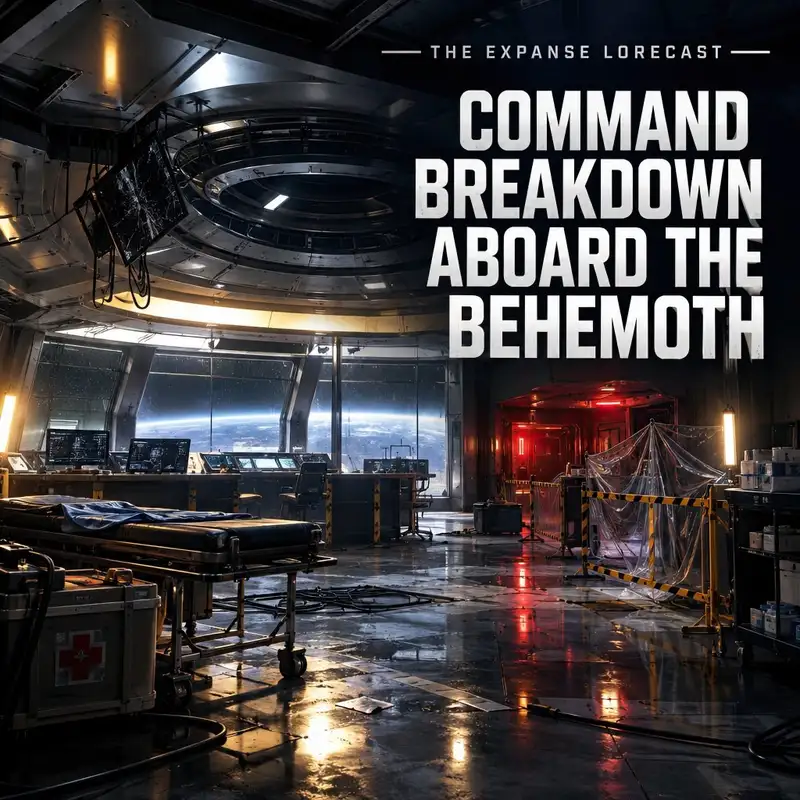
The Behemoth’s great drum began to turn while the trapped fleet was still counting its wounded. It was an emergency measure, and a dangerous one. The ship had been built around that rotating habitat, but it had not been prepared to use it this way, under damage, with frightened crews improvising around injured bodies and overloaded systems. Still, the drum offered something no other vessel in the Slow Zone could provide at the same scale: gravity. Not comfort. Not safety. Gravity for surgery, for circulation, for people whose bones, organs, and blood vessels had been punished by a deceleration no human command had ordered and no human technology understood.
The Behemoth became a hospital because the disaster left it little choice. Survivors came aboard from ships that could no longer support them properly. Medical personnel needed room, equipment, power, air, water, and a surface beneath their feet. The Outer Planets Alliance flagship, sent to the Ring as a declaration that Belters could stand beside Earth and Mars as a political power, found that its most important military asset was temporary gravity and spare volume.
That achievement should have strengthened the ship’s legitimacy. Instead, it exposed how fragile that legitimacy was. The Behemoth was carrying wounded people from several political communities. It was functioning as shelter, medical center, communications node, and armed flagship. And while the crew tried to keep people alive, Captain Klaes Ashford was moving toward a decision that could have turned the ship’s communications system into a weapon aimed at the alien station at the center of the Slow Zone.
The crisis aboard the Behemoth was not simply a story about a captain losing his judgment. Nor was it merely a mutiny on a troubled warship. It was a failure of command design under conditions no institution had prepared to endure. A politically assembled crew, aboard a converted civilian vessel, had been asked to manage alien technology, mass casualties, rival fleets, incomplete intelligence, and the possibility that one wrong act could kill everyone inside the Ring.
The ship itself carried the first part of that problem in its structure. Before it was the Behemoth, it was the Nauvoo, a vast generation ship built for a Mormon expedition beyond the Solar System. Its original mission had required endurance, habitat space, self-sufficiency, and the ability to sustain a community across a journey measured not in weeks or months, but generations. It was designed to be a moving society.
The Outer Planets Alliance took that civilian project and converted it into something else. The new vessel needed to be a warship, or at least look like one. It needed weapons, defensive systems, military command spaces, and enough political presence to ensure that Earth and Mars could not treat the Belt as a collection of scattered stations, hired labor, and inconvenient radicals. The Behemoth was meant to show that the Belt could field a flagship and participate in the future of humanity on terms other than obedience.
That was a powerful symbol. It was also a difficult engineering and institutional compromise. A generation ship is not a purpose-built naval vessel merely because someone installs weapons and gives it a new name. Its volume was useful. Its rotating drum was useful. Its endurance was useful. But its systems, internal layout, maintenance needs, and emergency procedures had been inherited from another purpose. The conversion was not simply a matter of bolting military hardware onto a large hull. It required a command culture capable of using that hull under pressure.
The Behemoth did not yet have that culture. It had a mission, a flag, and political sponsors. It had officers with different loyalties, different histories, and different ideas about what the ship was supposed to become. That was not unusual in coalition warfare. It was dangerous because the coalition had not had time to become an institution.
Captain Klaes Ashford held formal command. He was responsible for the ship, its mission, and its standing within the Outer Planets Alliance. Executive Officer Michio Pa stood directly beneath him in the chain of command, but she was more than a conventional executive officer. Her position carried Belter political meaning. She represented the need for the Behemoth to be visibly and credibly Belter, not simply an armed project supervised by outside patrons.
Carlos “Bull” de Baca, the chief of security, occupied a less tidy place. He was not the executive officer. He was not the captain. But he had experience, practical authority over security personnel, and a connection to Fred Johnson, one of the most influential figures in the Outer Planets Alliance. Bull was there in part because the Behemoth’s sponsors did not entirely trust any one person with such an important ship.
That arrangement made political sense on paper. Ashford had command. Pa had executive authority and legitimacy. Bull provided competence, security, and an informal channel to the people who had helped create the expedition. The difficulty was that all three roles overlapped when the ship faced a crisis. A captain could issue orders, but security had to enforce them. An executive officer could maintain discipline, but only if the crew accepted the chain of command. A security chief could stabilize a dangerous situation, but doing so might look like an attempt to seize the ship.
Before the expedition reached the Ring, those tensions were already visible. Ashford and Bull did not trust one another. Bull judged Ashford harshly, seeing a commander more concerned with image and authority than with the unglamorous work of readiness, repair, and survival. Ashford saw Bull as a challenge inside his own command structure, a man whose influence did not arise from the captain’s confidence. Pa was caught between them. She had reason to resent the political management that had shaped the officer corps, but she also had to live with the consequences of that management every day.
None of this meant that the Behemoth was doomed from the start. Political coalitions can function. Mixed commands can function. Even rival officers can become effective under a clear mission and tested procedures. But the Behemoth had not been given the luxury of a slow shakedown period. It was sent toward the greatest discovery in human history while still trying to prove that its command structure worked.
The pursuit of the Rocinante made the weakness harder to ignore. A falsified broadcast had implicated James Holden and his ship in an attack. The information environment was confused, political pressure was intense, and every major force approaching the Ring had reason to fear being outmaneuvered by the others. The Behemoth could not simply ignore Holden. To do so risked making the Outer Planets Alliance appear weak, compromised, or secretly aligned with him against Earth and Mars.
The decision to pursue and fire on the Rocinante was not only tactical. It was political theater conducted with real weapons. The OPA had come to the Ring to claim standing. A flagship that looked hesitant in the face of an apparent attack could lose credibility before the expedition had even entered the alien structure. Yet the episode also revealed the limitations of the Behemoth’s conversion and the uncertainty within its command. The ship was large, formidable in appearance, and politically important. That did not automatically make it agile, efficient, or psychologically ready for a fast-moving confrontation.
For Ashford, the episode carried another cost. A commander’s confidence does not exist in isolation. It depends on what the crew thinks, what subordinate officers think, and whether a leader appears to understand the ship he commands. The Behemoth had been sent to demonstrate strength. Any sign that it was clumsy, divided, or technically unreliable could become a challenge to the captain’s authority.
Then the expedition entered the Ring, and ordinary naval assumptions began to fail. Inside was a space humans would call the Slow Zone, dominated by the immense alien station at its center. The ships that entered were no longer operating in an environment shaped by familiar orbits, known weapons, and human-made rules. They were inside an engineered system left by a civilization no one understood.
At first, the station imposed a limit on movement. Ships could still maneuver, but not beyond a threshold the humans had not chosen and could not explain. Then a Martian marine used a grenade near the station. The response was immediate, though not comprehensible in human terms. The permitted speed was reduced dramatically. Every vessel in the Slow Zone was forced to obey a new limit.
For the ships, the result was catastrophic. The fleet had been moving too quickly for the new condition. It had no time to brake gradually, no warning that would allow crews to secure themselves, and no human mechanism to resist the imposed deceleration. Bodies struck restraints, couches, decks, bulkheads, and equipment. People who had survived spaceflight, combat, and long periods of acceleration were injured or killed by a force that arrived without warning and disregarded every familiar limit of human engineering.
The Behemoth suffered along with the rest. Its crew was not protected by political status or by the size of the hull. But it remained unusually useful after the initial damage. Other ships were crippled, their crews wounded, their medical capacity overwhelmed, or their life-support systems strained. The fleet had lost mobility. It had lost the ability to escape. It had also lost the comforting illusion that any of the three great human political communities controlled the situation.
Tactically, the vessels were damaged and their crews injured. Operationally, the expedition had become an immobilized flotilla. Strategically, Earth, Mars, and the Outer Planets Alliance were trapped together in an alien environment where none of their normal advantages could guarantee survival. Politically, the emergency made every command decision more consequential. A rash action by one ship could endanger all of them. A refusal to act could also be fatal. Nobody knew the station’s rules, its intentions, its thresholds, or whether there was any path home.
This was not merely an intelligence shortage. It was a failure of shared interpretation. The commanders possessed fragments of evidence. They had observed restrictions, responses, and consequences. But they could not agree on what those observations meant. Was the station defending itself? Was it testing the fleet? Was it responding to weapons, energy use, movement, or something humans had not yet recognized? In the absence of reliable answers, fear could present itself as certainty.
The Behemoth’s size now became both burden and opportunity. It had more people to protect, more systems to manage, more compartments to secure, and more machinery that could fail. But it also had the drum. Bull recognized that the rotating habitat could provide the gravity the wounded needed. The idea was not glamorous. It was not a tactical masterpiece. It was a logistical and medical decision, and in the Slow Zone those were more important than firepower.
Spinning the drum carried risk. The ship was damaged. Its conversion had been incomplete in places and improvised in others. Emergency rotation imposed stresses on a structure that had to support not only the machinery itself, but frightened people, medical operations, and the improvised movement of supplies. Engineers had to trust their systems. Crews had to do disciplined work while exhausted and injured. The people aboard had to accept that the ship’s best available chance of saving lives involved placing additional stress on a vessel already trapped inside an alien machine.
They did it because the alternative was worse. In gravity, medical treatment becomes easier in ways people from planetary surfaces often take for granted. Bodies can be positioned. Equipment stays where it is put. Blood and fluids behave more predictably. Injured people can be moved without every action becoming a struggle against momentum and floating debris. Gravity does not solve trauma, but it gives medicine a workable environment.
The Behemoth became a refuge for people who had not boarded it as members of its crew. That changed the ship’s political character. It was no longer simply the OPA flagship. It was a place where survivors from across the expedition depended on Belter infrastructure and Belter labor. Air management, food, water, medicine, berth space, access control, and medical triage became questions of command. Every decision affected people who did not necessarily recognize Ashford, Pa, or Bull as legitimate authorities.
The ship was also becoming a center of communication. In a trapped fleet, information is power. The vessel that can receive reports, shelter senior personnel, maintain internal order, and provide a working platform for negotiation gains influence whether it wants that influence or not. The Behemoth’s humanitarian role increased its authority. It also increased the stakes of who controlled it.
Bull saw the emergency as a reason to focus on survival. Stabilize the ship. Treat the wounded. Keep systems working. Avoid provoking the unknown station. Preserve the possibility that someone, somewhere, would find a way out. It was not a passive strategy. It demanded labor, discipline, security, and a willingness to accept that immediate rescue mattered more than appearances.
Ashford drew a different conclusion. The Ring was undeniably dangerous. The station had demonstrated the ability to impose conditions on human ships and human bodies with terrifying ease. Ashford’s fear was not irrational in the narrow sense. Anyone looking at the dead and injured around him had reason to fear the system that had caused it. The problem was the leap from fear to irreversible action.
Ashford increasingly treated the Ring itself as an existential threat that had to be destroyed before it could endanger humanity beyond the Slow Zone. That judgment rested on incomplete evidence. No one aboard the Behemoth knew whether an attack would destroy the Ring, whether it was technically possible, whether it would trap the fleet, or whether it would trigger a response far worse than the one already endured. But uncertainty did not restrain Ashford.
Bull believed that was precisely the wrong response. A damaged, overcrowded hospital ship was not in a position to gamble with the survival of the entire expedition. The immediate mission was to keep people alive and prevent further escalation.
The conflict between those views did not remain an argument in a briefing room. Ashford moved to remove Bull, using the language of medical incapacity and command authority. Security officers confined Ashford. Pa faced the decision that gives this episode its lasting importance. The captain and the security chief were issuing contradictory orders. There was no neutral position. To obey one was to defy the other.
Pa authorized Ashford’s confinement and assumed acting command. That decision was necessary in the moment, but it was not clean. The Behemoth had political sponsors, but no settled constitutional process that could resolve a command crisis inside the Slow Zone. Pa’s authority depended on the people willing to recognize it, the officers who chose to support it, and the systems she could actually control.
That is why describing the event as a simple mutiny misses the point. Ashford had been the captain. Bull did not become captain merely by having security personnel detain him. Pa’s accession did not erase the political conflict that produced it.
Pa inherited a damaged vessel, wounded personnel, outside refugees, strained supplies, and an alien threat no one could define. Bull remained influential because he understood the ship’s immediate needs and retained connections with security and operations, even as injury and exhaustion narrowed his ability to act. The acting captain could issue orders, but orders required people, power, communications, and access to engineering spaces before they could become reality.
The wider expedition offered no easy solution. Earth, Mars, and the OPA were not one fleet. They had not entered the Ring as a unified coalition with a single commander and agreed emergency procedures. Each had reasons to fear domination by the others. Each had internal divisions. Each carried wounded people, damaged ships, and political expectations that did not disappear simply because escape had become impossible.
Ashford’s confinement did not end his influence because command is not located only in a captain’s chair. It lives in loyalties, access, routine, belief, and fear. A confined officer can still have supporters. He can still persuade people that the acting command is illegitimate, cowardly, compromised, or blind to danger.
Father Hector Cortez became associated with that movement. Cortez interpreted the Ring through his own religious and moral framework. Faith can give people language for confronting terror and uncertainty. It can also give a frightening event a shape that feels more certain than the evidence permits. Cortez’s conviction that the Ring represented a threat did not establish what the Ring was, what it wanted, or how it would react to attack.
Ashford’s supporters took control of key areas of the ship and pursued a plan to use the Behemoth’s communications laser against the station. A communications system is designed to send information across distance. Under the right conditions, enough focused energy can become a weapon. The difference lies not only in hardware, but in intent, targeting, access, and the willingness to accept consequences.
The plan was strategically reckless because the consequences were unknown, not because they were known. An attack might provoke the station. It might destroy the trapped flotilla. It might close the route home. No human commander could offer a reliable forecast. Ashford’s faction was asking everyone in the Slow Zone to accept an irreversible gamble based on fear and conviction.
At that point, the decisive battle was not between Earth, Mars, and the Belt. It was inside the Behemoth. The important terrain was engineering, reactor access, internal communications, power distribution, security positions, and the paths that connected them.
This kind of internal conflict is difficult even aboard a healthy vessel. Aboard the Behemoth, it was worse. The ship contained wounded civilians and military personnel from multiple backgrounds. Weapons could not be used carelessly. A missed shot can strike a bulkhead, a power line, an air system, or someone who never chose a side.
Bull became central to the resistance because he understood what had to be controlled and what could not be allowed to fail. He was not operating from the comfort of a secure command center. He was injured, exhausted, and working in an environment where every movement cost more than it should. His value came from practical judgment. He knew that stopping Ashford required more than winning an argument.
Pa’s loyalists, Holden, Naomi Nagata, and others were drawn into the struggle for the same reason. Naomi brought technical understanding and a clear appreciation of how vulnerable ships become when power, communications, and control systems are contested. Their presence mattered, but the crisis remained fundamentally the Behemoth’s. They could assist.
Clarissa Mao’s intervention also mattered. She was not a trusted officer who had appeared to restore order. She carried her own history, motives, damage, and limited understanding of the wider crisis. In emergencies, institutions sometimes survive because help comes from people they did not expect to rely on. That does not make the institution healthy. It shows how close it came to failing.
The struggle was costly. The resistance succeeded because it combined people willing to act, access to technical knowledge, and the recognition that shutting down the Behemoth’s capacity to fire was more important than preserving the appearance of normal operations.
Disabling power was not a triumph in the ordinary military sense. In the Slow Zone, those strengths had become part of the danger. The Behemoth could survive only by becoming less capable of acting like the armed flagship it had been built to be.
Stopping Ashford’s attack prevented one catastrophe. It did not solve the larger problem. The station still controlled the conditions inside the Slow Zone. The ships remained trapped. The fleet needed a solution that did not depend on destroying an enemy it could not identify.
Holden’s developing understanding pointed in another direction. The station appeared to react to what it perceived as threats. The answer was not a superior strike. It was de-escalation on a scale that required cooperation from forces that had recently pursued one another, fired on one another, and treated one another as political rivals.
The coordinated reactor shutdown was therefore not merely a technical procedure. It was an act of collective restraint. Each ship had to accept vulnerability. Each commander had to trust that other commanders would also stop behaving like combatants. In normal naval doctrine, voluntarily reducing one’s capacity to fight in the presence of danger sounds like surrender. In the Slow Zone, it became a condition of survival.
The immediate tactical result was that the flotilla stopped presenting the same kind of active threat. Operationally, the ships avoided an immediate escalation with the station. Politically, no single faction could honestly claim sole credit. Earth, Mars, the OPA, independent crews, scientists, soldiers, refugees, and civilians all depended on one another’s restraint.
The Behemoth was crucial to that survival, but it did not save the fleet alone. Its rotating drum preserved people who might otherwise have died. Its size and life-support capacity made it a refuge. Its internal resistance prevented a potentially disastrous attack. Its crew helped buy the time in which a broader solution became possible.
That is the irony of the Behemoth’s mission. It had been built as a political and military statement. The OPA wanted a ship that could not be ignored. The vessel achieved historical importance not by defeating Earth or Mars, not by annihilating a hostile fleet, and not by proving that Belters could wield a larger weapon.
Ashford’s failures mattered. His fear, pride, deteriorating judgment, and willingness to impose an irreversible solution on everyone trapped in the Slow Zone turned a command dispute into a near-catastrophe. But his individual failure was enabled by institutional conditions. The Behemoth had an ambiguous command structure, politically balanced staffing, untested emergency procedures, and contested control over systems that could be used for either survival or destruction.
Pa’s role was not uncomplicated triumph. She did not inherit a stable captaincy. She assumed responsibility because the existing captain could no longer be trusted with the immediate survival of the ship and the fleet around it. Her authority remained contested, and the burden of that contest fell on wounded crews, security personnel, engineers, refugees, and people who had no role in creating the political arrangement that had failed them.
Bull’s role revealed another hard truth about crisis command. Formal rank matters, but practical control of essential functions can matter more when systems collapse. He understood security, engineering access, medical necessity, and the difference between a ship that looks powerful and a ship that can keep people alive. Yet the fact that he had to use that practical authority against his captain also revealed the legitimacy problem at the heart of the Behemoth’s command.
The ship would later become Medina Station, fixed at the center of a new human political geography. That future gave the Behemoth a different kind of importance. But during the Slow Zone crisis, it was not yet a stable station or a durable symbol of order. It was an overloaded, damaged vessel filled with people trying to decide whether authority meant obedience to rank, protection of life, control of machinery, or the courage to refuse a catastrophic order.
The Behemoth became politically credible not because it could destroy a gate or threaten an alien station. It became credible because enough of its crew chose to preserve the lives trapped behind them when fear, weapons, and uncertain intelligence converged.