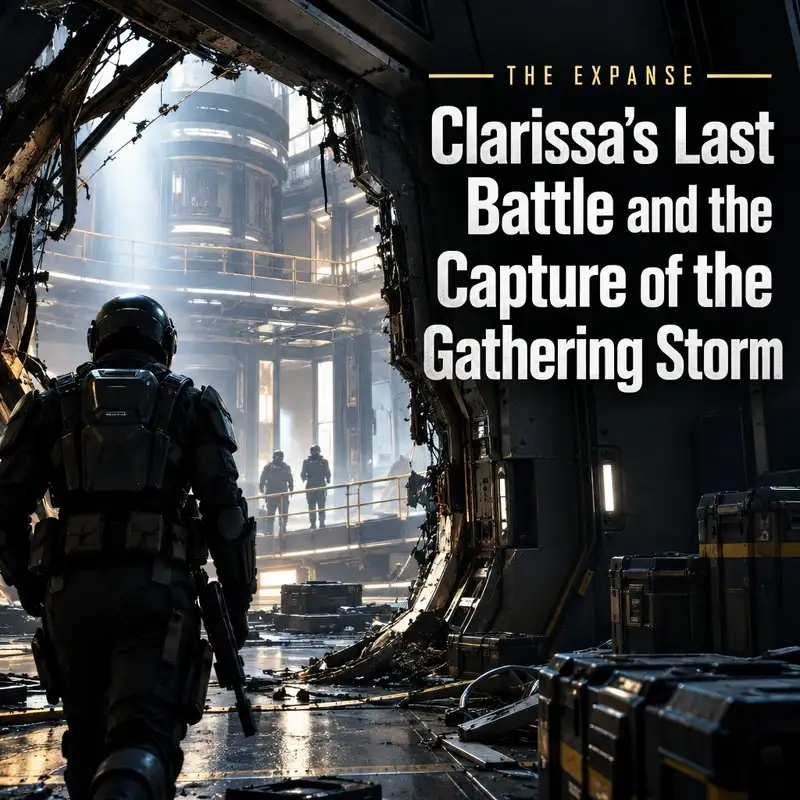
Clarissa’s Last Battle and the Capture of the Gathering Storm
Deep inside Medina Station, Naomi Nagata and Clarissa Mao are trying to create uncertainty rather than destruction. Naomi’s altered traffic cards are designed to make surveillance and traffic-control systems hesitate, verify bad information, and waste precious time on false diagnostics. The resistance does not need Medina blind forever. It needs a short interval in which prisoners can move, ships can escape, and Laconian command can no longer tell with confidence which contact matters most.
That uncertainty is enough. The resistance does not need to destroy Laconian power. It needs a gap in it. Ships are preparing to flee through different gates. Prisoners are being released. Occupation authorities are being forced to respond to disturbances across a station built to regulate movement among more than a thousand human systems. Outside Medina, the Laconian destroyer Gathering Storm remains the most immediate threat to any ship that tries to escape. If its crew can identify, track, and pursue the fugitives, the breakout becomes a slaughter. If Medina’s sensors can be made unreliable for even a short time, then the resistance may preserve people, ships, and the beginnings of a future war.
But the operation is already compromised. The danger is not a remote Laconian weapon or an alien-derived system too advanced to understand. It is a human source inside the resistance network. Jordao has informed for the occupation. Security personnel are closing in on Naomi and Clarissa before the sabotage can become fully secure. In the next few minutes, the survival of a distributed escape plan will depend on one exhausted former prisoner whose body is already failing.
Clarissa’s last battle and the capture of the Gathering Storm are often remembered as a dramatic death and a daring boarding action. They were both of those things. But together they were something more consequential. They showed how an outmatched resistance could create a local advantage against an empire that possessed better ships, better weapons, tighter command structures, and access to technologies no one outside Laconia fully understood. The resistance did not defeat Laconia in open battle. It attacked the assumptions that made Laconian control appear effortless.
Laconia did not arrive as another claimant in a political argument. It arrived with overwhelming force. The Heart of the Tempest, one of Laconia’s immense Magnetar-class warships, neutralized Medina’s old defenses with alien-derived capabilities that made conventional resistance look obsolete. That demonstration was important not only because of the weapons involved. It told every observer that Laconia possessed an industrial and scientific base far beyond anything the old powers had prepared to face. The station’s defenders could not simply trade fire and hope courage would narrow the gap.
The Gathering Storm was not the Heart of the Tempest. It was smaller, a Pulsar-class fast-attack destroyer rather than a massive capital ship. But it was still a formidable expression of Laconian advantage. It carried advanced weapons, dense point-defense coverage, strong missile capability, and a rapid-fire railgun arrangement that made close engagement especially dangerous. It was designed to move quickly through the gate network and impose Laconian power where a Magnetar-class ship could not be spared. For an ordinary independent ship, and even for a veteran warship like the Rocinante, the Gathering Storm was not an opponent to meet casually.
After the Tempest departed to begin the broader Laconian campaign against the old Solar System, Santiago Jilie Singh remained at Medina as governor and as captain of the Gathering Storm. His position fused political and military authority in one command. On paper, it was efficient. In practice, it made Medina an occupation governed through a narrow chain of command, surveillance systems, security forces, curfews, censorship, and the constant threat of detention. Laconia had taken the station’s weapons and offices. It had not won the confidence of the population that kept the station functioning.
That distinction was central. A station cannot be controlled by guns alone. Medina needed technicians, dockworkers, traffic controllers, recyclers, medical staff, ship crews, traders, cooks, maintenance workers, and families who understood its routines better than any newly arrived occupation force could. The Laconian authorities could issue orders, inspect records, and arrest suspected dissidents. They could not instantly replace the informal relationships through which people found spare parts, moved information, hid passengers, altered manifests, or learned which official had begun asking the wrong questions.
Singh’s tightening control produced visible compliance. It did not produce legitimacy. The more force he used to demonstrate authority, the more he confirmed that authority rested on coercion rather than consent. None of that meant every resident of Medina became a resistance fighter. Most people faced the ordinary calculations of an occupied population. They had families, jobs, medical needs, debts, ration requirements, and too much experience of vacuum to confuse recklessness with bravery. But it did mean the occupation had to govern a population that had reasons to conceal information from it.
The resistance associated with Saba and the Voltaire Collective understood that it could not retake Medina by force. There would be no glorious last stand on the station’s command deck. No improvised militia could defeat a Laconian destroyer, let alone summon enough ships to challenge the empire’s larger fleet. The objective was narrower, and in strategic terms more realistic. The resistance would preserve itself. It would get people out. It would free detainees before they vanished into the occupation system. It would move ships and personnel beyond immediate Laconian reach. And it would deny Singh the clean, orderly victory that would prove Medina had accepted its new rulers.
This meant coordinating several actions at once. Prisoners had to be released. Disruption had to draw security personnel away from critical targets. Communications and traffic systems had to be interfered with. Escape vessels had to be moved through different gates so they could not all be trapped or pursued along a single route. The Gathering Storm had to be distracted, delayed, or, if fortune and preparation allowed, taken out of Laconian hands entirely. Each action was limited on its own. Together they overloaded the occupation’s ability to sort threat from noise.
This was not a plan built on mass. The resistance lacked mass. It was built on access, timing, and the fact that a station’s infrastructure is not merely equipment. It is accumulated human knowledge. A traffic system has routines. A prison has staffing patterns. A security service has response procedures. A warship has assumptions about where danger will come from. Even highly disciplined forces depend on systems that work as expected, particularly when they are trying to suppress disorder across a large civilian habitat.
The plan also carried a moral burden. Every act of resistance inside Medina risked exposing civilians to retaliation. A released prisoner might be a future fighter, an innocent detainee, or both. A disrupted transit system could help escape ships disappear, but it could also frighten civilians who depended on the same systems for safe docking, air, cargo, and travel. Laconia’s response to disorder was not likely to be patient. The resistance could not pretend that an escape operation would leave the station untouched. It acted because remaining passive would allow the occupation to remove every person capable of organizing opposition.
Laconia enjoyed real intelligence advantages. It had access to official records, station administration, secure military channels, and trained security personnel. Its forces were better equipped than the people opposing them, and their command structure was clearer. The empire had arrived with a coherent strategic purpose, while the systems it conquered were still trying to understand what had happened. That initial shock mattered. A force that knows what it intends to do can move faster than a coalition still debating whether the old political world exists.
But intelligence is not the same as information collection. It is the ability to understand what the information means. The Laconian occupation could identify dissidents, monitor communications, and uncover a genuine resistance operation. It still struggled to see the full shape of that operation because the resistance was distributed across people, places, routines, and loyalties that did not appear on a formal organization chart. It did not have one headquarters to seize, one fleet to destroy, or one public leader whose arrest would end the threat.
Jordao’s betrayal demonstrates both the strength and the limit of Laconian intelligence. He was close enough to the resistance to provide Singh with dangerous information. His presence created an immediate threat to Naomi and Clarissa, and his report helped turn a difficult mission into a lethal one. But one informer did not expose every participant, every escape route, or every contingency. Compartmentalization left the resistance vulnerable in fragments while preventing the occupation from seeing the entire design. It is an old problem in clandestine war. The same walls that protect a network can keep its members from knowing where danger is coming from.
For Naomi, the decisive battlefield was Medina’s traffic and sensor architecture. Her sabotage depended on technical preparation, physical access, and an understanding of how the station’s systems would respond when their data became suspect. The altered traffic cards did not magically erase every sensor feed. They created a condition in which the system had to question itself. It could not return quickly to reliable surveillance because the apparent errors were embedded in the machinery used to validate and route information.
That distinction matters. Destroying a sensor can be obvious. An operator sees a dead feed and sends a repair team. Corrupting the system’s confidence is more dangerous because it forces the operator to choose between competing reports. Is the contact real? Is the transponder false? Is the traffic record corrupted? Is the failure local, deliberate, or spreading? Does a ship moving toward a gate represent an emergency, an evacuation, a hostile departure, or the normal confusion of a station in crisis? Every minute spent answering those questions becomes time that escaping vessels can use.
In a space conflict, uncertainty has military value. A destroyer does not need visual contact to kill a ship, but it does need a target picture reliable enough to choose pursuit, calculate an intercept, launch weapons, and avoid wasting ammunition on the wrong contact. The Gathering Storm’s weapons were formidable. They did not make its crew omniscient. If the station’s systems could not provide clean tracking data, and if the broader escape created too many competing demands, then superior weapons could be temporarily separated from useful targets.
Naomi’s work therefore did not merely conceal a few fugitives. It disrupted Laconia’s command and control at the exact point where command and control mattered most. Medina was the hub through which the empire intended to regulate movement. Making the hub unreliable forced Laconian officers to operate with incomplete information at the moment they most needed certainty. The resistance could not manufacture a fleet. It could manufacture confusion.
Clarissa was there because she was not simply the person she had once been. Long before Medina, she had called herself Melba Koh. She was the daughter of Jules-Pierre Mao, and she had used false identity, sabotage, and murder in an attempt to punish James Holden and the people around him for her father’s downfall. Her campaign against the Rocinante’s crew had been driven by grief, loyalty, rage, and a refusal to see the damage her own actions caused. She had become, in every practical sense, a weapon built for revenge.
Imprisonment did not erase that history. Nor did joining the Rocinante make anyone forget it. Clarissa’s later life was defined less by a single moment of forgiveness than by responsibility. She worked. She repaired things. She accepted supervision, especially from Amos Burton, who understood better than most that trust is not a feeling granted once and kept forever. It is a pattern established through conduct. Over the years, Clarissa became part of a crew because she performed the difficult, ordinary labor of belonging to one.
The same was true at Medina. She was not assigned to Naomi’s mission as a ceremonial symbol of redemption. She was useful. She understood technical work. She had experience operating under danger. She knew what it meant to make a decision that could not be undone. And she understood the cost of being treated as a tool, because her own body still carried the evidence.
Clarissa’s illegal endocrine implants had once given her bursts of extraordinary speed and strength. They accelerated her responses and pushed her body beyond ordinary human limits for short periods. But they were not a clean enhancement. They had always been dangerous. Decades later, the damage was no longer theoretical. The implants had imposed a long physical debt, and Clarissa was nearing the point when her body could no longer pay it. Activating them was not like drawing a weapon from a holster. It was more like borrowing time from a system already close to collapse.
That made the implants an inheritance from her earlier life. The body she had weaponized in pursuit of revenge remained marked by that choice even after her politics, loyalties, and sense of self had changed. Clarissa had not escaped her past by becoming a different person. She had learned to live responsibly inside its consequences. Her final mission did not make the implants noble. It gave their last use a purpose that was no longer centered on her own anger.
When Jordao’s betrayal brings Laconian security down on Naomi and Clarissa, the sabotage is no longer a purely technical operation. The altered traffic cards are in place, but the people who installed them are exposed. Naomi must survive for the wider plan to retain its coherence. The station systems must remain compromised long enough for the breakout to continue. Jordao’s information threatens to turn a hidden systems attack into a contained security incident, and the arrival of armed personnel turns the problem brutally immediate.
Clarissa’s choice to activate the implants is not a planned sacrificial charge. It is an emergency response to a collapsing situation. She has no reason to believe her body will survive another activation. She also has no credible alternative that protects Naomi and preserves the sabotage. In the confined, pressurized spaces of a station, close combat is not glamorous. It is fast, disorienting, and catastrophic for anyone caught without the advantage. Bulkheads, equipment, access points, and the presence of vulnerable infrastructure limit every movement. A firefight can kill defenders, attackers, and bystanders, or ruin the systems everyone depends on to breathe.
The implants give Clarissa the speed and violence required to stop the immediate threat. She kills the Laconian attackers. She kills Jordao. The act contains the compromise at the point where it has become most dangerous. Naomi survives. The sensor disruption survives. The escape plan remains possible. Tactically, Clarissa has done exactly what the resistance needs: she has prevented the occupation from regaining control of the situation before the wider operation can unfold.
The cost is lethal. Clarissa is already sick and physically diminished. The exertion, the toxic effects of the implants, and the injuries of the fight overwhelm the body that has carried her through years of labor, confinement, travel, and regret. Naomi remains with her as she dies. There is no larger audience to certify the moment. No empire pauses its machinery because one person has reached the end of a hard and painful life. Outside the compartment, alarms, escape routes, command decisions, and armed movement continue.
It would be too simple to call this redemption purchased with death. Clarissa had already changed through years of responsibility before Medina. Her death does not erase the people she harmed, and it does not transform violence into virtue. What it reveals is continuity of a different kind. When her final choice comes, she uses the weapon embedded in her damaged body to protect someone else and preserve a collective effort. The tactical act is violent. The moral meaning comes from the purpose it serves and from the life that led her to that purpose.
While Clarissa and Naomi fight for the station-side half of the operation, the naval half is moving into position outside Medina. The Gathering Storm cannot simply be ignored. If it remains under Laconian control, it can pursue escapees after the sensor disruption clears, hunt down ships that have chosen the wrong gate, and serve as the armed center of the occupation’s response. Even a successful evacuation could become only a delay if the destroyer is free to follow.
The Rocinante cannot reasonably defeat the Gathering Storm in a straightforward duel. The Rocinante is a veteran ship with an experienced crew, extensive combat history, and a reputation earned through survival against opponents who often had better resources. But reputation is not armor, and courage does not change the geometry of weapons range. The Gathering Storm represents a newer and more advanced military system. It has defenses designed to defeat missiles, weapons suited to punish close approaches, and the speed to decide when and where to engage. Meeting it head-on would risk losing the Rocinante and the people depending on it.
The resistance therefore chooses a more difficult objective than merely surviving an exchange. It chooses to capture the destroyer. At first glance, that seems absurd. Boarding an advanced Laconian warship is more dangerous than trying to run from it. But the logic is sound. Destroying the ship would remove a threat, but it might also consume time, ammunition, and ships the resistance could not afford to lose. Delaying it might still leave it capable of pursuit once the station’s systems recovered. Capturing it would remove the immediate danger, deny Laconia a prototype warship, and provide the resistance with a mobile asset it could study and eventually use.
That value had limits from the beginning. A captured destroyer does not make a resistance equal to an empire. The ship still requires trained personnel, maintenance knowledge, spare parts, ammunition, repair facilities, and an understanding of unfamiliar Laconian systems. A weapon cannot be sustained by admiration. Nor can one captured hull reproduce the industrial base that built it. The Gathering Storm would be valuable precisely because it was rare, not because it made every other disadvantage disappear.
Its intelligence value could be as important as its guns. A Laconian warship contained evidence of design philosophy, communications practices, software, security arrangements, maintenance procedures, and command assumptions. Even partial access to those systems could teach the resistance where Laconia was strong, where it was dependent on specialized infrastructure, and where its confidence might exceed its understanding. An empire that has spent decades in isolation can emerge with remarkable tools and still discover that those tools have vulnerabilities once other people begin examining them.
To take the Gathering Storm, the resistance must prevent it from using its superiority freely. Alex Kamal flies the Rocinante as the diversionary element. His task is not to win a heroic duel. It is to demand attention. The Rocinante has to be threatening enough, mobile enough, and unpredictable enough that the destroyer cannot simply ignore it while focusing on station traffic and departing ships. In space combat, attention is a resource. A captain who must track one dangerous opponent, interpret corrupted sensor data, coordinate with a station in disorder, and evaluate multiple departing contacts has less capacity to recognize an attack developing from another direction.
Bobbie Draper leads the boarding effort. Her value is not mystical combat ability. It is professional judgment developed through years as a Martian Marine, a soldier, a bodyguard, an investigator, and a commander who has watched institutions fail around her. She understands what a boarding operation requires. The attackers need to approach a moving warship without being detected or destroyed. They need to control relative motion. They need a way through the hull. They need suits, weapons, breaching tools, local information, and a plan for what happens after entry.
Amos is part of that boarding force. His role is practical, tactical, and essential. He does not stand beside Clarissa during her final fight. Her battle takes place inside Medina’s infrastructure, while his takes place in the assault on the destroyer. Their separation matters. Clarissa’s death is not an accessory to Amos’s action sequence, and Amos’s contribution to the capture is not a substitute for the grief he will have to carry afterward. The operation works because different people are doing different necessary things in different locations, often without knowing whether the others are still alive.
Boarding a warship in vacuum is not simply infantry combat transferred into a spacecraft. The approach itself can be fatal. The target may maneuver. Its point-defense network may engage anything it identifies as hostile. The hull may be armored, compartmentalized, or prepared for battle. Once inside, attackers face pressure hazards, damaged systems, unfamiliar layouts, armed defenders, and the possibility that the crew will choose to disable or destroy critical systems rather than surrender them. The resistance must capture the ship intact enough to matter, which means applying force carefully in a situation where careful force is a luxury.
The broader breakout creates the opening. Medina’s failing sensor picture muddies the operational environment. The released prisoners and station disturbances pull security assets in competing directions. Departing traffic creates targets, false leads, and urgent demands for action. The Rocinante forces the Gathering Storm to treat it as an immediate military problem. The destroyer is not helpless. Its crew remains dangerous, trained, and equipped with a ship superior to anything the boarders bring. But superiority is not the same as immunity. The resistance has created a narrow interval in which the ship cannot fully apply its advantages.
The boarding team reaches the Gathering Storm from outside, breaches the hull, and fights inward toward control of the vessel. The details are necessarily brutal and close. At this range, advanced naval doctrine collapses into the oldest military questions: who holds the passage, who can communicate, who knows the layout, who can keep moving after the first plan fails, and who controls the command spaces before the defenders can restore coordination. Bobbie’s leadership matters because she can hold the mission together under that pressure. Amos matters because he is effective at the practical work of surviving a violent, disordered environment.
The capture exposes a weakness inherent in Laconia’s occupation model. The empire has excellent ships and disciplined crews, but it is trying to hold a hostile station while conducting a wider interstellar campaign. It cannot put an armed guard on every service corridor, every access route, every civilian work gang, every data connection, and every piece of station infrastructure. It cannot make every local technician loyal through surveillance. It cannot guarantee that the people who appear compliant have accepted the permanence of imperial rule. Military power can seize the center of a system. It cannot remove every path around it.
Once the Gathering Storm is taken, the resistance has achieved an extraordinary local success. The ship, surviving personnel, and escaping vessels withdraw toward Freehold. The breakout has not liberated Medina. It has not stopped Laconia’s campaign against the old powers. It has not erased the imbalance in ships, industry, or alien-derived technology. But it has preserved a body of people who can continue to resist, and it has carried away something Laconia expected to remain beyond the reach of its enemies.
Tactically, the mission succeeds. Medina’s surveillance is disrupted. Naomi survives the security response. The immediate threat to the escape is contained. The Gathering Storm is removed from Laconian control. Operationally, the resistance escapes with people, ships, information, and organizational continuity. Those are not dramatic abstractions. A resistance without experienced personnel becomes a slogan. A resistance without ships cannot move between systems. A resistance without information acts blindly. The breakout preserves the means to make later choices.
Strategically, the capture damages Laconia’s claim to inevitability. The empire remains far stronger than its opponents, but its power has been shown to be vulnerable to local knowledge, deception, and coordinated action. The Gathering Storm becomes proof that Laconian technology can be seized, studied, and used against its builders. That proof matters politically as much as militarily. Occupied populations do not need to believe that victory is certain before they decide resistance is possible. They need to see that the occupier can be made to fail.
Still, the ship’s value remains conditional. The resistance has acquired a demanding machine, not a miracle. Keeping it operational will require maintenance, training, logistics, and careful adaptation. Its systems may be more advanced than anything available to the resistance, but advanced systems can also be more dependent on specialized knowledge and parts. The Gathering Storm offers opportunity, intelligence, mobility, and firepower. It does not cancel the hard arithmetic of fuel, ammunition, repair, crew endurance, and industrial capacity.
The price of the operation is left behind on Medina. Civilians remain under occupation. The Laconian authorities consider mass punishment and retaliation because empires that rely on fear often answer defiance by trying to make examples of populations. The escape may inspire hope, but it also leaves the people unable to flee exposed to a government determined to prove that resistance carries unbearable consequences. The resistance has made a morally necessary choice under terrible constraints, not a clean one.
Singh’s failure leads to his removal and death, but treating him as the sole cause of the disaster would flatter the system that created him. His inexperience, paranoia, and punitive instincts worsen the occupation. Yet the deeper problem is Laconia’s belief that superior weapons and centralized command can substitute for legitimacy, local knowledge, and durable political relationships. Singh becomes the visible casualty because authoritarian institutions often punish the officer who fails in public while preserving the assumptions that made failure likely.
Clarissa Mao’s final battle matters because it preserves the human and technical links that the resistance needs to survive. She saves Naomi, and through Naomi she helps preserve the sabotage that blinds Medina long enough for the larger escape to work. Her death is not valuable because suffering washes away guilt. It is valuable because, after years of becoming someone different, Clarissa makes a final choice for other people rather than for revenge.
Clarissa’s final fight and the capture of the Gathering Storm belong to the same kind of victory. Neither destroys Laconia. Both preserve future choices. Clarissa uses the last strength of a body once modified for violence to keep Naomi alive long enough for the escape to work. The resistance takes an imperial destroyer and turns it into mobility, intelligence, and proof that the enemy’s systems can be penetrated. The battle ends with loss, but not with helplessness.