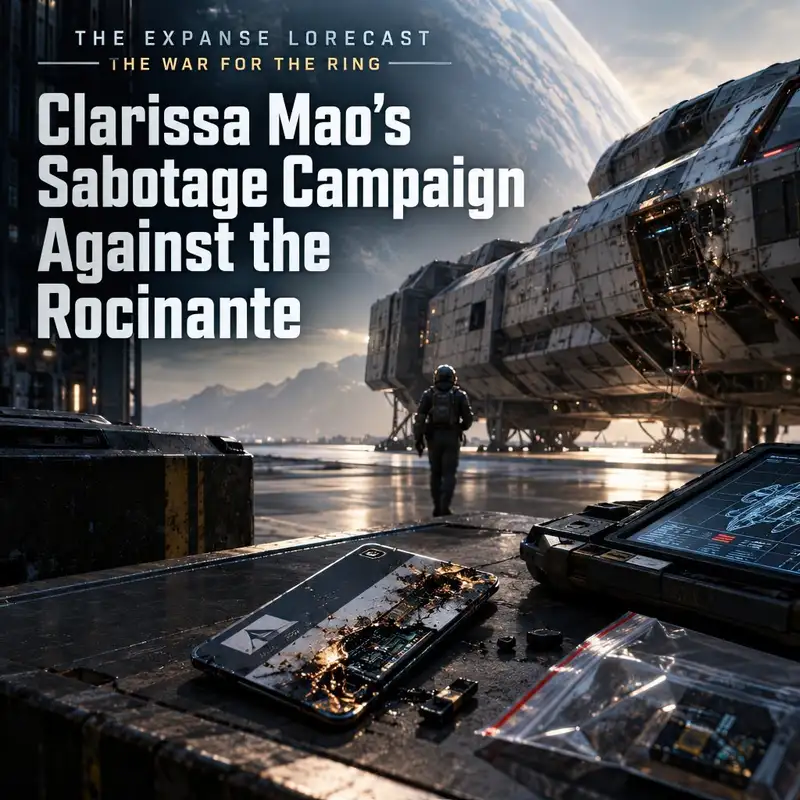
Clarissa Mao’s Sabotage Campaign Against the Rocinante
The explosion aboard the Seung Un was only the first weapon Clarissa Mao used. The more dangerous one arrived almost at once, carried across the expedition in the face and voice of James Holden. A transmission from the Rocinante appeared to claim responsibility for the attack. It tied the bombing to the Outer Planets Alliance and declared authority over the Ring, humanity’s first direct doorway to more than a thousand unknown systems.
For the people watching it, this was not an abstract media problem. A United Nations ship had been attacked in a crowded, politically unstable flotilla. Holden commanded a heavily armed former Martian warship. He was already famous, already controversial, and already associated in the public imagination with Belt causes, even though he did not answer to any Outer Planets Alliance command. If he had chosen that moment to turn the Rocinante into a private political weapon, the consequences could have reached far beyond one damaged ship.
The immediate question was not whether the transmission looked perfect. In a crisis, few lies need to be perfect. They only need to arrive before the facts.
Clarissa’s campaign against the Rocinante nearly succeeded because it did not begin as an attempt to overpower the ship in a fight. It began as an attack on trust, attribution, and legitimacy. The bomb made fear physical. The forged broadcast gave fear a political explanation. And the expedition’s divided command structure turned that explanation into an operational threat before anyone had time to prove it false.
The Rocinante was uniquely suited to become a false flag because it already carried too many meanings for too many people. It had begun life as the Martian gunship Tachi, a vessel built by the Martian Congressional Republic Navy. After the destruction of the Canterbury and the chain of crises that followed, Holden and his crew seized the ship, renamed it, and made it their home. Its hull was still Martian. Its armament was still military. Its legal status was still contested.
Mars had never forgotten that point. The Rocinante was not merely a ship that had changed hands. It was a public reminder that the Martian state had lost control of one of its own warships during a period of escalating interplanetary distrust. The legal pressure to reclaim it became important because Holden needed a way to protect his crew’s practical independence without surrendering the ship that kept them alive.
That need brought Monica Stuart and her documentary crew into the Rocinante’s orbit. Monica had access, money, and a public platform. Holden had a ship Mars wanted back. The arrangement gave him political cover and gave her material for a documentary. It also placed civilians, equipment, and outside personnel close to a warship whose security depended heavily on the trustworthiness of everyone allowed aboard.
That was the opening Clarissa needed. There is a common temptation, especially after a successful act of sabotage, to imagine that security failed because everyone involved was foolish. Usually, security fails because ordinary systems have to remain usable. Ships need maintenance. Cameras need power. Communications systems need people who understand them. Civilian crews need access to spaces they are authorized to use. A captain cannot run a vessel by treating every technician, journalist, contractor, and passenger as an enemy agent.
The Rocinante’s vulnerability was not that Holden allowed journalists near his ship. The vulnerability was that a disputed military vessel operating inside a politically sensitive expedition had no clean boundary between civilian access, public relations, legal pressure, and military security. Clarissa did not smash through that boundary. She entered through it.
One of Monica Stuart’s people, Elio Casti, became part of the communications compromise that allowed Clarissa’s false message to reach the flotilla through the Rocinante. The available evidence does not support treating him as a fully informed partner in a mass-casualty conspiracy. That distinction matters. Sabotage networks often rely on uneven knowledge. One participant may believe he is helping with a technical intrusion, an embarrassing broadcast, or an act of political mischief, while another understands that the same access will be paired with murder and an attack on a United Nations ship.
Clarissa’s operation depended on that separation. She did not need every person around her to share her hatred. She needed enough people to perform narrow tasks without seeing the whole design.
The identity she wore during the expedition was Melba Koh. Under that name, Clarissa presented herself as a capable technical worker aboard the Cerisier. The disguise was not simply a false name on a personnel record. It was a social role. It gave her a reason to be near maintenance systems, equipment, work crews, and the unnoticed routines that keep fleets functioning.
Technical labor can disappear in the public imagination because it rarely receives the attention given to commanders, politicians, and ship captains. But a flotilla is held together by people who inspect cables, check seals, maintain power systems, move supplies, clean machinery, repair access panels, and make sure an error in one compartment does not become a disaster for everyone aboard. Those workers also see things. A person who uses technical access for sabotage must understand not only machinery, but the rhythm of people who know what machinery is supposed to sound like.
Clarissa understood that rhythm well enough to hide inside it. She was patient. She was prepared. She was also driven by a grievance so distorted that preparation became a form of self-destruction.
Clarissa Mao was the daughter of Jules-Pierre Mao and the sister of Julie Mao. Her family had once possessed immense wealth, influence, and reach. The Mao name stood for corporate power on a scale that could shape governments, research programs, transport networks, and private security arrangements. Then the Protogen conspiracy was exposed. Eros became the site of an atrocity and an alien experiment. Jules-Pierre Mao was arrested. The family’s public position collapsed.
Clarissa blamed Holden for that collapse. Her anger was not baseless in the narrow sense that Holden had played a role in exposing crimes connected to the Mao family. But the larger blame she assigned to him was profoundly false. Holden did not create the Protogen program. He did not choose to conduct lethal experiments on human beings. He did not order Eros transformed. He did not decide that profit, influence, and access to alien technology justified atrocities. Those choices belonged to Jules-Pierre Mao and the network around him.
Clarissa could not accept that distinction. Holden became, in her mind, the thief of her father’s dignity, her sister’s memory, and her family’s future. That belief combined grief with privilege. She had suffered real loss, but she interpreted that loss as an injustice committed by the man who had helped expose the crime.
A private vendetta, however, would not be enough. Killing Holden in a corridor or poisoning him in his cabin would make him a martyr and leave the Mao legacy untouched. Clarissa needed him to become a villain in public. She needed the destruction of James Holden’s reputation to look like a restoration of moral order.
That is why the forged message mattered as much as the bomb. Her plan joined several forms of attack into one event. An explosive device was placed aboard the Seung Un. The Rocinante’s communications were compromised. A fabricated transmission using Holden’s likeness and voice was prepared. And the message did not merely claim that Holden had attacked an enemy. It presented him as a political actor asserting authority over the Ring on behalf of the Outer Planets Alliance.
That claim was designed to activate every fear already present in the flotilla. Earth feared that the Belt might use the Ring to alter the balance of power in the Solar System. Mars feared the loss of strategic control and the erosion of the military order it had spent generations building. Many Belters feared that Earth and Mars would once again decide the future of distant workers without their consent. The Outer Planets Alliance itself was not a single organization with one command structure, one ideology, or one policy. It was a broad and fractured political field. That made it easy to exploit. A declaration supposedly made in the Alliance’s name could sound credible to people who had never agreed on what the Alliance actually was.
The Rocinante’s reputation completed the deception. Holden had aided Belters. He had worked with representatives of the Outer Planets Alliance. He had challenged Earth and Mars. He had used the ship’s guns in conflicts where governments preferred plausible deniability to clean responsibility. To his allies, that made him independent and difficult to control. To his enemies, it made him a man who might decide that his own moral certainty was enough to justify armed action.
Clarissa did not invent those suspicions. She weaponized them.
In military terms, the operation was a small combined-arms campaign. The bomb provided physical damage and immediate urgency. The communications intrusion provided false attribution. The political message shaped interpretation. And the existing distrust among Earth, Mars, and the Belt gave the deception its audience.
The operation’s goal was not simply to destroy a ship. It was to make every armed vessel near the Ring see the Rocinante as a threat before the Rocinante could explain itself.
This kind of attack is difficult to defend against because its target is not one computer system or one hull plate. It attacks the relationship between evidence and action. Commanders must make decisions while evidence is incomplete. They cannot always wait for a full forensic investigation when they believe a hostile warship may be maneuvering near civilians, military vessels, and the most strategically valuable discovery in human history.
That pressure was Clarissa’s weapon. But sabotage has a vulnerable period before detonation. Bombs, altered systems, forged transmissions, and hidden identities all depend on time. Routine work can expose what elaborate ideology overlooks. A technician notices a cable where it should not be. A maintenance record does not match a system’s behavior. A panel shows signs of recent access. A person who should not be anxious is suddenly too careful.
Ren noticed enough to become dangerous.
His discovery threatened Clarissa’s entire schedule. If he warned the right people, the explosive device could be found, the communications compromise could be traced, and Melba Koh’s identity could be examined before the false flag was launched. Clarissa had built her campaign around concealment. Ren made concealment impossible.
At that moment, the sabotage campaign crossed a line from conspiracy into direct murder. Clarissa had illegal glandular implants that could flood her body with chemicals, giving her short bursts of extraordinary speed and strength. They were not protomolecule technology. They were human-made enhancements, brutal in their own way because they treated the body as a temporary instrument to be driven past normal limits.
In an immediate struggle, the implants gave Clarissa an enormous advantage. They let her move faster and strike harder than someone around her expected. But they were not a durable military capability. The cost was severe. After the surge came pain, exhaustion, disorientation, and physical collapse. The implants could help her win seconds or minutes. They could not give her a sustainable campaign, reliable medical support, or control over the larger crisis she was creating.
Against Ren, they were enough. His death was both an operational success and the clearest proof of Clarissa’s moral failure. She did not kill in a battlefield exchange. She killed to preserve a timeline. Ren had become an obstacle to a plan, and Clarissa treated his life as expendable because it threatened her revenge.
That decision also made her operation more fragile. Every murder creates evidence. Every missing worker creates questions. Clarissa had silenced a warning, but she had also tied herself more tightly to the machinery of the crime.
Then the Seung Un was attacked.
The exact scale of the damage and loss does not need to be inflated to understand the strategic effect. Nearby personnel had to consider casualties, damage control, fire, pressure, communications, and the possibility of further attacks. Commanders had to decide whether the bombing was isolated, whether it was the start of a larger operation, and whether the apparent claim of responsibility meant an armed extremist was still at large.
The forged transmission answered those questions too quickly. Holden’s face and voice seemed to take responsibility. The message framed the attack as part of a political claim over the Ring. The danger was that the Rocinante, an armed ship with a controversial captain, might now be using violence to seize control of the expedition’s objective.
The lie imposed a tempo on everyone else. This was an intelligence failure, but it was not simply stupidity. The people reacting to the broadcast did not possess the reader’s knowledge. They did not know Clarissa Mao was alive and operating under a false identity. They did not know how the Rocinante’s systems had been compromised. They did not know that the apparent political declaration had been manufactured. They knew that a ship had been attacked, that the attacker appeared to have identified itself, and that the supposed attacker had the weapons to make another strike credible.
Under those conditions, waiting could look like weakness or negligence. Acting could look like escalation or panic. Clarissa had arranged the situation so that every choice carried risk.
The expedition also lacked a clean unified chain of command. Earth, Mars, Outer Planets Alliance factions, scientists, religious delegates, private operators, civilian crews, and political observers had come to the Ring with different priorities. Some wanted security. Some wanted scientific access. Some wanted political recognition.
A flotilla can share a destination without sharing command. The Behemoth stood at the center of that problem. It was an immense and politically symbolic ship associated with the Belt. Its existence represented a demand for Belter power and a warning that the Outer Planets Alliance could not be excluded from decisions about the Ring. But a symbol is also a liability. When the forged message tied Holden to an Outer Planets Alliance claim, the Behemoth’s command faced pressure to demonstrate that the Belt was not responsible for the bombing.
Its response to the Rocinante was therefore both political and military. The Rocinante was treated as an immediate armed threat. That decision was understandable in the narrow operational sense. If Holden’s claim had been real, failing to respond could have allowed a warship to dictate terms at the Ring. But the response also showed the trap Clarissa had built. A false accusation had created pressure for the Belt’s most visible military asset to act against a ship that had not committed the attack.
The deception turned denial into firepower. For Holden and the Rocinante crew, the situation offered no clean response. Their systems had been used against them. Their apparent message had made them enemies of people who had been allies, partners, or at least temporary fellow travelers.
The Ring had already demonstrated that it could not be approached casually. An earlier high-speed attempt had shown that transit carried risks beyond ordinary navigation. The Rocinante could not simply sprint toward the opening and hope its drive, armor, and point-defense system would solve the problem. It had to control its speed. It had to brake.
Alex Kamal’s skill as a pilot mattered here, but skill did not remove the physical constraints. In space, ships do not stop because the engines cut out. They retain motion. To slow down, a ship must turn and thrust against its own direction of travel. That takes time, reaction mass, crew tolerance, and judgment. Near an alien gate whose behavior was uncertain, it also takes the willingness to choose the least bad danger.
The Rocinante’s flight toward the Ring was not a triumphant charge. It was an escape from an attribution trap. Holden could not stay outside and litigate the authenticity of a transmission while armed ships treated him as a bomber. He could not safely assume that every pursuer would stop firing once he protested.
Her sabotage had therefore produced an unintended operational result. Rather than isolating the Rocinante for a quiet destruction, it helped drive the larger expedition into the Ring crisis before its political authorities, military forces, and scientists were ready.
Inside the Slow Zone, Clarissa’s original plan began to lose its shape. The human ships that crossed the Ring did not enter another ordinary region of space. They entered an alien transit environment organized around a central station and the gates leading to distant systems. Then the station imposed an extreme speed restriction. Ships moving too fast were suddenly subject to forces and limits no human commander had planned around.
The people inside the Slow Zone did not understand why the station behaved as it did. They could observe the result. They could see that ordinary assumptions about velocity, acceleration, pursuit, and escape no longer applied. They could not confidently assign purpose to the builders of the Ring network, much less assume the station was reacting to humanity in a way humans could interpret.
For naval operations, the effects were immediate. Evasion depends on thrust and timing. Escape depends on distance and acceleration. Inside the Slow Zone, the entire logic of maneuver warfare was disrupted.
The change was also medical. Crews who had been strapped into couches and managed by the familiar discipline of high-speed travel now faced an environment where the usual relationship between thrust, motion, and survival had been broken by something alien.
Fleet discipline suffered because fleet confidence suffered. Weapons were still dangerous. Ships were still vulnerable. But the old assumptions about what could chase, evade, intercept, or flee had become unreliable.
Clarissa had created chaos, but chaos was not the same as control. Her system-level attack had depended on the Rocinante being isolated and politically condemned. The Slow Zone trapped everyone inside a shared emergency. It did not erase the accusations against Holden, but it changed their urgency. The question was no longer only who had bombed the Seung Un.
For Clarissa, that meant the indirect method had failed to produce the clean result she wanted. Holden was still alive. The Rocinante was still intact. The flotilla had not settled into a stable political alignment around her lie.
She turned to direct action. In the confusion of the Slow Zone crisis, Clarissa made her way toward the Rocinante. This was no longer sabotage at a distance. The scale had narrowed from flotilla politics to human bodies in compartments and airlocks.
Naomi Nagata became a target because she was part of Holden’s closest circle and because the Rocinante itself was the route to him. Attacking Naomi was tactically useful in the immediate sense. It could remove resistance, create fear, and open access. It was also psychologically revealing.
Close operations aboard a ship are different from a conventional ground assault. There is no open terrain to maneuver across. Every bulkhead, hatch, suit locker, cable run, and access corridor matters. Pressure, power, and life support are part of the battlefield.
Clarissa’s implants again gave her a short-term advantage. In a confined confrontation, speed and strength can overwhelm a person before that person has time to understand the threat. But the same limitation remained. Her body was not an inexhaustible weapon.
Anna Volovodov intervened.
Anna was not a marine, intelligence officer, or trained boarding specialist. She was a religious leader and humanitarian participant who had entered the expedition for reasons very different from Clarissa’s. Anna saw a person in danger and an attacker who had to be stopped.
The contrast between them was important. Anna had none of those advantages. What she had was moral clarity in the moment. She did not need a theory of the Ring, a political doctrine, or a family grievance to understand that Naomi needed help and Clarissa had to be restrained.
That intervention ended the direct attack, but it did not instantly resolve the larger damage Clarissa had caused. The Seung Un had still been bombed. The false broadcast had still pushed the fleet toward violence. Holden’s reputation had still been attacked. The expedition’s distrust had still been exposed as a vulnerability.
Clarissa’s capture revealed why the campaign had been dangerous, and why it was ultimately unsustainable. First, the operation depended on too few people and too many precise actions. A hidden identity had to remain convincing. A communications compromise had to function at the right moment. A bomb had to remain undiscovered. Clarissa herself had to remain physically capable of moving through the crisis after using implants that left her weakened. Any one of those parts could fail. Several did.
Second, the cover story could not survive prolonged investigation. Attribution is powerful in the first minutes of a crisis because people act before they know enough. Clarissa could force the flotilla to react, but she could not forever control what investigators would find.
Third, the campaign relied on an environment that behaved according to human expectations. Clarissa understood political distrust. She understood shipboard access. She understood the use of communications and spectacle. She did not control the Ring station. Once the Slow Zone altered the operating environment, her carefully arranged sequence became entangled with a crisis far beyond her experience.
Fourth, direct violence exposed what deception had concealed. As Melba Koh, Clarissa could move through systems and routines. As an attacker aboard the Rocinante, she had to reveal herself.
The failure was tactical because Holden survived. It was operational because Clarissa lost control of the sequence she had initiated. It was political because destroying Holden’s reputation could not restore the Mao family’s authority or erase Jules-Pierre Mao’s crimes.
Yet Clarissa’s story did not end at the moment of capture. The wider crisis inside the Slow Zone forced enemies into forms of cooperation none of them would have chosen under normal conditions. When the danger shifted again, Clarissa’s knowledge, strength, and willingness to act became relevant to the survival of people she had tried to destroy. Her assistance during the later emergency did not absolve her. It did not bring Ren back.
It did, however, begin to expose the emptiness of the identity she had built around revenge. Clarissa had imagined herself as the instrument of her family’s restoration. Holden had not ruined the Mao family. The Mao family’s own choices had done that. Clarissa’s campaign only added new victims to an old pattern of treating other people as material for a private ambition.
The institutional lesson was just as severe. The flotilla near the Ring was vulnerable because it possessed interdependence without trust. Earth, Mars, the Belt, civilian institutions, and armed forces all needed one another. None could safely control the Ring alone. But they entered the crisis carrying years of resentment, competition, legal disputes, and fear. Clarissa did not create those conditions. She recognized how easily they could be made to fire on themselves.
Her bomb damaged one ship. Her forged attribution endangered an entire expedition. The Rocinante nearly fell not because one enhanced infiltrator could overpower a warship, but because a divided system found it easier to believe guilt than to verify it.