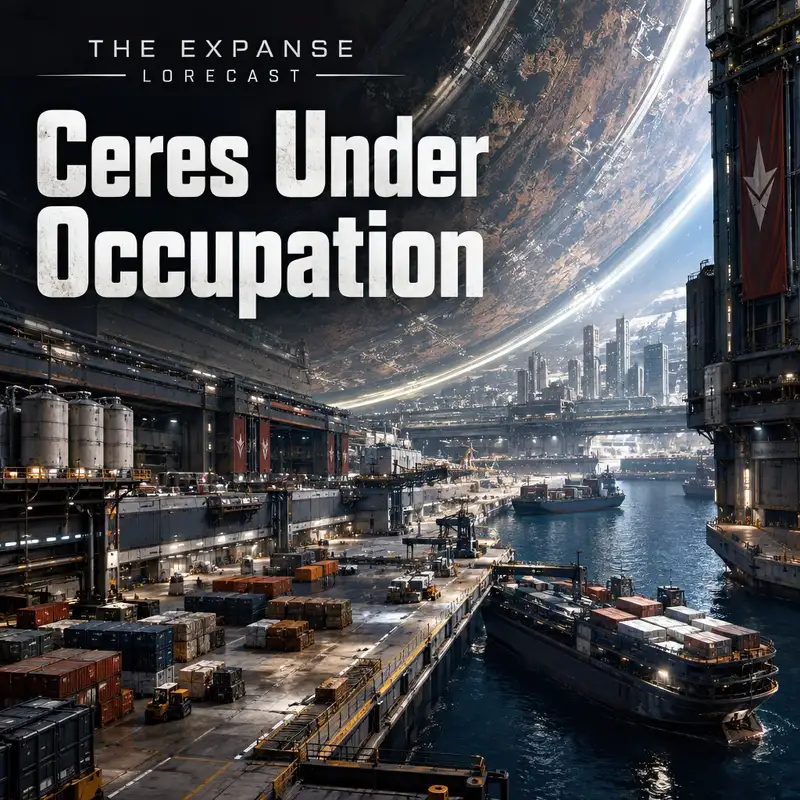
Ceres Under Occupation
The fleet came toward Ceres prepared for resistance. The Earth-Mars coalition had reason to expect mines, missiles, hidden ships, damaged docks, unreliable transponder data, and a station command network willing to turn every approach lane into a trap. Ceres had been a Free Navy center of power, a major Belt port, and a political prize large enough that Marco Inaros could not just ignore it. The coalition’s intelligence, strengthened by the capture of the Free Navy ship Azure Dragon, made the station an urgent objective. Taking it would deny Marco a base, disrupt his communications and logistics, and show that his movement could not hold every place it claimed to govern. But as the coalition closed on Ceres, the military problem changed. The anticipated fortress was no longer waiting to fight. Marco had withdrawn. Local security was prepared to surrender. The immediate question was no longer how to defeat an enemy fleet or breach a defended station. It was whether a population measured in the millions could survive the condition in which its supposed liberators had left it.
That was the central fact of Ceres under occupation. A station can be captured in a day, or even in an hour, if its defenders decide not to fight. It cannot be made safe nearly so quickly. A city on a planet can endure damage while its people seek water from a river, air from an atmosphere, power from a distant grid, or shelter somewhere beyond the ruined district. Ceres had none of those margins. It was a human settlement inside machinery. Its air, water, power, transport, communications, medical care, recycling, docks, and food supply all depended on systems that required maintenance, skilled labor, replacement parts, and steady movement of cargo. Control of Ceres was never just control of a map point in the Belt. It meant responsibility for the machines that kept people alive.
That responsibility made Ceres valuable long before the Free Navy War. It was a commercial hub, a transport center, a workplace, and a political space where Belter identity had been shaped by generations of labor under Inner economic power. Cargo moved through its docks. Workers maintained its systems. Families built their lives around shifts, contracts, ship departures, and the permanent knowledge that a failed valve or neglected recycler could become a public emergency. It was also associated with Anderson Dawes, whose influence rested on local political networks and on his ability to speak to grievances that were neither invented nor trivial. The Belt had been used as an extraction zone for generations. Its workers supplied the larger human economy while often living under harsher conditions, with less political power and less room for error than the governments and corporations that depended on them.
But Dawes’s local legitimacy was not the same thing as sovereign control. He could represent Ceres in political terms without commanding every armed ship that entered its orbit. He could influence station factions without determining the strategy of a mobile war fleet. That distinction became decisive under Marco Inaros. Marco did not need to win every argument on Ceres. He needed to control enough ships, enough weapons, enough loyal personnel, and enough fear to make his decisions irreversible. In a life-support-dependent habitat, armed authority can become very direct. Whoever controls docking access, security, communications, and the movement of critical equipment has leverage that no public speech can easily overcome.
Marco’s Free Navy drew strength from real Belt anger. Earth and Mars had spent generations treating Belter labor as necessary but politically subordinate. Inner governments had intervened in Belt affairs when resources, security, or trade required it, often without granting comparable power to the people who lived with the consequences. Marco understood that history. He could speak about dignity, independence, and the right of Belters to control their own future because those demands had deep roots. His success did not depend on inventing oppression. It depended on converting genuine grievance into military loyalty and political obedience.
That conversion had limits. The Free Navy was not the Belt. It was not the whole Outer Planets Alliance, and it was not every station government, labor association, ship crew, or family that had reason to resent the Inner planets. It was a military and political coalition organized around Marco’s authority. Some Belters supported it. Some feared it. Some hoped it would force a better settlement. Others recognized from the beginning that its methods would bring disaster. The difference mattered because Marco’s strategy required him to speak for a population much larger and more diverse than the forces he actually commanded.
Ceres gave him both a symbol and a problem. Holding the station demonstrated that the Free Navy could seize a major Belt center and claim the functions of government. It offered docks, personnel, information networks, and access to a population whose political support carried value beyond the station itself. But it also tied Marco to the obligations of rule. A movement can survive on raids, propaganda, selective violence, and promises of future freedom for a while. Governing a station requires engineers, administrators, medical workers, cargo handlers, technicians, and systems that continue functioning after the cameras and speeches are over. It requires feeding people who may not support you. It requires protecting infrastructure that you could destroy more easily than replace. The problem with claiming sovereignty is that someone eventually asks whether the lights will remain on.
Marco’s wider war made that burden harder to carry. After the bombardment of Earth, the conflict was no longer a contest over recognition or local autonomy. It had become a system-wide struggle in which Earth, Mars, anti-Free Navy Belters, and independent interests all had reasons to oppose him. He needed to preserve mobility, keep the coalition divided, and avoid a decisive engagement on terms chosen by the larger navies. A fixed station could be useful, but it could also become a trap. If the coalition concentrated force against Ceres, Marco faced a choice. He could risk ships and personnel in its defense, or he could leave the coalition a prize that had been turned into a liability.
That choice exposed the fracture between revolutionary rhetoric and military command. On Ceres, Marco’s decisions were observed by people who understood what the station meant. Anderson Dawes had a direct stake in its survival, both politically and personally. Ceres was not abstract terrain to him. It was a constituency, a workforce, and a place whose people would remember who had protected them and who had treated them as expendable. Michio Pa, a senior Free Navy commander, saw the issue from a different position. She was part of the armed movement Marco had built, but she increasingly confronted the question of what that armed power was actually for.
The disagreement was more than about temperament. It was about the purpose of force. A military organization can use scarcity as leverage. It can move supplies away from an approaching enemy, deny docks, remove weapons, destroy records, and leave behind a burden that slows pursuit. Those are recognizable forms of military denial. But a revolutionary movement that says it exists to defend an oppressed population accepts a different political test. It must show that the population’s survival matters more than the leader’s freedom of maneuver. Once the leadership begins treating its own civilians as a resource to be spent, abandoned, or weaponized, it risks proving that its promised future is only another form of rule from above.
Dawes and Pa did not need perfect knowledge of Marco’s long-term intentions to understand the danger. They could see what Ceres required to remain habitable. They could see that the station’s systems were not luxuries and that its population could not just be left to improvise around the loss of critical infrastructure. Their objections also showed the weakness of their position. Marco controlled the military initiative. He could make decisions quickly, move ships, issue orders, and present his choices as necessities of war. Local political authority had less weight when the armed force had already decided that the local population would bear the cost.
Marco’s answer was a denial strategy. Before the coalition arrived, the Free Navy stripped, removed, disabled, or abandoned resources that Ceres needed. The exact inventory is less important than the pattern. Defensive systems, sensors, communications equipment, docking capability, medical stores, transport systems, power capacity, and life-support resources all mattered because they served both military and civilian functions. On a station, that overlap is unavoidable. The same infrastructure that supports security also supports workers moving between sectors. The same power system that feeds a sensor network also runs pumps, recyclers, lights, clinics, and repair facilities. The same docks that receive warships receive food, medicine, spare parts, and the personnel needed to keep the station alive.
Marco’s operational logic was not difficult to understand. He could not assume that Ceres would remain defensible once the coalition moved against it. Holding the station might trap Free Navy assets in a battle against larger and better-supported forces. Leaving it intact would hand the coalition a useful port, political symbol, and logistical base. Stripping it did both immediate military work and political work. It denied the coalition resources. It forced Earth and Mars to divert ships, cargo, technicians, and attention toward relief. It created a humanitarian emergency that could be blamed on the arrival of Inner power. And it offered Marco the hope that Belters would resent the coalition for ruling Ceres under armed protection, even if the Free Navy had created the crisis.
This was not irrational in the narrow sense. Armies have often destroyed infrastructure during withdrawal to slow an enemy and increase the cost of occupation. Rail lines, bridges, fuel depots, ports, communications systems, and power grids have all become targets when commanders believed they could not hold them. But Ceres was not a bridge over a river or an empty fuel dump. It was a city whose environment had to be actively maintained. Denial warfare against a habitat does not stay inside the military sphere. It reaches into homes, clinics, workspaces, water systems, and air supplies. It makes the civilian population part of the weapon.
That was the moral failure of Marco’s decision, but it was also its strategic weakness. His war depended on the claim that the Belt deserved a future not controlled by Earth and Mars. Ceres was one of the places where that future had to be made material. If a major Belter station could be stripped for the convenience of a mobile fleet, then Marco was not building an independent Belt economy or a stable Belt government. He was consuming both in order to keep his own war alive. The coalition would pay immediate costs, but the Belt would pay the deeper price. It would lose equipment, capacity, confidence, and time. Those losses would outlast the tactical withdrawal.
The coalition did not win Ceres through a great fleet battle. There was no decisive exchange of torpedoes that settled the station’s fate. No dramatic siege broke the Free Navy line. Marco left before the coalition could force that confrontation, and the security forces remaining at the station prepared to surrender. From a narrow tactical perspective, this made the seizure comparatively easy. Coalition ships could approach without having to destroy the port they hoped to use. Their personnel did not need to fight through every pressure door or clear every habitation level. The enemy’s defenses had not been defeated in the usual sense. They had been made irrelevant by withdrawal, dismantling, and the decision not to contest the station.
The absence of a conventional battle was the central military fact. Marco exchanged fixed ground for time, mobility, and a burden placed on his opponents. The coalition gained Ceres, but not as a ready-made base. It gained a damaged population center whose survival now depended on the very governments that had arrived in warships. A commander looking only at the tactical map might call that a Free Navy defeat. A commander looking at the campaign might see a more complicated result. Marco had lost control of the station, but he had forced his enemies to spend resources on something other than pursuit. He had also created a political test that Earth and Mars could fail if they treated Ceres as conquered territory rather than a place whose people needed partnership and support.
That was the trap within the victory. Fleet power could secure the approaches to Ceres. Marines and security personnel could establish control over docks, command centers, weapons stores, and access points. Coalition patrols could deter sabotage, identify remaining threats, and protect incoming relief shipments. None of that restored a station. Naval officers could not just order recycling systems back into operation. A warship’s engineering crew could help, but it could not replace the accumulated knowledge of local technicians who knew the station’s aging machinery, improvised repairs, undocumented modifications, supply bottlenecks, and work routines. A fleet command center could identify what had been taken. It could not instantly manufacture the parts, trained labor, and institutional trust required to replace it.
The immediate work was therefore less glamorous than the approach. It involved restoring environmental systems, power, recycling, medical support, transport, docking capacity, and the flow of essential supplies. It meant determining what still functioned, what had been damaged, what had been removed, and what could be made usable first. It meant protecting repair crews without making them look like prisoners in their own workplace. It meant finding people who had spent their lives maintaining the station and persuading them that cooperating with the new armed authority would not simply make them instruments of another Inner occupation.
For the people living there, the distinction between Free Navy withdrawal and coalition arrival could be difficult to experience as a clean moral transition. Workers, families, patients, maintenance crews, local administrators, and people with no allegiance to any armed faction had already been placed at risk by Marco’s decision. Now armed forces from Earth and Mars were arriving to restore order, deliver material aid, and assume practical control over the station’s security. Those things could be necessary and still unsettling. A population that has long been treated as an object of policy does not become trusting because the policy has changed its language.
Holding the docks was not the same as holding Ceres. Holding Ceres was not the same as making it functional. And making it functional was not the same as gaining the consent of the people who lived there. The coalition needed all three. Its military success depended on local labor. Its political success depended on acknowledging that local labor as more than a workforce to be directed under emergency conditions. The station had to be restored by people who understood its systems, but it also had to be restored in a way that gave those people some reason to believe they would have a role in deciding what came next.
Fred Johnson occupied an important place in that effort because he could not be reduced to one side of the old Inner-Belt divide. He had been a United Nations Marine, then a figure associated with Belter politics and the Outer Planets Alliance. His past did not make him universally trusted. No one in the Belt was trusted by everyone, especially after the Free Navy had turned old grievances into open war. But Fred had relationships across factions, unions, station interests, and the broader coalition. He could speak to Earth and Mars in terms they understood while also recognizing that Ceres could not be administered as a captured enemy installation.
In the aftermath of the seizure, Avasarala recognized Fred as an acting authority for Ceres. That arrangement was practical before it was constitutional. The coalition needed someone who could help coordinate local political interests, technical labor, and emergency administration without making the station appear to be under permanent direct rule from Earth. Fred could provide a bridge. He could help negotiate among people who had different loyalties but shared an immediate interest in keeping Ceres alive. He could bring OPA factions, local administrators, labor organizations, and coalition representatives into a working relationship, even if that relationship remained tense and temporary.
The provisional nature of the arrangement mattered. Ceres had not suddenly solved the Belt’s constitutional future. It had not become an independent state with settled institutions. It had not become a neutral port beyond the reach of Earth and Mars. The coalition’s material support gave it power whether anyone wanted to admit it or not. Ships bringing supplies also controlled access to supplies. Military forces protecting the station also controlled the use of force. Emergency aid could be generous, necessary, and politically sincere while still creating dependency. The task was not to pretend those realities did not exist. The task was to prevent them from becoming another permanent hierarchy imposed without Belter participation.
That required an uncomfortable balance. Direct Inner military rule might have been administratively simple in the short term. It would also have confirmed much of Marco’s propaganda. He had claimed that Earth and Mars would never treat Belters as equals, that any promise of relief would become another mechanism of control. If the coalition arrived, issued orders, appointed outsiders, and ignored local authority, it would give his narrative new life even as his forces retreated. But leaving Ceres entirely to fragmented local politics, without security and material support, could have allowed the crisis to deepen. The coalition had to exercise power while proving that power was not its only purpose. That is a difficult thing for any occupying force to do, and history suggests that few manage it cleanly.
Avasarala understood the larger dilemma. The war against Marco could not become a war against all Belters. Earth had already suffered devastating harm, and rage made collective punishment politically tempting. Mars had its own losses, fears, and internal fractures. Both Inner powers had military reasons to secure Ceres and political reasons to distrust any station that had fallen under Free Navy control. But treating every Belter population center as hostile territory would have widened the conflict Marco wanted. It would have driven neutral people toward resentment, made cooperation harder, and transformed the coalition’s legitimate security effort into proof that the Inner planets intended to restore the old order by force.
Ceres therefore became a test of coalition discipline. The United Nations Navy and Martian Congressional Republic Navy had the capacity to impose security. They could escort cargo, patrol traffic, guard infrastructure, and deter attacks. Their presence mattered because Free Navy forces had demonstrated that civilian survival could be used as a weapon. Yet military capability did not answer the political question. Who made decisions about work, distribution, repairs, policing, and public information? Who spoke for the station? Who received credit when systems were restored, and who received blame when shortages continued? Those questions were not secondary to the war. They were part of it.
The coalition’s objective had to be more precise than simply retaking Ceres. It had to show that Ceres could be protected without being punished for Marco’s crimes. That did not mean pretending the station was free of Free Navy sympathizers, criminal networks, rival OPA factions, or people willing to exploit chaos. Security problems remained real. But security had to distinguish among them. A station population is not an enemy formation. It contains people who resisted, people who complied because they had no safe alternative, people who benefited, people who suffered, and people who simply tried to keep their children fed and their work crews alive. Any policy that erased those distinctions would make administration easier to describe and harder to sustain.
The information war mattered because the fight over Ceres was never only about equipment and patrol routes. James Holden’s role there was limited compared with the work of engineers, administrators, and coalition commanders, but it was politically significant. Holden recorded interviews with ordinary Belters, making their experiences visible to audiences who might otherwise know Ceres only through military communiques and factional propaganda. Those broadcasts did not make him neutral. Holden had his own commitments, alliances, and understanding of the war. Nor could a collection of interviews represent every resident of a station that large and divided.
What the interviews could do was complicate easy stories. They challenged the idea that Ceres was simply a Free Navy stronghold populated by enemies of Earth and Mars. They also challenged any comforting coalition narrative in which the arrival of warships automatically transformed hardship into liberation. The people speaking had lived under Marco’s authority, endured the consequences of his withdrawal, and now faced emergency rule backed by the same Inner powers whose history had shaped Belt resentment. Their testimony made it harder to turn the station into an abstraction.
That had strategic value. Coalitions are sustained not only by shared objectives but by shared interpretations. Earth needed to believe that defeating Marco did not require treating all Belters as accomplices. Belters needed evidence that the coalition could distinguish between civilians and the Free Navy. OPA factions needed reasons to cooperate with Earth and Mars without surrendering every claim to autonomy. Even people who disliked Holden’s methods or distrusted his politics had to contend with the visibility those accounts created. Public testimony could not repair a recycler or fill a medical storeroom, but it could influence who was willing to help, who feared betrayal, and whose suffering became politically legible.
Marco’s decision at Ceres did more damage to his own position than a battlefield defeat might have done. A fleet loss can be blamed on inferior numbers, bad intelligence, betrayal, or the changing fortunes of war. Ceres was harder to explain away because the condition of the station reflected a choice. Marco had claimed that the Belt’s future required liberation from Inner power. Yet when confronted with the possibility of losing a major Belt center, he treated its people and infrastructure as expendable components of his campaign. He could still argue that the coalition had forced the crisis. He could still present the withdrawal as necessary. But the material evidence remained. The Free Navy had left Ceres less able to sustain its own population.
For Anderson Dawes, that was a direct political indictment. His influence depended on the idea that Ceres mattered as a community, not merely as a bargaining chip in system-wide negotiations. Marco’s strategy made local stewardship subordinate to mobile warfare. It told the people of Ceres that their station could be emptied of the means of survival if doing so complicated an enemy advance. Whatever Dawes’s own compromises and ambitions, he understood the political meaning of that message. A revolutionary movement cannot demand loyalty from a population while showing that its survival ranks below the leader’s tactical convenience.
For Michio Pa, the station became evidence of a broader failure inside the Free Navy. Her growing break with Marco was more than a clash of personalities or a sudden discovery that war was cruel. It was a recognition that Marco’s command structure had become incapable of serving the cause it claimed to represent. The issue was not whether force could ever be necessary. The Belt had been denied power for too long to imagine that negotiation alone would correct every injustice. The issue was whether armed force protected the material future of Belters or consumed it. At Ceres, Marco gave a clear answer, even if it was not the answer he wanted his followers to hear.
Denial strategy can produce short-term operational gains. It can slow an advancing enemy, disrupt supply plans, burden relief organizations, and create political confusion. Marco achieved some of those effects. The coalition could not just seize Ceres and continue at full speed. It had to devote attention to restoring a station whose condition affected millions. But revolutionary war has another requirement. It needs a constituency that believes victory will leave life better than submission. By stripping Ceres, Marco undermined that belief. He made the Belt’s infrastructure seem less like the foundation of an independent future and more like fuel for an endless conflict centered on himself.
The damage was institutional as well as physical. Systems can be rebuilt, though never without cost. Political trust is harder to restore. Every station, union, crew, and OPA faction watching Ceres had to consider what Marco’s victory would mean in practice. Would local needs be protected? Would military commanders respect civilian authority? Would resources be distributed for the common survival of the Belt, or pulled away whenever the leader needed another advantage? Those questions weakened the Free Navy’s claim to represent a unified people. Its military power remained dangerous, but its political foundation had begun to erode.
Ceres under occupation therefore reveals a harsh distinction between liberation as a slogan and liberation as a system of survival. Marco could use the Belt’s anger because that anger had been earned through exploitation, neglect, and political exclusion. He could not build a durable Belt future by making Belter life-support systems another weapon to be spent. His withdrawal from Ceres had military logic. It imposed costs on the coalition and denied it an intact prize. But the same decision exposed the contradiction at the center of his war. He demanded sovereignty for the Belt while treating one of its largest populations as terrain to be abandoned.
The coalition’s seizure of Ceres was not uncomplicated liberation either. Earth and Mars arrived with the armed force needed to remove Free Navy control, secure the station, and support emergency restoration. That mattered. Without security, supplies, and outside assistance, the damage left by Marco could have become even more severe. But the coalition also inherited authority, dependency, and suspicion. Armed Inner governments could not just declare themselves benevolent and expect a historically exploited population to accept the claim. Their legitimacy depended on what they did after the surrender, how they used power, who they listened to, and whether Belters had meaningful authority in the work of rebuilding their own station.
The decisive labor was not the approach of warships or the raising of a new flag over a dock. It was the work of restoring systems, moving supplies, repairing damaged capacity, treating patients, reopening transport, coordinating crews, and negotiating among institutions that did not trust one another. Fred Johnson’s provisional authority mattered because Ceres needed a political bridge as much as it needed material aid.
Ceres showed that control of a station is meaningless unless someone can keep it alive. Marco could seize it, strip it, and leave it behind. The coalition could capture it with little resistance. Neither act, by itself, answered the question that mattered to the people inside: who would maintain the systems on which their lives depended, and under what authority? The answer could not come from one commander, one fleet, or one declaration of victory. It had to be built through Belter labor, emergency support, negotiated power, and the difficult refusal to make civilians pay forever for the ambitions of those who claimed to speak in their name.