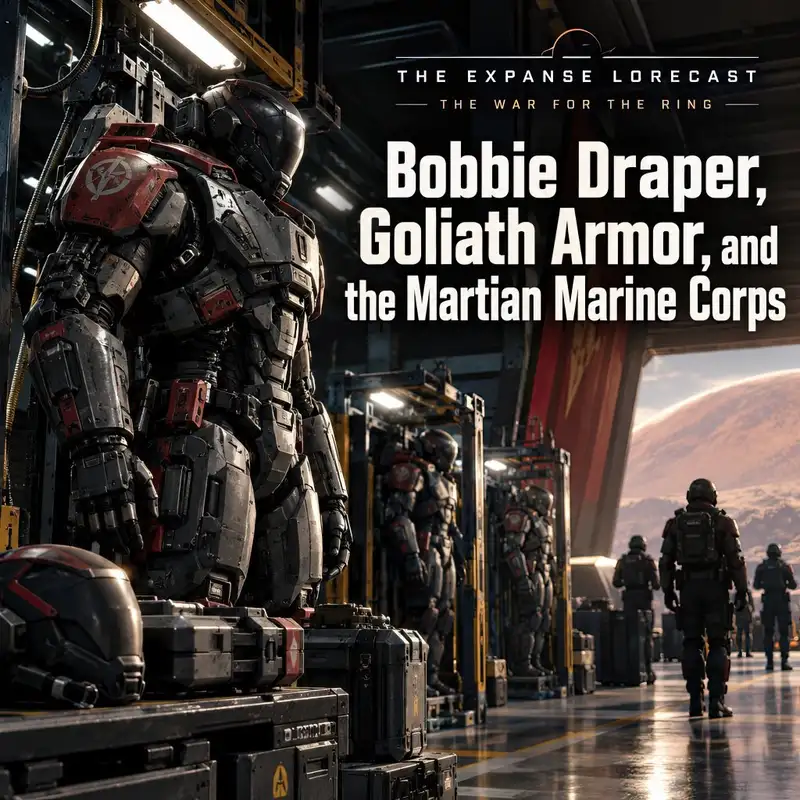
Bobbie Draper, Goliath Armor, and the Martian Marine Corps
Gunnery Sergeant Roberta Draper entered the Ganymede crisis wearing armor designed to make a human being formidable in places where an unarmored human being could barely remain alive. Her Mark Three Goliath suit gave her protection, sealed life support, sensors, communications, and the capacity to carry weapons that ordinary infantry could not handle. It connected her to her unit and to the Martian military system behind it. In the right fight, against a recognized enemy, with clear orders and a functioning chain of command, it was the kind of equipment that could turn disciplined training into decisive local power.
Then something appeared that did not belong in any recognized category. Bobbie saw her fellow Marines die confronting an opponent that seemed to ignore the assumptions built into their weapons, their armor, and their training. The immediate failure was not simply mechanical. Her suit had not suddenly become useless. The deeper failure was one of recognition. Nobody on that battlefield understood what they were fighting, who had sent it, or what political purpose its appearance was meant to serve.
That uncertainty mattered because Ganymede was already a dangerous place. Roughly eighteen months after the Eros Incident, Earth and Mars remained locked in an uneasy ceasefire. Neither government could assume the other’s intentions were benign. Both possessed powerful armed forces, deep historical grievances, and political constituencies ready to interpret every movement as preparation for betrayal. A military incident did not need to be planned as a war to become one. It only needed to be misread at the wrong moment.
Ganymede made that danger larger than a clash between patrols. It was one of the outer system’s major agricultural centers, a place where food production, transport infrastructure, station life, and military security overlapped. Damage there did not remain local. It threatened supplies on which distant populations depended. When armed forces fought around Ganymede, they were not merely contesting terrain. They were risking a system that helped keep much of the outer planets fed.
Bobbie Draper reveals what the Martian Marine Corps could do at its best, and what it could not protect itself from. The Corps had built her into a professional soldier able to function under pressure, trust her equipment, lead people through hostile environments, and distinguish a serious threat from ordinary confusion. But Ganymede placed that professionalism inside a crisis shaped by secrecy, political manipulation, and a weapon so unfamiliar that ordinary military assumptions became traps.
The Martian Marine Corps was naval infantry. Its Marines existed for the hard edge of naval power, where ships, stations, moons, vacuum, hostile terrain, and civilian infrastructure all created problems that could not be solved by a distant warship alone. They could provide security aboard vessels, conduct boarding actions, fight through stations where a missed shot might rupture a pressure hull, and operate on planets or moons where gravity, atmosphere, and terrain changed the character of combat.
That role required more than courage. It required technical discipline. A Marine operating in a suit had to understand life support, communications, sensors, weapons, seals, maneuvering, ammunition, power, and the physical limits of the human body. In a pressurized environment, a careless action could kill civilians or destroy the infrastructure the mission was meant to secure. In vacuum, a damaged seal, a broken comm link, or a failed power system could turn a survivable tactical problem into a death sentence.
The Marine Corps also depended on the Martian Congressional Republic’s wider society. Mars could field sophisticated military systems because it maintained schools, research institutions, shipyards, supply chains, technicians, medical services, industrial workers, and an economy organized around long-term collective projects. A Goliath suit did not emerge from a locker by force of patriotic feeling. It required designers, fabricators, maintainers, transport crews, armorers, software specialists, and a state capable of moving expensive equipment where it was needed.
This was one of the foundations of Martian military confidence. Mars did not simply possess advanced hardware. It believed that preparation, discipline, and technical competence could compensate for its smaller population and strategic vulnerability relative to Earth. The Martian project was built around the conviction that sacrifice in the present would produce security, prosperity, and eventually a transformed world. Its military culture reflected that belief. The soldier was not merely an expendable body in uniform. The soldier was supposed to be a trained component in a larger national machine.
Bobbie fit that culture unusually well. She was physically imposing, highly capable, intensely loyal to Mars, and deeply identified with the Marines around her. But her authority was tactical. As a gunnery sergeant, she could lead, assess, fight, and make decisions under fire. She could not determine the strategic purpose of a deployment, decide what intelligence senior command received, or control the diplomatic narrative once an incident became politically dangerous.
That distinction became critical on Ganymede. Militaries often celebrate the independence of junior leaders, but independence has limits. A platoon commander may have to act when communications fail. A gunnery sergeant may need to preserve lives with seconds to decide. Yet the larger institution still determines what information reaches the unit, what enemy it expects, what political constraints surround the mission, and what story will be told afterward. Tactical competence can save people. It cannot repair a strategic deception that began far above the battlefield.
The Mark Three Goliath armor represented both the strength and the limits of that system. It was not a superhero costume and not a mobile tank in the simple sense. It was a powered combat suit built for a trained operator. Its armor and environmental systems helped a Marine survive hazards that would incapacitate or kill an unprotected person. Its sensors extended awareness beyond ordinary sight and hearing. Its communications connected the operator to a unit. Its power-assisted structure allowed the Marine to carry protection and weaponry beyond normal infantry limits.
In a hostile environment, that combination mattered. Vacuum does not forgive a rifleman who needs to pause and adjust equipment. Low gravity changes movement, recoil, and the consequences of falling. Station combat creates narrow approaches, blind corners, fragile systems, and civilians who may be only a bulkhead away from the fighting. A Marine in powered armor could operate longer, carry more, and remain effective after lesser protection had failed. The suit transformed the operator’s relationship to the environment.
But it did not eliminate dependence. The armor required power. It required maintenance. It needed replacement parts, ammunition, life-support servicing, calibration, storage, and transport. It depended on trained personnel who could repair it, inspect it, and understand its data. A damaged suit could protect its operator until it could not. A suit without power or air was not a symbol of strength. It was a heavy, complicated problem attached to a living person.
Nor did armor make its wearer invulnerable. Explosives, kinetic impacts, internal damage, pressure loss, fire, exhaustion, and overwhelming force could still disable or kill a Marine. Even when the suit remained intact, the person inside could be injured, disoriented, or physically overwhelmed. The Marine Corps understood this in principle. No serious service treats equipment as magic. But institutions can become accustomed to threats they know how to classify. A suit designed to resist expected weapons is still vulnerable to an enemy designed outside the expected threat model.
The specific age of Bobbie’s armor also becomes significant. Her Mark Three Goliath suit was an older model, and its characteristic video compression later helped identify the equipment involved in the Ganymede incident. That detail is easy to treat as technical trivia. It is more important than that. The suit did not merely protect Bobbie. It recorded evidence. It became a witness of sorts, carrying sensor data from a battlefield where human memory, official reports, and political interest would all be contested.
Military equipment often performs that double function. It is a weapon and a record. A gun camera, a telemetry log, a damaged hull, an ammunition expenditure, a communications trace, or a sensor return may later matter as much as the action itself. But evidence does not explain itself.
On Ganymede, Bobbie and her Marines entered an environment already shaped by Earth–Mars rivalry. Martian and United Nations forces operated near one another in a politically sensitive space. Their presence was not necessarily proof that war had begun, but it created a condition in which fear could spread quickly. Communications could be incomplete.
Then the hybrid appeared. What Bobbie encountered was not an alien species in any ordinary sense. It was a human being transformed through protomolecule-related experimentation into something intended to function as a weapon. But Bobbie did not know the full history of that program when she saw it. She knew only what a soldier could know in the moment: an enemy had appeared that did not behave like a conventional infantryman, did not respond as expected to the force used against it, and was killing her people.
That is the point at which training becomes both essential and insufficient. Training gives soldiers procedures for uncertainty. It teaches them to observe, communicate, cover one another, preserve ammunition, maintain movement, and keep working when fear narrows the mind. Bobbie’s discipline mattered because panic would not have helped anyone. But no amount of drill can provide a ready answer when the basic categories of the fight collapse. Is the contact an Earth weapon? A Martian weapon? A secret project? An alien phenomenon? A deliberate provocation? At Ganymede, those questions were not academic. They shaped who would be blamed, who might fire next, and whether a local disaster could become interplanetary war.
Bobbie survived. Her platoon did not. That fact gave her a unique position in the crisis. She was not an outside analyst reviewing reports from a safe office. She had seen the encounter, worn the equipment, led the people who died, and carried the memory of what ordinary official language could not easily contain. Yet survival did not give her political authority. It made her useful, vulnerable, and difficult to manage.
The immediate tactical result was devastating for her unit. Once the first violence was interpreted through the Earth–Mars security dilemma, each side could see hostile intent in actions that might have been caused by a third party. The hybrid did not need to defeat either navy by itself.
This is one of the oldest mechanisms of war, even in a setting of fusion drives and powered armor. States prepare for enemies they understand. They build doctrine around known capabilities, known routes, and known political rivalries. A hidden actor introduces an unfamiliar weapon at the right location, and the established powers supply the panic, mobilization, and retaliation. The weapon’s tactical effect matters. Its ability to distort interpretation may matter more.
Ganymede was especially vulnerable because the battlefield was also a food system. Agricultural infrastructure is not glamorous military history, but it is often the part that determines whether a crisis remains contained. Food did not simply appear because a station had recycling systems. Agriculture required light, water, nutrients, machinery, power, replacement parts, and workers able to keep all of it functioning.
Damage to Ganymede therefore threatened much more than the people immediately caught in the fighting. It could disrupt supply lines across the outer system, strain already precarious stations, raise prices, create shortages, and give political movements new grievances to exploit. A moon that produced food was also a strategic asset.
Neither Earth nor Mars could regard that damage as a minor side effect. A war that destroyed infrastructure needed by Belter and station populations would not simply weaken an opponent. It could generate a humanitarian emergency, deepen resentment against both Inner powers, and demonstrate that the great powers were willing to gamble with other people’s survival.
That is why governments needed an explanation they could manage. The ceasefire between Earth and Mars was fragile, but a full war would have been worse. Political leaders had reasons to prevent escalation. In the abstract, that is a familiar diplomatic necessity.
For Bobbie, it came with a brutal human cost. Her testimony was shaped into an account that made a dead Marine, Private Travis, responsible for firing first. The story could be used to reduce immediate political pressure. It could suggest that the crisis began with a localized mistake rather than an unknown weapon and a deeper conspiracy.
It would be easy to call this simply a lie and leave it there. That would miss the institutional problem. Bobbie was not merely choosing between truth and falsehood in a private moral vacuum. She was an enlisted leader inside a system of command, loyalty, discipline, grief, and diplomatic pressure. She understood that a wider Earth–Mars war could kill far more people than those already lost on Ganymede.
The issue was not that preserving the ceasefire lacked strategic value. It plainly had value. The issue was how a military institution treated the people whose deaths had created the evidence. Private Travis became politically useful because he could not answer back. Bobbie became politically dangerous because she could.
This is a recurring civil-military problem. Soldiers are asked to serve the state, and states sometimes require secrecy. A surviving witness may be praised, protected, isolated, promoted, discredited, or quietly directed toward an acceptable account. The person who saw the event has tactical knowledge but little control over the institutional language used to describe it.
Bobbie’s dilemma also reveals the difference between loyalty and obedience. Loyalty to Mars did not mean blind acceptance of every explanation offered by Martian command. Loyalty to her Marines did not mean she could prevent their deaths from being used for diplomatic convenience. Her identity had been built around trust in the service, but Ganymede forced her to confront the possibility that the institution she loved could protect itself by narrowing the truth.
The political process did not reveal everything at once. Chrisjen Avasarala recognized that Bobbie’s account contained more than an embarrassing battlefield anomaly. Avasarala was a senior United Nations political figure with her own sources, suspicions, and institutional leverage. She was not Earth in human form, and she did not represent every United Nations official or agency.
For Avasarala, Bobbie was not only a diplomatic witness. She was a source with direct experience of the hybrid threat. Her suit data, gun-camera record, observations, and unwillingness to forget the encounter could be connected to intelligence from elsewhere. This is how major conspiracies are often uncovered, not through one perfect document, but through records that should not fit together and people who refuse to accept easy explanations.
Bobbie’s role changed in the process. She moved from the familiar structure of a formal military chain of command into something less stable. She became an operational asset in an investigation that crossed national, corporate, and security boundaries. That transition mattered. In the Marine Corps, authority had recognizable lines. Orders came from above. Responsibilities were assigned. Equipment and comrades formed a known system.
That did not make her less of a Marine. In some ways, it revealed the transferable value of her training. She could assess threats, protect others, maintain composure, and recognize when an explanation did not match the evidence. But the context had changed. The conspiracy surrounding the hybrids had used Martian personnel and the Earth–Mars conflict as raw material for someone else’s policy.
The emerging truth was worse than an ordinary weapons breakthrough. Jules-Pierre Mao’s network, working with rogue actors linked to the United Nations system, had supported experiments intended to create protomolecule-enhanced soldiers. The hybrid on Ganymede was not evidence that the Martian Marine Corps had created Project Caliban. The Marines were among the people deceived and endangered by it.
The program represented a failure of accountability across several institutions at once. Corporate wealth and research capacity provided resources. Government access provided protection and influence. Military competition provided the strategic rationale. Secrecy prevented ordinary oversight. Vulnerable human beings became experimental subjects. Each part could hide behind another. The corporation could claim to be pursuing research. Officials could claim national security. Security personnel could claim they were following orders.
But it had come from somewhere. It had come from human institutions deciding that the possibility of strategic advantage outweighed the restraints that should govern experimentation, military research, and the treatment of human beings. The protomolecule made the project more dangerous, but the moral choice to weaponize people was human.
The strategic lesson was severe. Arms races do not always produce weapons that remain under the control of the people who fund them. A state or private network may seek a capability that will intimidate an opponent, shift a balance of power, or secure a monopoly on force. The more extraordinary the technology, the more dangerous the gap between possession and understanding becomes.
Bobbie mattered in the later effort against the hybrid program because she understood that gap at a personal level. She had met the weapon in combat. She knew what it could do to trained Marines. She knew that confidence, armor, and firepower were not enough if the people making decisions still misunderstood the enemy.
The effort to rescue Mei Meng and confront the program on Io was not a one-person mission. It depended on people with different forms of knowledge. Praxidike Meng understood his daughter, the research environment around the missing children, and the human stakes buried beneath official security language. Avasarala’s investigation connected political inconsistencies to operational evidence.
Bobbie’s contribution was military, but it was not merely about being the strongest person in the room. She brought the habits of a professional Marine. She recognized the hybrid threat as something that could not be treated casually. She understood how to function under pressure, how to protect a team, and how to keep a mission focused when fear and anger threatened to take over.
At Io, armed action helped neutralize immediate threats and disrupt the program. But tactical success was only part of the outcome. The larger achievement was exposure. The hybrid project could no longer be understood as an isolated anomaly or a convenient explanation for Ganymede’s violence.
That revelation did not dissolve the mistrust among Earth, Mars, and the Belt. It did not repair Ganymede’s damage or return Bobbie’s platoon. It did not make the protomolecule comprehensible. It did, however, show that the old political map was inadequate. The threat was not only a rival navy on the other side of a ceasefire.
Seen through Bobbie’s experience, the Martian Marine Corps emerges as a capable but bounded institution. Its strengths were real. It trained people for hostile environments. It integrated advanced equipment with disciplined small-unit leadership. It valued competence, cohesion, and technical mastery. Its Marines could operate where ordinary infantry would be constrained by vacuum, low gravity, fragile infrastructure, and the need to protect complex systems while fighting inside them.
The Corps also gave its members a powerful sense of identity. A Marine was not only a person with a job. The uniform, the armor, the chain of command, and the shared hardship connected the individual to Mars’s larger project. That could create extraordinary resilience. Bobbie’s grief did not break her professionalism. Her loyalty did not vanish when command disappointed her.
Yet the limits were just as real. The Marines depended on accurate intelligence. They depended on logistics and maintenance. They depended on leaders who understood the environment in which they were sending their troops. Above all, they depended on a threat model connected to reality.
Goliath armor magnified the capability of the person wearing it. It did not correct false intelligence. It did not expose a secret research program. It did not restore food production on Ganymede. It did not protect a dead private from being blamed for a politically useful account. The best suit in the system remains a poor instrument for repairing decisions made in offices far from the battlefield.
This distinction matters because military institutions are often judged by their visible equipment. A powered suit is dramatic. The less visible requirements are harder to dramatize: the technicians, the supply contracts, the training pipelines, the intelligence analysts, the legal authorities, the diplomatic calculations, and the political trust that allows soldiers to believe their service is being used honestly.
Bobbie’s survival made those invisible systems impossible to ignore. She was living evidence that the Ganymede encounter had not been an ordinary clash. Her presence challenged the version of events that different authorities preferred. The armor had protected her body. It had also helped preserve the record that threatened the conspiracy.
The later view of Bobbie in Gods of Risk adds another dimension to this history. After the events of Caliban’s War, she appears as an ex-Marine, set adrift from the role that had given her structure and purpose. The story is viewed largely through the experiences of her sixteen-year-old nephew, David Draper, and through the wider dynamics of the Draper family.
Demobilization is not simply the moment when a uniform is returned or a final paycheck arrives. A military institution provides routines, status, comradeship, equipment, clear responsibilities, and a vocabulary for competence. It tells people where they belong and what they are for.
For Bobbie, the transition is shaped by more than ordinary career change. Ganymede had damaged her trust in the institutions that formed her. The important point is that she has been separated from the world in which her capabilities were most clearly recognized. A person trained to carry responsibility under extreme conditions may struggle to find a place in a society that sees only an intimidating former soldier or a difficult family member.
That is not a weakness peculiar to Bobbie. It is an institutional consequence of how military systems work. States invest enormous effort in creating highly capable people for dangerous tasks. They often devote less imagination to what happens when those people return carrying knowledge, grief, anger, and habits formed under conditions civilian life cannot reproduce.
Mars had promised its people a future built through discipline and sacrifice. The Marines were one expression of that promise. When a Marine like Bobbie is set adrift, the problem is not merely personal. It raises a wider question about whether the society that built such disciplined loyalty can still recognize its obligations to those who carried it.
Bobbie Draper’s story is therefore not only the story of an armored Marine confronting a monster. The Martian Marine Corps could produce extraordinary soldiers because Mars had produced extraordinary networks of training, technology, collective identity, and institutional purpose. Bobbie’s competence was real. Her armor was real. Her loyalty to her Marines was real.
But Ganymede exposed the limits of all three. A secret program introduced an enemy outside conventional assumptions. Political authorities needed a narrative more manageable than the truth. A dead subordinate became a convenient explanation. A surviving Marine became inconvenient evidence. The institution that had trained Bobbie to trust disciplined systems had to confront the possibility that some of its own systems were willing to use her without fully telling her why.
The Mark Three Goliath armor symbolized Martian confidence that preparation could make violence precise, survivable, and governable. In many circumstances, that confidence was justified. A trained Marine in a properly supported suit had capabilities few unarmored soldiers could match. But armor cannot make war controlled when the people who created the threat conceal its nature. It cannot impose accountability on a conspiracy. It cannot substitute for honest command.
Bobbie survives Ganymede because of training, equipment, endurance, and a measure of chance. She matters afterward because survival leaves her carrying something more dangerous than a weapon. She carries evidence. Her refusal to let the dead be reduced entirely to a diplomatic convenience gives that evidence moral force. In the end, the Goliath suit preserved a Marine. Bobbie Draper made sure that what destroyed her platoon could not remain safely hidden behind rank, secrecy, or an official story.