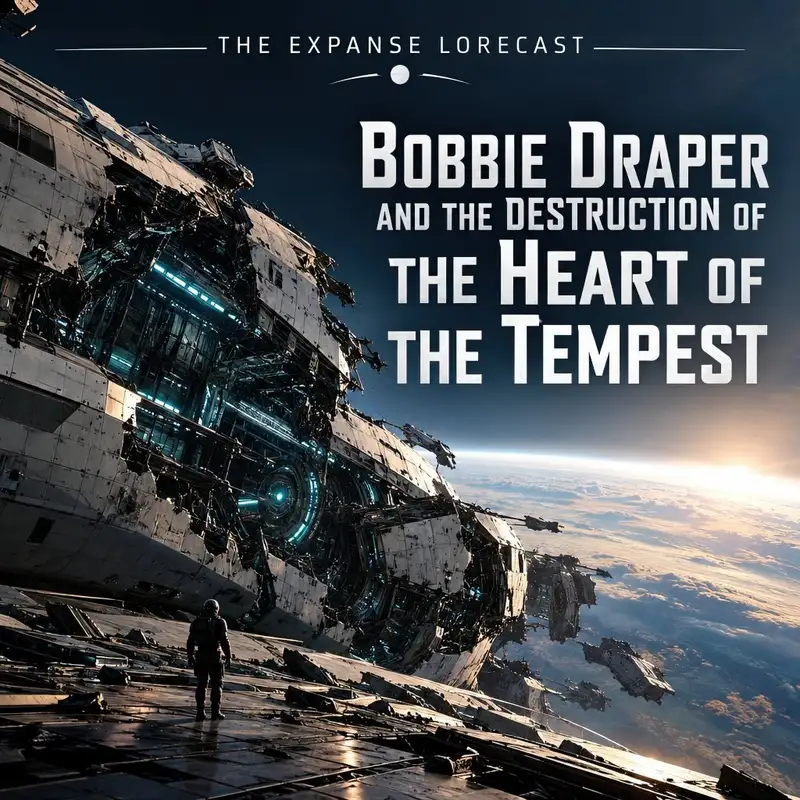
Bobbie Draper and the Destruction of the Heart of the Tempest
The plan to kill the Heart of the Tempest began to fail before Bobbie Draper reached the target. Point-defense fire had torn through the White Crow, killed Rini Glaudin, and damaged the shuttle meant to place an antimatter charge with precision. The weapon itself remained intact. That left Bobbie with a brutally narrow choice: abandon an operation the Underground might never be able to repeat, risk more people in an improvised rescue, or turn herself into the final guidance system.
For Bobbie Draper, the choices were no longer abstract. She could abandon the attack and preserve what remained of the strike force. She could ask Alex Kamal to attempt a rescue, risking the Gathering Storm and everyone aboard it. Or she could improvise while the Tempest’s point-defense cannons were already reducing the available options with a kind of mechanical efficiency that no speech about courage could overcome. The package had to reach the target. The destroyer had to survive if possible. And the enemy could not be allowed to focus on both at once.
What followed is sometimes remembered as a heroic final charge, and there was heroism in it. But that description is too small. Bobbie’s last operation was the final phase of a carefully built attack that had gone wrong, adapted to failure, and still achieved its objective. The Heart of the Tempest was not defeated by an ordinary ship in a fair engagement. It was destroyed because the Underground found a weakness, captured the right cargo, created a distraction, accepted terrible losses, and forced Laconia’s most powerful weapon to confront the same realities that governed every other human military machine. Supply lines. Damage. Detection. Timing. And the limits of fear as a political instrument.
The Heart of the Tempest mattered because its existence had changed the military balance of the human worlds. It was a Magnetar-class battleship, built by Laconia with alien-derived systems and a level of industrial capacity unavailable to Earth, Mars, the Belt, or the scattered governments that had emerged after the Free Navy war. Its weapons and defenses made conventional opposition seem almost pointless. At Point Leuctra, during Laconia’s seizure of power, the Tempest had demonstrated what that meant in practice. Fleets built around the old assumptions of human naval warfare could not simply meet it in open battle and expect skill, numbers, or courage to close the gap.
None of that meant the Tempest was literally indestructible. No warship is. A ship may be exceptionally difficult to kill without being immune to loss. It may be superior in firepower, protection, sensors, and maneuver without being beyond the reach of circumstance. But the distinction was easy to miss for the people living under Laconian rule. A nearly invulnerable battleship could have much of the political effect of an invulnerable one. It made resistance look futile. It allowed the empire to present obedience as the only rational response.
The Tempest was not only a weapon. It was a message delivered in metal, force, and reputation. Laconia’s occupation forces did not need to use it against every station, shipyard, or colony. The knowledge that it could appear was itself a form of coercion. Governors, transport operators, workers, local security officials, and frightened families all had reason to believe that the empire possessed a level of violence no opposition could answer.
Yet the ship carried damage from its earlier combat. The fighting at Point Leuctra had left a weakness in its sensor coverage. The novels do not provide a neat engineering diagram of the flaw, and it would be a mistake to imagine that the Underground possessed one. What mattered was more limited and more useful. There was a gap in the Tempest’s awareness, a damaged area that could complicate its ability to detect an approaching threat under the right conditions.
Why that weakness remained exploitable years later is not fully explained. Perhaps repair was difficult. Perhaps the damage was judged acceptable because the ship’s other capabilities made it seem insignificant. Perhaps Laconian commanders believed no surviving enemy possessed the means to exploit it. Whatever the explanation, the result was a critical fact of the war. The most formidable warship in human history had a blind area. Not a fatal weakness by itself. Not an invitation to attack. But a condition that made an otherwise impossible plan conceivable.
Bobbie Draper was the officer capable of recognizing what such an opportunity meant. She commanded the Gathering Storm, a captured Laconian destroyer operating as an Underground asset. The ship was not the Rocinante, and Bobbie’s mission was not an extension of someone else’s command. The Gathering Storm was a prize of war, a dangerous and valuable piece of enemy equipment placed in the hands of a resistance that could not afford to waste either ships or trained people.
Alex Kamal served as the destroyer’s pilot and as Bobbie’s closest operational partner. That mattered because naval combat in The Expanse is never the work of one person alone. A commander can choose an objective and accept a risk. A pilot still has to place the ship where it can survive long enough to make the choice matter. Engineers must keep systems functioning. Weapons crews must react under pressure. Medical personnel must deal with injuries that can turn a successful maneuver into a catastrophe. On a captured Laconian destroyer, the burden was heavier still. The Underground had acquired a powerful asset, but it had not acquired an unlimited pool of replacement crews, maintenance specialists, spare parts, or safe shipyards.
Bobbie’s earlier life gave her the experience to understand the stakes. She had been a Martian Marine, trained in a military culture that valued planning, discipline, and the survival of the unit. She had also seen Mars lose the confidence that had once sustained its national project. She understood what happens when an institution built around technological superiority discovers that history has changed around it. By the time she commanded the Gathering Storm, she was not merely a former soldier looking for another fight. She was a commander responsible for a scarce weapon and scarce people in a resistance that could not replace losses at Laconia’s rate.
Her motives were personal in the way all serious commitments are personal. Laconia had conquered the human worlds, killed people she knew, and treated independent political life as a technical problem to be solved by military force. But personal anger was not the same as personal revenge. Bobbie understood that destroying a Laconian ship would matter only if it changed the position of the Underground. A resistance cannot survive on defiance alone. It needs communications, safe ports, intelligence, personnel, material, and a reason for frightened people to believe that joining it is not simply volunteering for a slower death.
The opportunity began with a raid near Jupiter. The Gathering Storm intercepted a Laconian resupply freighter moving through the Jovian theater under frigate escort. The operation had more than one purpose. The Underground wanted to disrupt Laconian activity, seize information, and capture a human target connected to the empire’s operations. It was not a clean raid. The escort frigates were destroyed, and the freighter was damaged, but the intended intelligence target was not secured alive. The Underground gained less from that portion of the operation than it had hoped.
That failure mattered. Resistance warfare often produces a misleading public picture in which every raid becomes either a triumph or a disaster. The actual record is usually less tidy. The raid achieved important things. It destroyed enemy escorts, captured cargo, and revealed vulnerabilities in Laconian logistics. It also failed to obtain all the intelligence it sought, created danger for the Gathering Storm, and guaranteed that Laconia would respond with force. The Underground had struck a convoy, but it had also announced that it possessed both the ability and the willingness to threaten imperial supply movements.
The cargo changed the meaning of the raid. Among the material taken from the freighter was antimatter held in magnetic containment. It had not been shipped as a conventional bomb. It was intended as an energy source for the Tempest’s Magnetar-class weapon. In Laconian hands, it was part of the battleship’s combat system. In Underground hands, it became a possibility.
Possibility is the right word. Antimatter is not a convenient explosive one can simply place in a container and throw at an enemy. It requires containment. It requires handling. It presents danger to the people moving it as well as to the intended target. And turning an energy source into a weapon does not grant the attacker the ability to deliver it. The Underground had captured something with immense destructive potential, but potential does not remove the problem of range, targeting, timing, or survival.
Still, the cargo revealed something essential about Laconian power. The Magnetar-class ships looked like they had escaped the normal conditions of war. They had not. They depended on specialized fuel, technical equipment, containment systems, trained personnel, secure transport, and schedules that could be interrupted. Their alien-derived capabilities did not emerge from nowhere. They rested on industrial labor, logistics, planning, and a chain of material support extending far beyond the hull of a battleship.
That did not make Laconia equal to its enemies. The empire retained enormous advantages in technology, industry, command structure, and force projection. But it meant that Laconian supremacy had seams. A superweapon still had to be supplied. A warship built around exotic systems still needed components moved through space by freighters that could be found, boarded, damaged, and robbed. The Underground did not become technologically equal to Laconia by taking the cargo. It gained one narrow opportunity to turn Laconia’s own logistical system against the ship it served.
Laconia’s response created the deadline. The Heart of the Tempest was sent toward Jupiter to locate and destroy the Gathering Storm. In a conventional engagement, the imbalance was obvious. The captured destroyer could not trade fire with a Magnetar-class battleship and expect to survive. It did not possess the defensive depth, weapons, or industrial backing to fight a contest of attrition. The Gathering Storm had to avoid becoming what Laconia expected it to be: a target whose destruction would restore the empire’s reputation.
The Underground’s task was therefore not to hold Jovian space. It was not to defeat the Tempest in a broad fleet action. It was to make the battleship vulnerable for a few minutes, under a specific set of conditions, before its superior capabilities could bring the engagement back onto Laconia’s terms. The known sensor gap mattered, but only as part of that larger problem. The resistance could not know exactly how the Tempest would search, how its commanders would interpret a contact, how it would maneuver once threatened, or how quickly its defensive systems would adapt.
That uncertainty is the difference between intelligence and omniscience. The Underground knew enough to attempt an attack. It did not know enough to guarantee success. The plan would have to leave room for improvisation, and improvisation in combat usually means that someone pays for an earlier assumption with time, equipment, blood, or all three.
The decision to risk the Gathering Storm also exposed a serious strategic disagreement within the resistance. Naomi Nagata had become one of the Underground’s central leaders in the aftermath of the catastrophe in Ring space and the loss of so many established structures. Her concern was not cowardice. It was preservation. The Underground depended on hidden networks, limited communications, trusted personnel, smuggling routes, sympathetic communities, and a handful of ships capable of acting independently. A resistance that gambled all of those assets on one dramatic engagement could hand Laconia an enormous victory even while trying to challenge it.
Naomi’s position reflected the logic of clandestine war. Networks endure because they avoid battles they cannot afford. They survive by refusing the enemy’s preferred terms. They protect people, information, and material for the long struggle. An empire with superior ships can destroy a visible force. It has greater difficulty destroying an organization that can disperse, adapt, communicate through indirect channels, and preserve its legitimacy among populations forced to live under occupation.
Bobbie saw the same facts from another angle. A resistance that never takes visible risks may preserve itself so carefully that it becomes politically irrelevant. Laconia’s greatest advantage was not only military power. It was the belief that military power had settled the question of who would govern humanity. The Tempest was the clearest symbol of that belief. If the Underground could destroy it, the victory would not magically liberate the occupied systems. But it would demonstrate that Laconia could be hurt, that its machines could fail, and that its promise of permanent control was not a law of nature.
Both women understood scarcity. Naomi emphasized the rarity of ships, crews, and networks. Bobbie emphasized the rarity of strategic opportunities. The disagreement was not between caution and courage. It was between two forms of responsibility. One sought to preserve the resistance’s capacity to continue. The other sought to use that capacity in a way that might transform the political conditions of the war.
The attack went forward because the potential result justified the risk. Not because victory was certain. Not because anyone believed the Gathering Storm could overpower the Tempest. And not because Bobbie’s life was considered expendable. The plan depended on preserving the destroyer if possible. The strike would only be worthwhile if the Underground retained an asset capable of carrying the result forward.
The design divided the mission into two tasks. The Gathering Storm would be the visible threat. It would engage the Tempest, maneuver under pressure, draw attention, and survive long enough to occupy the battleship’s sensors, weapons, and command staff. Alex Kamal’s role was central. He had to fly a captured destroyer through a battle against an enemy that possessed overwhelming advantages. He had to manage damage, react to changing threats, and keep the ship operational while making it appear dangerous enough to demand the Tempest’s attention.
The White Crow would do something different. The small shuttle carried Bobbie Draper, Rini Glaudin, and the antimatter device. Its route exploited the known weakness in the Tempest’s sensor coverage. The objective was not to board the battleship, seize its bridge, or conduct a conventional sabotage mission. No small team was going to capture a Magnetar-class warship by storming a hatch. The purpose was delivery. The antimatter had to reach a position where it could destroy the target.
The separation of roles was militarily sound because it forced the Tempest to solve two different problems. The Gathering Storm was a recognizable combat threat. It could not be ignored. The White Crow was the concealed element, approaching through a gap in the battleship’s awareness while the larger ship concentrated on the destroyer. The resistance did not need stealth to make the shuttle permanently invisible. It needed concealment long enough to move the payload into the final approach.
That distinction matters. Low signature is not invisibility. A craft can reduce the chance of detection by controlling emissions, limiting maneuvers, and approaching through a known blind area. But it remains vulnerable once it must adjust course, once a sensor acquires it, or once the defending ship identifies it as a threat. The sensor gap gave the White Crow an opening. It did not disable the Tempest’s point-defense systems, remove its crew, or suspend the laws of relative motion.
The plan also acknowledged the human limits of command. Bobbie would ride with the delivery team because the payload required someone capable of making decisions at close range. Rini’s role was to operate the White Crow. Alex would remain with the Gathering Storm because the destroyer needed its pilot, and because the attack required a command structure that did not place every essential person on the same small craft. This was not a romantic division of labor. It was redundancy, however limited, inside a force that could not afford much redundancy at all.
For a time, the plan worked. The Tempest’s attention was divided. The White Crow advanced. The sensor weakness that had survived from an earlier battle created a route into the space where the shuttle could matter. But a plan can be sound and still fail at the point where execution meets an enemy’s defenses. Once the White Crow was detected, its size became a liability. It was too small to absorb damage, too fragile to rely on armor, and too close to a warship whose point-defense cannons existed precisely to kill incoming threats before they could reach the hull.
The point-defense fire struck the shuttle. Rini Glaudin was killed. The White Crow was damaged. The original delivery plan ceased to exist in any useful sense. The sensor gap had enabled an approach, but it had not neutralized the Tempest’s defensive systems. The battleship’s commanders did not need to understand every part of the resistance plan. They only had to identify a hostile object close enough to threaten the ship and destroy it before that threat reached its destination.
Rini’s death was not a dramatic ornament placed around Bobbie’s sacrifice. It was the event that changed the operation. Before the shuttle was hit, the attack depended on a vehicle, a pilot, a payload, and a coordinated delivery route. Afterward, the shuttle could no longer reliably place the antimatter device where it needed to go. The strike had become an emergency salvage effort. The remaining question was whether Bobbie could preserve the objective long enough to make Rini’s death, the risk to the Gathering Storm, and the entire raid on the Laconian freighter mean something.
At that point, the mission became one of physics, timing, and attention. The Tempest was moving. The antimatter package had to remain intact. Bobbie had only the maneuvering capability of her Laconian power armor, limited time, and an enemy whose point-defense system was becoming more dangerous with every second. There was no safe path. There was only a narrow interval in which the device might be placed on a trajectory that would carry it into the battleship.
Bobbie left the damaged White Crow in her armor. This was not a conventional boarding maneuver. She was not trying to land on the Tempest, cut through its hull, and fight her way inside. Her armor was not an answer to a battleship’s defensive grid. It was a tool that gave one person mobility in vacuum and a limited ability to act after the shuttle had failed.
The key was to turn herself into the visible threat. The antimatter device had to move toward the Tempest without attracting the full attention of its defenses. Bobbie used her armor’s weapons and her own movement to force the point-defense system to focus on her. The armor was small, active, armed, and unmistakably hostile. It gave the Tempest something to shoot at. More importantly, it created a moment in which the drifting package could become the danger the battleship did not prioritize until too late.
This was deception in its most severe form. Bobbie was not trying to survive by evading notice. She was making herself noticeable so that the real weapon might not be. The difference is important. A decoy is not simply an object placed in harm’s way. It is an element of a plan designed to shape the enemy’s attention and decision cycle. Bobbie understood that the Tempest’s defenses could not treat every threat equally. If the armor drew fire, the antimatter device had a chance. If the device drew fire first, the mission failed.
She also prevented Alex from turning the Gathering Storm into a rescue ship. That decision was cruel only if one ignored the rest of the force. A rescue attempt would have exposed the destroyer to the Tempest’s weapons and risked the lives of everyone aboard. It might have failed to save Bobbie while destroying the Underground’s most valuable remaining warship. In the final stage of the fight, Bobbie protected the mission by refusing to allow one person’s survival to consume the larger force.
That was not indifference to life. It was command responsibility under conditions where every choice killed someone or placed someone at risk. The Underground had already lost Rini. It had already accepted damage to the White Crow and danger to the Gathering Storm. Bobbie’s final action prevented the battle from becoming a chain of rescue attempts, each one drawing more people into the Tempest’s killing zone.
Her courage mattered because it was attached to operational understanding. Sacrifice by itself is not strategy. A person can die bravely and still leave the mission unchanged. Bobbie’s death had military meaning because it completed a sequence prepared by others and preserved the assets that had to survive after her. The intelligence about the sensor gap, the capture of antimatter, the distraction by the Gathering Storm, Rini’s approach through the blind coverage, Alex’s maneuvering, and Bobbie’s final deception all formed one operation. Remove any one of those elements, and the Tempest probably survives.
The antimatter device reached the Heart of the Tempest and detonated. The Laconian battleship was destroyed.
The exact scale of the blast is less important than the military fact. A ship that had become the empire’s most visible instrument of coercion was gone. The destruction was not the result of a standard exchange of missiles and railgun fire. It did not prove that ordinary human warships could now meet Magnetar-class battleships on equal terms. It proved something narrower and more consequential. Laconian superiority could be defeated when its systems were vulnerable, its logistics were compromised, and its commanders were forced into a fight shaped by enemy intelligence and deception.
The Gathering Storm survived, but survival did not mean it emerged untouched. The destroyer suffered significant damage and radiation exposure. The Underground had lost Bobbie Draper and Rini Glaudin. Material could be repaired or replaced only with difficulty. Skilled personnel could not be replaced quickly at all. The battle was a tactical success, a mission success, and a strategic signal, but it was not a costless victory. The resistance had spent precious people and exposed one of its most valuable ships to gain the result.
The difference matters because wars are not won by declaring every successful attack decisive. The destruction of the Tempest did not end the Laconian Empire. It did not liberate every occupied station. It did not erase Laconia’s industrial advantages, its remaining ships, its state security apparatus, or its capacity to inflict violence on communities that resisted. Occupied workers still had to breathe Laconian-controlled air. Transport crews still had to navigate imperial checkpoints. Colonies still had to calculate whether open resistance would bring retaliation against people who had not chosen the fight.
But the Tempest’s destruction changed the political imagination of the war. Before the battle, Laconia’s power could appear permanent because it seemed physically unanswerable. The empire’s message was simple. Its technology was superior. Its command was unified. Its weapons were overwhelming. Resistance could impose costs, perhaps, but it could not alter the final outcome. The loss of the Tempest made that claim impossible to maintain without qualification.
For the Underground, that mattered as much as the material loss inflicted on Laconia. Resistance movements require more than weapons. They require the belief that action can produce results. A frightened population may dislike an occupying power and still remain passive if it concludes that opposition is futile. A successful strike does not automatically create an insurgency, and it certainly does not make every act of resistance wise. But it can alter calculations. It can convince isolated groups that they are not alone. It can make local officials hesitate before treating imperial victory as inevitable. It can encourage recruitment, cooperation, intelligence sharing, and the dangerous decision to move from private resentment into organized action.
Naomi Nagata’s larger strategy benefited from that shift. The Underground still needed networks, communications, trusted personnel, and patience. Bobbie’s attack did not replace those things. It created space for them to matter. With the Tempest gone, Laconia had lost a singular instrument of immediate intimidation at a moment when the empire was already under pressure from wider events. The catastrophe in Ring space had disrupted assumptions across human civilization. Laconia’s ability to project power was no longer simply a question of possessing superior ships. It had become a question of where those ships could operate, how they could be supplied, and whether the empire could defend the industrial foundations of its military advantage.
That is why the battle’s logistical lesson mattered so much. The Tempest died because the Underground intercepted a supply movement and recognized that the cargo was more valuable as a weapon than as loot. Laconian military power depended on specialized infrastructure, transport capacity, trained operators, repair systems, and concentrated command. Those strengths made the empire formidable. They also created targets. A force that builds extraordinary ships must sustain extraordinary ships. A state that relies on exceptional technology must protect the routes, facilities, people, and assumptions that keep that technology functioning.
The sensor weakness carried a similar lesson. Laconia’s advantages did not remove the consequences of past combat. Damage endured. Repairs had limits. Assessments could be wrong. A flaw that seemed manageable under one set of conditions could become fatal when an enemy learned about it, prepared for it, and arrived with the means to exploit it. The Tempest was defeated by a resistance that refused to accept Laconia’s own estimate of what was possible.
For civilians under occupation, the consequences were indirect but real. One destroyed battleship did not put food in a station’s recyclers, restore local autonomy, or protect a family from a security raid. It did not make Laconian authority disappear from transit routes and colony governments. But it weakened the emotional foundation of imperial rule. The belief that resistance was impossible is itself a form of control. When that belief breaks, even partially, the occupier must spend more resources to produce the same obedience.
Bobbie Draper did not destroy the Heart of the Tempest by matching its strength. The Underground combined intelligence, prior damage, captured logistics, deception, disciplined roles, and a willingness to accept costs Laconia believed its enemies would refuse. Bobbie’s final action turned a failing delivery plan into a successful strike, but the victory belonged to the system around her as much as to the sacrifice itself. The Tempest died because even an alien-enhanced battleship still depended on assumptions, supply, attention, and human decisions that could be attacked.