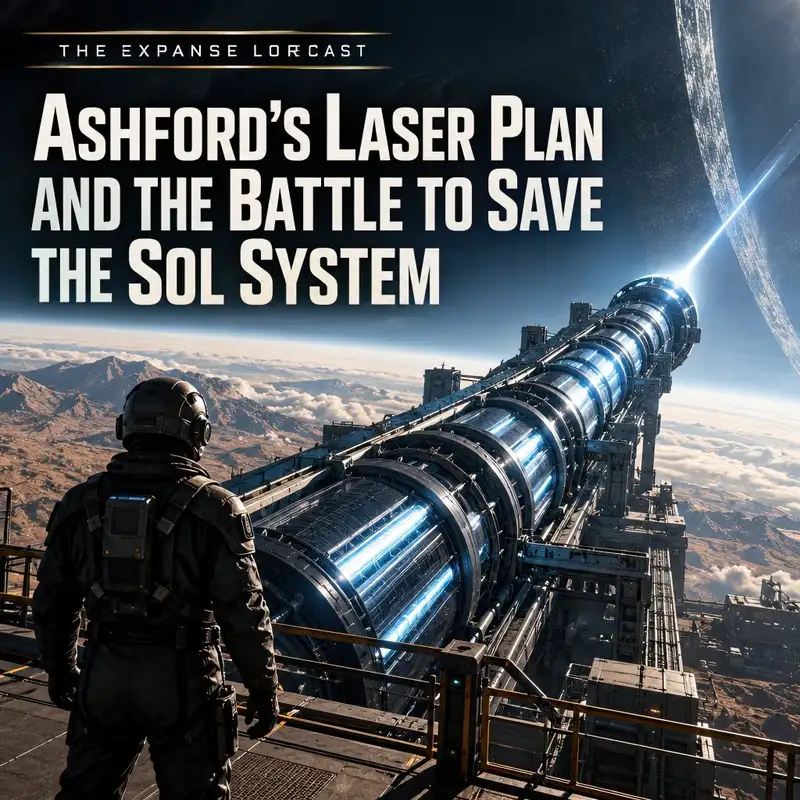
Ashford’s Laser Plan and the Battle to Save the Sol System
The Behemoth’s great communications laser was never meant to be a weapon. It had been built into a generation ship, a vessel designed to carry settlers across an interstellar void so long that its passengers would live and die before arrival. Now that same laser was being rerouted through an improvised flagship trapped inside alien machinery. Klaes Ashford intended to aim it at the Ring itself.
The reasoning was grimly simple. The expedition had entered an unknown space beyond the Ring near Uranus. Its ships had been slowed, trapped, and subjected to physical rules no human authority understood. At the center of that space stood an alien station with power beyond any human fleet. If that station could threaten the Solar System, Ashford believed the expedition had one duty above all others: destroy the danger, even if the people inside the Ring died with it.
That makes Ashford’s decision more difficult than a story of one reckless commander and one obvious answer. He was confronting an intelligence failure at civilization scale. He had incomplete evidence, no reliable chain of command, no tested doctrine for alien contact, and no reason to assume that an ancient machine would interpret human caution as harmlessness. James Holden’s alternative was also a gamble. It required the fleet to shut down its active reactors and trust an explanation delivered by something that wore the face of a dead detective.
The struggle aboard the Behemoth was therefore not only a mutiny, or a boarding action, or a technical emergency. It was a contest between two ways of managing fear. Ashford chose irreversible violence. Holden and his allies chose reversible restraint. One plan attempted to remove a possible threat by attacking it. The other attempted to reduce the signs that humanity itself might be perceived as threatening.
The Ring expedition had arrived already burdened by suspicion. The protomolecule had transformed Venus into something no government could control or fully explain. Then it had built the Ring, a vast alien structure beyond Uranus. The Ring was not an Earth project, a Martian discovery, or an Outer Planets Alliance installation. It belonged to an extinct or vanished civilization whose technology had already demonstrated an unsettling ability to use human bodies, human systems, and human assumptions for purposes nobody understood.
Every major power had a reason to go. Earth could not allow Mars or the Belt to monopolize access to the greatest discovery in human history. Mars could not permit Earth to define the political and military rules of first contact. The Outer Planets Alliance could not accept another decision about Belter space being made by Inner governments while Belter workers and stations bore the practical risks. Scientists wanted data. Religious representatives wanted meaning. Journalists wanted access. Corporations and political leaders wanted influence before influence became property.
The resulting flotilla was not a unified expeditionary force. It contained ships and personnel from competing governments, OPA organizations, civilian institutions, religious groups, and private interests. Its participants could cooperate when faced with a common danger, but they did not begin with a common command structure or a shared theory of what the Ring represented. Some saw a frontier. Some saw a weapon. Some saw a miracle. Some saw a trap with better architecture.
The Behemoth embodied that ambiguity. It had begun as the Nauvoo, a Mormon generation ship built to carry a religious community toward another star. When circumstances changed, the Outer Planets Alliance converted the enormous hull into an improvised flagship. That conversion gave the OPA a vessel with unusual scale, powerful systems, and political visibility. It did not transform the Behemoth into a seamless warship with a settled chain of command, a unified crew culture, or decades of naval doctrine behind it.
Then Manéo Jung-Espinoza demonstrated that the Ring was not merely a doorway. He attempted to pass through it at tremendous speed, treating the moment as spectacle and personal triumph. Instead, he encountered a limit imposed by the alien system. Inside the Ring, motion itself was regulated. The transition turned velocity into lethal stress. His death was not just a tragedy of individual recklessness. It was the first unmistakable warning that human ships had entered a place where familiar assumptions about thrust, inertia, and survival no longer applied.
Once the expedition crossed through, it found the interior space later called the Slow Zone. Ships could still exist there. Their crews could still communicate, argue, maneuver within limits, and prepare weapons. But the central station had imposed a restriction on motion that made conventional naval power nearly irrelevant. A battleship, a freighter, a research vessel, and a converted generation ship were all subject to the same alien constraint. Their reactors, railguns, torpedoes, armor, and point-defense cannons did not disappear. Their freedom to use them with confidence did.
That distinction matters. The fleet was not disarmed in the ordinary military sense. It was rendered strategically helpless by an authority it could neither identify nor challenge. Human commanders retained their ships, but no longer controlled the environment in which those ships operated. The Slow Zone had turned an expedition into a hostage crisis. Engineers, clergy, media workers, security personnel, scientists, and ordinary crews were trapped together inside a system that could alter the physical conditions of their survival.
The central station’s behavior could be observed. Its purpose could not. It had forced the ships to slow. It had imposed dangerous conditions on crews. It appeared to react to the presence of human technology. It possessed energy and capabilities far beyond anything in the Solar System. Those facts were enough to justify fear. They were not enough to establish intent. The station might have been a defensive system responding automatically to unfamiliar inputs. It might have been the remnant of a dead civilization’s last security protocol. It might have been preparing a larger response. The people trapped inside it did not know.
James Holden acquired the expedition’s most important, and least institutionally trustworthy, source of intelligence. On the central station, he encountered the Investigator. The Investigator appeared in the form of Josephus Miller, the Ceres detective who had died during the Eros crisis. But the original Miller was dead. The figure speaking to Holden was not simple survival, resurrection, or a ghost in any ordinary human sense. It was a protomolecule-mediated construct using Miller’s surviving patterns and appearance as an interface.
That distinction did not make the information less useful. It made it harder to believe. The Investigator had access to parts of the station and its history that no human being could reach. It communicated that the station was in a defensive state. It warned that active fusion reactors, the power sources that kept the trapped ships alive and mobile, might be interpreted as weapons. The station’s behavior, in this account, was not necessarily directed at humanity as a species. It was responding to threat signatures according to rules built for a war older than human civilization.
Holden had reason to take that warning seriously. He had seen the station’s power. He had watched the Investigator interact with alien systems. He had learned enough about the Ring builders to understand that humanity had entered a battlefield without knowing who had fought there, what weapons had been used, or why the network had gone dormant. But what Holden knew was still incomplete. He did not possess a technical manual. He could not produce a testable model of the station’s decision-making. He could only report what an alien construct had told him.
For Ashford, this was an impossible intelligence problem. The warning might be correct, but its source was inseparable from the phenomenon everyone feared. Holden was asking a multinational flotilla to accept life-threatening instructions based on communications from a machine that had borrowed a dead man’s identity. At the same time, the station’s rising activity suggested that something was escalating. Ashford did not need to assume the station was malicious to conclude that it was dangerous. A reactor-triggered defense mechanism could kill everyone in the Slow Zone and still have no intention in any human moral sense.
Ashford’s threat assessment began from a defensible premise. The Ring was connected to the Solar System. It was not an isolated artifact on a distant world that could be placed behind a quarantine line and studied at leisure. Whatever lay inside it had a route back to Sol. If the central station possessed the ability to project force through the Ring or activate some larger system, waiting for certainty might mean waiting until no response remained possible.
His proposed solution was strategic denial. Destroy the Ring, or damage it enough to prevent whatever threat might emerge from reaching the Solar System. If the expedition could not survive that act, then it would be sacrificed to protect the billions beyond the Ring. Military history contains many versions of this logic. Commanders have destroyed bridges, burned supplies, sealed ports, scuttled ships, and abandoned outposts because they believed temporary or local loss was preferable to a larger catastrophe. The moral burden does not vanish because the logic is recognizable. But it is recognizable.
Father Hector Cortez helped turn that calculation into a moral argument. Cortez did not merely provide religious language around a technical decision. He gave Ashford’s fear a civilizational frame. If humanity stood before an existential danger, then the people inside the Slow Zone could be understood as a necessary sacrifice. The expedition would become a wall between the Solar System and an unknowable enemy. In that view, hesitation was not prudence. It was cowardice disguised as caution.
The problem was not that Ashford feared too much. The problem was that he treated fear as evidence that attack was the only responsible action. His plan depended on several assumptions that could not be verified. It assumed the laser could meaningfully damage the Ring. It assumed that damaging the Ring would reduce the danger rather than activate the station’s defenses. It assumed the station would not interpret a massive directed-energy strike as confirmation that the human fleet was hostile. And it assumed that he had the authority to make an irreversible decision for every trapped crew and, potentially, every person in the Solar System.
Those assumptions moved the plan from grim necessity toward strategic recklessness. The crucial flaw was not lack of courage. Ashford was prepared to die. It was the choice to turn uncertain intelligence into an act that could not be recalled once begun. A reactor shutdown could be reversed. A communications channel could be reopened. A ship could restart its systems if conditions changed. A laser strike at alien infrastructure could not be taken back after the beam left the emitter.
The weapon itself also exposed the limits of Ashford’s plan. The Behemoth possessed enormous power infrastructure because it had been designed for a monumental civilian mission. It had the systems necessary to support a generation ship and, after conversion, the presence to serve as an OPA flagship. But electrical potential is not the same thing as combat capability. A communications laser is designed to send information across distance. Turning it into a weapon required more than ordering a crew to increase power.
The conversion required control over engineering, power distribution, targeting, structural systems, maintenance access, and trained specialists. It required people who understood which components could tolerate altered loads, which safety limits could be overridden, and which failures might disable the ship before the weapon ever fired. It also required those people to cooperate. A weapon system is not merely a machine. It is a network of labor, training, access, discipline, and trust.
Sam Rosenberg understood that better than Ashford did. She was an engineer, and engineering gave her a practical kind of power. She could see the difference between a plan on a command deck and a system that would actually function under stress. Her resistance was not a philosophical objection conducted at safe distance. It was direct interference with the conversion of the laser. By delaying, sabotaging, and refusing to make the system work cleanly, she demonstrated that the Behemoth’s immense size did not make it obedient.
That is one of the enduring lessons of military and industrial history. A government may own a shipyard, a reactor, or a weapons plant. It may issue lawful orders. It may possess security forces. None of that guarantees that a complex system can be made to perform a new mission quickly, safely, or reliably. Skilled workers are not interchangeable parts. They carry knowledge that may not appear on a command chart, and their cooperation often determines whether an organization’s theoretical power becomes usable power.
Ashford’s response to that resistance revealed that his operation had become more than a disputed command decision. He could not persuade the people required to make the laser function. So he turned toward secrecy, coercion, and force. The Behemoth’s mixed crew made that especially dangerous. It included OPA personnel, civilian specialists, political representatives, security staff, and people drawn into the expedition for purposes other than fighting a shipboard civil war. There was no simple dividing line between military subordinates and civilian outsiders.
Ashford possessed formal authority as acting captain. But formal authority is only one part of command. Practical control depends on who holds engineering spaces, who controls communications, who can move safely through damaged compartments, who commands trained security personnel, and who retains the confidence of the crew.
Sam Rosenberg’s death marked that collapse with terrible clarity. Ashford killed a technician whose expertise was necessary to the mission he claimed would save humanity. It was not merely a personal crime, though it was that. It was an institutional failure. He had reached the point where maintaining control of the operation required violence against the people most capable of warning him that the operation was unsafe, incomplete, or strategically unsound.
A commander may order subordinates into danger. Military organizations exist partly because societies sometimes require people to accept risks under lawful authority. Ashford had taken a collective survival decision, hidden its implications, and converted dissent into treason. The question aboard the Behemoth was no longer simply whether the Ring was dangerous.
Carlos “Bull” de Baca became central because he understood the practical terrain of that question. Bull was not attempting to become a rival political leader or claim the captaincy for himself. He was a security officer faced with a deteriorating shipboard crisis.
That objective was difficult precisely because the Behemoth could not be treated like a battlefield on a planet. The ship was damaged and unstable. Many areas were in microgravity. A weapon fired carelessly could puncture pressure boundaries, sever power lines, ignite equipment, or endanger civilians hiding behind bulkheads. Every compartment captured by either side had to remain useful afterward.
Ashford’s people had access to confiscated Martian powered armor. That gave them a major advantage in protection and force. Powered armor can turn a human being into a formidable boarding combatant. It improves strength, survivability, mobility, and the ability to operate in hostile environments. Armor still depends on power, communications, ammunition, and the ability to identify threats. Its wearer can still be isolated, misled, trapped, or forced into a corridor where brute strength becomes less useful than control of the next door.
Bull’s defense of engineering was not a glorious last stand in the sentimental sense. It was a delaying action. He and the people around him were trying to preserve time. Time for Naomi Nagata and other engineers to work on the systems that mattered. Time for Holden’s warning to reach more ships. Time for the trapped crews to decide whether they believed an alien station could be de-escalated.
The struggle also showed the difference between command and coercion. Ashford could use armored personnel to seize space. He could not use them to produce technical consensus. He could compel silence in one compartment. He could not compel every reactor crew in the Slow Zone to accept his interpretation of the crisis. Saving that fleet required a political act as much as a military one.
Anna Volovodov and Monica Stuart helped create that act through communication. Their role is easy to underrate because they did not control the laser, command powered armor, or operate the station. But the central problem was not only mechanical. Every ship in the Slow Zone had to decide what to do with its reactor. The crews had incomplete information. They were frightened. They had reason to distrust Earth, Mars, the OPA, Holden, the protomolecule, and one another.
No central admiralty could simply issue an order and expect immediate obedience. The expedition had never possessed that kind of unified authority. Why should a Martian captain accept a warning delivered through an Earther associated with a protomolecule apparition? Why should anyone believe that shutting down a reactor near unknown alien machinery would make them safer rather than helpless?
Anna and Monica’s broadcast did not solve those doubts by proving every claim. It gave the crews a common explanation and a common action. The proposed action was simple enough to be understood across factions: shut down the reactors. Reduce the signal that the station might interpret as a threat. Do not attack. Do not race for advantage.
That was a remarkable form of distributed command. It depended on persuasion rather than coercion. Every crew retained the power to refuse. Every captain had to weigh the danger of shutting down against the danger of remaining active. A captain did not need to endorse Holden as a prophet or accept the Investigator as trustworthy in every respect. They only had to judge that temporarily reducing their reactor signature was less dangerous than continuing along a path that appeared to be escalating the station’s response.
The contrast with Ashford’s model could not have been sharper. Ashford concentrated authority, concealed his purpose, and sought to impose a decision through force. The shutdown campaign distributed authority, shared the rationale, and asked independent crews to take a visible but reversible risk. It was messy. It was slow. It was vulnerable to doubt.
Naomi Nagata’s role was essential in translating that political choice into operational reality. A reactor shutdown is not a theatrical gesture. Shutting it down under crisis conditions requires competence, coordination, and an understanding of what systems can be preserved on reserves. It means accepting vulnerability in the hope that vulnerability will be read as restraint.
That choice was especially hard for crews who had just watched an alien environment take control of motion and threaten their survival. Naval commanders do not turn off the systems that keep their ships alive because somebody asks politely. The shutdown plan worked because the alternative was worse: continued activity might be telling the station that the human fleet intended to fight.
Clarissa Mao’s final decision aboard the Behemoth brought the crisis back to the level of individual responsibility. Clarissa had helped create the conditions that made the expedition so vulnerable. Operating under an assumed identity, she had framed Holden for the destruction of the United Nations Navy ship Seung Un. Her motive was personal revenge against Holden, whom she blamed for the death of her father.
Her role in the final struggle cannot erase that harm. It should not be treated as a sudden transformation that makes her previous actions disappear. But it does matter that, when faced with Ashford’s plan, Clarissa recognized a boundary she could no longer cross. Anna’s appeal reached her because it did not offer easy absolution. It confronted the difference between revenge and responsibility. Clarissa could not undo what she had done. She could choose whether to help produce another catastrophe.
By disabling critical Behemoth systems, Clarissa attacked the operation at its real center of gravity. The laser did not depend only on Ashford’s determination. Disrupting those systems did not instantly make the danger disappear, but it made Ashford’s plan less reliable at the moment reliability mattered most. Control charts may show who owns a compartment. They do not show who can still make the machinery fail.
Bull’s delaying action, Sam’s resistance, Naomi’s engineering, Anna and Monica’s broadcast, and Clarissa’s reversal all converged on the same purpose. They did not need to prove that Holden was completely right about the alien station. They needed to prevent Ashford from forcing a permanent answer before the evidence was sufficient. Their objective was to preserve the possibility of another choice.
Ashford still managed to fire the laser. The shot did not destroy the Ring. More importantly, it did not resolve the uncertainty that had justified the plan in Ashford’s mind. An attack on the Ring was not a controlled demolition. It was a signal sent into an incomprehensibly powerful defense system.
The station’s response should not be described as anger or judgment. Nothing in the event requires the station to possess human emotions or intentions. Ashford had feared that waiting might expose the Solar System to danger. By firing, he made the expedition’s threat posture unmistakable. The attempt to eliminate risk had increased it.
At the same time, enough ships had shut down their reactors. Across the Slow Zone, crews who did not fully trust one another had chosen restraint over action. Their decision reduced the active signatures that the station appeared to identify as dangerous. It was not a proven procedure. Nobody could guarantee the station would respond as Holden hoped.
But the gamble had an advantage Ashford’s plan did not. It gave the system a chance to stand down without demanding that humanity first prove it could overpower something vastly stronger. It reduced the immediate threat signal. It preserved lives aboard the trapped ships.
The results unfolded at several levels. Tactically, Ashford’s laser did not achieve its stated purpose. Strategically, the expedition avoided provoking an unknown response that might have reached beyond the Slow Zone and back toward the Solar System. For the civilians, engineers, support staff, and crews caught inside the Ring, survival came not from one superior weapon but from a fragile agreement to stop behaving like an attacking fleet.
Then the restrictions lifted. The ships were no longer held under the same crippling limitations. And the dormant network connected to the central station opened. Humanity had not conquered those worlds. It had not even surveyed most of them.
The gates did not make travel within a system instantaneous. A ship passing through a gate still had to cross ordinary distances by ordinary means. It still needed fuel, reaction mass, maintenance, trained crews, food, air, water, spare parts, and places to dock. But the network created routes between stars where none had existed before.
The old balance among Earth, Mars, and the Belt did not survive unchanged. Earth could no longer assume that the Solar System was the whole of human possibility. Belter communities gained new opportunities in transport and transit, but also faced new forms of competition and exploitation. Medina Station, the transformed Behemoth, would eventually stand at the center of a network whose political importance exceeded anything its original builders had imagined.
Ashford’s fear was not irrational. He faced an alien station with terrifying capability, evidence of a dead interstellar civilization, and the possibility that one mistake could endanger the Solar System. A responsible commander could not simply dismiss those facts because another plan sounded more hopeful. But Ashford’s method became indefensible when it treated uncertain danger as a sufficient reason for irreversible attack, secret coercion, and the sacrifice of people denied a voice in their own fate.
The alternative was not faith in alien goodwill. The station did not need to be kind for the shutdown plan to work. Humanity needed only to recognize that, under extreme uncertainty, reducing its own threatening behavior was safer than proving its hostility. The people who saved the fleet did not solve the alien mystery. They preserved enough options for humanity to survive it, and in doing so they opened a future far larger, and far more dangerous, than the Solar System they had set out to protect.