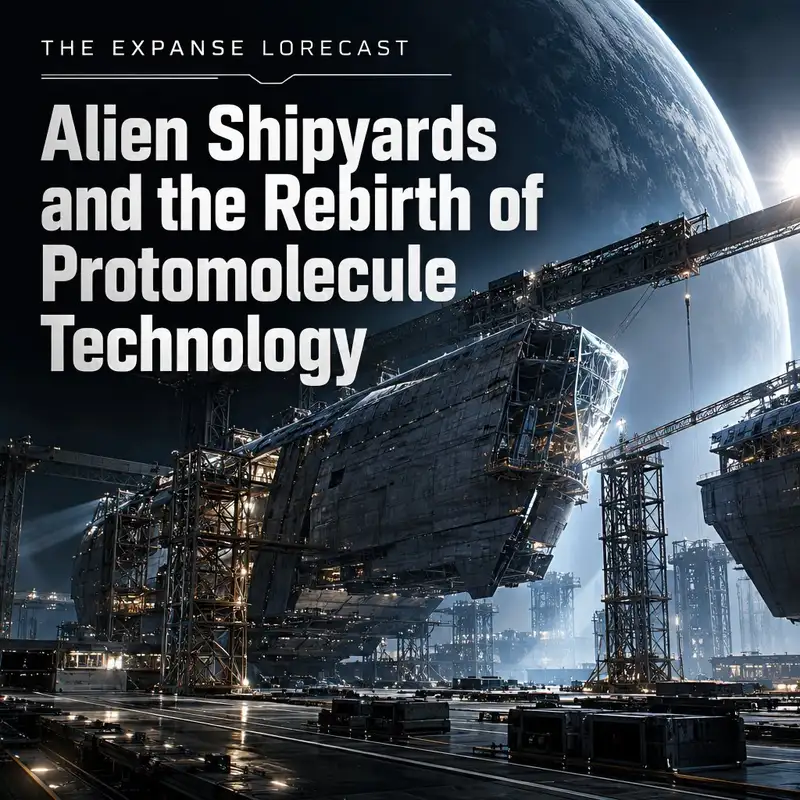
Alien Shipyards and the Rebirth of Protomolecule Technology
The Underground could spend ships and lives trying to kill Laconian warships one at a time, or it could attack the reason those warships could keep appearing. That was the harder target and the more consequential one. The alien construction platforms in the Laconia system were not merely another military installation. They were the industrial mechanism that allowed a comparatively small human state to turn partial access to alien technology into renewable strategic power.
That difference separates a raid from an industrial campaign. A warship is a present capability. A shipyard is a promise of future capability. Conventional navies understand this well. A fleet can lose hulls, crews, ammunition, and prestige, then recover if its yards, training systems, supply routes, and political authority remain intact. Laconia’s advantage was more concentrated and more dangerous. It had fused human military organization with an alien means of production that no other government could match. Its shipyard was not simply a place where vessels were assembled. It was the bottleneck through which an imperial project converted incomplete knowledge of alien technology into renewable coercive power.
The story begins during the collapse of the old Martian order. The opening of the Ring Network had changed the political economy of Mars before it changed the military map. Mars had spent generations organizing its society around a difficult, collective project: making a hostile planet habitable. That project required discipline, technical education, industrial planning, military protection, and faith that sacrifice in the present would produce a Martian future. The gates undermined that bargain. Why spend generations terraforming one world when more than a thousand systems appeared to offer new worlds, new resources, and new exits from old constraints?
The result was not that Mars suddenly became weak or that every Martian abandoned the republic. Its navy remained formidable, its industry remained sophisticated, and many Martians remained committed to their society. But the political foundation beneath its long-term project had fractured. Personnel left. Equipment disappeared into black markets and clandestine networks. Some officers and officials began to see the old republic not as a national future worth preserving, but as a decaying institution unable to adapt to a new strategic age.
Winston Duarte emerged from that crisis with a different answer. He led a faction of Martian defectors through the Laconia gate, taking ships, trained personnel, military knowledge, and a protomolecule sample. His project was not merely a refuge for people who had lost faith in Mars. Duarte intended to create a new state beyond the reach of the old powers, one that could develop in secret and return with enough force to impose order on a divided human civilization.
The Laconia system offered more than distance. Distance alone is not security in a civilization with fast ships, gate transit, intelligence services, commercial traffic, and political rivals. What Duarte obtained was isolation combined with control. A breakaway state could limit access, monitor arrivals, restrict information, shape education, organize labor, and direct scarce resources toward military research. It could keep inconvenient questions away from the people handling its most sensitive work. It could also give itself something the fragmented governments of the old Solar System rarely enjoyed: time.
That time mattered. The Laconian state had roughly three decades to build institutions, train personnel, test equipment, identify useful knowledge, suppress failures, and conceal its progress. The rest of humanity knew that Duarte and his followers had vanished through a gate with dangerous assets. It did not know what they had found, what they could operate, what they had failed to understand, or what kind of force might eventually return. Uncertainty was part of Laconia’s arsenal from the beginning.
The most important asset in the Laconia system was not a Martian battleship or a hidden weapons cache. It was an ancient orbital construction complex left behind by the civilization that built the Ring Network. Human observers could recognize its industrial significance. It was not a ruin in the ordinary sense. It had the appearance of a working system, or at least a system capable of being made to work. It included vast structures and evidence of an enormous construction process, including partially completed vessel-like forms whose scale exceeded anything produced by human yards.
But recognizing industrial capacity is not the same as understanding it. The platform was not a human blueprint archive waiting to be opened. It was not an obedient factory with labels, manuals, safety procedures, and a customer-service desk. Its original purpose remains uncertain. It may have been capable of fabricating enormous craft, but that does not establish that it was designed for human-style warships or that every object it produced had a military purpose. The Ring builders had technologies, needs, and forms of organization that humans could only partially infer from surviving artifacts.
Laconia’s achievement was therefore not simple possession. Possession is the easiest stage of technological conquest. A state can seize a laboratory, capture a ship, occupy a mine, or inherit an abandoned industrial zone without knowing how to make any of it work. Activation is harder. Interpretation is harder still. Reliable production, the ability to repeat a process with predictable results and connect it to a military system, is harder than all of them.
The protomolecule sample brought through the gate was essential to that process, but it should not be mistaken for a magic key that granted Laconia instant mastery. The protomolecule was an engineered alien system with capabilities humans had observed, feared, and exploited in fragments. It could interact with Ring-builder infrastructure. It could alter matter, biology, and machinery in ways that made conventional scientific categories feel inadequate. Yet every demonstrated capability came with uncertainty. Human beings could activate systems without comprehending their full purpose, trigger processes they could not stop, and interpret an alien response as success shortly before discovering that it had created a larger problem.
Paolo Cortázar stood near the center of Laconia’s research program. He was brilliant, ruthless, and unusually willing to treat human beings as material for experimentation. Those qualities made him valuable to Duarte’s state and dangerous to everyone around him. Cortázar’s work helped transform alien systems from an inaccessible inheritance into a source of usable capability. But technical brilliance is not strategic wisdom, and experimentation is not mastery. He could advance a program while still misunderstanding the deeper systems he was touching.
The difference matters because authoritarian states often confuse access with control. A laboratory can make a device activate. A military can field a weapon. A ruler can issue an order that produces visible results. None of that proves the system is understood, safe, or durable. Laconia’s leaders had enough knowledge to build extraordinary ships and enough confidence to use them against other humans. They did not possess a complete theory of the Ring builders, the protomolecule, or the forces that had destroyed the gate-building civilization.
The alien construction platform became useful because Laconia built a human system around it. Engineers had to translate military requirements into forms the platform could produce. Officers had to decide what kinds of ships they wanted. Scientists had to distinguish promising results from catastrophic ones. Security personnel had to protect the facility and its workers. Commanders needed crews capable of operating unfamiliar vessels. Technicians needed ways to maintain systems whose internal logic was only partially visible. Political authorities had to keep all of this funded, secret, and loyal.
A conventional naval shipyard depends on long chains of industry. It needs raw materials, refined metals, electronics, machine tools, reactors, propulsion components, sensors, weapons, dry docks, transport, skilled labor, maintenance facilities, and a government capable of paying for all of it. It also needs institutions that can train people over decades. A warship is not merely manufactured. It is designed, supplied, inspected, crewed, armed, repaired, and eventually replaced.
The Laconian platform compressed parts of that process in ways ordinary industry could not. It could fabricate structures and systems that human yards could not easily duplicate. It gave Laconia access to materials, construction methods, energy technologies, and weapons-related possibilities that lay beyond conventional Martian or Earth engineering. But it did not abolish logistics. The platform still required security, personnel, energy, transport, scientific expertise, testing, command supervision, and raw inputs of some kind. The ships it produced still needed crews, doctrine, operational planning, repair capability, and political purpose.
This was the strength and weakness of Laconian industrial power. The platform allowed a small state to create a naval capability out of proportion to its population and visible industrial base. Meanwhile, it concentrated that capability in a unique facility that could not be replaced through ordinary procurement. Earth could build another yard. Mars could reopen a factory or redesign a ship. Laconia could preserve technical knowledge, surviving hulls, trained officers, and research programs. But it could not simply order a new Ring-builder construction complex from another supplier.
The earliest Laconian vessels revealed a state still learning how to direct the alien infrastructure. Ships such as the Proteus belonged to an intermediate stage in the process. They should not be understood as pure Ring-builder vessels or as simple Martian designs with a few exotic components installed. They were products of human direction working through alien industrial capability. Their significance lay in what they demonstrated. Laconia had begun to turn a mysterious artifact into a functioning military production system.
Over time, that system produced more capable hybrid designs. The Magnetar-class battleships became the most dramatic expression of the program. They were not merely larger conventional warships. Their construction, materials, energy systems, defenses, weapons, and performance reflected a technological foundation unavailable to the rest of humanity. Smaller advanced combatants, including Pulsar-class ships, extended that advantage across more than one type of mission. Laconia was not trying to imitate the old Earth and Martian fleets. It was trying to make those fleets strategically obsolete.
The key word was not invincible. It was overmatch. A force achieves overmatch when its enemy cannot reliably answer its capabilities with the tools, information, and doctrine currently available. Laconia did not need every ship to be indestructible. It needed enough superiority in survivability, acceleration, sensors, weapons, and command integration to make conventional resistance appear futile. If a defending fleet could not identify what it was facing, could not damage it effectively, and could not predict its tactical behavior, then even a smaller Laconian force could create the political effect of an overwhelming armada.
That was what happened when Laconia emerged from isolation and seized Medina Station, the central hub of the Ring Network. Medina mattered because the gates had reorganized human geography. Control of one system did not mean control of every colony, but control of the hub meant influence over transit, inspection, trade, migration, communications routes, and the movement of armed forces. It was the closest thing the network possessed to a strategic crossroads.
Laconia’s campaign did not depend on occupying every station with infantry or destroying every opposing ship. It depended on demonstrating that the old powers could not contest its arrival on equal terms. The empire combined technological surprise with disciplined command and a coherent political objective. It offered order backed by force. Governments, stations, and colonies had to calculate whether resistance could achieve anything except destruction. Many found that the answer, at least in the short term, was no.
The shock was partly military and partly informational. The governments of Earth, Mars, and the Transport Union knew Laconia existed. They did not possess dependable intelligence about the size of its fleet, the depth of its industrial base, the performance of its ships, the limits of its weapons, or the scale of its research program. Their commanders faced an enemy whose capabilities had been developed behind a closed gate for decades. Laconia had studied the old human powers. The old powers had studied rumors.
This intelligence imbalance made Laconian strength appear even greater. When a conventional fleet sees an opponent absorb punishment that should have been decisive, it cannot immediately know whether the enemy is heavily armored, self-repairing, using unknown defensive systems, or simply fortunate. When a new weapon destroys a ship or disables an entire formation, observers do not automatically know its range, limitations, ammunition requirements, or vulnerabilities. A commander who lacks that knowledge must assume the worst until evidence permits something more useful.
Laconia exploited the uncertainty well. Its state had been built around secrecy, centralization, and the concentration of expertise. The same government that directed alien research also controlled access to the system where that research occurred. It could decide who learned what, when reports moved, which failures disappeared into classified archives, and which demonstrations were visible to the rest of humanity. It could direct labor toward military objectives without having to justify the cost to an electorate or negotiate openly with independent institutions.
That gave the empire speed. It also gave it blind spots. A narrow leadership circle can act quickly because fewer people must agree. It can also receive distorted information because fewer people are allowed to challenge the plan. A highly compartmentalized research system can protect secrets. It can also prevent engineers, officers, and political leaders from seeing how one danger connects to another. A state built around one exceptional ruler can make decisions efficiently, until that ruler becomes the center of every decision and the institution loses the ability to correct him.
The shipyard was part of that contradiction. It was protected because it was essential. It was hidden because it was irreplaceable. It was staffed by specialists because ordinary technicians could not simply be transferred in from elsewhere. It was embedded in an authoritarian state because Laconia needed to control knowledge as tightly as it controlled material. These measures made the facility formidable. They also made it a single point of failure on a civilizational scale.
The resistance gradually learned that direct symmetry was a dead end. It could not build a conventional fleet capable of matching Laconia ship for ship. It could not rely on the old governments to coordinate quickly enough or trust one another deeply enough. It could not assume that a dramatic battlefield victory would be available. So it had to think in terms of networks, intelligence, legitimacy, sabotage, mobility, and industrial targets.
Naomi Nagata represented much of that approach. Her work was not simply espionage in the narrow sense. A resistance requires people who can move information, build trust across political divisions, identify reliable contacts, understand local grievances, and keep a network alive after arrests, defeats, and betrayals. It must communicate without exposing everyone involved. It must distinguish an eager recruit from a security risk. It must make decisions while operating with incomplete information and delayed messages. That kind of work is slow, frustrating, and difficult to dramatize. It is also how a scattered opposition becomes more than a collection of isolated acts of defiance.
Bobbie Draper represented another requirement. Occupation becomes psychologically permanent when people believe the occupier cannot be hurt. The military case for striking Laconia was therefore not only about material damage. It was about changing the political imagination of the conquered systems. If the empire’s best ships could be challenged, if its secret facilities could be reached, and if its future military production could be disrupted, then obedience would no longer look like the only rational path.
These approaches were complementary. Naomi’s networks could identify vulnerabilities and coordinate a long campaign. Bobbie’s military judgment could translate a discovered vulnerability into an action capable of changing the strategic balance. Alex Kamal and the crews around them supplied the practical naval expertise needed to operate under conditions where the enemy’s systems exceeded anything they had trained against. None of them, alone, could destroy the shipyard. The operation required intelligence, planning, deception, movement, technical skill, political coordination, and people willing to take extraordinary risks.
The resistance’s opportunity came from understanding Laconian deployment patterns and the importance of the Heart of the Tempest. A great warship is not merely a weapon. It is also a commitment. Wherever it is deployed, it is not somewhere else. If the resistance could persuade Laconia to move major forces away from its home system, it could create a temporary opening around the construction platforms. The purpose of the broader fleet action was not simply to win a conventional battle against a superior enemy. It was to make the enemy choose where to concentrate its protection.
This is the logic of deception in a system where travel takes time and messages cannot outrun light. A diversion cannot be a theatrical gesture. It must be credible enough that the enemy commits real assets. It must unfold across distances that make rapid correction difficult. It must account for the possibility that an enemy commander will interpret the situation differently than expected. And it must remain coordinated among allies who do not share one chain of command, one political objective, or one level of risk tolerance.
The danger was substantial. A diversion can become a disaster if the enemy refuses the bait, reacts more quickly than expected, or discovers the underlying plan. Resistance cells can be compromised. A delayed transmission can arrive after the situation has changed. A ship can suffer damage, miss a rendezvous, or be forced to reveal itself early. The more elaborate the deception, the more ways it can fail. But the alternative was to leave Laconia’s industrial base untouched while its advanced fleet continued to define the limits of possible resistance.
Once the defensive screen around Laconia had been thinned, the target was clear. The Gathering Storm, Naomi, Bobbie, Alex, and the wider underground coalition were not attempting to capture an alien wonder intact. They were not seeking a symbolic strike against an imperial monument. Their objective was to disable or destroy the production center that made Laconia’s highest-end naval capabilities sustainable. This was an industrial strike conducted under combat conditions.
The tactical problem was severe. The construction platform was in Laconia’s own system, where the empire possessed local knowledge, defensive assets, prepared infrastructure, and the ability to react with forces that understood the terrain. The attackers could not assume that alien structures would fail like conventional human facilities. They could not know every internal system, every defensive arrangement, or every consequence of damaging a platform built for purposes no human fully understood. They had limited time, incomplete intelligence, and no guarantee that the diversion would continue to hold.
That uncertainty shaped the mission. The goal was not a perfect demolition plan based on complete engineering drawings. The goal was to render the platform unusable as the source of future advanced fleet production. In war, especially against unfamiliar infrastructure, commanders often cannot demand certainty. They must identify the effect required, select a plausible means of achieving it, and accept that the physical details may remain unclear even after the operation succeeds.
Individual courage mattered. It mattered that crews operated advanced vessels under extreme pressure. It mattered that people entered combat knowing they faced systems more capable than their own. It mattered that participants accepted risks they could not fully calculate. But courage without prior organization would have produced only a costly gesture. The assault worked because years of resistance activity had created intelligence channels, because the coalition had learned enough about Laconian behavior to shape its choices, because a diversion created time, and because the attackers selected a target whose loss would matter beyond the immediate fight.
The construction yards were destroyed or rendered unusable as Laconia’s advanced-production center. The exact internal mechanisms of the platform had never been fully available to human understanding, and the operation did not turn them into a neat engineering diagram. What mattered strategically was the result. The empire had lost the industrial system that allowed it to regenerate its most extraordinary naval power.
Tactically, that was a major blow against an alien-derived facility. Operationally, it constrained Laconia’s ability to expand or replace the highest-end elements of its fleet. A surviving Magnetar-class ship remained dangerous. A surviving Pulsar-class combatant remained dangerous. Trained Laconian crews remained dangerous. But every loss now carried a different weight. Before the strike, Laconia could imagine future production restoring its advantage. After the strike, each irreplaceable hull became more precious, each major deployment more risky, and each battle a potential reduction in power that could not be easily reversed.
Strategically, the operation attacked Laconia’s future rather than merely its present. That was why the shipyard mattered more than any individual warship. A warship is an instrument. A production system is an institution. Destroying an instrument removes one threat. Destroying an institution changes what an enemy can become. The empire could still occupy worlds, threaten rivals, and use surviving alien-derived systems. But it could no longer assume that the most advanced version of its navy would continue to grow without limit.
The political effects were just as important. Occupation relies partly on force and partly on expectation. People comply when they believe resistance is impossible, allies will not arrive, and the occupying power can outlast every challenge. The destruction of the yards did not liberate every colony. It did not end Laconian surveillance, erase local collaborators, repair damaged governments, or make food, transport, and security suddenly abundant. But it changed the expectation of permanence. It showed that the empire’s hidden core could be reached.
For resistance movements, that evidence has practical value. It improves recruitment, sustains morale, and makes cooperation less irrational. A station authority that had viewed Laconia as invulnerable might now consider withholding support, hiding resources, or sharing intelligence. A local commander might become more cautious about sending ships into danger. An occupied population might conclude that endurance has a strategic purpose. These changes are not as visible as a destroyed platform, but they shape the long war that follows.
The strike also revealed an intelligence lesson. Laconia’s secrecy had been one of its greatest advantages. It had concealed its research, its industrial base, and many of the limits of its technology. Yet secrecy is not perfect. Every system generates patterns. Ships move. Personnel communicate. supplies are required. Command decisions reveal priorities. A government can conceal a facility, but the effort to protect that facility can itself become evidence of its importance. The resistance succeeded not because it knew everything, but because it learned enough to identify the decisive dependency.
The loss exposed an institutional weakness as well. Laconia had concentrated authority, expertise, and production within a small number of protected structures. That concentration made the empire efficient during its rise. It also made the consequences of disruption enormous. A distributed industrial system can absorb loss by shifting work among multiple yards, contractors, regions, and technical communities. A unique alien platform has no equivalent redundancy. The more exceptional the capability, the less likely it is to have an easy replacement.
None of this meant that Laconia was reduced to an ordinary power overnight. The empire retained laboratories, artifacts, knowledge, command structures, soldiers, administrators, advanced ships, and the political machinery of occupation. The destruction of the yards did not eliminate protomolecule research. It did not remove the dangers embedded in the Ring-builder inheritance. It did not resolve the deeper threat posed by technologies humanity could use without fully understanding. Later events make that painfully clear.
Nor did the strike reset naval warfare to the era before Laconia. Surviving Laconian vessels still possessed capabilities the old powers could not casually match. The technical knowledge gained over decades did not vanish with one facility. Engineers, scientists, and officers carry experience in their minds, in records, in habits, and in institutional memory. A destroyed factory does not erase every design or every lesson. It changes the rate, scale, and reliability with which a state can turn knowledge into hardware.
That difference between knowledge and production is the heart of the episode. Human civilization had encountered alien technology before. It had activated artifacts, survived experiments, built theories, and occasionally made use of systems whose creators were long dead. Laconia went further. It created a state capable of converting alien inheritance into an organized military program. Its navy was not the product of one genius, one sample, or one miraculous machine. It was the product of secrecy, discipline, research, coercive political control, Martian expertise, and decades of patient development around a single irreplaceable industrial asset.
Destroying the construction platforms did not destroy every Laconian ship or erase every piece of alien-derived knowledge. It did something more strategically important: it broke the process that made the empire’s most overwhelming advantages renewable. The Underground attacked the future fleet rather than only the fleet already in space. In a war against a stronger opponent, that difference turned sabotage into strategy.